
There is a music in Irish surnames that no other European naming tradition quite replicates. It is the music of a language that was suppressed, that retreated to the western seaboard and the mountain valleys and the islands, that was beaten out of schoolchildren with a stick called the tally board for most of the 19th century, and that survived all of it with its phonetic beauty entirely intact. Irish surnames are the evidence that a language which sounds like this, which makes these sounds for these meanings and encodes these specific relationships between people and their landscapes and their ancestors, is not a language that the world can afford to lose, and that the families who carried it across two centuries of diaspora were carrying something worth carrying.
Irish surnames are primarily patronymic in their construction, built from the Mac, son of, or the Ó, grandson of or descendant of, prefixes that were attached to an ancestor’s given name or descriptive epithet and became permanent family identities. This system means that most Irish surnames are literally small genealogies, a declaration of descent that was considered the most important piece of information about a person’s identity in Gaelic Irish society where the fine, the extended kin group, was the primary social and legal unit. When Oliver Cromwell’s administration and later British colonial policy stripped the Ó and Mac prefixes from Irish surnames, it was understood as an act of cultural erasure, the removal of the declaration of ancestry from the name itself. The recovery of those prefixes in the 19th and 20th centuries was understood as an act of cultural restoration.
The Irish landscape lives in Irish surnames with the same completeness that the Swedish landscape lives in Swedish compound names, but in a different key. Where Swedish surnames are clear and literal, the hill and the stream stated plainly, Irish surnames are filtered through the specific poetic tradition of a language that made no clear distinction between the geographical and the mythological, that named landscape features for the divine beings who inhabited them and named people for the landscape features that defined their territories. A Doherty is a descendant of the hurtful one. A Gallagher is a descendant of the eager helper. A Murphy is a descendant of the sea warrior. Every Irish surname is a sentence in a language of extraordinary depth and equally extraordinary beauty.
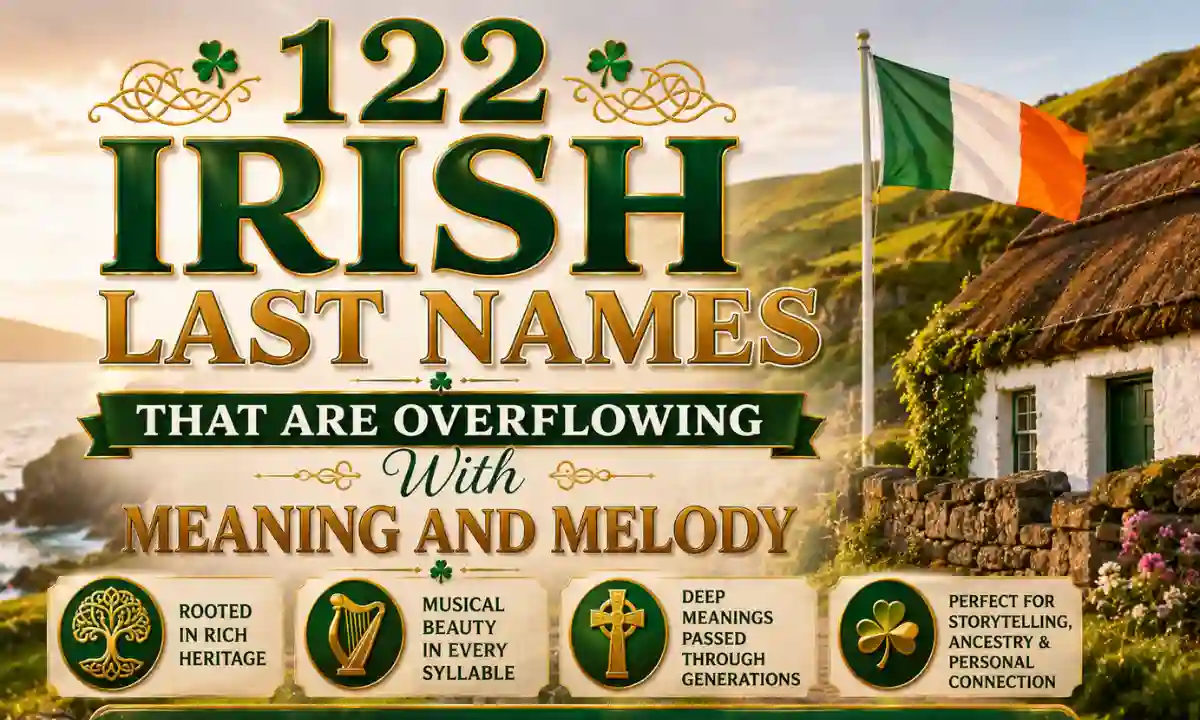
This collection gives you 122 of the most beautiful, most musically compelling, and most historically significant Irish surnames ever recorded, organized by their geographical origins, linguistic roots, and the social worlds they carry. Frequency data is based on Irish census records and diaspora surname databases.
Quick Note on Frequency: Irish surnames vary enormously in frequency. The most common appear hundreds of thousands of times across the Irish diaspora. The rarest survive in single family lines in specific Irish-speaking regions. For character and research purposes, rarer surnames often carry the most specific regional and historical associations.
The Great Munster Names
Murphy
- Origin: Irish Gaelic
- Meaning: Sea warrior, descendant of the sea warrior
- Frequency: Very Common
The most common surname in Ireland derives from the Gaelic Ó Murchadha, descendant of the sea warrior, Murchadh being a compound of muir, sea, and cath, battle or warrior, belonging to a Munster dynasty of considerable authority whose descendants spread across Ireland and across the world in numbers that made Murphy the most recognizable Irish name in the global diaspora.
Sullivan
- Origin: Irish Gaelic
- Meaning: Dark-eyed, hawk-eyed, one-eyed
- Frequency: Very Common
The Ó Súilleabháin surname whose meaning connects to the word for eye, súil, belongs to one of the great Munster dynasties whose territory covered much of what is now Cork and Kerry and whose numbers in the Munster tradition made them one of the most powerful families in the province before and after the English conquest.
McCarthy
- Origin: Irish Gaelic
- Meaning: Son of Carthach, son of the loving one
- Frequency: Very Common
The Mac Cárthaigh surname derives from Carthach, meaning loving or loving one, belonging to the Kings of Desmond who were the most powerful Gaelic dynasty in Munster and whose struggle against the Anglo-Norman Fitzgeralds defined the political history of Munster for four centuries.
O’Brien
- Origin: Irish Gaelic
- Meaning: Descendant of Brian, high king’s kin
- Frequency: Very Common
The Ó Briain surname carries the direct descent from Brian Boru who won the Battle of Clontarf in 1014 and whose brief unification of Ireland under a single high king became the defining event of Irish national mythology, O’Brien belonging to a family that produced kings of Munster and Thomond for centuries after the great king’s death.
Riordan
- Origin: Irish Gaelic
- Meaning: Descendant of the royal poet, kingly bard
- Frequency: Common
The Ó Ríordáin surname derives from a compound of rí, king, and bardan or bard, poet, Riordan carrying the specific dignity of a family whose ancestor combined the two highest callings in early Irish society, the royal and the poetic, in a name of considerable cultural and political authority.
Herlihy
- Origin: Irish Gaelic
- Meaning: Descendant of the under-lord, underking
- Frequency: Uncommon
The Ó hEircealaigh surname derives from a title meaning the underking or the lord under the king, belonging to a Munster family whose position in the hierarchical structure of Gaelic Irish governance was one of the specific and important middle ranks of authority between the ri tuaithe, the local king, and the ri ruirech, the provincial king.
Callanan
- Origin: Irish Gaelic
- Meaning: Descendant of the little warrior, small fighter
- Frequency: Uncommon
The Ó Callanáin surname carries the diminutive warrior tradition in a Cork and Tipperary name of considerable warmth, the callan root connecting to the warrior tradition and the diminutive AN suffix adding the affectionate smallness that Irish naming used to distinguish related family lines.
Twomey
- Origin: Irish Gaelic
- Meaning: Descendant of Tuaim, of the mound
- Frequency: Uncommon
The Ó Tuama surname that derives from Tuaim, the mound or tumulus, carries the landscape-naming tradition of Munster in a Cork surname whose most famous bearer was the 18th century Gaelic poet Seán Ó Tuama whose poetry house at Croom was the center of the Maigue poets who produced some of the finest Irish-language poetry of the period.
Crowley
- Origin: Irish Gaelic
- Meaning: Descendant of the hunchback, descendant of Roth Ruadh
- Frequency: Common
The Ó Cruadhlaoich surname carries the hard hero or possibly hunchback tradition in a Cork name of considerable historical depth, Crowley belonging to a family whose territory in west Cork made them one of the most important Munster families and whose later history of agrarian activism made them central figures in the land struggles of the 19th century.
Sheehan
- Origin: Irish Gaelic
- Meaning: Descendant of the peaceful one, the little peaceful one
- Frequency: Common
The Ó Síodhacháin surname derives from the word for peaceful or fairy, síodhach, carrying the peace tradition in a name of warm Munster phonetic character, Sheehan belonging to the Cork and Kerry tradition and carrying the specific quality of a name that combines the supernatural and the peaceful in the characteristic Irish manner.
Mahony
- Origin: Irish Gaelic
- Meaning: Descendant of the bear, bear’s child
- Frequency: Common
The Ó Mathghamhna surname derives from mathghamhan, bear, belonging to a Cork family whose bear-totem ancestry is preserved in a name of considerable phonetic complexity and historical depth, the bear being simultaneously a symbol of strength and a sacred animal in the pre-Christian Irish tradition.
Driscoll
- Origin: Irish Gaelic
- Meaning: Descendant of the intermediary, the go-between
- Frequency: Common
The Ó Eidirsceóil surname derives from eidirsceol, intermediary or go-between, belonging to a west Cork dynasty whose maritime territory made them the most important family on the Mizen Head peninsula and whose name carries the diplomatic tradition of a family whose position between the sea and the land made them natural mediators.
Hurley
- Origin: Irish Gaelic
- Meaning: Descendant of the sea tide, sea motion
- Frequency: Common
The Ó hUrthuile surname carries the sea-motion tradition in a Munster name of considerable maritime depth, Hurley belonging to the tradition of Clare and Limerick families whose coastal territory gave them names connected to the movement of the sea.
Lenihan
- Origin: Irish Gaelic
- Meaning: Descendant of the little mantle, cloak-wearer
- Frequency: Uncommon
The Ó Leannacháin surname derives from the word for mantle or cloak, lenn, belonging to a Munster family of the Clare and Tipperary borderlands whose name carries the garment tradition in a form of considerable Irish phonetic warmth.
Connacht and the West
Gallagher
- Origin: Irish Gaelic
- Meaning: Eager helper, descendant of the eager helper
- Frequency: Very Common
The Ó Gallchobhair surname derives from gallchobhar, eager helper, a compound of gall, foreign or eager, and cobhair, help, belonging to the most numerous family in Donegal whose territory in the Barnesmore Gap area made them the gatekeepers of the most important route in Ulster and whose eagerness in help of the O’Donnell lords made them one of the most valued families in the province.
Walsh
- Origin: Old English/Irish
- Meaning: Welshman, the Welsh one
- Frequency: Very Common
The Breathnach surname that was anglicized to Walsh derives from breathnach, the Welsh one or Welshman, belonging to the descendants of Welsh soldiers who came to Ireland with the Norman invasion and who, unlike most Normans, were identified by their Welsh rather than French origin, Walsh carrying the ethnic identity tradition in a name that became one of the most common in Ireland.
Burke
- Origin: Norman French/Irish
- Meaning: From the fortress, de Burgh
- Frequency: Very Common
The de Búrca surname derives from the Norman de Burgh, from the fortified settlement, belonging to the great Norman family whose arrival in Connacht transformed the political landscape of the province and whose descendants became so Gaelicized that they were eventually considered more Irish than the Irish themselves, Burke carrying the fortress tradition in a name of extraordinary social and cultural transformation.
Kelly
- Origin: Irish Gaelic
- Meaning: Bright-headed, war, descendant of Ceallach
- Frequency: Very Common
The Ó Ceallaigh surname derives from Ceallach, whose meaning connects to brightness or to the church, belonging to the royal family of Uí Maine in Connacht who were the most important Gaelic dynasty in east Galway and whose spread across Ireland made Kelly one of the most common surnames in the country.
Quinn
- Origin: Irish Gaelic
- Meaning: Descendant of Conn, chief, intelligent
- Frequency: Very Common
The Ó Coinn or Ó Cuinn surname derives from Conn, meaning chief or intelligence, belonging to multiple families of the same name across Ireland of whom the Tyrone Quinns were the most powerful, Quinn carrying the intelligence-chief tradition in a name that crossed from Ulster into Connacht naming patterns.
Flaherty
- Origin: Irish Gaelic
- Meaning: Descendant of the bright ruler, the bright lord
- Frequency: Common
The Ó Flaithbheartaigh surname derives from a compound of flaith, prince or lord, and beartach, bright or acting, belonging to the ruling family of Iar Connacht, west Galway, whose naval power in the waters of Galway Bay and the western islands made them the most important family in the region and whose name carries the bright-ruler tradition.
Naughton
- Origin: Irish Gaelic
- Meaning: Descendant of Nechtan, pure one
- Frequency: Uncommon
The Ó Neachtain surname derives from Nechtan, an ancient name connected to the water deity and meaning the pure one, belonging to a Connacht family of considerable antiquity whose name preserves the pre-Christian water-divinity tradition in a form of considerable phonetic elegance.
Conneely
- Origin: Irish Gaelic
- Meaning: Descendant of Conghal, hound valor
- Frequency: Uncommon
The Ó Coingheallach surname derives from Conghal, a compound of cú, hound, and gal, valor or battle fury, carrying the warrior-hound tradition of Irish heroic naming in a Connacht name of considerable Gaelic depth that belongs to the island families of Connemara.
Kilbane
- Origin: Irish Gaelic
- Meaning: Descendant of the white warrior, son of the fair one
- Frequency: Very Rare
The Mac Giolla Bháin surname derives from giolla, servant or devotee, and bán, white or fair, belonging to the island communities of Connacht whose names often carry the giolla compound that was used to indicate devotion to saints and to particular qualities.
Coyne
- Origin: Irish Gaelic
- Meaning: Descendant of the gentle one, the calf
- Frequency: Uncommon
The Ó Cadhain surname derives from cadhan, the barnacle goose or possibly the gentle one, belonging to a Connacht family of Galway and Mayo whose avian or gentle tradition connects them to the coastal landscape of the western seaboard where the barnacle goose was a familiar winter visitor.
Forde
- Origin: Irish Gaelic
- Meaning: Descendant of the man of the ford, the ford dweller
- Frequency: Common
The Ó Fuartháin or de Fórda surname carries the ford tradition in a name that bridges the Gaelic and Norman naming systems, belonging to Connacht families whose ancestral homes were beside the river crossings that were the most important strategic locations in the Irish landscape.
Staunton
- Origin: Norman French/Irish
- Meaning: From the stone settlement
- Frequency: Uncommon
A Norman place-name surname that became deeply embedded in the Connacht tradition, Staunton carrying the stone settlement of the English place-name tradition in a name that arrived with the Norman invasion and became as characteristically Connacht as any name of Gaelic origin.
Folan
- Origin: Irish Gaelic
- Meaning: Descendant of the little seagull
- Frequency: Very Rare
The Ó Faoláin surname that in its western form became Folan derives from faolán, little seagull or wolf, belonging to the Connacht island communities where the seagull was a familiar and significant presence and whose name carries the avian coastal tradition in a form of extraordinary rarity outside the western Irish communities.
Davitt
- Origin: Hebrew/Irish
- Meaning: Son of David, beloved one
- Frequency: Uncommon
The Mac Daibhéid surname derives from the Hebrew David through the Norman French, belonging to the Mayo tradition and made famous by Michael Davitt who founded the Land League in 1879 and whose campaign for land reform changed the social structure of rural Ireland, Davitt carrying the beloved tradition in a name of considerable national political authority.
Ulster and the North
O’Neill
- Origin: Irish Gaelic
- Meaning: Descendant of Neil, champion
- Frequency: Very Common
The Ó Néill surname carries the direct descent from Niall of the Nine Hostages, the legendary High King of Ireland whose descendants dominated Ulster and Irish politics for over a thousand years, O’Neill belonging to the most powerful Gaelic dynasty in the country whose resistance to English colonization culminated in the Flight of the Earls in 1607.
Doherty
- Origin: Irish Gaelic
- Meaning: Descendant of the hurtful one, the obstructer
- Frequency: Very Common
The Ó Dochartaigh surname derives from dochartach, hurtful or obstructing, belonging to the most numerous family in County Donegal whose territory of Inishowen made them the most important dynasty in the northwestern peninsula and whose name’s apparently negative meaning was in practice understood as the formidable quality that made them difficult to overcome.
McLaughlin
- Origin: Irish Gaelic
- Meaning: Son of the devotee of Saint Secundinus
- Frequency: Common
The Mac Lochlainn surname derives from Lochlann, the Norse lands, or from the saint’s name Secundinus, belonging to an Ulster family of considerable historical importance whose name connects to both the Norse Viking tradition and the early Christian saint tradition simultaneously.
Donnelly
- Origin: Irish Gaelic
- Meaning: Descendant of the world-mighty one, world brave
- Frequency: Common
The Ó Donnghaile surname derives from a compound of donn, dark or world, and gal, valor, belonging to a Tyrone family of considerable importance in the Ulster political landscape whose name carries the world-valor tradition in a form of warm, accessible phonetic elegance.
Devlin
- Origin: Irish Gaelic
- Meaning: Descendant of the fierce one, the unlucky one
- Frequency: Common
The Ó Doibhilin surname carries the fierce or unlucky tradition in a Tyrone and Derry name of considerable antiquity, Devlin belonging to a family who served as hereditary stewards to the O’Neills and whose position in the Ulster social hierarchy made them among the most important of the Ulster tanist families.
Heggarty
- Origin: Irish Gaelic
- Meaning: Descendant of the unjust one, injustice
- Frequency: Uncommon
The Ó hÉigceartaigh surname derives from éigceartach, unjust or wrongful, belonging to a Donegal family whose apparently negative designation was likely a warrior epithet praising ferocity in battle rather than a moral judgment, the Irish tradition of warrior names often deliberately selecting the qualities most alarming to opponents.
Mullan
- Origin: Irish Gaelic
- Meaning: Descendant of the little bald one, bald summit
- Frequency: Common
The Ó Maoláin surname derives from maol, meaning bald or bald summit of a hill, the bald one being both a physical description and a designation for a tonsured monk in the Irish monastic tradition, Mullan carrying the ambiguous tonsure-or-bald-hill tradition in a name of warm Ulster phonetic character.
Convery
- Origin: Irish Gaelic
- Meaning: Descendant of the hound of the plain
- Frequency: Uncommon
The Ó Coinbheara surname derives from a compound of cú, hound, and béara, plain, belonging to a Derry family whose hound-of-the-plain designation connects them to the warrior tradition of the great hunting hounds that were among the most valued possessions in Gaelic Irish society.
Friel
- Origin: Irish Gaelic
- Meaning: Descendant of Ferghal, super valor
- Frequency: Uncommon
The Ó Frighil surname derives from Ferghal, a compound of fear, man, and gal, valor or battle fury, carrying the super-valor tradition in a Donegal name that belongs to a bardic family who served as hereditary poets to the O’Donnell lords and whose literary tradition made them one of the most culturally significant families in Ulster.
McBrearty
- Origin: Irish Gaelic
- Meaning: Son of the judge, son of the brehon
- Frequency: Very Rare
The Mac Breitheamhnaigh surname derives from breitheamhnaigh, judge or brehon, belonging to one of the hereditary legal families of Ulster whose function in the Gaelic Irish judicial tradition was the most important possible for a civilization that operated through the complex customary law called the Brehon Laws.
Delargy
- Origin: Irish Gaelic
- Meaning: Descendant of the red warrior
- Frequency: Very Rare
The Ó Dubhdarach or Dearg family name carries the red-warrior tradition in a Antrim surname of considerable antiquity and extraordinary rarity, Delargy being almost entirely confined to the Glens of Antrim community where it has been carried since the medieval period.
Sweeney
- Origin: Irish Gaelic
- Meaning: Well-going, the pleasant one
- Frequency: Common
The Mac Suibhne surname derives from suibhne, well-going or pleasant, belonging to a Donegal gallowglass family of Scottish Hebridean origin whose mercenary soldiers served the Ulster lords from the 13th century and who became so thoroughly integrated into Ulster society that their Scottish origin is preserved only in their name’s connection to the Hebridean Mac Suibhne tradition.
Bradley
- Origin: Irish Gaelic
- Meaning: Descendant of the steward, son of the spirited one
- Frequency: Common
The Ó Brolcháin surname that was anglicized to Bradley carries the spirited or lively tradition in a Derry and Tyrone name of considerable antiquity, Bradley belonging to a bardic family who served as hereditary poets to the O’Cahans and whose literary tradition was among the most significant in late medieval Ulster.
Leinster and the Pale
Byrne
- Origin: Irish Gaelic
- Meaning: Descendant of Bran, raven
- Frequency: Very Common
The Ó Broin surname derives from Bran, raven, belonging to the most important Leinster dynasty whose territory in Wicklow made them the most powerful Gaelic family in the province and whose resistance to the English administration in the Pale was maintained through centuries of guerrilla warfare from their mountain strongholds.
Kavanagh
- Origin: Irish Gaelic
- Meaning: Descendant of Caomhánach, gentle one, follower of St. Kevin
- Frequency: Common
The Ó Caomhánach surname derives from caomhánach, the gentle one or the follower of Saint Kevin whose monastery at Glendalough was the spiritual center of Leinster, Kavanagh belonging to a branch of the MacMurrough royal dynasty of Leinster whose member Dermot MacMurrough invited the Anglo-Norman invasion of Ireland in 1169.
Nolan
- Origin: Irish Gaelic
- Meaning: Descendant of the famous one, champion
- Frequency: Common
The Ó Nualláin surname derives from nuallán, the famous or renowned one, belonging to a Leinster family of the Carlow and Laois area whose name carries the famous one tradition in a form of warm, accessible phonetic elegance that has traveled well across the diaspora.
Dunne
- Origin: Irish Gaelic
- Meaning: Descendant of the brown one, dark warrior
- Frequency: Common
The Ó Duinn or Ó Doinn surname derives from donn, brown or dark, belonging to the Kings of Uí Failghe in the midlands of Leinster whose territory covered what is now Offaly and Laois and whose name carries the brown or dark warrior tradition in a form of considerable phonetic directness.
Brennan
- Origin: Irish Gaelic
- Meaning: Descendant of the sad one, raven
- Frequency: Common
The Ó Braonáin surname derives from braonán, a diminutive of braon, teardrop or raven, belonging to multiple families of the same name across Leinster and Connacht whose name carries the raven-teardrop tradition in a form of warm Irish phonetic beauty.
Kinsella
- Origin: Irish Gaelic
- Meaning: Descendant of Cinnsealaigh, head lord
- Frequency: Uncommon
The Ó Cinnseallaigh surname derives from Cinnsealaigh, a compound of ceann, head, and sealach, possession or lordship, belonging to a Wexford dynasty of great antiquity who were the kings of Uí Ceinsealaigh before the Norman conquest and whose name carries the head-lord compound in a form of considerable Leinster historical authority.
Doyle
- Origin: Irish Gaelic
- Meaning: Descendant of the dark foreigner, the dark stranger
- Frequency: Very Common
The Ó Dubhghaill surname derives from dubhghall, dark foreigner, belonging to a family whose ancestor was one of the dark-haired Danes as distinguished from the fair-haired Norwegians and whose name carries the Viking heritage of Leinster’s coastal settlements in a form that became one of the most common surnames in the province.
Cullen
- Origin: Irish Gaelic
- Meaning: Descendant of Cuilen, little cub, holly
- Frequency: Common
The Ó Cuilinn surname derives from cuilinn, the holly tree, or from the personal name Cuilen, the little cub, belonging to a Wexford family of considerable antiquity whose botanical and animal traditions are preserved in a name of warm Irish phonetic character.
Brophy
- Origin: Irish Gaelic
- Meaning: Descendant of the victory victor
- Frequency: Uncommon
The Ó Bróithe surname carries the victory tradition in a Leinster name of considerable antiquity, Brophy belonging to the Offaly and Laois tradition in a form of warm Irish phonetic elegance that is among the more characteristically Leinster of the provincial surnames.
Quirke
- Origin: Irish Gaelic
- Meaning: Descendant of Corc, heart or pureness
- Frequency: Uncommon
The Ó Cuirc surname derives from Corc, an ancient name meaning heart or perhaps connecting to the pre-Christian tradition of the sacred heart as a divine quality, Quirke belonging to the Tipperary tradition in a form of considerable phonetic interest that is distinctively Irish in its construction.
Gaelic King Names
O’Donnell
- Origin: Irish Gaelic
- Meaning: Descendant of Domhnall, world ruler
- Frequency: Common
The Ó Domhnaill surname carries the descent from Domhnall, a compound of domhan, world, and all, mighty or ruler, belonging to the most powerful dynasty in Donegal whose resistance to English colonization made Red Hugh O’Donnell one of the great heroic figures of Irish history, O’Donnell carrying the world-ruler tradition in a name of absolute Gaelic authority.
Fitzpatrick
- Origin: Norman French/Irish
- Meaning: Son of Patrick, son of the noble one
- Frequency: Common
The Mac Giolla Phádraig surname that was later rendered as Fitzpatrick using the Norman Fitz prefix, belonging to the Kings of Ossory in what is now Kilkenny and Laois who were the most powerful native Irish dynasty of Leinster after the Norman conquest, Fitzpatrick carrying the rare distinction of being a Gaelic Mac family that adopted the Norman Fitz convention.
MacMurrough
- Origin: Irish Gaelic
- Meaning: Son of Murchadh, son of the sea warrior
- Frequency: Very Rare
The Mac Murchadha surname carries the sea-warrior tradition of the Leinster royal dynasty whose invitation of the Norman invasion in 1169 made Dermot MacMurrough one of the most controversial figures in Irish history, his name inseparable from the event that transformed Ireland’s political landscape permanently.
O’Conor
- Origin: Irish Gaelic
- Meaning: Descendant of Conchobhar, lover of hounds
- Frequency: Common
The Ó Conchobhair surname derives from Conchobhar, a compound of cú, hound, and cobhair, help, belonging to the last High Kings of Ireland whose dynasty in Connacht produced Rory O’Connor, the last man to hold the title of High King, O’Conor carrying both the hound-lover tradition and the final chapter of the Gaelic Irish high kingship.
MacCarthy Mór
- Origin: Irish Gaelic
- Meaning: Son of the loving one, the great McCarthy
- Frequency: Very Rare
The Mac Cárthaigh Mór title-surname of the senior branch of the McCarthy dynasty carries both the loving ancestor tradition and the Mór, great, designation that indicated seniority among the many McCarthy family branches, belonging to the Kings of Desmond whose final holders of the title were recognized as petty kings under the English crown before the tradition was eventually extinguished.
MacLysaght
- Origin: Irish Gaelic
- Meaning: Son of the iron-thighed warrior
- Frequency: Very Rare
The Mac Giolla Iasachta surname of extraordinary phonetic complexity derives from a compound meaning the son of the foreign youth or the iron-thighed one, belonging to a Clare family whose name carries one of the most elaborate physical descriptions in the Irish surname tradition.
O’Rourke
- Origin: Irish Gaelic
- Meaning: Descendant of Ruarc, the champion
- Frequency: Common
The Ó Ruairc surname carries the champion tradition in a name belonging to the Kings of Breifne whose territory straddled what is now Leitrim and Cavan and whose member Tighearnán O’Rourke’s role in the events that led to the Norman invasion made him one of the most significant and most complex figures of 12th century Irish history.
O’Reilly
- Origin: Irish Gaelic
- Meaning: Descendant of Raghallach, the courageous one
- Frequency: Common
The Ó Raghallaigh surname derives from Raghallach, the courageous one, belonging to the Kings of East Breifne in Cavan whose territory was one of the most powerful kingdoms in Connacht and Ulster and whose name carries the courage tradition in a form of warm, rolling Irish phonetic beauty.
Maguire
- Origin: Irish Gaelic
- Meaning: Son of the pale one, fair-complexioned
- Frequency: Common
The Mag Uidhir surname derives from odhar or uidhir, pale or dun-colored, belonging to the Lords of Fermanagh whose territory around Lough Erne made them one of the great Ulster dynasties and whose most famous member Hugh Maguire was one of the principal leaders of the Nine Years’ War.
MacMahon
- Origin: Irish Gaelic
- Meaning: Son of the bear, bear’s descendant
- Frequency: Common
The Mac Mathghamhna surname carries the bear tradition in a name belonging to multiple families of the same Gaelic root, the most important being the ruling family of the kingdom of Thomond in Clare whose territory was the heartland of the O’Brien kingdom and whose name preserves the bear totem of the pre-Christian Irish tradition.
Landscape and Nature Names
Rooney
- Origin: Irish Gaelic
- Meaning: Descendant of the champion, the red one
- Frequency: Common
The Ó Ruanaidh surname derives from ruanaidh, meaning red or champion, belonging to a Down family of considerable antiquity whose name carries the red-champion tradition in a form of warm Irish phonetic accessibility.
Moroney
- Origin: Irish Gaelic
- Meaning: Descendant of the sea warrior
- Frequency: Uncommon
The Ó Maolruanaidh surname derives from a compound of maol, bald or devoted, and ruanaidh, champion or red, belonging to a Clare and Limerick family whose compound name carries both the tonsure-devotion tradition and the champion tradition in a form of considerable Irish phonetic complexity.
Glennan
- Origin: Irish Gaelic
- Meaning: Descendant of the little valley one
- Frequency: Very Rare
Named for the valley, gleann, with the diminutive AN suffix, Glennan carries the landscape tradition in a form of extraordinary rarity that belongs to the Irish tradition of surnames derived from landscape features through the personal name tradition.
Carney
- Origin: Irish Gaelic
- Meaning: Descendant of the victorious warrior
- Frequency: Common
The Ó Catharnaigh surname derives from catharnach, victorious warrior or warrior, belonging to a western Ireland family of Roscommon and Mayo whose victorious-warrior tradition carries the martial naming culture of Connacht in a form of warm Irish accessibility.
Dolan
- Origin: Irish Gaelic
- Meaning: Descendant of the black warrior, dark one
- Frequency: Common
The Ó Dubhlainn surname derives from Dubhlann, a compound of dubh, black or dark, and flann, ruddy or blood-red, belonging to a Connacht family whose double-color compound creates one of the more visually specific of all Irish surname etymologies.
Loughran
- Origin: Irish Gaelic
- Meaning: Descendant of the bright little lake
- Frequency: Uncommon
The Ó Lachtnáin surname that became Loughran derives from the lake, loch, tradition in a name whose landscape connection to the lakes of Ulster carries the hydrological naming tradition in a form of warm Irish phonetic character.
Keenan
- Origin: Irish Gaelic
- Meaning: Descendant of the little ancient one
- Frequency: Common
The Ó Cianaín surname derives from cianán, a diminutive of cian, ancient or distant, carrying the ancient-one tradition in a name of considerable historical depth, the Ó Cianaín family having been hereditary annalists to the Maguires of Fermanagh and therefore custodians of the written record of Ulster history.
Scanlan
- Origin: Irish Gaelic
- Meaning: Descendant of the little scandal, little contention
- Frequency: Common
The Ó Scannláin surname derives from scannlán, a diminutive of scannal, contention or scandal, belonging to a Munster family whose apparently contentious designation was in practice a warrior epithet celebrating the family’s capacity for conflict, Scanlan carrying the contention tradition in a form of Irish phonetic warmth.
Tully
- Origin: Irish Gaelic
- Meaning: Descendant of the man of the flood, peaceful
- Frequency: Common
The Ó Maoltuile surname that became Tully derives from a compound of maol and tuile, flood or abundance, carrying the flood-abundance tradition in a form of warm Irish phonetic accessibility that was adopted across multiple Gaelic families of different provincial origins.
Aherne
- Origin: Irish Gaelic
- Meaning: Descendant of the horse lord, lord of the horses
- Frequency: Common
The Ó hEachthighearna surname derives from a compound of each, horse, and tighearna, lord, Aherne carrying the horse-lord tradition in a name of considerable equestrian authority that belongs to a Munster family of Clare and Limerick whose horse-related designation connects them to the most prestigious form of wealth in medieval Gaelic Irish society.
Descriptive and Character Names
Quigley
- Origin: Irish Gaelic
- Meaning: Descendant of the untidy one, the unkempt
- Frequency: Common
The Ó Coigligh surname derives from coigil, a word connected to untidiness or possibly to the distaff, belonging to a Donegal and Galway family whose apparently unflattering designation was likely a warrior nickname celebrating the fearsome appearance of a battling ancestor, Quigley carrying the distinctive tradition in a form of warm Irish phonetic accessibility.
Fearon
- Origin: Irish Gaelic
- Meaning: Descendant of the man, the male one
- Frequency: Uncommon
The Ó Fearáin surname derives from fear, man, carrying the most fundamental designation of masculinity in the Irish language as a family name, Fearon belonging to the Ulster tradition in a form of considerable phonetic directness.
Hogan
- Origin: Irish Gaelic
- Meaning: Descendant of the young warrior, youth
- Frequency: Common
The Ó hÓgáin surname derives from óg, young, and the diminutive suffix, belonging to a Munster family of Tipperary whose young-warrior tradition carries the Irish naming culture’s specific valuing of vigorous youth as a quality worth commemorating in a family identity.
Coogan
- Origin: Irish Gaelic
- Meaning: Descendant of the little smith
- Frequency: Uncommon
The Ó Cuagáin surname derives from cuach, a bowl or smith’s hammer, with the diminutive suffix, belonging to a Connacht family of Roscommon whose little-smith tradition carries the craft tradition in a form of warm Irish diminutive naming.
Carolan
- Origin: Irish Gaelic
- Meaning: Descendant of the little champion, little hero
- Frequency: Uncommon
The Ó Cairealláin surname derives from a diminutive of the warrior tradition, belonging to a family made most famous by Turlough O’Carolan, the blind harpist who is considered the last great composer in the Irish musical tradition, Carolan carrying both the little-champion tradition and the specific musical legacy of Ireland’s greatest harper.
Treacy
- Origin: Irish Gaelic
- Meaning: Descendant of the fighter, warrior
- Frequency: Common
The Ó Treasaigh surname derives from treasach, warlike or fighter, belonging to a Galway family whose warrior designation carries the martial tradition in a name of warm Irish phonetic character that has become one of the more distinctive of the Connacht surnames.
Meehan
- Origin: Irish Gaelic
- Meaning: Descendant of the little mead drinker, the intoxicated one
- Frequency: Common
The Ó Miadhacháin surname derives from miadhach, honorable or mead-drinking, the mead-drinking tradition being a specifically royal designation in early Irish society where the sharing of mead at the feast was the primary ceremony of kingship, Meehan carrying the honor-feast tradition in a form of warm Irish accessibility.
Fagan
- Origin: Irish Gaelic
- Meaning: Descendant of Faodhagán, little wolf
- Frequency: Uncommon
The Ó Faodhagáin surname carries the little wolf tradition in a name of considerable phonetic warmth, the wolf being among the most feared and most respected of the animals in the Irish wild and its naming tradition connecting the bearer to the predatory intelligence and pack authority of the wolf.
Sheridan
- Origin: Irish Gaelic
- Meaning: Descendant of the seeker, the searcher
- Frequency: Uncommon
The Ó Sirideáin surname derives from sireadh, seeking or searching, belonging to a Cavan and Longford family made famous by the playwright Richard Brinsley Sheridan whose comedies of the late 18th century were among the most brilliantly witty in the English theatrical tradition.
Breathnach
- Origin: Irish Gaelic
- Meaning: The Welsh one, Welshman
- Frequency: Uncommon
The Breathnach surname preserved in its Gaelic form carries the Welshman tradition in one of the few Irish surnames that maintains the Gaelic form as the primary rather than the anglicized version, belonging to a tradition of ethnic identity naming that recorded the foreign origins of settlers who became Irish.
Norman and Hiberno-Norman Names
Fitzgerald
- Origin: Norman French
- Meaning: Son of Gerald, son of the spear ruler
- Frequency: Very Common
The Mac Gearailt or Fitzgerald surname carries the Norman Fitz prefix meaning son of with the Germanic Gerald, meaning spear-ruler, belonging to the most powerful Anglo-Norman dynasty in Ireland whose Earls of Desmond and Earls of Kildare shaped the political history of Munster and Leinster for three centuries.
Power
- Origin: Norman French
- Meaning: From the poor one, humble, le Poer
- Frequency: Common
The le Poer surname that became Power was one of the first Norman families to arrive in Ireland with Strongbow in 1169 and whose descendants became so thoroughly Irish that their name represents the most complete example of the Hibernicization of a Norman family, Power carrying the poverty-humility tradition in a name that became one of the most distinctively Irish of all Norman surnames.
Roche
- Origin: Norman French
- Meaning: From the rock, the rock dweller
- Frequency: Common
The de la Roche surname that became Roche carries the rock-dwelling tradition of the Norman French place-name naming culture in a name that was among the earliest Norman arrivals in Ireland and whose descendants became one of the most thoroughly Hibernicized of all the Norman families in Munster.
Prendergast
- Origin: Norman Welsh
- Meaning: From Pembroke, from the fort village
- Frequency: Uncommon
One of the oldest Norman surnames in Ireland, Prendergast arrived with Strongbow’s invasion and carries the Welsh-Norman place-name tradition in a form of considerable historical antiquity, the family having been among the original Norman-Welsh settlers who formed the vanguard of the conquest.
Lacy
- Origin: Norman French
- Meaning: From Lacy, Norman place name
- Frequency: Uncommon
The de Lacy surname carries one of the most powerful Norman names in Irish history, Hugh de Lacy having been granted the lordship of Meath by Henry II in 1172 and whose descendants’ power in the Irish midlands rivaled the king’s own authority until their eventual suppression.
Devereux
- Origin: Norman French
- Meaning: From Évreux, Norman place name
- Frequency: Uncommon
Named for the Norman town of Évreux, Devereux belongs to the Wexford Norman-Irish tradition and carries the specific warmth of a family that arrived with the first wave of Norman settlement and whose subsequent history in County Wexford made them one of the Old English families who maintained their Catholic identity through the Reformation.
Meyler
- Origin: Norman Welsh
- Meaning: From Meilyr, chieftain
- Frequency: Very Rare
A surname of Norman-Welsh origin that arrived with the first wave of Anglo-Norman settlement, Meyler carries the Welsh chieftain tradition in a form of extraordinary rarity that is almost entirely confined to the Wexford tradition where the first Norman settlers established themselves.
Rossiter
- Origin: Anglo-Norman
- Meaning: From Rochester, rooks’ fort
- Frequency: Very Rare
A Wexford surname of Anglo-Norman origin that carries the English place-name tradition in a form of considerable rarity, Rossiter belonging to the Old English Wexford community whose surnames preserve the Norman and English settlement of the county in forms largely unchanged since the medieval period.
Rare and Melodic Names
Ní Mhaonaigh
- Origin: Irish Gaelic
- Meaning: Daughter of the wealthy one
- Frequency: Very Rare
The specifically feminine form of Ó Maonaigh that uses the Ní prefix for unmarried women, carrying the wealthy-one tradition in a name that is simultaneously a declaration of descent and a grammatical statement of gender in the Irish language’s specific surname system, belonging to the tradition of the Donegal musician family Altan.
Ó Háinle
- Origin: Irish Gaelic
- Meaning: Descendant of the beautiful one, handsomeness
- Frequency: Extremely Rare
The surname preserved in its full Gaelic form that carries the beautiful-one or handsome tradition in a name of extraordinary rarity, belonging to a family whose name preserves the Gaelic aesthetic naming tradition that understood physical beauty as a quality worth commemorating in family identity.
Mac Con Midhe
- Origin: Irish Gaelic
- Meaning: Son of the hound of Meath
- Frequency: Extremely Rare
One of the most complex of all Irish compound surnames, Mac Con Midhe derives from cú, hound, and Mide, Meath, belonging to a hereditary bardic family of Ulster who served as poets to the O’Neills and whose name carries the hound-of-Meath compound in a form that has no equivalent in any other naming tradition.
Ó Longáin
- Origin: Irish Gaelic
- Meaning: Descendant of the little ship, the little vessel
- Frequency: Very Rare
The surname that preserves the ship or long tradition in Irish naming, Ó Longáin carries the maritime tradition in a form of extraordinary rarity that belongs to the Cork and Munster tradition of families who maintained the ships and the coastal knowledge of the Irish maritime culture.
Mac Giolla Chríost
- Origin: Irish Gaelic
- Meaning: Son of the servant of Christ, Christ’s devotee
- Frequency: Extremely Rare
One of the most specifically religious of all Irish surnames, Mac Giolla Chríost derives from the giolla devotee tradition applied to Christ himself, belonging to a family whose name is a permanent declaration of Christian devotion in the most direct possible Gaelic form.
Ó Dobhailen
- Origin: Irish Gaelic
- Meaning: Descendant of the black seal or dark flood
- Frequency: Extremely Rare
A surname of extraordinary rarity that carries either the black seal or the dark flood tradition in a form of considerable phonetic beauty, belonging to the most ancient stratum of Irish naming where pre-Christian animal and natural force traditions were preserved in family designations.
Mag Fhloinn
- Origin: Irish Gaelic
- Meaning: Son of the red one, blood red
- Frequency: Very Rare
The Mag form of the Flann, red or blood-red, tradition that carries the color naming culture in the specifically Connacht and Ulster Mag construction, belonging to a family whose red designation connects them to the bloodline tradition of Irish heroic naming.
Ó Caiside
- Origin: Irish Gaelic
- Meaning: Descendant of the curly-haired one
- Frequency: Very Rare
The Cassidy surname in its Gaelic form carries the curly-haired tradition in a name belonging to a Fermanagh family who were hereditary physicians to the Maguires, their medical knowledge being as characteristic of their family identity as the curly hair of their eponymous ancestor.
Mac an Bhaird
- Origin: Irish Gaelic
- Meaning: Son of the bard, bardic descendant
- Frequency: Extremely Rare
The surname that carries the bardic tradition in its most direct Gaelic form, Mac an Bhaird belonging to one of the great hereditary bardic families of Ulster whose poetry and learning were the most consequential intellectual production of late medieval Gaelic Ireland.
Ó Fallamhain
- Origin: Irish Gaelic
- Meaning: Descendant of the ruler, the supremely ruling one
- Frequency: Extremely Rare
A surname of extraordinary rarity that carries the ruler tradition in a form of considerable Gaelic authority, belonging to a family whose name preserves the sovereignty naming tradition of the pre-Norman Gaelic political world.
Ó Maolfabhail
- Origin: Irish Gaelic
- Meaning: Descendant of the devotee of the laws
- Frequency: Extremely Rare
The surname that anglicized to Lavelle carries the devotee-of-the-laws tradition, belonging to a family whose name preserves the brehon law tradition in a form connecting the personal devotion indicated by the maol prefix with the legal tradition that was the most sophisticated indigenous legal system in medieval Europe.
Clancy
- Origin: Irish Gaelic
- Meaning: Son of the red warrior, Flannchadha’s descendant
- Frequency: Common
The Mac Fhlannchadha surname carries the red-warrior compound tradition in a Clare name whose most famous cultural bearer was the family of the same name in the traditional music tradition, Clancy belonging to the West Clare tradition and to the international folk revival through the Clancy Brothers whose music brought Irish traditional song to the world stage.
Lohan
- Origin: Irish Gaelic
- Meaning: Descendant of the black-haired warrior, the blackbird
- Frequency: Uncommon
The Ó Luachán surname carries either the warrior darkness or the blackbird tradition in a name of considerable phonetic warmth, Lohan belonging to a Galway and Clare family whose name preserves the avian naming tradition of the western seaboard.
Egan
- Origin: Irish Gaelic
- Meaning: Descendant of Aodhagán, little fire
- Frequency: Common
The Mac Aodhagáin surname derives from the diminutive of Aodh, fire or the fire deity, belonging to one of the most important hereditary legal families of Connacht whose role as brehons to the O’Kellys and other Connacht families made them among the most significant intellectuals in late medieval Ireland.
Frequently Asked Questions
Q: What is the difference between Ó and Mac in Irish surnames?
A: Both Ó and Mac are prefixes indicating descent in the Irish patronymic naming system, but they indicate different degrees of relationship. Mac, or Mc as an abbreviation, means son of, indicating direct paternal descent from the named ancestor. Ó means grandson of or descendant of, indicating a more distant relationship. In practice by the time surnames became hereditary in the 11th and 12th centuries, both prefixes indicated descent from a founding ancestor rather than a literal generational relationship. The Ó prefix is specific to Irish Gaelic naming while Mac is shared with Scottish Gaelic naming. Both prefixes were stripped from surnames under English colonial administration and restored in the 19th and 20th centuries as acts of cultural recovery.
Q: Why do so many Irish surnames have apparently negative meanings?
A: Many Irish surnames with apparently negative meanings, including Doherty meaning hurtful, Quigley meaning unkempt, and several others, derive from warrior epithets that were originally complimentary rather than critical. In the Irish heroic tradition, qualities like ferocity, unpredictability, and intimidating appearance were considered admirable in a warrior. When these epithets became hereditary surnames, their original warrior context was often forgotten and the literal meaning was preserved without its original valence. Similarly, many physical descriptions that seem neutral or negative, like bald, dark, or one-eyed, were originally identifying rather than evaluative.
Q: How were Irish surnames affected by British colonial policy?
A: British colonial policy systematically anglicized Irish surnames through several mechanisms. The Ó and Mac prefixes were commonly dropped under administrative pressure, particularly during the 17th and 18th centuries. Irish Gaelic names were phonetically approximated into English spelling, often losing their etymological transparency in the process. Some Gaelic surnames were translated into their English meaning equivalents, so that, for example, families named for the smith became Smith. Some names were completely replaced with English names of similar sound. The recovery of authentic Gaelic forms has been an ongoing cultural project since the Gaelic Revival of the late 19th century.
Q: Are there Irish surnames that are exclusively used in particular regions?
A: Yes, Irish surnames show strong regional clustering that reflects the territorial nature of the original Gaelic clan system. Surnames like Delargy, Heggarty, and Friel are almost exclusively found in Donegal. Driscoll and Mahony are strongly associated with west Cork. The Ó Conor family is specifically associated with Connacht. McCarthy is predominantly a Munster name while O’Neill is overwhelmingly an Ulster name. This regional concentration makes Irish surnames useful tools for genealogical research, as the regional origin of a surname often provides the most direct indication of where a family’s Irish roots lie.
Q: What are the most common Irish surnames and why?
A: The most common Irish surnames, Murphy, Kelly, Sullivan, Walsh, and Byrne, are common because they descend from the most powerful and most numerous Gaelic dynasties whose descendants spread across the country over centuries. Murphy and Sullivan represent the great Munster dynasties. Kelly represents the royal family of Uí Maine in Connacht. Walsh represents the widespread Welsh-Norman settlement. Byrne represents the great Wicklow dynasty. The frequency of a surname in Ireland tends to be a rough indicator of the historical power and extent of the original family whose name it bears.
Conclusion
Irish surnames are the most complete surviving record of the Gaelic Irish civilization’s understanding of what mattered most about a person’s identity, that you were your ancestors, that you were your landscape, that you were the qualities your family had been known for long enough that those qualities had become your name. They carry the sea warriors of Munster and the bright lords of Connacht, the hound-lovers of the high kingship and the poets who praised them, the Norman arrivals who became more Irish than the Irish themselves and the ancient families who had been Irish since before anyone thought to write the name down. They carry the beauty of a language that was beaten out of schoolchildren for a century and survived intact, that sounds like nothing else on earth, that makes these specific sounds for these specific meanings and produces in doing so a music that the world has been unable to stop listening to since the first Irish surname was spoken. Whatever name from this collection you carry or are considering, you are carrying a piece of that music, a fragment of a civilization’s most enduring record of who it was and what it valued and where on the island of Ireland it stood when it looked out at the sea and decided that this, right here, was home. Which surname from this collection speaks most clearly to you? I would love to hear in the comments below.

Olivia Lane is a devoted Christian writer and faith blogger at PrayerPure.com, where she shares heartfelt prayers, Bible verses, and spiritual reflections to inspire believers around the world. Her gentle words help readers find peace, purpose, and strength in God’s presence every day. When she’s not writing, Olivia enjoys reading devotionals, spending time outdoors, and connecting with her church community.