
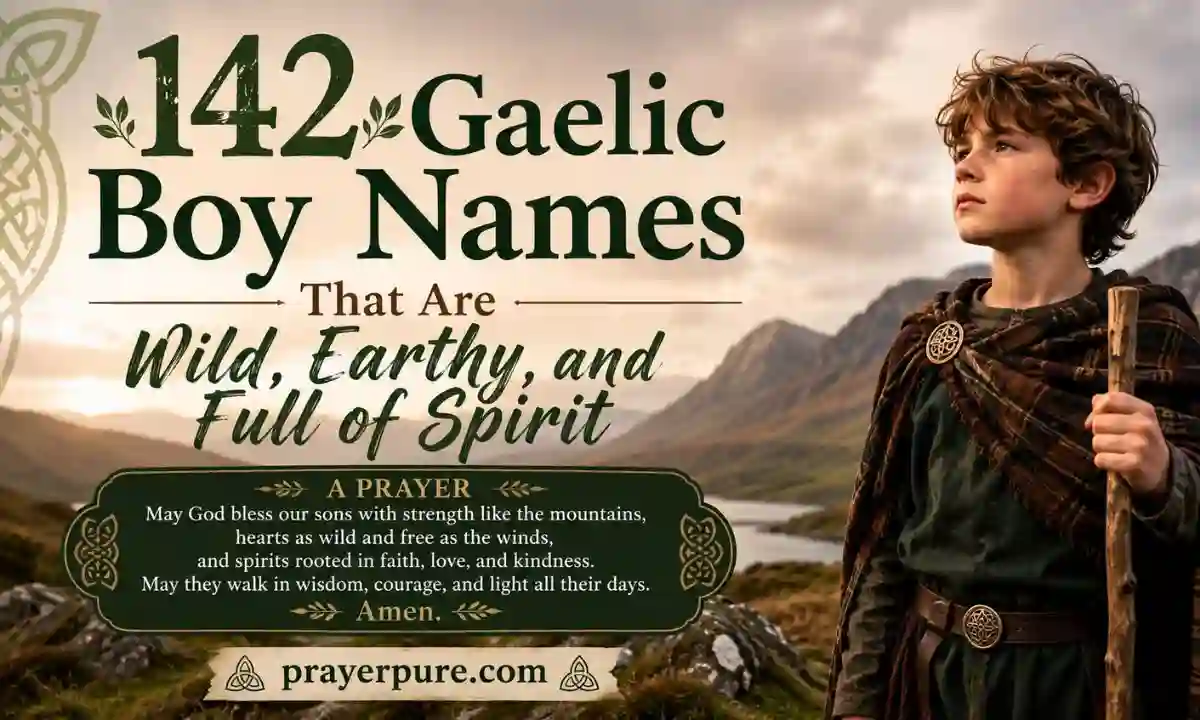
There is a quality to Gaelic names that no translation can fully capture. When you say the name Ciarán aloud — the dark one — you are not simply describing a color. You are invoking the tradition of the dark warrior, the man whose darkness is not absence of light but concentration of power. When you say Fionn — the bright one — you are not describing a hair color. You are invoking the greatest hero of Irish mythology, the wisdom-seeker who burned his thumb on the Salmon of Knowledge and gained all the understanding that the world contains. When you say Cú Chulainn’s original name Sétanta, you are invoking a boy who killed the smith’s hound with his bare hands and then offered himself as the replacement — the child who turned a violent act into a moral obligation with perfect composure.
Gaelic naming traditions — both Irish Gaelic and Scottish Gaelic — developed over thousands of years in cultures that valued specific things above all others: courage in battle, skill with words, loyalty to clan and family, connection to the natural world, and a particular kind of fierce intelligence that combined physical power with poetic vision. The Gaelic hero was not simply a fighter — he was expected to compose poetry, to debate philosophy, to know the genealogies of his people going back to the divine founders, to navigate the complex obligations of the honor code, and to do all of this in a landscape of extraordinary beauty that he was expected to love and describe in precise poetic language.
This list covers the full range of Gaelic boy names — Irish and Scottish, ancient and emerging, heroic and gentle — with genuine meanings and cultural contexts. Every name here is real, documented, and carries a story worth knowing.
📌 Gaelic names carry meanings that often exist in multiple layers — the linguistic root meaning, the mythological or historical figure who bore the name, and the cultural tradition that gives the name its spirit. The meanings given here attempt to capture all available layers.
Understanding Gaelic Naming Traditions
The Two Gaelic Traditions
Irish Gaelic and Scottish Gaelic are closely related but distinct languages — both descended from Old Irish and sharing a common heritage that stretches back two and a half thousand years to the Celtic migrations into the British Isles. Irish Gaelic developed in Ireland and through the Dalriadic migrations into western Scotland in the fifth and sixth centuries CE became the ancestor of Scottish Gaelic. The two traditions share many names — Séamus appears as both Irish and Scottish, Aonghas appears in both traditions — but each has developed its own distinctive forms and its own particular cultural emphases.
Irish Gaelic naming is more closely connected to the Mythological Cycle — the stories of the Tuatha Dé Danann — and to the Ulster Cycle with Cú Chulainn and the Red Branch Knights. Scottish Gaelic naming is more closely connected to the Highland clan system whose complex genealogical traditions preserved ancient name forms through centuries of feudal organization.
The Pronunciation Challenge
Gaelic names are notorious for their apparent mismatch between spelling and pronunciation. Caoimhe is pronounced KEE-va. Tadhg is pronounced TYE. Aoife is pronounced EE-fa. These pronunciations reflect the sound system of the Irish language where combinations like ao, ae, and dh have sounds that do not exist in English. When parents choose Gaelic names they are choosing not just a meaning but a linguistic heritage — and honoring that heritage includes learning the correct pronunciation.
The Naming Formula
Traditional Irish naming used the patronymic system — Mac meaning son of and Ó meaning grandson of or descendant of — creating surnames from given names. Ó’Brien means descendant of Brian. Mac Cormaic means son of Cormac. This patronymic system means that most traditional Irish surnames are simply given names that became hereditary — and many Irish surnames can be reclaimed as given names.
The Tuath and Clan
In Gaelic tradition, individual identity was inseparable from community identity. A man’s name carried his tuath — his tribal community — and his clan. The name he bore was often the name of a founder, a hero, or a divine ancestor — giving every individual a direct linguistic connection to the origin story of their people.
The Great Heroes — Names From Irish Mythology
Cú Chulainn
- Origin: Irish Gaelic
- Meaning: Hound of Culann
- Pronunciation: koo HULL-in
- Mythological context: Cú Chulainn was born Sétanta and received his famous name when he killed the smith Culann’s great hound and offered himself as replacement guardian. The greatest warrior of the Ulster Cycle, he single-handedly defended Ulster against the armies of Connacht during Queen Medb’s cattle raid. He fought from a battle chariot, entered a terrifying battle frenzy called the ríastrad, and died by manipulation of his own honor code. His name — hound of Culann — carries the heritage of Ireland’s greatest warrior.
Fionn
- Origin: Irish Gaelic
- Meaning: White, fair, bright
- Pronunciation: FYUN
- Mythological context: Fionn mac Cumhaill was the leader of the Fianna — Ireland’s warrior band — whose wisdom came from accidentally tasting the Salmon of Knowledge. He burned his thumb on the salmon as it cooked, put his thumb in his mouth, and received all the wisdom in the world. He could access this wisdom by putting his thumb between his teeth — the act of divination called imbas forosnai. Every Fionn carries the heritage of the wisdom-seeker who gained knowledge through accident and pain.
Oisín
- Origin: Irish Gaelic
- Meaning: Little deer, fawn
- Pronunciation: UH-sheen
- Mythological context: Oisín was the son of Fionn mac Cumhaill by a woman who had been transformed into a deer. He traveled to Tír na nÓg — the Land of Eternal Youth — with the fairy queen Niamh and lived three hundred years there. When he returned to Ireland he found his world entirely gone — his father’s era three centuries past — and fell from his horse, instantly aging three hundred years. His little deer name carries the heritage of the mortal who lived in the fairy world and could not return.
Lugh
- Origin: Irish Gaelic/Celtic
- Meaning: Light, possibly connected to the Celtic deity Lugus
- Pronunciation: LOO
- Mythological context: Lugh Lámhfhada — Lugh of the Long Arm — was the sun god of the Tuatha Dé Danann who killed the Fomorian king Balor with his magical spear. He was the master of all arts and crafts — not the greatest at any single skill but better than anyone at every skill simultaneously. The festival of Lúnasa — Lughnasadh — is named for him. Every Lugh carries the heritage of the divine master of all arts.
Cormac
- Origin: Irish Gaelic
- Meaning: Son of the charioteer, possibly defilement of the chariot
- Pronunciation: KOR-mak
- Mythological context: Cormac mac Airt was the greatest of the mythological High Kings of Ireland — a king of legendary wisdom who created the laws, built the great Hall of Tara, and possessed the magic branch of nine golden apples that produced music so beautiful all who heard it forgot their sorrow. He was described as the wisest man who ever ruled Ireland. Every Cormac carries the heritage of the philosopher-king of Irish tradition.
Conall
- Origin: Irish Gaelic
- Meaning: Strong wolf, high valor
- Pronunciation: KUN-ul
- Mythological context: Conall Cernach was one of the great warriors of the Red Branch Knights — the companion of Cú Chulainn who avenged his friend’s death. His strong wolf name carries the heritage of the warrior whose loyalty outlasted death.
Fergus
- Origin: Irish/Scottish Gaelic
- Meaning: Man of force, vigorous man
- Pronunciation: FER-gus
- Mythological context: Fergus mac Róich was the great warrior of the Red Branch who was exiled from Ulster over the treachery that killed the sons of Uisneach. He was Cú Chulainn’s foster-father and one of the Ulster Cycle’s most complex figures — a man of enormous strength and genuine goodness trapped in impossible situations. Fergus in the Scottish tradition was the legendary ancestor of the Scottish kings.
Cú Roí
- Origin: Irish Gaelic
- Meaning: Hound of the plain
- Pronunciation: koo REE
- Mythological context: Cú Roí mac Dáire was a mysterious warrior of the Ulster Cycle — a shapeshifter who appeared in many forms and whose castle could not be found twice in the same place. The beheading contest in the story of Fled Bricrenn — possibly the source of Sir Gawain and the Green Knight — features Cú Roí as the supernatural challenger.
Feidlim
- Origin: Irish Gaelic
- Meaning: Ever good, always good
- Pronunciation: FEL-im
- Mythological context: Feidlim mac Daill was the greatest prophet in the Ulster Cycle — the man who prophesied the terrible fate of Deirdre before her birth. His ever good name carries the heritage of the seer whose goodness is precisely what makes his prophecies so devastating — the truth-teller who always speaks truly.
Naoise
- Origin: Irish Gaelic
- Meaning: Unknown, possibly warrior
- Pronunciation: NEE-sha
- Mythological context: Naoise was the great warrior and harper who eloped with Deirdre — Ireland’s Helen of Troy — and whose death with his brothers at the hands of King Conchobhar caused Deirdre’s own death and the exile of Fergus mac Róich. His story is one of the Three Sorrows of Irish Storytelling — the love that destroyed a kingdom.
Sétanta
- Origin: Irish Gaelic
- Meaning: Unknown, possibly connected to the Setantii tribe
- Pronunciation: SHAY-tan-ta
- Mythological context: Sétanta was the birth name of Cú Chulainn — the name he bore before he killed the hound and received his famous name. As a given name, Sétanta carries the heritage of the hero before his defining act — the potential before the deed.
Manannán
- Origin: Irish Gaelic
- Meaning: Son of the sea, connected to the Isle of Man
- Pronunciation: man-AN-awn
- Mythological context: Manannán mac Lir was the Irish god of the sea — the lord of the Land Beneath Waves who rode his chariot across the sea’s surface. He owned magical possessions including a cloak of mist, a boat that moved without sails, and the Feast of Age that kept the Tuatha Dé Danann immortal. His sea-son name carries the heritage of the most significant Irish divine figure of the Otherworld.
Diarmuid
- Origin: Irish Gaelic
- Meaning: Without enemy, free from envy
- Pronunciation: DEER-mid
- Mythological context: Diarmuid Ó Duibhne was the most beautiful man in Ireland — blessed or cursed with a love spot on his forehead that caused any woman who saw it to fall instantly and fatally in love with him. He eloped with Gráinne who had been promised to the aging Fionn mac Cumhaill and spent years fleeing across Ireland before his death by a magical boar on Beinn Ghulbain mountain. His without-enemy name carries the profound irony of a man whose beauty made everyone his enemy.
Kings and High Kings
Brian
- Origin: Irish Gaelic
- Meaning: High, noble, possibly strength
- Pronunciation: BRY-an
- Historical context: Brian Boru was the greatest High King of Ireland — the king who broke Viking power at the Battle of Clontarf in 1014 and who died in his tent after the victory, cut down by a fleeing Viking. The O’Brien dynasty that bears his name ruled Munster for centuries. Every Brian carries the heritage of the greatest warrior-king in Irish history.
Niall
- Origin: Irish Gaelic
- Meaning: Champion, cloud, passionate
- Pronunciation: NEEL or NYE-ul
- Historical context: Niall of the Nine Hostages was the legendary High King of Ireland and ancestor of the Uí Néill dynasty that dominated Irish politics for centuries. He is said to have raided Britain four times and taken hostages — possibly including the young Patrick who would return as Saint Patrick. Y-chromosome studies have suggested that millions of men worldwide may be his descendants — making Niall one of the most reproductively successful men in recorded history.
Conchobhar
- Origin: Irish Gaelic
- Meaning: Lover of hounds, dog lord
- Pronunciation: KON-uh-var or KRO-ver
- Mythological context: Conchobhar mac Nessa was the King of Ulster in the Ulster Cycle — the king whose desire for Deirdre led to the deaths of Naoise and his brothers and the destruction of the Red Branch. He was simultaneously a great king and the cause of the greatest catastrophe his kingdom experienced — the dog lord whose pride destroyed what his power had built.
Muirchertach
- Origin: Irish Gaelic
- Meaning: Sea ruler, navigator, expert sailor
- Pronunciation: MWIR-hyer-tach
- Historical context: Several High Kings of Ireland bore this name — the sea ruler title designating kings whose power extended across the waters between Ireland and Scotland.
Máel Sechnaill
- Origin: Irish Gaelic
- Meaning: Devotee of Sechnall, devotee of the secondary saint
- Pronunciation: MWALE SHEH-null
- Historical context: Máel Sechnaill II was the last undisputed High King of all Ireland before Brian Boru — the king who twice submitted to Brian and twice reasserted his own power. His complex relationship with Brian Boru and his long reign shaped Irish history in the Viking Age.
Flann
- Origin: Irish Gaelic
- Meaning: Red, blood-red
- Pronunciation: FLAN
- Historical context: Flann Sinna was a significant High King of Ireland in the ninth century. The blood-red color meaning carried by Flann creates a warrior name of elemental directness.
Cú Connacht
- Origin: Irish Gaelic
- Meaning: Hound of Connacht
- Pronunciation: koo KUN-acht
- Historical context: Several kings of Connacht bore names with the hound of Connacht formula — following the same naming tradition as Cú Chulainn hound of Culann. The hound as a royal warrior designation was one of the most significant naming traditions in Gaelic kingship.
Ruaidrí
- Origin: Irish Gaelic
- Meaning: Red king, red ruler
- Pronunciation: ROO-ree
- Historical context: Ruaidrí Ua Conchobhair was the last High King of Ireland — the king whose power collapsed before the Anglo-Norman invasion of 1169-70. His red king name carried a color heritage of royal power.
Warriors and Battle Names
Cáel
- Origin: Irish Gaelic
- Meaning: Slender, slim
- Pronunciation: KALE
- Mythological context: Cáel was a warrior of the Fianna who loved the fairy woman Créd — a love story that ended with both dying for each other. His slender name carries the heritage of the lean warrior whose physical quality was precision rather than mass.
Aodh
- Origin: Irish Gaelic
- Meaning: Fire
- Pronunciation: AY or EE
- Historical/mythological context: Aodh was one of the most common names in medieval Ireland — carried by multiple high kings and saints. The fire meaning connects directly to the Irish mythological and religious tradition where fire was the most sacred element — the fire of the divine smith, the fire of the sun, the sacred fire of Brigid’s perpetual flame.
Cathal
- Origin: Irish Gaelic
- Meaning: Battle ruler, strong in battle
- Pronunciation: KA-hal
- Historical context: Cathal was a name carried by multiple Irish kings — the battle ruler meaning designating both military excellence and the right to rule through that excellence. Cathal Crobderg Ó Conchobhair — Red-Hand Cathal — was one of the most significant kings of Connacht.
Tighearnach
- Origin: Irish Gaelic
- Meaning: Lord, noble
- Pronunciation: TEER-nach
- Historical context: Tighearnach was the name of multiple Irish saints and kings — the lord or noble meaning carrying the heritage of the ruling class.
Fearghall
- Origin: Irish Gaelic
- Meaning: Man of valor, super valor
- Pronunciation: FAR-ul
- Historical context: Fearghall was a High King of Ireland in the eighth century. His man of valor name carries the warrior heritage of valor as the defining masculine quality in Gaelic tradition.
Donnchadh
- Origin: Irish Gaelic
- Meaning: Brown warrior, dark warrior
- Pronunciation: DUN-uh-kha
- Historical context: Donnchadh was a common name among Irish kings and nobles — the brown or dark warrior whose color designation carried the warrior tradition.
Muiredach
- Origin: Irish Gaelic
- Meaning: Sea lord, lord of the sea
- Pronunciation: MWI-ree-dach
- Historical context: Muiredach was the name of the abbot of Monasterboice whose high cross — Muiredach’s Cross — is the finest example of Irish high cross carving in existence. His sea lord name carries the heritage of the monastic tradition.
Goll
- Origin: Irish Gaelic
- Meaning: One-eyed
- Pronunciation: GOL
- Mythological context: Goll mac Morna was the warrior of the Fianna who killed Fionn’s father and who later became Fionn’s loyal lieutenant — one of the Irish tradition’s most complex stories of former enemies becoming companions. His one-eyed name carried a physical mark that designated his difference from ordinary warriors.
Caílte
- Origin: Irish Gaelic
- Meaning: Slender, hardness, possibly thin as steel
- Pronunciation: KALE-tya
- Mythological context: Caílte mac Rónáin was one of the greatest warriors of the Fianna and a poet of extraordinary ability. In Acallam na Senórach — The Colloquy of the Old Men — he survives into Saint Patrick’s time and walks through Ireland with the saint, telling him the stories of each place. His steel-thin name carries the heritage of the warrior who outlived his age.
Amergin
- Origin: Irish Gaelic
- Meaning: Born of song, song birth
- Pronunciation: AV-er-in
- Mythological context: Amergin the White Knee was the first druid of the Milesian invaders — the legendary ancestor of the Gaelic people — who recited the great cosmological poem Am Gáeth i Muir — I am a wind on the sea — as he landed in Ireland. His song birth name carries the heritage of the first Gaelic poet, the man who claimed Ireland by naming it.
Nature and Landscape Names
Glenn
- Origin: Irish/Scottish Gaelic
- Meaning: Valley, glen
- Pronunciation: GLEN
- Cultural context: Glenn simply means valley in Gaelic — the narrow mountain valley that is one of the defining landscape features of both Ireland and Scotland. The glen’s quality of being enclosed and sheltered while running with water gives Glenn a name of protective natural intimacy.
Ardal
- Origin: Irish Gaelic
- Meaning: High valor, bear valor
- Pronunciation: AR-dal
- Cultural context: Ardal combines ard meaning high or noble with the value element — creating a name of elevated worth. Ardal O’Hanlon the Irish comedian and actor made this name internationally known with warmth and humor.
Bradan
- Origin: Irish Gaelic
- Meaning: Salmon
- Pronunciation: BRAD-an
- Mythological context: The salmon in Gaelic tradition was the Salmon of Knowledge — the fish that ate the hazelnuts falling from the nine hazel trees of wisdom into the Well of Segais and that absorbed all the knowledge in the world. The salmon was the most significant animal in Irish mythological tradition. A boy named Bradan carries the heritage of the fish that knows everything.
Rowan
- Origin: Scottish/Irish Gaelic
- Meaning: Red, little red one, also the rowan tree
- Pronunciation: ROH-an
- Cultural context: The rowan tree — mountain ash — was the most magically protective tree in Gaelic tradition. Rowan berries, rowan wood, and the red thread tied around rowan branches were used to protect against evil, fairy interference, and malevolent magic. A boy named Rowan carries the heritage of the protection tree.
Colm
- Origin: Irish Gaelic/Latin
- Meaning: Dove, from the Latin columba
- Pronunciation: KOL-um
- Historical context: Colm Cille — Columba — was the great Irish monk who founded the monastery of Iona in Scotland in 563 CE and who preserved learning through the Dark Ages. His dove name carries the heritage of the monastic tradition’s most significant founder and the peace symbol of the dove.
Barra
- Origin: Scottish Gaelic/Irish
- Meaning: Summit, high place, also fair-haired
- Pronunciation: BAR-a
- Cultural context: Barra is both the name of the Scottish Hebridean island and a given name derived from it or from the saint Finbar — Fionnbarra — meaning fair summit. The summit meaning and the island connection give Barra a name of highland geographical beauty.
Dara
- Origin: Irish Gaelic
- Meaning: Oak tree, fruitful, wise
- Pronunciation: DAR-a
- Cultural context: Dara means oak tree in Irish — the sacred tree of the Celts whose Druids — from the Proto-Celtic dru-wid meaning oak knowledge — derived their name from the oak’s wisdom. The oak in Celtic tradition was the most significant tree — older than most other trees, home to mistletoe, struck by lightning in ways that made it sacred to the thunder gods.
Lochlann
- Origin: Irish Gaelic
- Meaning: Land of the lochs, land of the fjords, Norse lands
- Pronunciation: LOKH-lan
- Historical context: Lochlann was the Irish name for Scandinavia — the land of the lochs or fjords from which the Vikings came. A boy named Lochlann carries the heritage of the Irish perspective on the Vikings — the fierce northern people who raided and settled and eventually became Irish.
Fál
- Origin: Irish Gaelic
- Meaning: Unknown, possibly connected to Lia Fáil the Stone of Destiny
- Pronunciation: FAWL
- Mythological context: Lia Fáil — the Stone of Destiny — was the sacred stone at the Hill of Tara that cried out when touched by the rightful King of Ireland. The stone that now stands at Tara is said to be this stone. A boy named Fál carries the heritage of the stone that recognized kingship.
Cian
- Origin: Irish Gaelic
- Meaning: Ancient, distant, enduring
- Pronunciation: KEY-an
- Mythological context: Cian was the father of Lugh — the sun god — who was killed by the three sons of Tuireann in one of the Irish mythological stories. His ancient enduring name carries the heritage of the ancestor of the divine sun.
Wolf and Animal Names
Mac Tíre
- Origin: Irish Gaelic
- Meaning: Son of the land, wolf
- Pronunciation: mak TEER-uh
- Cultural context: Mac Tíre — literally son of the land — was the Irish euphemistic name for the wolf, used instead of the animal’s actual name as a mark of respect. In Gaelic culture, the wolf was the most significant wild animal — pack-hunting, intelligent, and simultaneously feared and admired as the wild counterpart of the domestic dog.
Faolán
- Origin: Irish Gaelic
- Meaning: Little wolf, wolf cub
- Pronunciation: FAY-lawn
- Historical context: Faolán was a common Irish name — carried by saints and warriors — whose little wolf meaning carried the heritage of the wolf’s power in a diminutive form accessible to a child who would grow into the name’s full significance.
Conán
- Origin: Irish Gaelic
- Meaning: Little hound, little wolf
- Pronunciation: KUN-awn
- Mythological context: Conán Maol — the bald Conán — was the comic figure of the Fianna, the trickster and complainer who provided humor to the warrior narratives. His little hound name carried a diminutive quality that matched his role as the least dignified of the warriors.
Art
- Origin: Irish Gaelic
- Meaning: Bear
- Pronunciation: ART
- Historical context: Art was the name of the High King of Ireland Art mac Cuinn — Art the Lonely — whose loneliness is one of the recurring themes of his story. The bear meaning carries the heritage of the most powerful animal in the Celtic world — the bear king who embodied strength, sovereignty, and the transition between winter and spring.
Bran
- Origin: Irish/Welsh Gaelic
- Meaning: Raven, crow
- Pronunciation: BRAN
- Mythological context: Bran mac Febail was the hero of the Voyage of Bran — the story of a man who heard fairy music and found a silver branch and was led to the Land of Women across the sea. Bran the blessed was the Welsh giant-king whose head continued to prophesy after his death. The raven name carries the heritage of the bird of prophecy and of the transition between worlds.
Ailill
- Origin: Irish Gaelic
- Meaning: Sprite, elf, possibly fawn-like
- Pronunciation: AL-ill
- Mythological context: Ailill mac Máta was the husband of Queen Medb of Connacht — the king whose comparison of his wealth with Medb’s sparked the Cattle Raid of Cooley. His sprite or elf-like name carried a supernatural quality that distinguished him from ordinary mortals.
Oisín
Already noted in the heroes section, Oisín belongs equally in the animal section as the little deer name — the warrior whose mother was transformed into a deer.
Conchúr
- Origin: Irish Gaelic
- Meaning: Lover of hounds
- Pronunciation: KON-uh-khor
- Cultural context: Conchúr is a variant of Conchobhar — the dog lover whose connection to hounds designated a specific type of warrior nobility in the Gaelic tradition.
Mac Con
- Origin: Irish Gaelic
- Meaning: Son of the hound
- Pronunciation: mak KUN
- Historical context: Mac Con was a name of several Irish kings — the son of the hound, whose hound connection designated warrior excellence and tracking skill.
Dark and Powerful Names
Ciarán
- Origin: Irish Gaelic
- Meaning: Dark one, little dark one
- Pronunciation: KEER-awn
- Historical context: Multiple saints bore this name — Saint Ciarán of Clonmacnoise who founded one of Ireland’s greatest monasteries and Saint Ciarán of Saighir who is sometimes called the first saint of Ireland. The dark one name carries a complexity — darkness in Gaelic tradition was not absence of goodness but concentration of power and mystery.
Dubhthach
- Origin: Irish Gaelic
- Meaning: Black, very dark
- Pronunciation: DOO-ha
- Mythological context: Dubhthach Dóeltengae — the Black Tongue — was one of the warriors of the Red Branch whose sardonic tongue was as dangerous as his sword. The very dark name carried both physical and character description.
Dúnlaith
- Origin: Irish Gaelic
- Meaning: Dark sovereignty, black chieftain
- Pronunciation: DOON-la
- Cultural context: Dúnlaith as a masculine name carries the dark sovereignty meaning — the chieftain whose power has the quality of darkness rather than light.
Morann
- Origin: Irish Gaelic
- Meaning: Dark son, great man
- Pronunciation: MOR-an
- Mythological context: Morann was the legendary Irish judge — the wisest judge in Irish mythology — who wore a magical collar that tightened around the neck of any judge who gave an unjust verdict. His great man name carried the heritage of perfect judicial wisdom.
Scully
- Origin: Irish Gaelic
- Meaning: From Scolaidhe, student, scholar
- Pronunciation: SKUL-ee
- Cultural context: Scully as a given name (rather than a surname) carries the heritage of the scholar — the student of learning whose role was essential in the monasteries that preserved knowledge through the Dark Ages.
Donal
- Origin: Irish Gaelic
- Meaning: World ruler, ruler of the world
- Pronunciation: DON-ul
- Historical context: Donal — Domhnall in its full form — was one of the most common names among Irish kings and nobles. The world ruler meaning carries the heritage of the most ambitious possible royal aspiration — the king whose power extends everywhere.
Cú Mara
- Origin: Irish Gaelic
- Meaning: Hound of the sea
- Pronunciation: koo MAR-a
- Cultural context: Cú Mara — hound of the sea — follows the naming formula of Cú Chulainn hound of Culann and Cú Connacht hound of Connacht. The sea hound creates a maritime warrior identity.
Light and Fire Names
Aodh
Already noted in the warriors section, Aodh belongs most naturally in the light and fire section as the fire name — the most direct possible designation of the sacred element.
Lugh
Already noted in the heroes section, Lugh belongs equally in the light section as the sun god whose name connected light and divine power.
Soillse
- Origin: Scottish Gaelic
- Meaning: Light, brightness, radiance
- Pronunciation: SHOL-sha
- Cultural context: Soillse means light in Scottish Gaelic — the brightness of the fire or the sun that was the most sacred element in the Gaelic world.
Flann
Already noted in the kings section, Flann belongs equally in the fire section as the red or blood-red name that carries the quality of fire color.
Cainnech
- Origin: Irish Gaelic
- Meaning: Handsome, comely, possibly bright
- Pronunciation: KAN-ikh
- Historical context: Saint Cainnech — anglicized as Canice — was one of the Twelve Apostles of Ireland and the patron saint of Kilkenny. His possibly bright or handsome name carried the heritage of the monastic tradition.
Eimhin
- Origin: Irish Gaelic
- Meaning: Prompt, swift
- Pronunciation: EV-in
- Cultural context: Eimhin carries the swift and prompt meaning — the hero who acts without hesitation, whose quickness is both physical and mental. Saint Eimine of Inis Celtra and the Annals of Eimhin are associated with this name.
Solam
- Origin: Irish Gaelic
- Meaning: Peace, Solomon
- Pronunciation: SOL-am
- Cultural context: Solam is the Irish form of Solomon — the peace name from the Hebrew tradition that entered Irish naming through the biblical and monastic traditions.
Saints and Scholars
Colm
Already noted in the nature section, Colm belongs most naturally in the saints section as Colm Cille — Columba — whose monastery on Iona became the most significant religious institution in the early medieval British Isles.
Ciarán
Already noted in the dark names section, Ciarán belongs equally in the saints section as the name of the founder of Clonmacnoise — the monastery on the Shannon whose illuminated manuscripts are among the most significant in Irish history.
Brendan
- Origin: Irish Gaelic
- Meaning: Prince, sword, or from a Celtic root meaning raven
- Pronunciation: BREN-dan
- Historical context: Saint Brendan the Navigator was the Irish monk who is said to have sailed across the Atlantic and possibly reached North America in the sixth century — centuries before the Norse or Columbus. His ocean navigation story — the Navigatio Sancti Brendani — was one of the most widely read texts in medieval Europe. Tim Severin’s twentieth century voyage in a replica currach proved the journey was technically possible.
Pádraic
- Origin: Irish Gaelic/Latin
- Meaning: Noble, patrician
- Pronunciation: PAW-drik
- Historical context: Pádraic is the Irish form of Patrick — Saint Patrick who was born in Roman Britain and brought to Ireland as a slave before escaping, training as a monk, and returning to convert Ireland. His patrician noble meaning carries the heritage of the man who gave Ireland its Christianity and its most significant cultural tradition.
Finnian
- Origin: Irish Gaelic
- Meaning: White, fair
- Pronunciation: FIN-ee-an
- Historical context: Multiple saints bore this name — Saint Finnian of Clonard who founded the great school at Clonard that produced the Twelve Apostles of Ireland, and Saint Finnian of Moville whose psalter was copied without permission by the young Colm Cille — the copyright dispute that started a battle. The fair white name carries the heritage of the great monastic tradition.
Mochta
- Origin: Irish Gaelic
- Meaning: My choice, chosen one
- Pronunciation: MOK-ta
- Historical context: Saint Mochta of Louth was a disciple of Saint Patrick who is said to have lived three hundred years. His my choice or chosen one name carried the heritage of the divinely selected.
Caomhán
- Origin: Irish Gaelic
- Meaning: Little gentle one, gentle child
- Pronunciation: KWEE-vawn
- Historical context: Multiple saints bore this name — the little gentle one designation being appropriate for the monastic tradition’s value of gentleness alongside courage.
Abbán
- Origin: Irish Gaelic
- Meaning: Little abbot
- Pronunciation: AB-awn
- Historical context: Saint Abbán was one of the early Irish saints — his little abbot name carrying the heritage of the monastic leadership role in diminutive form.
Molaisse
- Origin: Irish Gaelic
- Meaning: My flame, my light
- Pronunciation: mol-ASH-a
- Historical context: Saint Molaisse of Devenish was a significant Irish saint whose island monastery on Lough Erne was an important pilgrimage site. His my flame name carried the fire heritage.
Scottish Gaelic Names
Alasdair
- Origin: Scottish Gaelic
- Meaning: Defender of men, Scottish Alexander
- Pronunciation: AL-as-dair
- Cultural context: Alasdair is the Scottish Gaelic form of Alexander — the defender of men meaning from the Greek tradition given the characteristic Scottish Gaelic phonological transformation. Alasdair mac Mhaighstir Alasdair — Alexander MacDonald — was the greatest Gaelic poet of the eighteenth century whose poetry celebrated the Highland world with extraordinary lyrical beauty.
Dùghall
- Origin: Scottish Gaelic
- Meaning: Dark stranger, dark foreigner
- Pronunciation: DOO-ul
- Historical context: Dùghall — anglicized as Dugald — was the Scottish Gaelic name for the darker-haired Vikings as opposed to Fionnghall the fair foreigners (who became Fingal). The dark stranger name carried the heritage of the Scottish experience of Norse settlers who became absorbed into Highland culture.
Fionnghall
- Origin: Scottish Gaelic
- Meaning: Fair stranger, fair foreigner
- Pronunciation: FYUN-gal
- Historical context: Fionnghall — Fingal — was the Scottish Gaelic name for the fair-haired Vikings. James Macpherson’s eighteenth century Ossian poems made Fingal a legendary Scottish hero equivalent to the Irish Fionn mac Cumhaill — the poems that caused the greatest literary controversy in British history about whether Macpherson invented or genuinely translated ancient Scottish poetry.
Iain
- Origin: Scottish Gaelic
- Meaning: God is gracious, Scottish John
- Pronunciation: EE-an
- Cultural context: Iain is the Scottish Gaelic form of John — one of the most fundamental Christian names given a completely distinctive Scottish phonological character. Iain is used as both a given name and a cultural marker — Iain Banks the novelist who wrote The Wasp Factory and a series of science fiction novels published under the name Iain M. Banks made this name famous in contemporary Scottish literature.
Seumas
- Origin: Scottish Gaelic
- Meaning: Supplanter, Scottish James
- Pronunciation: SHAY-mus
- Cultural context: Seumas is the Scottish Gaelic form of James — the supplanting name from the Hebrew tradition given a Scottish character. The Jacobite cause — named for Jacobus the Latin form of James — gives the Scottish Seumas a heritage of loyalty to the Stuart kings who were expelled in 1688.
Ruaridh
- Origin: Scottish Gaelic
- Meaning: Red king, red ruler
- Pronunciation: ROO-ree
- Cultural context: Ruaridh is the Scottish Gaelic form of the Irish Ruaidrí — the red king. Several MacDonald and Campbell chiefs bore this name — Ruaridh Mór MacLeod of Harris being particularly significant.
Alastar
- Origin: Scottish Gaelic
- Meaning: Defender of men
- Pronunciation: AL-as-tar
- Cultural context: Alastar is a variant of Alasdair — the Scottish Alexander — in a slightly different Scottish Gaelic phonological form.
Tormod
- Origin: Scottish Gaelic/Norse
- Meaning: Thor’s mind, Thor’s courage
- Pronunciation: TOR-mot
- Cultural context: Tormod is the Scottish Gaelic form of the Norse name Þormóðr — Thor’s mind or Thor’s courage. The Norse-Gaelic fusion that produced names like Tormod is one of the most significant linguistic features of Scottish Highland naming — the merging of the Scandinavian and Gaelic traditions in the medieval period.
Domhnall
- Origin: Irish/Scottish Gaelic
- Meaning: World ruler
- Pronunciation: DOH-null or DOW-null
- Historical context: Domhnall is both the Irish Donal and the Scottish Donald — the world ruler name that was one of the most common in both traditions. The MacDonalds — Clan Donald — who claimed descent from Somhairle Mór and ultimately from the Irish high king are the largest Scottish clan and their world-ruler name carried extraordinary clan prestige.
Gillebride
- Origin: Scottish Gaelic
- Meaning: Servant of Brigid, devotee of Brigid
- Pronunciation: GIL-uh-breed
- Cultural context: Gillebride follows the Gil- naming pattern — Gil meaning servant or devotee combined with a saint’s name. Brigid the great Irish saint whose festival of Imbolc marked spring was also venerated in Scotland and those devoted to her carried her name in their own.
Mànus
- Origin: Scottish Gaelic/Latin
- Meaning: Great, magnanimous
- Pronunciation: MAH-nus
- Historical context: Mànus is the Scottish Gaelic form of Magnus — the great one. Magnus Barefoot the Norwegian king who is said to have claimed the Scottish islands by sailing in a boat across the Kintyre peninsula instead of around it made this great name significant in Scottish Norse heritage.
Coinneach
- Origin: Scottish Gaelic
- Meaning: Handsome, comely
- Pronunciation: KON-yach
- Historical context: Coinneach is the Scottish form of the Irish Cainnech — the handsome one. The Brahan Seer — Coinneach Odhar — was the legendary Scottish Highland prophet who is said to have predicted everything from the Battle of Culloden to the Caledonian Canal centuries before they occurred.
Lachlann
- Origin: Scottish Gaelic
- Meaning: Land of the lochs, from Norway
- Pronunciation: LOKH-lan
- Cultural context: Lachlann — Lachlan — is the Scottish form of the Irish Lochlann — the Norse lands, Scandinavia. In Scotland the name designated those of Norse heritage — the Norsemen who settled the islands and Western Highland coast and whose descendants became the Lords of the Isles.
Sorley
- Origin: Scottish Gaelic/Norse
- Meaning: Summer voyager, summer traveler
- Pronunciation: SOR-lee
- Historical context: Sorley is the Scottish Gaelic form of the Norse Somhairle meaning summer voyager — the Viking who sailed in summer. Somhairle Mór — Somerled — was the twelfth century warrior who drove the Norse from western Scotland and founded the Lordship of the Isles. His summer voyager name carried the heritage of both the Gaelic and Norse traditions in a single person.
Carstaidh
Wait — that’s feminine. Let me use:
Buchann
- Origin: Scottish Gaelic
- Meaning: From Buchan, the district
- Pronunciation: BOO-han
- Cultural context: Buchann designates the northeast Scottish region of Buchan whose Gaelic name means cow land or possibly the district of Buach. John Buchan who wrote The Thirty-Nine Steps bore the regional surname as his family name.
Fionnlagh
- Origin: Scottish Gaelic
- Meaning: Fair warrior, fair hero
- Pronunciation: FYUN-la
- Historical context: Fionnlagh — anglicized as Finlay or Finley — means the fair warrior or fair hero. Fionnlagh mac Ruairidh was the father of Macbeth — the historical Macbeth rather than Shakespeare’s — whose father’s fair warrior name gives the historical king a genuine family heritage.
River and Water Names
Abhainn
- Origin: Irish/Scottish Gaelic
- Meaning: River
- Pronunciation: AV-in
- Cultural context: Abhainn simply means river in Gaelic — the flowing water that was the organizing feature of every Gaelic landscape. The river in Gaelic tradition was both practical — transport, fishing, water supply — and sacred, with each significant river having its own divine or fairy guardian.
Laoire
- Origin: Irish Gaelic
- Meaning: Calf herder, from the river Laois
- Pronunciation: LAY-ree or LWEE-ree
- Historical context: Laoire is connected to both the ancient province of Leinster and to the tradition of cattle culture central to Gaelic life. Laoire mac Néill was a High King of Ireland who refused to convert to Christianity when Saint Patrick arrived — the pagan king who faced Patrick across the sacred fire at the Hill of Slane in one of the founding confrontations of Irish Christianity.
Tigernmas
- Origin: Irish Gaelic
- Meaning: Lord of death, death lord
- Pronunciation: TEER-nus
- Mythological context: Tigernmas was a legendary High King of Ireland who was said to have introduced the worship of Crom Cruach — the golden idol — and who died with his people while worshipping on the plain of Mag Slécht on the eve of Samhain. His death lord name carries the heritage of the ritual sacrifice tradition.
Torna
- Origin: Irish Gaelic
- Meaning: Unknown, possibly from torann meaning thunder
- Pronunciation: TOR-na
- Mythological context: Torna Éces was the legendary poet who fostered the young Niall of the Nine Hostages — the great fosterer of High Kings whose name carries the heritage of poetic education.
Flaithrí
- Origin: Irish Gaelic
- Meaning: Ruler’s arm, princely strength
- Pronunciation: FLA-hree
- Historical context: Flaithrí Ó Maolchonaire was a seventeenth century Irish historian and theologian who founded Saint Anthony’s College in Louvain — one of the most significant institutions of Irish Catholic exile learning. His princely strength name carried the heritage of Irish scholarly resistance.
Clan and Lineage Names
Somhairle
Already noted as Sorley in the Scottish section, Somhairle belongs equally in the lineage section as the name of the founder of the Lords of the Isles.
Giolla Críost
- Origin: Irish/Scottish Gaelic
- Meaning: Servant of Christ, devotee of Christ
- Pronunciation: GIL-a KREEST
- Cultural context: Giolla Críost follows the Giolla naming pattern — the boy dedicated to Christ’s service. In medieval Gaelic culture, names of this form expressed a family’s devotion while simultaneously creating a name of genuine weight and meaning.
Muirgheal
- Origin: Irish Gaelic
- Meaning: Sea bright, bright as the sea
- Pronunciation: MWIR-ul
- Cultural context: Muirgheal carries the sea brightness meaning — the luminous quality of the sea’s surface in morning light — in a name that was used for both men and women in the Gaelic tradition.
Iarfhlaith
- Origin: Irish Gaelic
- Meaning: Western sovereign, western lord
- Pronunciation: EER-la
- Historical context: Iarfhlaith was a name carried by Irish nobles — the western sovereign designation connecting the bearer to the western tradition of Irish mythology where the Otherworld lay.
Eochaid
- Origin: Irish Gaelic
- Meaning: Horse, horseman
- Pronunciation: UKH-ee
- Mythological context: Multiple mythological kings bore this name — Eochaid Airem the High King whose fairy wife Étaín was the subject of one of the most beautiful Irish mythological narratives. The horse name carried the heritage of equestrian culture that was central to Celtic kingship.
Flaithbheartach
- Origin: Irish Gaelic
- Meaning: Bright sovereignty, shining lord
- Pronunciation: FLA-ver-tach
- Historical context: Flaithbheartach was a name carried by multiple Irish kings — the bright sovereignty meaning declaring both luminous quality and royal power.
Cairbre
- Origin: Irish Gaelic
- Meaning: Charioteer
- Pronunciation: KAR-bra
- Mythological context: Cairbre Nia Fer — Cairbre champion of men — was the king of Leinster and the enemy of Cú Chulainn. The charioteer name carried the heritage of the warrior’s most essential companion in early Gaelic warfare.
Cellach
- Origin: Irish Gaelic
- Meaning: Church, bright-headed
- Pronunciation: KEL-akh
- Historical context: Cellach was the name of several Irish kings and abbots — the church or bright-headed meaning connecting it to both the ecclesiastical and warrior traditions.
Rare and Ancient Names
Érenn
- Origin: Irish Gaelic
- Meaning: Ireland
- Pronunciation: AYR-in
- Cultural context: Érenn is the genitive form of Éire — Ireland itself — as a personal name. Naming a son Ireland was the most complete possible declaration of national identity and the most direct possible connection between a person and their homeland.
Macha
Wait — that’s feminine. Let me use:
Sethor
- Origin: Irish Gaelic
- Meaning: Unknown, possibly from the early Gaelic tradition
- Pronunciation: SHA-hor
- Cultural context: Sethor was an early Irish name of uncertain meaning carried in the early Christian period — one of the genuinely ancient names whose etymology has been obscured by time.
Mog Ruith
- Origin: Irish Gaelic
- Meaning: Servant of the wheel
- Pronunciation: mog RETH
- Mythological context: Mog Ruith was the greatest druid in Irish mythology — the blind druid whose power exceeded all others and whose daughter Tlachtga gave Samhain its sacred fire. His servant of the wheel name may refer to the sun wheel — the solar disc that the druids venerated.
Adnán
- Origin: Irish Gaelic
- Meaning: Unknown, ancient Irish name
- Pronunciation: AD-nawn
- Cultural context: Adnán was one of the ancient Irish names carried in the early medieval period — its meaning uncertain but its antiquity genuine.
Duarcán
- Origin: Irish Gaelic
- Meaning: Unknown, possibly from duarc meaning unsociable
- Pronunciation: DWAR-cawn
- Cultural context: Duarcán represents the category of genuinely ancient Irish names whose meanings have been partially obscured but whose sound carries the unmistakable quality of old Gaelic.
Finnbarr
- Origin: Irish Gaelic
- Meaning: Fair summit, fair crest
- Pronunciation: FIN-bar
- Historical context: Saint Finnbarr of Cork — the patron saint of Cork city — was the founder of the monastery on the Lee marshes that became the city of Cork. His fair summit name carries the heritage of the monastic founder whose church became a city.
Tairrdelbach
- Origin: Irish Gaelic
- Meaning: Instigator, the one who provokes
- Pronunciation: TAR-ul-vakh
- Historical context: Tairrdelbach Ua Conchobhair was one of the most powerful kings of Connacht — the instigator name carrying the heritage of the king who initiated conflict rather than simply responding to it.
Snedgus
- Origin: Irish Gaelic
- Meaning: Unknown, appears in voyage tales
- Pronunciation: SNED-gus
- Mythological context: Snedgus and Mac Ríagla were two monks whose voyage story is one of the immram texts — the Irish sea voyage tales that may have influenced Sinbad and that describe impossible islands across the western ocean.
Modern Gaelic Revival Names
Tadhg
- Origin: Irish Gaelic
- Meaning: Poet, philosopher, bard
- Pronunciation: TYE or TIGUE
- Cultural context: Tadhg carries the poet-philosopher meaning — the man whose primary skill is with words and ideas. In Gaelic tradition the poet — the filí — was one of the most significant social figures, keeper of genealogy and praise and satire. Tadhg mac Cárthaigh was a king of Desmond whose name appears in the MacCarthy genealogies.
Rónán
- Origin: Irish Gaelic
- Meaning: Little seal, seal
- Pronunciation: ROH-nawn
- Mythological context: Rónán mac Aeda was an Irish king whose story — Fingal Rónáin — is one of the most tragic in Irish literature, involving the Phaedra theme of a son falsely accused by a stepmother. Saint Rónán Finn of Lough Derg gave his name to multiple sacred sites. The seal name carries the heritage of the selkie tradition — the seal people of Irish and Scottish mythology who could shed their skins and take human form.
Cillian
- Origin: Irish Gaelic
- Meaning: Bright-headed, warrior
- Pronunciation: KIL-ee-an
- Historical context: Saint Cillian was the Irish missionary who evangelized Franconia in Germany in the seventh century and was martyred in Würzburg. Cillian Murphy the actor whose portrayal of Peaky Blinders’ Tommy Shelby and his Oscar-winning performance in Oppenheimer have made this name internationally recognized.
Fiachra
- Origin: Irish Gaelic
- Meaning: Raven, king of ravens
- Pronunciation: FEE-a-khra
- Historical context: Fiachra was one of the children of Lir who was transformed into a swan. Saint Fiachra of Meaux was an Irish monk who settled in France whose garden-centered life made him the patron saint of gardeners. The raven king name carries the heritage of the most intelligent and prophetically significant bird.
Tiernan
- Origin: Irish Gaelic
- Meaning: Little lord, kingly
- Pronunciation: TEER-nan
- Historical context: Tiernan Ua Ruairc was the king of Breifne whose wife was abducted by Diarmait Mac Murchada — the event that set off the chain of events leading to the Anglo-Norman invasion of Ireland. The little lord name carries this pivotal historical heritage.
Cormac
Already noted in the heroes section, Cormac belongs equally in the revival section as one of the most successfully revived traditional Irish names.
Lorcan
- Origin: Irish Gaelic
- Meaning: Little fierce one, intense
- Pronunciation: LOR-kan
- Historical context: Lorcan Ua Tuathail — Laurence O’Toole — was the Archbishop of Dublin who defended the city against the Anglo-Normans and who is the patron saint of Dublin. His fierce little one name carried the intensity of the man who stood between his city and its conquerors.
Donnacha
- Origin: Irish Gaelic
- Meaning: Brown warrior, dark warrior
- Pronunciation: DUN-uh-ha
- Cultural context: Donnacha is the modern Irish form of Donnchadh — the dark warrior name that was common among Irish kings and nobles. Donnacha Rua Mac Conmara was an eighteenth century Irish poet of extraordinary gifts.
Eimear
Wait — that’s feminine. Let me use:
Diarmait
- Origin: Irish Gaelic
- Meaning: Without enemy, free from envy
- Pronunciation: DEER-mit
- Historical context: Diarmait Mac Murchada was the king of Leinster who invited the Anglo-Normans to Ireland to help him regain his kingdom — the most consequential political decision in Irish history. His without enemy name carries the profound irony of the man whose decision created Ireland’s longest-standing political conflict.
Flannán
- Origin: Irish Gaelic
- Meaning: Little red one, bright little one
- Pronunciation: FLAN-awn
- Historical context: Saint Flannán was the son of a king who became a hermit and whose monastic foundation in the Burren gave the Kilflannán area its name. The Flannan Isles in Scotland are named for him — the remote islands whose lighthouse keepers mysteriously vanished in 1900 in one of the most enduring maritime mysteries.
Cú Mhara
- Origin: Irish Gaelic
- Meaning: Hound of the sea
- Pronunciation: koo VAR-a
- Cultural context: Already noted in the warrior section, Cú Mhara belongs equally in the revival section as a name of the hound-formula tradition that is experiencing contemporary interest.
Conchobar
- Origin: Irish Gaelic
- Meaning: Lover of hounds
- Pronunciation: KON-uh-var
- Cultural context: Conchobar is the modern Irish form of Conchobhar — the dog lover king whose name is experiencing revival as part of the broader movement to restore ancient Irish names.
Frequently Asked Questions
Q: What is the difference between Irish Gaelic and Scottish Gaelic names? A: Irish Gaelic and Scottish Gaelic are closely related languages descended from Old Irish, but they diverged significantly over the past thousand years. Irish Gaelic names tend to preserve older forms more faithfully — Fionn, Ciarán, Aoife. Scottish Gaelic names show the phonological developments specific to Scotland — Alasdair for Alexander, Iain for John, Seumas for James. The Norse influence in Scotland also created hybrid names like Tormod — Thor’s mind — and Sorley — summer voyager — that reflect the Gaelic-Norse fusion of the Western Highlands and Islands. Scottish Gaelic names also show influence from the clan system — names associated with specific clans like the MacDonalds, MacLeods, and Campbells have particular cultural resonance in Scotland that purely Irish names lack.
Q: Why are Gaelic names so difficult to pronounce from their spelling? A: The Irish language has a completely different sound system from English and a spelling system that represents that sound system quite accurately — it is English speakers who find it counterintuitive, not Irish speakers. Several features cause the confusion. First, Irish has lenition — a process where certain consonants are softened when preceded by specific grammatical particles, written with an h after the consonant: bh is pronounced like w or v, mh like w or v, dh like y or gh, ch like the Scottish loch. Second, Irish has a system of broad and slender vowels — the same consonant can be pronounced differently depending on whether it is adjacent to broad (a, o, u) or slender (e, i) vowels. Third, some Irish letter combinations represent single sounds: ao sounds like ee or ay, ua sounds like oo-a, ai sounds like various combinations. The key is to learn these patterns rather than apply English phonological rules.
Q: Are there naming conventions in Gaelic culture that modern parents should know about? A: Traditional Irish naming customs included the ceathrair — the practice of naming the first son after the paternal grandfather and the second son after the maternal grandfather, the first daughter after the paternal grandmother and the second after the maternal grandmother. This created naming cycles through generations and is why the same names recur repeatedly in family genealogies. The deirbhfine — the close kin group — also influenced naming, with names circulating within four generations of a family. Modern Irish parents are not bound by these customs but awareness of them can help when choosing traditional names — picking the name of a recent ancestor might inadvertently repeat the traditional pattern, or consciously using it might honor the tradition.
Q: Which Gaelic names are most successfully used internationally? A: Several Gaelic names have crossed cultural boundaries successfully. Finn, Fionn, and their variants are now widely used across English-speaking countries. Liam — the Irish short form of William — became the most popular boy’s name in the United States for several years. Declan, Cormac, Brennan, Connor, and Kieran all work effectively in English-speaking contexts while retaining their Gaelic heritage. In Scotland, Iain, Alasdair, Callum, Fergus, and Hamish have all found appreciation beyond the Scottish community. The key factors for international wearability are pronounceability from the spelling — Finn works better than Fionn for non-Gaelic speakers — and cultural recognition through literature, film, or prominent bearers.
Q: What is the mythological tradition behind so many Gaelic warrior names? A: Gaelic warrior names carry the tradition of the Fianna — the warrior band of Irish mythology whose members had to pass extraordinary tests of poetry, strength, and honor to join. A Fianna warrior had to be able to compose twelve types of poetry, had to defend himself against nine warriors while standing in a hole up to his waist, had to run through a forest without cracking a twig, and had to weave his hair while running so that no braid came loose. This standard — the combination of warrior excellence and poetic ability — defines the Gaelic heroic ideal and explains why so many warrior names carry poetic or intellectual dimensions alongside their military ones. Oisín the son of Fionn was simultaneously a great warrior and the greatest Irish poet. Amergin was simultaneously a warrior and the first Irish druid-poet. The Gaelic tradition saw these as the same thing — the man of complete excellence.
Conclusion
Gaelic boy names carry the landscape of Ireland and Scotland inside them — the mountains and rivers and sacred hills, the standing stones and holy wells, the places where the otherworld is visible through the membrane of the ordinary. They carry the heroes — Fionn and Cú Chulainn and Diarmuid and Oisín — whose stories are not simply entertainment but philosophical statements about what it means to be a person of excellence in the world. They carry the saints — Colm and Brendan and Finnian — whose monasteries preserved the knowledge of the ancient world through its darkest centuries. They carry the kings and the poets and the druids and the warriors whose names were repeated generation after generation because repetition was how the culture maintained its connection to its origin stories.
A Gaelic name is a story compressed into a word. Fionn is the wisdom burned into a thumb. Oisín is the deer-son who lived three hundred years in paradise and came home to find his world gone. Diarmuid is the beautiful man who could not escape his own beauty. Cormac is the philosopher king who had a magic branch of golden apples.
These are wild names. Earthy names. Names full of spirit. Names from a tradition that understood that a person’s name should carry something worth carrying — not just a pleasant sound but a genuine heritage, a real story, a connection to a place and a people and a way of understanding the world.
Which Gaelic boy name speaks most deeply to you? I would love to hear in the comments below!

Olivia Lane is a devoted Christian writer and faith blogger at PrayerPure.com, where she shares heartfelt prayers, Bible verses, and spiritual reflections to inspire believers around the world. Her gentle words help readers find peace, purpose, and strength in God’s presence every day. When she’s not writing, Olivia enjoys reading devotionals, spending time outdoors, and connecting with her church community.