
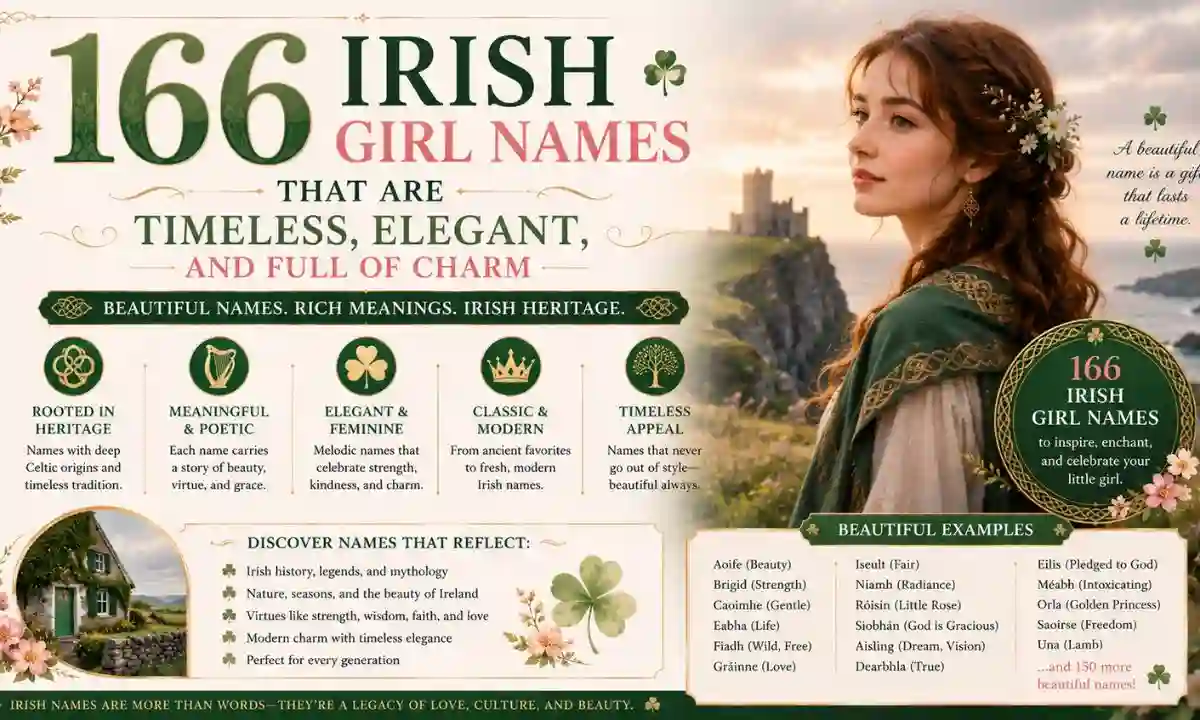
There is a particular music to Irish girl names that exists nowhere else in the world’s naming traditions. It is the music of a language, Irish Gaelic, that was shaped by fifteen hundred years of poetry and storytelling and song on the western edge of Europe, a language whose consonants soften in ways that defy the expectations of every other language family and whose vowels carry a particular quality of longing and beauty that the Irish literary tradition has always described as something between grief and joy, the bittersweet quality the poets called something untranslatable in English. When you encounter a name like Aoife, which sounds like Ee-fa, or Caoimhe, which sounds like Kee-va, or Siobhan, which sounds like Shih-vawn, you are encountering the accumulated phonological wisdom of a language that decided long ago that the most beautiful sounds were worth protecting from simplification, even if that meant making the gap between spelling and pronunciation a source of perpetual surprise.
Irish girl names draw from several extraordinary wells simultaneously. The mythological tradition of the Tuatha Dé Danann, the divine race of Celtic Ireland, gives names like Clíodhna and Áine and Brigid that carry the full weight of pre-Christian Irish religious imagination. The hero tales and the Ulster Cycle give names like Deirdre and Niamh and Gráinne whose love stories and tragedies created the templates for Irish romantic narrative that would echo through every subsequent century of Irish literature. The Christian tradition, arriving in Ireland in the fifth century and immediately producing saints of extraordinary spiritual achievement, gives names like Brigid and Ita and Attracta that carry the specific heritage of Irish Christian mysticism. The bardic and literary tradition that produced some of the finest poetry in any European language gives names whose beauty was celebrated in verse across a thousand years. And the contemporary Irish tradition, shaped by the revival of the Irish language and the extraordinary cultural flowering of modern Ireland, gives names that carry all of these layers while feeling entirely fresh and entirely of the present moment.
These 166 names are timeless because Irish culture has always understood that the most important things are worth preserving across every generation, elegant because the Irish language has always treated beauty of sound as inseparable from depth of meaning, and full of charm because Ireland has always been a place where the gift of enchantment, in the oldest sense of the word, was considered one of the highest human accomplishments.
Popularity rankings are based on Irish naming data and SSA data where available.
Quick Info: Irish names often have pronunciations that differ significantly from their spellings. Pronunciation guides are provided for names where the gap between spelling and sound is particularly significant.
Names From Irish Mythology
Áine
- Origin: Irish Gaelic
- Meaning: Brightness, radiance, splendor
- Pronunciation: AWN-ya
- Popularity: Top 30 in Ireland
The name of the Irish goddess of summer, wealth, and sovereignty whose home was on the hill of Knockainey in County Limerick and whose association with the fairy mounds of Munster made her one of the most beloved figures in Irish mythology, Áine carries a warm, luminous quality and a profound mythological heritage as the divine embodiment of summer’s brightness and the generosity of the land.
Clíodhna
- Origin: Irish Gaelic
- Meaning: Shapely, the shapely one
- Pronunciation: KLEE-na
- Popularity: Widely used in Ireland
The name of the queen of the Irish fairies of Munster who is associated with the waves of the sea and with the gift of healing, and who in some traditions was the most beautiful woman who ever lived in the Otherworld, Clíodhna carries a cool, mysterious quality and a profound mythological heritage rooted in the Irish tradition of the divine woman who exists at the threshold between the human and the supernatural worlds.
Niamh
- Origin: Irish Gaelic
- Meaning: Bright, radiant, beautiful
- Pronunciation: NEE-av or NEEV
- Popularity: Top 10 in Ireland
The name of the daughter of the sea god Manannán Mac Lir who came from Tír na nÓg, the Land of Eternal Youth, on her white horse to take the hero Oisín to live with her in paradise, Niamh carries an extraordinary mythological heritage and a warm, luminous quality as the name of the most beautiful woman of the Otherworld whose love story with Oisín became one of the most celebrated romantic narratives in all of Irish literature.
Étaín
- Origin: Irish Gaelic
- Meaning: Jealousy, possibly passion
- Pronunciation: AY-tawn
- Popularity: Widely used in Ireland
The name of the most celebrated beauty of Irish mythology whose story of transformation, reincarnation, and love across lifetimes is told in the medieval tale Tochmarc Étaíne, one of the oldest and most beautiful love stories in European literature, Étaín carries a cool, slightly mysterious quality and a profound mythological heritage rooted in the theme of love that transcends death and transformation.
Fionnuala
- Origin: Irish Gaelic
- Meaning: Fair shoulder, white shoulder
- Pronunciation: FIN-oo-la or fih-NOO-la
- Popularity: Widely used in Ireland
The name of the daughter of the god Lir who was transformed with her brothers into swans by a jealous stepmother and who wandered the waters of Ireland for nine hundred years, Fionnuala carries a profound mythological heritage through the Children of Lir, one of the three great sorrows of Irish storytelling, and a cool, graceful quality rooted in the image of the swan on dark water.
Gráinne
- Origin: Irish Gaelic
- Meaning: Grace, love, the sun goddess
- Pronunciation: GRAW-nya
- Popularity: Top 30 in Ireland
The name of the princess who fled on the night of her betrothal to the aging Fionn mac Cumhaill with the young warrior Diarmuid, creating one of the great Irish pursuit stories and one of the most celebrated love narratives in the Celtic world, Gráinne carries an extraordinary heritage as the name of the woman whose choice to follow love rather than duty set in motion a story that shaped Irish romantic imagination for two thousand years.
Brigid
- Origin: Irish Gaelic
- Meaning: Exalted one, strength, fiery arrow
- Pronunciation: BRIJ-id
- Popularity: Widely used in Ireland and internationally
Perhaps the most significant name in Irish cultural heritage, carried first by the great goddess Brigid of the Tuatha Dé Danann who presided over poetry, healing, and smithcraft, and then by the great saint Brigid of Kildare whose monastery became one of the most important centers of early Christian learning in Europe, Brigid carries a profound dual heritage as both the supreme goddess and the supreme female saint of Ireland, a name that holds the entire transition from Celtic paganism to Celtic Christianity.
Manannán
- Already noted in the context of Niamh above.
Tlachtga
- Origin: Irish Gaelic
- Meaning: Earth spear, the earth
- Pronunciation: TLAKH-tga
- Popularity: Rare/Reviving
The name of the daughter of the great druid Mog Ruith whose magical knowledge and tragic story gave her name to the Hill of Tlachtga where the great Samhain fires were lit each year, Tlachtga carries a cool, archaic quality and a profound mythological heritage rooted in the pre-Christian festival that became Halloween.
Aoibhinn
- Origin: Irish Gaelic
- Meaning: Beautiful, radiant, pleasant
- Pronunciation: EE-vin
- Popularity: Widely used in Ireland
The name of multiple figures in Irish mythology including the fairy queen of North Leinster, Aoibhinn carries a warm, beautiful quality and a deep mythological heritage rooted in the tradition of the fairy women whose beauty was considered the standard against which all human beauty was measured.
Clodagh
- Origin: Irish
- Meaning: From the River Clodagh
- Pronunciation: KLOH-da
- Popularity: Top 30 in Ireland
A name derived from the River Clodagh in County Tipperary, Clodagh carries a cool, flowing quality and a deep Irish geographical heritage rooted in the tradition of river names as girl’s names that has produced some of the most distinctive Irish girl names.
Names From the Ulster Cycle
Deirdre
- Origin: Irish Gaelic
- Meaning: Broken-hearted, possibly sorrowful
- Pronunciation: DEHR-druh or DEER-druh
- Popularity: Widely used in Ireland and internationally
The name of the most celebrated tragic heroine of Irish literature whose beauty was so extraordinary that a druid prophesied at her birth that she would bring ruin to Ireland, and who fled to Scotland with Naoise rather than marry the king Conchobar, only for both to be killed through treachery, Deirdre carries the most complete tragic heritage of any Irish name and a profound literary significance as the Juliet of Irish storytelling.
Emer
- Origin: Irish Gaelic
- Meaning: Swift, also possibly related to twin
- Pronunciation: EE-mer
- Popularity: Widely used in Ireland
The name of the wife of the great hero Cú Chulainn who was chosen from all the women of Ireland for her six gifts of beauty, voice, sweet speech, needlework, wisdom, and chastity, Emer carries a warm, distinguished quality and a profound Ulster Cycle heritage as the partner of Ireland’s greatest hero.
Fedelm
- Origin: Irish Gaelic
- Meaning: Unknown, possibly ever good
- Pronunciation: FEH-delm
- Popularity: Rare/Reviving
The name of the prophetess who appeared to Queen Medbh before the great cattle raid of Cooley and whose repeated prophesy of I see it crimson, I see it red became one of the most famous passages of the Táin Bó Cúailnge, Fedelm carries a cool, slightly dramatic quality and a profound Ulster Cycle heritage.
Medbh
- Origin: Irish Gaelic
- Meaning: She who intoxicates, mead woman
- Pronunciation: MAY-v or MAYV
- Popularity: Widely used in Ireland
The name of the great warrior queen of Connacht whose cattle raid to acquire the Brown Bull of Cooley drives the plot of the Táin Bó Cúailnge, the central epic of the Ulster Cycle, Medbh carries a bold, commanding quality and a profound mythological heritage as one of the most powerful female figures in Celtic literature, a queen who led armies and whose sovereignty was tied to the fertility of the land.
Findabair
- Origin: Irish Gaelic
- Meaning: Fair eyebrows, fair and smooth
- Pronunciation: FIN-a-wir
- Popularity: Rare
The name of the daughter of Queen Medbh and King Ailill whose beauty was used as a diplomatic tool in the cattle raid, Findabair carries a cool, slightly archaic quality and a deep Ulster Cycle heritage as a character whose story explores the limits of female autonomy within patriarchal political structures.
Heroines of the Fenian Cycle
Sádhbh
- Origin: Irish Gaelic
- Meaning: Sweet, goodness
- Pronunciation: SYVE or SIVE
- Popularity: Top 30 in Ireland
The name of the deer-woman who was the beloved of the hero Fionn mac Cumhaill and the mother of the poet Oisín, transformed into a deer by the dark druid Fear Doirc and separated from Fionn before their son was born, Sádhbh carries a warm, sweet quality and a profound Fenian Cycle heritage rooted in the theme of transformation and loss.
Creidne
- Origin: Irish Gaelic
- Meaning: Belief, faith
- Pronunciation: KRED-nya
- Popularity: Rare/Reviving
A name meaning belief and faith from the Fenian tradition, Creidne carries a cool, slightly unusual quality and a deep Irish mythological heritage.
Ailbhe
- Origin: Irish Gaelic
- Meaning: White, bright
- Pronunciation: AL-va
- Popularity: Top 30 in Ireland
A name meaning white and bright carried by multiple figures in Irish mythology and history, Ailbhe carries a warm, luminous quality and a deep heritage rooted in the Irish tradition of white as the color of the Otherworld and of spiritual purity.
Names of Irish Saints
Ita
- Origin: Irish Gaelic
- Meaning: Thirst for holiness
- Pronunciation: IH-ta
- Popularity: Widely used in Ireland
The name of Saint Ita of Killeedy whose monastery in County Limerick became one of the most important centers of female religious life in early medieval Ireland and who was called the Foster Mother of the Saints of Ireland for the many distinguished monks she educated, Ita carries a warm, devotional quality and a profound heritage as one of the most beloved female saints of the Irish tradition.
Gobnat
- Origin: Irish Gaelic
- Meaning: Little mouth, also related to the bee
- Pronunciation: GUB-net
- Popularity: Widely used in Munster
The name of the patron saint of beekeepers whose monastery at Ballyvourney in County Cork remains a pilgrimage site to the present day and who according to tradition used her bees to protect her community from plague and invasion, Gobnat carries a warm, slightly unusual quality and a profound heritage as the saint whose ministry was inseparable from the natural world.
Attracta
- Origin: Latin/Irish
- Meaning: To draw toward, attractive
- Pronunciation: a-TRAK-ta
- Popularity: Widely used in Connacht
The name of the fifth-century saint who established a hospice and sanctuary in County Roscommon and who was known for her healing miracles, Attracta carries a warm, slightly unusual quality and a deep heritage as one of the earliest female saints of Connacht.
Lasair
- Origin: Irish Gaelic
- Meaning: Flame, blaze
- Pronunciation: LAS-ir
- Popularity: Rare/Reviving
The name of a medieval Irish saint meaning flame, Lasair carries a bold, luminous quality and a deep heritage rooted in the tradition of fire as both a spiritual and a practical symbol in Irish Christian culture.
Lua
- Origin: Irish Gaelic
- Meaning: Moon
- Pronunciation: LOO-a
- Popularity: Rare/Reviving
A minimal Irish name meaning moon, Lua carries a cool, celestial quality and a deep heritage rooted in the tradition of lunar names in Irish spiritual culture.
Classical Irish Names for Girls
Aoife
- Origin: Irish Gaelic
- Meaning: Beautiful, radiant, joyful
- Pronunciation: EE-fa
- Popularity: Top 5 in Ireland
One of the most popular Irish girl names and one of the most phonologically surprising for non-Irish speakers, Aoife carries a warm, joyful quality and a profound mythological heritage through Aoife the greatest female warrior in the world who became the mother of Cú Chulainn’s son, a name that combines extraordinary softness of sound with the heritage of the mightiest female fighter in Celtic tradition.
Caoimhe
- Origin: Irish Gaelic
- Meaning: Gentle, beautiful, precious
- Pronunciation: KEE-va
- Popularity: Top 10 in Ireland
A name meaning gentle and precious that has consistently been one of the most popular Irish girl names for decades, Caoimhe carries a warm, tender quality and a deep heritage as one of the most quintessentially Irish names, the name that most perfectly captures the Irish tendency toward sounds that are softer and more surprising than their spelling suggests.
Siobhán
- Origin: Irish Gaelic
- Meaning: God is gracious
- Pronunciation: shih-VAWN
- Popularity: Top 20 in Ireland/Widely known internationally
The Irish form of Joan and Jane carrying the God is gracious meaning through a distinctive Irish phonological transformation that turns an English J sound into an Irish SH sound, Siobhán carries a deep Irish heritage and is one of the names most often cited as an example of the gap between Irish spelling and Irish pronunciation.
Saoirse
- Origin: Irish Gaelic
- Meaning: Freedom, liberty
- Pronunciation: SEER-sha or SAIR-sha
- Popularity: Top 10 in Ireland
The Irish word for freedom used as a name, Saoirse carries a bold, political quality and a profound heritage rooted in the Irish independence movement of the early twentieth century when names celebrating freedom were given as declarations of nationalist aspiration, associated internationally with the actress Saoirse Ronan whose career has given the name worldwide recognition.
Róisín
- Origin: Irish Gaelic
- Meaning: Little rose, rose
- Pronunciation: ROH-sheen
- Popularity: Top 20 in Ireland
The Irish diminutive of the rose name, Róisín carries a warm, botanical quality and a profound political heritage through the song Róisín Dubh, Dark Little Rose, a seventeenth-century poem that uses the image of the little rose as an allegory for Ireland herself, making Róisín one of the names most deeply identified with Irish national identity.
Sinéad
- Origin: Irish Gaelic
- Meaning: God is gracious
- Pronunciation: shih-NAYD
- Popularity: Top 20 in Ireland
The Irish form of Janet and Jane carrying the God is gracious meaning through the distinctive Irish phonological transformation, Sinéad carries a warm, musical quality and a profound cultural heritage, associated internationally with the singer Sinéad O’Connor whose extraordinary voice and fierce independence made her one of the most significant Irish cultural figures of the late twentieth century.
Fionnuala
- Already celebrated in the mythology section above.
Orla
- Origin: Irish Gaelic
- Meaning: Golden princess, golden sovereign
- Pronunciation: OR-la
- Popularity: Top 10 in Ireland
A beautiful Irish name combining the elements for gold and sovereignty, Orla carries a warm, regal quality and a profound heritage as a name that celebrates both physical beauty, the golden quality of light and hair, and political authority, the princess who holds power, in a single elegant compound.
Muireann
- Origin: Irish Gaelic
- Meaning: Sea white, sea fair
- Pronunciation: MWIR-an
- Popularity: Top 30 in Ireland
A beautiful Irish compound combining muir meaning sea with the fair or white element, Muireann carries a cool, maritime quality and a deep mythological heritage as the name carried by multiple figures in Irish mythology associated with the sea.
Sorcha
- Origin: Irish Gaelic
- Meaning: Brightness, light
- Pronunciation: SOR-a-kha or SUR-a-ha
- Popularity: Top 20 in Ireland
An Irish name meaning brightness and light, Sorcha carries a warm, luminous quality and a deep heritage as one of the most beloved traditional Irish light names, the name that contains the Irish landscape’s particular quality of brightness, the light that comes through clouds after rain.
Names From Irish Literature
Cathleen
- Origin: Irish Gaelic/Greek
- Meaning: Pure, unsullied
- Pronunciation: KATH-leen
- Popularity: Widely used internationally
The Irish form of Katherine carrying the pure meaning through the Irish phonological tradition, Cathleen carries a deep literary heritage through W.B. Yeats’s play Cathleen Ni Houlihan in which the title character is Ireland personified as an old woman who becomes young again when young men give their lives for her, making Cathleen one of the most politically charged names in Irish literary history.
Nora
- Origin: Latin/Irish
- Meaning: Honor, light
- Pronunciation: NOR-a
- Popularity: Top 20 in Ireland/#155 SSA
The Irish short form of Honora carrying the honor meaning in a warm, clean form, Nora carries a profound literary heritage through Nora Barnacle the wife of James Joyce who inspired many of the female characters in his work and who is herself one of the most significant women in Irish literary history.
Molly
- Origin: Hebrew/Irish
- Meaning: Beloved, wished-for child
- Pronunciation: MOL-ee
- Popularity: Top 20 in Ireland/#124 SSA
The Irish form of Mary carrying the beloved meaning in its most warm and familiar form, Molly carries a profound literary heritage through Molly Bloom the unforgettable heroine of James Joyce’s Ulysses whose forty-page interior monologue is one of the most celebrated passages in twentieth-century literature.
Nuala
- Origin: Irish Gaelic
- Meaning: Fair shoulder, white shoulder
- Pronunciation: NOO-la
- Popularity: Top 30 in Ireland
The short form of Fionnuala carrying the same white shoulder meaning in a warmer, more accessible form, Nuala carries a deep Irish heritage and a warm, clean quality that has made it one of the most beloved simplified forms of a longer Irish mythological name.
Biddy
- Origin: Irish Gaelic
- Meaning: Strength, fiery arrow
- Pronunciation: BID-ee
- Popularity: Historically widely used in Ireland
The Irish diminutive of Brigid carrying the strength meaning in its most affectionate folk form, Biddy carries a warm, slightly vintage quality and a deep Irish heritage through Biddy Early the legendary wise woman and healer of County Clare whose blue bottle and supernatural knowledge made her one of the most celebrated figures of Irish folk tradition.
Pegeen
- Origin: Irish/Greek
- Meaning: Pearl, precious
- Pronunciation: peh-GEEN
- Popularity: Historically widely used in Ireland
The Irish diminutive of Peg and Margaret carrying the pearl meaning in its most distinctly Irish form, Pegeen carries a warm, folk quality and a profound literary heritage through Pegeen Mike the heroine of John Millington Synge’s The Playboy of the Western World, one of the masterworks of Irish dramatic literature.
Contemporary Irish Names
Aoibhe
- Origin: Irish Gaelic
- Meaning: Beauty, radiance
- Pronunciation: EE-va
- Popularity: Top 10 in Ireland
A name meaning beauty and radiance that has been consistently among the most popular Irish girl names in recent years, Aoibhe carries a warm, luminous quality and a deep heritage as one of the distinctly Irish names whose spelling creates the perpetual pleasant surprise of a much softer sound than the letters suggest.
Laoise
- Origin: Irish Gaelic
- Meaning: Light, warrior queen
- Pronunciation: LEE-sha
- Popularity: Top 20 in Ireland
An Irish name combining light with warrior queen qualities, Laoise carries a bold, luminous quality and a deep contemporary Irish heritage as one of the names that has been rising steadily in the modern Irish naming landscape.
Méabh
- Origin: Irish Gaelic
- Meaning: She who intoxicates
- Pronunciation: MAY-v
- Popularity: Top 20 in Ireland
A variant spelling of Medbh carrying the same intoxicating meaning in a slightly more accessible form, Méabh carries the full mythological heritage of the great warrior queen of Connacht and a warm, commanding quality.
Éabha
- Origin: Irish Gaelic
- Meaning: Life, living, the Irish form of Eve
- Pronunciation: AY-va
- Popularity: Top 20 in Ireland
The Irish form of Eve carrying the life meaning through the distinctive Irish phonological tradition, Éabha carries a warm, vital quality and a deep heritage as the Irish form of one of the most ancient and most fundamental of all feminine names.
Aoibhinn
- Already celebrated in the mythology section above.
Rónán
- While primarily masculine, the name is worth noting here for its connection to the seal mythology.
Ciara
- Origin: Irish Gaelic
- Meaning: Dark, black-haired, dark one
- Pronunciation: KEE-ra or KEER-a
- Popularity: Top 20 in Ireland/#363 SSA
An Irish name meaning dark and black-haired, Ciara carries a cool, slightly unusual quality and a deep heritage as one of the most beloved contemporary Irish names, carried by Saint Ciara of Kilkeary and associated with the particular beauty of the dark-haired Irish woman celebrated in traditional song and poetry.
Fiadh
- Origin: Irish Gaelic
- Meaning: Wild, deer, nature
- Pronunciation: FEE-a
- Popularity: Top 5 in Ireland
One of the fastest-rising Irish girl names of recent years, Fiadh means wild and deer and nature and carries a cool, fresh quality and a deep Irish heritage rooted in the tradition of names that celebrate the wild, untamed qualities of the Irish landscape rather than domesticated or cultivated beauty.
Réaltín
- Origin: Irish Gaelic
- Meaning: Little star
- Pronunciation: RAWL-teen
- Popularity: Widely used in Ireland
A beautiful Irish compound meaning little star, Réaltín carries a warm, celestial quality and a deep heritage as one of the most charming diminutive star names in any language.
Bláithín
- Origin: Irish Gaelic
- Meaning: Little flower, blossom
- Pronunciation: BLAW-heen
- Popularity: Widely used in Ireland
A beautiful Irish diminutive meaning little flower, Bláithín carries a warm, botanical quality and a deep heritage as one of the most affectionate flower names in the Irish tradition.
Names With Anglicized Forms
Maeve
- Origin: Irish Gaelic
- Meaning: She who intoxicates
- Pronunciation: MAYV
- Popularity: Top 20 in Ireland/#292 SSA
The Anglicized form of Méabh carrying the same warrior queen heritage in a form that has been embraced internationally, Maeve has become one of the most popular Irish names across the English-speaking world, combining the full force of its mythological heritage with a clean, accessible pronunciation.
Brigid
- Already celebrated in the mythology section above, Brigid belongs here as the Anglicized form that has spread worldwide from its Irish original.
Sheila
- Origin: Irish Gaelic
- Meaning: Blind, heavenly, the Irish form of Cecilia
- Pronunciation: SHEE-la
- Popularity: Widely used internationally
The Irish form of Cecilia and Síle carrying the heavenly meaning in a warm, accessible form, Sheila carries a deep Irish heritage and has been so thoroughly absorbed into Australian slang as a generic term for a woman that it has taken on a second life as a cultural marker of Irish-Australian identity.
Kathleen
- Origin: Irish/Greek
- Meaning: Pure, unsullied
- Pronunciation: KATH-leen
- Popularity: Widely used internationally
The Anglicized form of Caitlín carrying the pure meaning through a form that has been widely used across the Irish diaspora, Kathleen carries a warm, slightly nostalgic quality and a profound heritage as one of the names most associated with Irish-American identity across the twentieth century.
Eileen
- Origin: Irish Gaelic
- Meaning: Bright, shining, the bright one
- Pronunciation: eye-LEEN
- Popularity: Widely used internationally
The Anglicized form of Eibhlín carrying the bright and shining meaning in a warm, flowing form, Eileen carries a deep Irish heritage and a warm, slightly vintage quality, associated with the traditional Irish love song Eileen Aroon meaning Eileen my darling.
Colleen
- Origin: Irish Gaelic
- Meaning: Girl, young woman
- Pronunciation: kol-LEEN
- Popularity: Widely used internationally
The Irish word for girl used as a name, Colleen carries a warm, direct quality and a deep Irish heritage as one of the names that traveled most successfully through the Irish diaspora to become firmly established in Irish-American naming culture.
Norah
- Origin: Latin/Irish
- Meaning: Honor, light
- Pronunciation: NOR-a
- Popularity: Widely used internationally
A variant spelling of Nora carrying the same honor meaning in a slightly more formal form, Norah carries a warm, clean quality and a deep Irish heritage.
Nature and Landscape Names
Bláth
- Origin: Irish Gaelic
- Meaning: Flower, blossom
- Pronunciation: BLAW
- Popularity: Widely used in Ireland
The Irish word for flower used directly as a name, Bláth carries a warm, botanical quality and a deep heritage as one of the most minimal and most direct flower names in any language.
Fuinseog
- Origin: Irish Gaelic
- Meaning: Ash tree
- Pronunciation: FWIN-shohg
- Popularity: Rare/Reviving
The Irish word for the ash tree used as a name, Fuinseog carries a cool, slightly unusual quality and a deep heritage rooted in the tradition of the ash as one of the sacred trees of Irish mythology.
Caill
- Origin: Irish Gaelic
- Meaning: Forest, woodland
- Pronunciation: KALL
- Popularity: Rare
The Irish word for forest used as a name, Caill carries a cool, natural quality and a deep heritage rooted in the Irish landscape tradition.
Abha
- Origin: Irish Gaelic
- Meaning: River
- Pronunciation: AH-va or AW-va
- Popularity: Widely used in Ireland
The Irish word for river used as a name, Abha carries a cool, flowing quality and a deep geographical heritage rooted in the tradition of river names as girl’s names in Ireland.
Eithne
- Origin: Irish Gaelic
- Meaning: Kernel, grain, nut
- Pronunciation: EN-ya or ETH-na
- Popularity: Top 30 in Ireland
A name meaning the kernel or grain, the essential life-giving core at the center of things, Eithne carries a warm, slightly unusual quality and a profound mythological heritage as the name of multiple figures in Irish myth including the mother of the god Lugh and the daughter of Manannán Mac Lir.
Muirenn
- Origin: Irish Gaelic
- Meaning: Sea white, sea fair
- Pronunciation: MWIR-en
- Popularity: Widely used in Ireland
A variant of Muireann carrying the same sea and fair meanings in a slightly different form, Muirenn carries a cool, maritime quality and a deep Irish heritage rooted in the sea that defines so much of Irish geographical and cultural identity.
Rónnat
- Origin: Irish Gaelic
- Meaning: Little seal
- Pronunciation: RUN-at
- Popularity: Widely used in Ireland
A beautiful Irish diminutive meaning little seal, Rónnat carries a warm, slightly unusual quality and a deep heritage rooted in the selkie tradition of Irish and Scottish folklore where seals could transform into human form and whose hybrid identity between sea and land created some of the most poignant stories in the Celtic folk tradition.
Names of Virtue and Quality
Muirgheal
- Origin: Irish Gaelic
- Meaning: Sea brightness, bright sea
- Pronunciation: MWIR-al
- Popularity: Widely used in Ireland
A beautiful Irish compound combining muir meaning sea with geal meaning bright and white, Muirgheal carries a cool, luminous quality and a deep heritage as one of the compound names that combines the two most celebrated elements of Irish natural beauty.
Mella
- Origin: Irish Gaelic
- Meaning: Lightning, or pleasant
- Pronunciation: MEL-a
- Popularity: Widely used in Ireland
An Irish name meaning lightning or pleasant, Mella carries a warm, clean quality and a deep heritage as one of the names carried by an early Irish saint.
Treasa
- Origin: Irish Gaelic
- Meaning: Strength, the strong one
- Pronunciation: TRAH-sa
- Popularity: Widely used in Ireland
The Irish form of Teresa carrying the strength meaning through a distinctly Irish phonological form, Treasa carries a warm, powerful quality and a deep heritage as one of the characteristically Irish adaptations of a continental saint’s name.
Sadhbh
- Already celebrated in the Fenian Cycle section above.
Meadhbh
- A variant spelling of Méabh/Medbh already celebrated above.
Cróine
- Origin: Irish Gaelic
- Meaning: Saffron-colored, brown
- Pronunciation: KROH-nya
- Popularity: Rare/Reviving
An Irish name meaning saffron-colored, Cróine carries a warm, slightly unusual quality and a deep heritage as one of the color names in the Irish tradition that celebrate specific shades of the Irish natural world.
Names From Irish Poetry and Song
Úna
- Origin: Irish Gaelic
- Meaning: Lamb, unity, pure
- Pronunciation: OO-na
- Popularity: Top 30 in Ireland
A name meaning lamb and unity, Úna carries a warm, peaceful quality and a profound musical heritage through the song Úna Bhán, White Úna, one of the most celebrated love songs in the Irish tradition, and through Countess Cathleen Úna whose story Yeats immortalized in verse.
Clodagh
- Already celebrated in the mythology section above, Clodagh belongs here for its poetic geographical heritage through the river of the same name.
Máire
- Origin: Irish Gaelic/Hebrew
- Meaning: Beloved, wished-for child
- Pronunciation: MAW-ra or MOY-ra
- Popularity: Top 30 in Ireland
The Irish form of Mary carrying the beloved meaning through the distinctive Irish phonological transformation, Máire carries the most profound Marian heritage in a distinctly Irish form and a warm, devotional quality rooted in the central importance of the Virgin Mary in Irish Catholic culture.
Lile
- Origin: Irish Gaelic
- Meaning: Lily
- Pronunciation: LIL-a
- Popularity: Widely used in Ireland
The Irish word for lily used as a name, Lile carries a warm, botanical quality and a deep heritage as one of the most directly expressive of all the Irish flower names.
Deirbhile
- Origin: Irish Gaelic
- Meaning: Daughter of the poet, poetic daughter
- Pronunciation: DER-vil-a
- Popularity: Rare/Reviving
A beautiful Irish compound meaning daughter of the poet, Deirbhile carries a warm, literary quality and a deep heritage rooted in the Irish bardic tradition that placed the poet, the file, at the very highest level of social and intellectual status.
Frequently Asked Questions
Q: Why do Irish names look so different from how they sound?
A: The gap between Irish spelling and pronunciation reflects the specific phonological rules of the Irish language, which are consistent but very different from English rules. Irish uses combinations of consonants and vowels to indicate sounds that English represents differently. The BH in names like Aoibhe makes a V sound. The DH is often silent or makes a Y sound. The fada accent, the mark over vowels, lengthens the vowel sound. And certain consonant combinations before particular vowels are softened in ways that create sounds English spelling cannot directly replicate. None of this is arbitrary, every spelling follows the internal logic of Irish phonology, but that logic must be learned rather than guessed.
Q: What is the significance of mythology in Irish naming?
A: Irish mythology is not ancient history in the way that Greek or Roman mythology might feel ancient, something from a distant civilization that no longer exists. Irish mythology is a living part of Irish cultural identity, the stories of Cú Chulainn and Fionn and the Tuatha Dé Danann are told to Irish children, referenced in Irish literature, and reflected in Irish place names across the entire island. When an Irish parent names their daughter Niamh or Gráinne or Medbh, they are not making an arcane classical reference, they are drawing on a living tradition of stories that forms part of the shared cultural inheritance of every person in Ireland.
Q: Which Irish names are easiest for non-Irish speakers to use?
A: Irish names that work particularly smoothly outside Ireland include names whose Anglicized forms have become familiar, Maeve, Brigid, Nora, Eileen, Orla, Ciara, and Siobhan. Names whose pronunciation can be learned with a simple guide and maintained consistently, like Saoirse (SEER-sha), Aoife (EE-fa), and Caoimhe (KEE-va), have also been widely embraced internationally as parents discover that a brief explanation is a small price to pay for extraordinary beauty.
Q: What is the significance of the fada in Irish names?
A: The fada, the acute accent used over vowels in Irish names, indicates that the vowel should be lengthened. It is not merely decorative. Áine is not the same name as Aine, and Máire is not the same name as Maire. In Irish, length distinguishes meaning, so a fada can change a word entirely. Many Irish names lose their fada marks when they travel outside Ireland, which is technically incorrect but pragmatically understandable, and most Irish families outside Ireland make a personal decision about whether to maintain the accent mark in daily use.
Q: How has the Irish language revival affected naming?
A: The revival of Irish as a spoken language, which began with the Gaelic League in the 1890s and continues with the Gaeltacht regions where Irish is the community language and with the growth of Irish-medium education across the country, has had an extraordinary effect on Irish naming. Names that were rare or almost forgotten a generation ago, like Fiadh, Aoibhe, and Saoirse, have become top-ten names in recent years as Irish families increasingly choose names that express cultural identity and linguistic heritage. The Irish language is now more present in Irish baby names than at any time in the past century.
Conclusion
Irish girl names are timeless, elegant, and full of charm because they come from a culture that has always treated language as one of the most precious things a community possesses, worth preserving across centuries of political pressure, colonial imposition, and economic hardship, worth reviving when it falls into danger, and worth celebrating in every form it takes including the names given to daughters at the beginning of their lives. From the mythological grandeur of Niamh and Clíodhna and Étaín whose stories contain the full complexity of Irish supernatural imagination, to the warrior heritage of Medbh and Aoife and Emer whose strength and independence challenged every assumption about what Celtic women could be and do, to the saintly depth of Brigid and Ita and Gobnat whose spiritual lives created the template for Irish female sanctity, to the literary resonance of Deirdre and Nora and Molly and Cathleen whose fictional lives captured something essential about Irish female experience, to the natural world of Bláth and Abha and Muireann and Fiadh whose names give the Irish landscape a voice and a person to carry it forward, to the contemporary names like Aoibhe and Saoirse and Fiadh and Ciara that show the Irish naming tradition continuing to grow and create new beauty, these 166 names represent the full breadth of what Irish girl naming has to offer. Whether you choose the mythological depth of Niamh or the political resonance of Saoirse, the warrior heritage of Medbh or the tender beauty of Caoimhe, the saintly significance of Brigid or the literary weight of Deirdre, the natural simplicity of Bláth or the luminous warmth of Sorcha, you are giving your daughter a name that carries within it the music of a language that has survived everything and that sounds, in its finest names, exactly like what it is, ancient, living, and entirely, unmistakably itself.
Which name is your favorite? I would love to hear in the comments below!

Olivia Lane is a devoted Christian writer and faith blogger at PrayerPure.com, where she shares heartfelt prayers, Bible verses, and spiritual reflections to inspire believers around the world. Her gentle words help readers find peace, purpose, and strength in God’s presence every day. When she’s not writing, Olivia enjoys reading devotionals, spending time outdoors, and connecting with her church community.