

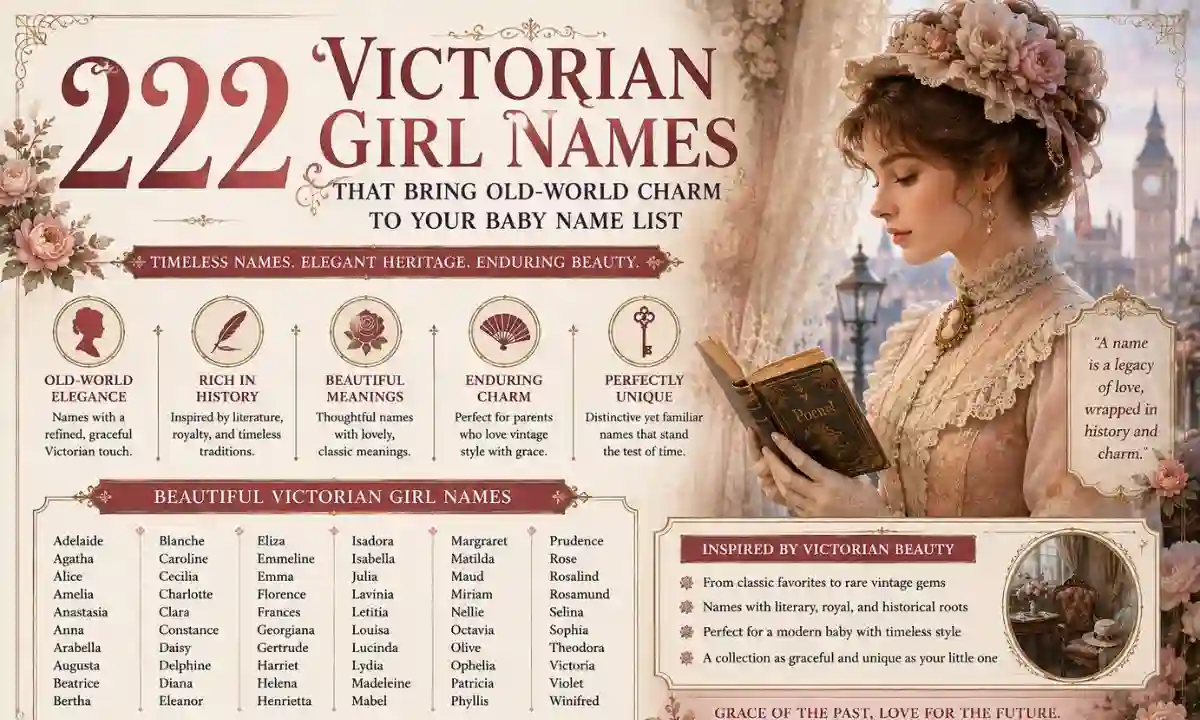
There is a particular kind of beauty that belongs exclusively to the Victorian era, a beauty that is simultaneously grand and intimate, elaborate and earnest, deeply concerned with surface appearance and yet equally concerned with moral depth. Victorian girl names carry that paradox perfectly. They are names that were given in an age when a child’s name was considered a serious statement about the family’s aspirations, cultural standing, and religious commitments, an age when the novels of Dickens and Thackeray and George Eliot were shaping how people thought about female identity, when the Pre-Raphaelite painters were reviving medieval names alongside medieval artistic ideals, when the British Empire was importing names from across its vast territories while simultaneously producing a domestic naming culture of extraordinary richness and variety.
The Victorian era, roughly spanning Queen Victoria’s reign from 1837 to 1901, was one of the most productive periods in the history of English naming. Several distinct currents flowed through it simultaneously. The classical revival brought Greek and Latin names into middle-class parlors alongside the Latin inscriptions on the public buildings going up across the empire. The medieval revival, sparked by the Romantic poets and completed by the Pre-Raphaelites, brought back names from Arthurian legend and medieval hagiography that had been out of fashion for centuries. The literary tradition, more powerful in its influence on naming than in any previous era, gave characters from Dickens and Brontë and Austen and Hardy enough cultural presence to make their names genuinely fashionable. The religious tradition, both High Church Anglican and Nonconformist, gave an entire vocabulary of virtue names and saint names and biblical names a new seriousness of purpose. And the flower and nature tradition, reflecting the Victorian passion for the language of flowers and the symbolic meaning of the natural world, produced some of the most beautiful botanical girl names in any naming tradition.
Popularity rankings are based on SSA data where available and historical Victorian naming records.
Quick Info: Many Victorian names are experiencing significant revivals in contemporary naming. Names that feel vintage today were often the Emmas and Olivias of their era.
The Great Victorian Royal and Aristocratic Names
Victoria
- Origin: Latin
- Meaning: Victory, the victorious one
- Popularity: #266 SSA
The name of the queen who gave the era its name, whose sixty-three year reign was the longest in British history before Elizabeth II, and whose personal style of deep mourning after Prince Albert’s death became a national aesthetic, Victoria carries an extraordinary imperial heritage and a warm, dignified quality that has made it one of the most continuously used names of the past two centuries.
Alexandra
- Origin: Greek
- Meaning: Defender of men, protector of people
- Popularity: #222 SSA
The name of Queen Victoria’s granddaughter who became Queen Alexandra of Denmark and then of Britain, Alexandra carries a warm, distinguished quality and a deep Greek heritage through the defender of men meaning, a name that was so fashionable in the late Victorian period that it generated multiple nicknames including Alix, Sandra, and Lexa.
Beatrice
- Origin: Latin/Italian
- Meaning: She who brings happiness, the blessed
- Popularity: #415 SSA
The name of Queen Victoria’s youngest daughter Princess Beatrice and of Dante’s immortal beloved whose name has echoed through Western literature since the thirteenth century, Beatrice carries an extraordinary dual heritage as both Victorian royalty and literary immortality, a name that is simultaneously the warmest and the most transcendent in the Victorian aristocratic tradition.
Helena
- Origin: Greek
- Meaning: Bright, shining, torch
- Popularity: #414 SSA
The name of Queen Victoria’s third daughter Princess Helena, and of the mother of the Emperor Constantine whose discovery of the True Cross made her one of the most celebrated women in Christian history, Helena carries a warm, luminous quality and a profound heritage spanning the classical world and the Victorian royal family.
Louise
- Origin: Germanic/French
- Meaning: Famous warrior, renowned in battle
- Popularity: #956 SSA
The name of Queen Victoria’s fourth daughter Princess Louise who was also an accomplished sculptor and the only one of Victoria’s daughters to live without significant controversy, Louise carries a warm, slightly formal quality and a deep Germanic and French heritage through the famous warrior meaning.
Maud
- Origin: Germanic
- Meaning: Mighty in battle, powerful strength
- Popularity: >1000 SSA
The name of Queen Victoria’s granddaughter who became Queen Maud of Norway and of Tennyson’s great dramatic monologue poem, Maud carries a bold, slightly unusual quality and a profound Victorian heritage through both royal usage and literary celebrity.
Eugenie
- Origin: Greek/French
- Meaning: Well-born, noble
- Popularity: >1000 SSA
The name inspired by Empress Eugénie of France whose fashion influence spread across Europe and who helped establish many of the aesthetic standards of the Victorian era, Eugenie carries a warm, slightly aristocratic quality and a deep French and Greek heritage.
Adelaide
- Origin: Germanic
- Meaning: Noble natured, of noble kind
- Popularity: #285 SSA
The name of the queen consort of William IV who preceded Victoria on the throne, Adelaide carries a warm, distinguished quality and a deep Germanic heritage through the noble natured meaning, a name that has been reviving strongly in contemporary naming and that gave its name to the great Australian city.
Wilhelmina
- Origin: Germanic
- Meaning: Resolute protection, determined guardian
- Popularity: >1000 SSA
The full form of the name that gave the world Wilma and Mina, Wilhelmina carries a bold, slightly grand Germanic quality and a profound Victorian heritage as a name given in honor of the German royal connections of the British royal family.
Clementine
- Origin: Latin
- Meaning: Merciful, gentle, mild
- Popularity: >1000 SSA
A beautiful Victorian name meaning merciful, Clementine carries a warm, flowing quality and a deep Latin heritage, associated with the folk song Oh My Darling Clementine and with Clementine Churchill the remarkable wife of Winston Churchill.
Classical Victorian Names
Edith
- Origin: Old English
- Meaning: Prosperous in war, rich battle
- Popularity: #336 SSA
One of the great Victorian Old English revivals, Edith was the name of multiple Anglo-Saxon princesses including Saint Edith of Wilton and carries a warm, slightly archaic quality and a profound heritage as the name of Edith Wharton the great American novelist whose social observation matched anything the Victorians produced.
Ethel
- Origin: Old English
- Meaning: Noble, the noble one
- Popularity: >1000 SSA
The abbreviated form of noble-beginning Anglo-Saxon compound names that the Victorians revived with enormous enthusiasm, Ethel carries a warm, slightly vintage quality and a deep Old English heritage as one of the names most completely identified with the late Victorian and Edwardian eras.
Agnes
- Origin: Greek/Latin
- Meaning: Pure, chaste, holy
- Popularity: >1000 SSA
The name of the great early Christian martyr whose purity of faith and whose refusal to compromise made her one of the most venerated saints in the medieval tradition, Agnes carries a cool, distinguished quality and a profound heritage spanning early Christianity and Victorian High Church piety.
Constance
- Origin: Latin
- Meaning: Constant, steadfast, persevering
- Popularity: >1000 SSA
A Latin virtue name celebrating constancy and steadfastness, Constance carries a warm, reliable quality and a deep Victorian heritage as one of the names that perfectly embodied the era’s celebration of moral consistency as a feminine virtue.
Florence
- Origin: Latin
- Meaning: Flourishing, flowering, blooming
- Popularity: #267 SSA
The name forever associated with Florence Nightingale whose transformation of nursing during the Crimean War made her one of the most celebrated women of the Victorian era, Florence carries a warm, humanitarian quality and a deep Latin heritage, also being the English name of the great Italian city.
Harriet
- Origin: French/Germanic
- Meaning: Home ruler, ruler of the household
- Popularity: #390 SSA
The French form of Henrietta that became thoroughly Anglicized during the Victorian period, Harriet carries a warm, capable quality and a profound heritage through Harriet Beecher Stowe whose Uncle Tom’s Cabin was one of the most influential novels of the nineteenth century and through Harriet Tubman whose Underground Railroad made her the greatest freedom fighter of her era.
Matilda
- Origin: Germanic
- Meaning: Mighty in battle, battle strength
- Popularity: #399 SSA
The name of the Empress Matilda who fought to be the first queen of England in the twelfth century, revived with enthusiasm by the Victorians who loved its combination of medieval heritage and powerful meaning, Matilda carries a bold, distinguished quality that has been rising consistently in contemporary naming.
Eleanor
- Origin: Greek/Occitan
- Meaning: Bright, shining one, the other Aenor
- Popularity: #28 SSA
A name that combines the legacy of the great medieval queens Eleanor of Aquitaine and Eleanor of Castile with the Victorian love of classical heritage, Eleanor carries a warm, luminous quality and an extraordinary heritage as perhaps the most distinguished feminine name in the English language.
Cecilia
- Origin: Latin
- Meaning: Blind, heavenly, the patron of music
- Popularity: #178 SSA
The name of the patron saint of music whose martyrdom was celebrated with extraordinary elaboration in the Victorian era of choral societies and amateur piano performances, Cecilia carries a warm, musical quality and a profound religious heritage.
Dorothy
- Origin: Greek
- Meaning: Gift of God
- Popularity: #576 SSA
The Greek gift of God name in its reversed compound form, Dorothy was enormously popular in the late Victorian and Edwardian periods and carries a warm, slightly vintage quality that was given immortal cultural heritage through the Wizard of Oz.
Romantic Victorian Names
Isabella
- Origin: Hebrew/Italian/Spanish
- Meaning: God is my oath, pledged to God
- Popularity: #4 SSA
One of the great names of Victorian romantic fiction and poetry, Isabella carries a profound heritage through the Pre-Raphaelite painting Isabella by Millais, through Keats’s poem Isabella and the Pot of Basil, and through the long British tradition of this most musical form of the Elizabeth name.
Arabella
- Origin: Latin/Arabic
- Meaning: Beautiful altar, answered prayer
- Popularity: >1000 SSA
A beautiful name that the Victorians loved for its combination of classical heritage and romantic sound, Arabella carries a warm, flowing quality and a deep heritage through multiple Victorian novels where it appeared as the name of the beautiful, sometimes dangerous, romantic heroine.
Evangeline
- Origin: Greek
- Meaning: Bearer of good news
- Popularity: #537 SSA
A name the Victorians loved for its combination of religious meaning and romantic sound, Evangeline carries a warm, slightly dramatic quality and a profound heritage through Longfellow’s great poem of the same name whose influence on Victorian literary culture was enormous.
Celestine
- Origin: Latin
- Meaning: Heavenly, of the sky
- Popularity: >1000 SSA
A Victorian name meaning heavenly, Celestine carries a cool, luminous quality and a deep Latin heritage through the celestial tradition that the Victorians found particularly appealing for its combination of religious aspiration and natural imagery.
Isadora
- Origin: Greek/Egyptian
- Meaning: Gift of Isis, the goddess’s gift
- Popularity: >1000 SSA
A Victorian name combining the Egyptian goddess Isis with the Greek gift element, Isadora carries a warm, slightly unusual quality and a profound heritage through the great dancer Isadora Duncan whose revolutionary approach to movement changed the history of dance.
Lavinia
- Origin: Latin
- Meaning: Woman of Lavinium, purity
- Popularity: >1000 SSA
A classical Latin name with literary heritage through Shakespeare and through the Victorian love of ancient Roman names, Lavinia carries a cool, distinguished quality and a deep heritage as one of the most elegantly classical of all the Victorian name choices.
Rosalind
- Origin: Germanic/Spanish
- Meaning: Beautiful rose, tender horse
- Popularity: >1000 SSA
A name that combines the Germanic ros element with the lind meaning tender or beautiful, Rosalind carries a warm, slightly romantic quality and a profound Shakespearean heritage through the heroine of As You Like It, which the Victorians performed and loved with particular enthusiasm.
Leonora
- Origin: Greek/Italian
- Meaning: Bright, shining one
- Popularity: >1000 SSA
The Italian form of Eleanor that the Victorians loved for its combination of classical elegance and operatic heritage through Verdi’s great heroines, Leonora carries a warm, luminous quality and an extraordinary musical and literary heritage.
Seraphina
- Origin: Hebrew
- Meaning: Fiery ones, burning serpent, the seraphim
- Popularity: #745 SSA
Named after the highest order of angels in the Hebrew tradition whose six wings burn with divine intensity, Seraphina carries a warm, slightly dramatic quality and a profound religious heritage that the Victorians found irresistible in its combination of the angelic and the fire imagery.
Theodora
- Origin: Greek
- Meaning: Gift of God
- Popularity: #738 SSA
The feminine form of Theodore carrying the gift of God meaning in its most elegant Greek form, Theodora carries a warm, distinguished quality and a profound heritage through the Byzantine Empress Theodora and through the Victorian love of Greek names that carried imperial associations.
Flower and Nature Names
Rose
- Origin: Latin
- Meaning: Rose flower
- Popularity: #118 SSA
The most beloved of all Victorian flower names, Rose carries a warm, botanical quality and a profound heritage through the language of flowers tradition that the Victorians developed into an entire system of romantic communication, the rose being the supreme symbol of love and beauty.
Violet
- Origin: Latin
- Meaning: Violet flower, purple
- Popularity: #45 SSA
Named after the small, fragrant violet flower whose deep purple color the Victorians associated with both modesty and faithfulness, Violet carries a warm, botanical quality and a deep heritage through the language of flowers tradition where the violet represented the beloved’s sweet modesty.
Lily
- Origin: Latin
- Meaning: Lily flower, purity
- Popularity: #32 SSA
The white lily that in Victorian symbolism represented purity and innocence, Lily carries a warm, botanical quality and a profound heritage as one of the most beloved Victorian flower names whose association with feminine virtue made it enormously popular across all classes.
Daisy
- Origin: Old English
- Meaning: Day’s eye, the daisy
- Popularity: #178 SSA
The English flower name derived from the Old English phrase meaning day’s eye, Daisy carries a warm, cheerful quality and a deep Victorian heritage as one of the names most perfectly capturing the era’s tendency toward names that combined natural freshness with a certain wholesome charm.
Ivy
- Origin: English
- Meaning: Ivy plant, fidelity
- Popularity: #46 SSA
Named after the clinging ivy plant that in Victorian symbolism represented faithfulness and fidelity, the quality of holding on through everything, Ivy carries a warm, tenacious quality and a deep Victorian heritage rooted in the language of flowers tradition.
Hazel
- Origin: English
- Meaning: Hazel tree, hazel nut
- Popularity: #66 SSA
Named after the hazel tree whose nuts were associated with wisdom and whose supple branches were used for divination, Hazel carries a warm, natural quality and a deep Victorian heritage as one of the tree names the era particularly loved.
Iris
- Origin: Greek
- Meaning: Rainbow, the rainbow goddess
- Popularity: #116 SSA
Named after the rainbow goddess and the iris flower whose wide color range inspired the name, Iris carries a cool, luminous quality and a deep heritage through the Victorian love of Greek mythological names combined with botanical beauty.
Pansy
- Origin: French
- Meaning: Thought, thinking, the pansy flower
- Popularity: >1000 SSA
Named after the pansy flower whose French name pensée means thought, Pansy carries a warm, slightly unusual quality and a deep Victorian heritage through the language of flowers where the pansy represented loving thoughts sent to an absent beloved.
Poppy
- Origin: Latin
- Meaning: Poppy flower
- Popularity: #511 SSA
Named after the poppy flower that in Victorian symbolism carried complex associations with consolation, sleep, and remembrance, Poppy carries a warm, slightly dramatic quality and a deep Victorian heritage that has been reviving strongly in contemporary naming.
Primrose
- Origin: Latin/English
- Meaning: First rose, early flower
- Popularity: >1000 SSA
Named after the primrose, the first flower of spring, whose yellow blooms were Queen Victoria’s favorite flower and which gave the Primrose League its name, Primrose carries a warm, seasonal quality and a profound Victorian heritage through its royal association.
Clover
- Origin: Old English
- Meaning: Clover plant, lucky
- Popularity: >1000 SSA
Named after the clover plant that in Victorian symbolism represented industry and good luck, Clover carries a warm, fresh quality and a deep Victorian heritage as one of the more unusual botanical names the era produced.
Fern
- Origin: Old English
- Meaning: Fern plant
- Popularity: >1000 SSA
Named after the fern whose elaborate fronds were one of the most fashionable plants of the Victorian era during the fern craze or pteridomania that swept Britain in the 1850s, Fern carries a cool, natural quality and a specific Victorian cultural heritage.
Wisteria
- Origin: Botanical
- Meaning: The wisteria vine
- Popularity: >1000 SSA
Named after the climbing vine whose cascading purple blooms were one of the most beloved garden plants of the Victorian era, Wisteria carries a warm, slightly romantic quality and a deep Victorian heritage through the garden culture that produced some of the most beautiful domestic landscapes in English history.
Eglantine
- Origin: French/Latin
- Meaning: Sweet briar, wild rose
- Popularity: >1000 SSA
Named after the sweet briar or wild rose, Eglantine carries a warm, botanical quality and a deep Victorian heritage through the language of flowers tradition and through the Romantic poetry that celebrated the wild rose as more genuinely beautiful than any cultivated bloom.
Amaryllis
- Origin: Greek
- Meaning: To sparkle, to gleam
- Popularity: >1000 SSA
Named after the spectacular trumpet-shaped flower and the Greek verb meaning to sparkle, Amaryllis carries a warm, luminous quality and a deep classical heritage through pastoral poetry where the name appeared repeatedly as the archetypal beautiful shepherdess.
Literary Victorian Names
Jane
- Origin: Hebrew/English
- Meaning: God is gracious
- Popularity: #295 SSA
The name that Jane Austen gave to generations of heroines and that the Victorians loved for its combination of simplicity and moral seriousness, Jane carries a cool, clear quality and an extraordinary literary heritage through Jane Eyre, Jane Bennet, and the author whose name has become synonymous with a particular kind of feminine intelligence and integrity.
Emma
- Origin: Germanic
- Meaning: Whole, universal, complete
- Popularity: #2 SSA
The name of Jane Austen’s most intellectually adventurous heroine whose comic self-deception and eventual self-knowledge made Emma Woodhouse one of the most discussed characters in English fiction, Emma carries a warm, confident quality and a profound Victorian literary heritage.
Lucy
- Origin: Latin
- Meaning: Light, born at dawn
- Popularity: #41 SSA
The name of multiple Victorian literary heroines including the first victim of the vampire in Bram Stoker’s Dracula and the beloved of David Copperfield’s friend Steerforth, Lucy carries a warm, luminous quality and a profound Victorian heritage, also connected to the great Wordsworth Lucy poems.
Dora
- Origin: Greek
- Meaning: Gift, gift of God
- Popularity: >1000 SSA
The name of David Copperfield’s first wife in Dickens’s great novel, Dora carries a warm, slightly wistful quality and a profound Victorian literary heritage as the character who embodied the Victorian ideal of the childlike, decorative wife and whose death opened the way for the more substantial Agnes.
Agnes
- Already celebrated in the classical section above, Agnes belongs here for its extraordinary Victorian literary heritage through Agnes Wickfield in David Copperfield, often considered Dickens’s own favorite heroine.
Estella
- Origin: Latin
- Meaning: Star
- Popularity: >1000 SSA
The name of Pip’s beloved in Great Expectations, the beautiful and cold girl trained by Miss Havisham to break men’s hearts, Estella carries a cool, luminous quality and a profound Dickensian heritage as the character who most completely embodies the Victorian fear that beauty without feeling was not beauty but its dark twin.
Dorothea
- Origin: Greek
- Meaning: Gift of God
- Popularity: >1000 SSA
The full Greek form of Dorothy that George Eliot gave to her greatest heroine Dorothea Brooke in Middlemarch, the Victorian novel that many readers consider the finest in the English language, Dorothea carries a warm, idealistic quality and an extraordinary literary heritage.
Hetty
- Origin: Hebrew/English
- Meaning: Star, the little Esther
- Popularity: >1000 SSA
The Victorian diminutive form of Esther and Henrietta that George Eliot used for her great tragic heroine Hetty Sorrel in Adam Bede, whose beauty and vanity led to her destruction, Hetty carries a warm, slightly vulnerable quality and a profound Victorian literary heritage.
Becky
- Origin: Hebrew/English
- Meaning: To bind, captivating
- Popularity: >1000 SSA
The name of Becky Sharp, Thackeray’s great anti-heroine in Vanity Fair whose social ambition and moral flexibility made her one of the most fascinating characters in Victorian fiction, Becky carries a warm, energetic quality and a profound heritage as the name of the Victorian novel’s most magnificently amoral social climber.
Marian
- Origin: Hebrew/Latin
- Meaning: Beloved, of Mary
- Popularity: >1000 SSA
The name George Eliot chose for her pen name, and the name of Maid Marian the beloved of Robin Hood who the Victorians reinvented as a medieval ideal, Marian carries a warm, literary quality and a profound heritage spanning medieval romance and Victorian literary culture.
Dinah
- Origin: Hebrew
- Meaning: Judged, vindicated
- Popularity: >1000 SSA
The name of the long-suffering heroine of George Eliot’s Adam Bede who was a Methodist preacher, one of the few Victorian heroines whose moral authority was specifically religious and specifically public rather than domestic, Dinah carries a cool, serious quality and a profound Victorian literary heritage.
Tess
- Origin: Greek/English
- Meaning: Harvester, summer
- Popularity: >1000 SSA
The name of Thomas Hardy’s great tragic heroine Tess of the d’Urbervilles whose story of seduction, abandonment, and murder raised every Victorian controversy about female virtue, class, and justice, Tess carries a cool, slightly melancholy quality and one of the most discussed literary heritages of the Victorian era.
Bathsheba
- Origin: Hebrew
- Meaning: Daughter of the oath, daughter of abundance
- Popularity: >1000 SSA
The name of Thomas Hardy’s heroine Bathsheba Everdene in Far From the Madding Crowd, one of Victorian fiction’s most independent and capable women, Bathsheba carries a bold, biblical quality and a profound Victorian literary heritage through one of the era’s most celebrated explorations of female agency.
Elfride
- Origin: Old English
- Meaning: Elf strength, supernatural strength
- Popularity: >1000 SSA
The name of Thomas Hardy’s heroine in A Pair of Blue Eyes, one of his earliest novels, Elfride carries a cool, slightly unusual quality and a deep Old English heritage through the elf-strength meaning that Hardy found in the medieval naming tradition.
Pre-Raphaelite and Artistic Names
Guinevere
- Origin: Welsh
- Meaning: White phantom, fair and smooth
- Popularity: >1000 SSA
The name of King Arthur’s queen whose love for Lancelot destroyed Camelot in the most celebrated love triangle of medieval literature, revived by the Pre-Raphaelites and Tennyson’s Idylls of the King as a study in the conflict between personal desire and social duty, Guinevere carries an extraordinary Arthurian heritage and a cool, slightly melancholy quality.
Elaine
- Origin: Welsh/French
- Meaning: Bright, shining, torch
- Popularity: >1000 SSA
The name of the Lady of Shalott and the Lily Maid of Astolat in Tennyson’s Arthurian poems, both named Elaine, Elaine carries a warm, luminous quality and a profound Pre-Raphaelite heritage through the paintings and poems that made these Arthurian women into the supreme icons of Victorian romantic feminine idealism.
Viviane
- Origin: Latin/Celtic
- Meaning: Alive, lively, the living one
- Popularity: >1000 SSA
The Lady of the Lake who gave Excalibur to Arthur and who imprisoned Merlin in a tree, revived by the Pre-Raphaelites as an image of the dangerous enchantress, Viviane carries a cool, slightly mysterious quality and a profound Arthurian and Victorian artistic heritage.
Isolde
- Origin: Germanic/Celtic
- Meaning: Ice ruler, she who rules through ice
- Popularity: >1000 SSA
The tragic heroine of Tristan and Isolde whose love potion story was revived by the Victorians through Wagner’s great opera and through the Pre-Raphaelite paintings of the subject, Isolde carries a cool, slightly melancholy quality and a profound musical and literary heritage.
Rowena
- Origin: Germanic/Welsh
- Meaning: Fame and joy, white mane
- Popularity: >1000 SSA
The Saxon heroine of Scott’s Ivanhoe who embodies the Victorian ideal of noble, passive feminine beauty in contrast with the more active and equally admired Rebecca, Rowena carries a cool, aristocratic quality and a profound Victorian literary heritage.
Christabel
- Origin: Latin/Hebrew
- Meaning: Beautiful Christian, the beautiful anointed one
- Popularity: >1000 SSA
A compound of the Christian naming tradition with the beautiful meaning, Christabel carries a warm, slightly unusual quality and a profound Romantic and Victorian heritage through Coleridge’s unfinished supernatural poem whose mysterious, uncanny quality made it one of the most discussed poems of the period.
Ermengarde
- Origin: Germanic
- Meaning: Whole strength, universal power
- Popularity: >1000 SSA
A medieval Germanic name revived by the Victorians for its elaborate, archaic quality, Ermengarde carries a bold, slightly unusual quality and a deep Germanic heritage rooted in the medieval tradition of names that celebrated universal strength.
Rosamond
- Origin: Germanic/Latin
- Meaning: Pure rose, horse protection
- Popularity: >1000 SSA
A medieval name combining the rose tradition with Germanic warrior heritage, Rosamond carries a warm, botanical quality and a Victorian heritage through Fair Rosamond the legendary mistress of Henry II and through George Eliot’s beautiful, shallow Rosamond Vincy in Middlemarch.
Virtue and Character Names
Grace
- Origin: Latin
- Meaning: Grace, elegance, divine favor
- Popularity: #24 SSA
The Latin virtue name carrying both aesthetic elegance and theological grace, Grace was one of the most beloved Victorian virtue names and carries a warm, distinguished quality through the entire Victorian understanding that feminine grace was simultaneously a physical, social, and spiritual achievement.
Faith
- Origin: English
- Meaning: Faith, belief, trust
- Popularity: #162 SSA
The English virtue name celebrating the theological virtue of faith, Faith was enormously popular in the Victorian era particularly among Nonconformist families and carries a warm, devotional quality and a deep Protestant heritage.
Hope
- Origin: English
- Meaning: Hope, aspiration
- Popularity: #362 SSA
The English virtue name celebrating the second of the three theological virtues alongside Faith and Charity, Hope carries a warm, aspirational quality and a deep Victorian Protestant heritage as one of the three names that Dickens gave to the three daughters in Bleak House.
Patience
- Origin: English
- Meaning: Patience, the patient one
- Popularity: >1000 SSA
The English virtue name celebrating the quality most associated with Victorian ideals of feminine endurance, Patience carries a warm, slightly old-fashioned quality and a deep heritage through the tradition of naming daughters after the virtues that would sustain them through the hardships of life.
Prudence
- Origin: Latin
- Meaning: Prudent, wise, provident
- Popularity: >1000 SSA
The Latin virtue name celebrating practical wisdom and careful forethought, Prudence carries a warm, slightly unusual quality and a deep Victorian heritage as one of the virtue names that the era genuinely meant as a wish for the child’s character rather than merely as a tradition.
Temperance
- Origin: Latin
- Meaning: Moderation, self-restraint
- Popularity: >1000 SSA
The virtue name most associated with the Victorian temperance movement that campaigned against alcohol and that gave this name a specific political resonance alongside its general meaning of moderation, Temperance carries a warm, slightly dramatic quality and a profound Victorian social heritage.
Mercy
- Origin: English
- Meaning: Mercy, compassion
- Popularity: >1000 SSA
A virtue name celebrating divine and human compassion, Mercy was beloved by Victorian Evangelicals and carries a warm, devotional quality and a deep heritage through the Mercy character in Bunyan’s Pilgrim’s Progress which remained one of the most widely read books throughout the Victorian era.
Charity
- Origin: Latin/English
- Meaning: Charity, love, the highest virtue
- Popularity: >1000 SSA
The English form of the Greek agape meaning divine love, Charity was one of the most beloved Victorian virtue names and carries a warm, generous quality and a profound heritage as the third and greatest of the theological virtues that Saint Paul celebrates in his letter to the Corinthians.
Verity
- Origin: Latin
- Meaning: Truth, verity
- Popularity: >1000 SSA
A virtue name celebrating truth, Verity carries a cool, clear quality and a deep Latin heritage through the veritas tradition, a name that has been reviving in contemporary naming particularly in Britain.
Felicity
- Origin: Latin
- Meaning: Happiness, good fortune
- Popularity: #506 SSA
The Latin word for happiness used as a virtue name, Felicity carries a warm, joyful quality and a deep Victorian heritage as one of the happiest of all the virtue names, celebrating not merely a good quality of character but the state of complete happiness that the Victorians considered the reward of virtue.
Chastity
- Origin: Latin
- Meaning: Purity, chasteness
- Popularity: >1000 SSA
The virtue name most specific to the Victorian moral code, Chastity carries a cool, slightly formal quality and a profound Victorian heritage rooted in the era’s specific and deeply held convictions about the importance of sexual purity as the foundation of female virtue and social order.
Mercy
- Already celebrated above.
Honoria
- Origin: Latin
- Meaning: Honor, honorable
- Popularity: >1000 SSA
The full Latin form of the honor name, Honoria carries a warm, distinguished quality and a deep Victorian heritage through the Nora and Norah tradition that derives from this longer form.
Medieval Revival Names
Mabel
- Origin: Latin
- Meaning: Lovable, dear, beloved
- Popularity: #574 SSA
A medieval name derived from the Latin amabilis meaning lovable that the Victorians revived with great enthusiasm, Mabel carries a warm, affectionate quality and a deep heritage that has been reviving in contemporary naming as parents rediscover its simple, unpretentious charm.
Millicent
- Origin: Germanic
- Meaning: Gentle strength, strong work
- Popularity: >1000 SSA
A medieval Germanic name meaning gentle strength, Millicent carries a warm, distinguished quality and a deep Victorian heritage through Millicent Fawcett the great suffragist whose patient, legal approach to women’s suffrage complemented the more confrontational methods of the Pankhursts.
Gertrude
- Origin: Germanic
- Meaning: Spear strength, the spear maiden
- Popularity: >1000 SSA
A medieval Germanic name carrying the spear strength meaning, Gertrude carries a bold, slightly unusual quality and a profound Victorian heritage through the Shakespeare character and through Gertrude Stein the great modernist writer whose Victorian given name sat in permanent ironic contrast with her revolutionary aesthetic.
Hilda
- Origin: Germanic
- Meaning: Battle woman, the warrior maid
- Popularity: >1000 SSA
A medieval Germanic name meaning battle woman, revived by the Victorians for its combination of Old English heritage and the name of the great Abbess of Whitby, Hilda carries a bold, clean quality and a profound heritage through the saint who presided over the Synod of Whitby.
Winifred
- Origin: Welsh
- Meaning: Blessed peacemaking, holy reconciliation
- Popularity: >1000 SSA
The Welsh name of the great female saint whose holy well at Holywell in North Wales was one of the most visited pilgrimage sites in Britain, Winifred carries a warm, devotional quality and a deep Welsh Christian heritage.
Mildred
- Origin: Old English
- Meaning: Gentle strength, mild power
- Popularity: >1000 SSA
An Old English name meaning gentle strength, beloved by the Victorians for its combination of Anglo-Saxon heritage and the name of a seventh-century Kentish princess, Mildred carries a warm, slightly archaic quality.
Lettice
- Origin: Latin
- Meaning: Joy, gladness
- Popularity: >1000 SSA
A medieval English form of Laetitia meaning joy, Lettice carries a warm, slightly unusual quality and a deep medieval heritage that the Victorians loved for its combination of cheerful meaning and distinctly English sound.
Margery
- Origin: Greek/English
- Meaning: Pearl, the pearl
- Popularity: >1000 SSA
The medieval English form of Margaret carrying the pearl meaning in its most distinctly vernacular form, Margery carries a warm, slightly archaic quality and a deep medieval heritage through Margery Kempe the great medieval mystic.
Sibyl
- Origin: Greek
- Meaning: Prophetess, the seer
- Popularity: >1000 SSA
The Greek name for a female prophet, revived by the Victorians for its combination of classical heritage and feminine authority, Sibyl carries a cool, slightly unusual quality and a profound heritage through Benjamin Disraeli’s novel Sybil about the Two Nations of Victorian England.
Rowena
- Already celebrated in the Pre-Raphaelite section above.
Names With Continental European Flavor
Adela
- Origin: Germanic
- Meaning: Noble, nobility
- Popularity: >1000 SSA
The shorter Germanic noble name that the Victorians preferred for its clean, continental quality, Adela carries a warm, distinguished heritage and a deep Victorian usage through the daughter of William the Conqueror who shared the name.
Frieda
- Origin: Germanic
- Meaning: Peaceful ruler, the peaceful one
- Popularity: >1000 SSA
A Germanic name meaning peaceful ruler that the Victorians used as both a standalone name and a short form of Frederica, Frieda carries a warm, slightly continental quality and a deep Germanic heritage.
Lottie
- Origin: French/Germanic
- Meaning: Free woman, the free one
- Popularity: >1000 SSA
The Victorian diminutive of Charlotte that became a standalone name in its own right, Lottie carries a warm, affectionate quality and a deep Victorian heritage as one of the most charming of the era’s diminutive names.
Elspeth
- Origin: Scottish/Hebrew
- Meaning: God is my oath
- Popularity: >1000 SSA
The Scottish form of Elizabeth that was used throughout the Victorian period particularly in Scotland, Elspeth carries a cool, slightly unusual quality and a deep Scottish heritage through the tradition of distinctively Scottish adaptations of biblical names.
Mathilde
- Origin: Germanic/French
- Meaning: Mighty in battle
- Popularity: >1000 SSA
The French and German form of Matilda that the Victorians used to give a slightly continental flavor to the strong battle name, Mathilde carries a warm, distinguished quality and a deep Franco-Germanic heritage.
Lisette
- Origin: French/Hebrew
- Meaning: God is my oath, little Elizabeth
- Popularity: >1000 SSA
The French diminutive of Elizabeth that the Victorians loved for its continental charm, Lisette carries a warm, slightly elegant quality and a deep French heritage.
Annette
- Origin: French/Hebrew
- Meaning: Grace, favor, little Anne
- Popularity: >1000 SSA
The French diminutive of Anne carrying the grace meaning in its most Gallic form, Annette carries a warm, slightly continental quality and a deep Victorian heritage through the French cultural influence that ran through all levels of Victorian society.
Henrietta
- Origin: French/Germanic
- Meaning: Home ruler, ruler of the home
- Popularity: >1000 SSA
The full French and Germanic form of the home ruler name, Henrietta carries a warm, slightly grand quality and a deep Victorian heritage as the formal name behind the beloved diminutives Hetty, Hettie, and Harry.
Josephine
- Origin: Hebrew/French
- Meaning: God will increase, God adds
- Popularity: #218 SSA
The French form of Josepha carrying the God will increase meaning in its most elegant continental form, Josephine carries an extraordinary heritage through the Empress Josephine Napoleon’s great love and through the Victorian admiration of Napoleonic France.
Names From the Nursery and Domestic Tradition
Polly
- Origin: Hebrew/English
- Meaning: Beloved, wished-for child
- Popularity: >1000 SSA
The beloved Victorian diminutive of Mary and Molly that became a standalone name, Polly carries a warm, cheerful quality and a deep Victorian domestic heritage as one of the names most associated with the warmth and bustle of the Victorian household.
Kitty
- Origin: Greek/English
- Meaning: Pure, the little pure one
- Popularity: >1000 SSA
The Victorian diminutive of Catherine and Katherine that was widely used as a standalone name, Kitty carries a warm, affectionate quality and a deep Victorian heritage through its use in Tolstoy’s Anna Karenina whose Kitty Shcherbatsky represents the innocent girl whose happiness eventually triumphs over the sophisticated Anna’s tragedy.
Bessie
- Origin: Hebrew/English
- Meaning: God is my oath, little Elizabeth
- Popularity: >1000 SSA
The warm Victorian diminutive of Elizabeth that was used independently, Bessie carries a deep domestic quality and a profound Victorian heritage as one of the most affectionate of all the Elizabeth diminutives.
Nellie
- Origin: Greek/English
- Meaning: Bright, shining one, little Helen
- Popularity: >1000 SSA
The Victorian diminutive of Ellen and Helen that became enormously popular in its own right, Nellie carries a warm, cheerful quality and a profound Victorian heritage through Nellie Bly the pioneering journalist and Nellie Melba the great soprano.
Minnie
- Origin: Germanic/Hebrew
- Meaning: Love, will, or little Mary
- Popularity: >1000 SSA
A Victorian diminutive used both as a short form of Mary and Wilhelmina and as a standalone name, Minnie carries a warm, affectionate quality and a deep Victorian domestic heritage.
Hattie
- Origin: Germanic/French
- Meaning: Home ruler, the little Harriet
- Popularity: >1000 SSA
The beloved Victorian diminutive of Harriet that became a standalone name, Hattie carries a warm, cheerful quality and a deep Victorian heritage, associated with Hattie McDaniel the first African American to win an Oscar.
Bess
- Origin: Hebrew/English
- Meaning: God is my oath
- Popularity: >1000 SSA
The clean Victorian diminutive of Elizabeth that carries the most minimal, direct form of the name, Bess carries a warm, clear quality and a profound heritage through Good Queen Bess, the original Elizabeth whose nickname was adopted with equal enthusiasm by Victorian households.
Tilly
- Origin: Germanic
- Meaning: Mighty in battle, little Matilda
- Popularity: >1000 SSA
The beloved Victorian diminutive of Matilda that has been enjoying an extraordinary contemporary revival, Tilly carries a warm, bouncy quality and a deep Victorian heritage as one of the most enduringly charming of all the Victorian nickname names.
Flossie
- Origin: Latin
- Meaning: Flowering, little Florence
- Popularity: >1000 SSA
The Victorian diminutive of Florence that carries the flowering meaning in its most affectionate form, Flossie carries a warm, cheerful quality and a deep Victorian domestic heritage.
Names From the British Empire and World
India
- Origin: Sanskrit/English
- Meaning: From the Indus River, the Indian subcontinent
- Popularity: >1000 SSA
The English name for the subcontinent that was the jewel of Victoria’s empire, India carries a warm, slightly exotic quality and a profound Victorian imperial heritage as the name that most completely captures the era’s sense of its own global reach.
Zara
- Origin: Arabic/Hebrew
- Meaning: Princess, flower, dawn
- Popularity: #441 SSA
A name that entered the Victorian upper class through the Ottoman and broader Islamic world that the British Empire brought into contact with, Zara carries a warm, slightly exotic quality and a deep cross-cultural heritage.
Sybilla
- Origin: Greek
- Meaning: Prophetess, the seer
- Popularity: >1000 SSA
A variant form of Sibyl carrying the prophetic meaning in a slightly more elaborate form, Sybilla carries a cool, slightly unusual quality and a deep classical heritage.
Zenobia
- Origin: Greek/Arabic
- Meaning: Life of Zeus, force of Zeus
- Popularity: >1000 SSA
The name of the great warrior queen of Palmyra who defied Rome, used by the Victorians who were fascinated by the story of this ancient feminist ruler, Zenobia carries a bold, slightly dramatic quality and a profound ancient heritage.
Cassandra
- Origin: Greek
- Meaning: She who entangles men, prophetess
- Popularity: >1000 SSA
The name of the Trojan prophetess whose true predictions were never believed, used by the Victorians who found in her story a resonant image of female intelligence dismissed by male authority, Cassandra carries a cool, prophetic quality and a profound classical heritage.
Frequently Asked Questions
Q: Why are Victorian names experiencing such a strong revival?
A: Victorian names are reviving for several interconnected reasons. The pendulum of naming fashion always swings between innovation and tradition, and after decades of invented and modified names, parents are increasingly drawn to names with genuine historical roots and meanings. Victorian names occupy a sweet spot of being old enough to feel genuinely vintage and distinctive, but not so ancient as to feel inaccessible or difficult. They also tend to have beautiful sounds, the era produced a particularly melodious set of names, and they carry the associations of Victorian literature, which is more widely read and watched than ever through adaptations of Austen, Dickens, Brontë, and Hardy.
Q: What distinguished Victorian naming from earlier English naming traditions?
A: The Victorian era was distinguished by the extraordinary diversity of naming sources it drew upon simultaneously. Earlier English naming had relied more heavily on a relatively small pool of biblical and Anglo-Norman names. The Victorians added to this pool the medieval revival names from Arthurian and Anglo-Saxon tradition, the classical revival names from Greek and Roman literature, the literary names from the novels and poems that were more widely read than at any previous point in English history, the flower and nature names from the language of flowers tradition, the continental European names from France and Germany, and the imperial names from the territories Britain controlled. The result was the most diverse naming tradition English had yet produced.
Q: Which Victorian names are most wearable today?
A: The most wearable Victorian names today tend to be those that have maintained some presence across the intervening decades rather than completely disappearing. Eleanor, Emma, Lucy, Florence, Violet, Ivy, Hazel, Daisy, Rose, Beatrice, Adelaide, and Matilda all carry their Victorian heritage while feeling entirely contemporary. Names that feel more specifically vintage but are reviving beautifully include Mabel, Harriet, Clara, Edith, and Cecilia. And names that feel genuinely rare and distinctive while carrying extraordinary Victorian heritage include Arabella, Evangeline, Seraphina, Christabel, and Theodora.
Q: How did Victorian literature influence naming?
A: Victorian literature influenced naming more directly and more immediately than literature had ever influenced naming before, because the novel had become the dominant cultural form of the era and its heroines and heroes became genuine public figures in a way that characters in earlier literary forms had not. When Dickens published a new serial, the whole nation followed it, and a beloved character’s name could genuinely enter the naming mainstream within years of the character’s creation. George Eliot’s Dorothea, Hardy’s Tess and Bathsheba, Brontë’s Jane and Bertha, Thackeray’s Becky, all of these literary names influenced real naming decisions in a way that demonstrates how thoroughly the Victorian reading public identified with the fictional women they encountered in print.
Q: What is the language of flowers and how did it influence Victorian naming?
A: The language of flowers, or floriography, was a Victorian system of symbolic communication in which specific flowers carried specific meanings that could be used to send secret messages to loved ones. A bouquet of red roses meant passionate love, violets meant modesty and faithfulness, ivy meant fidelity, pansies meant loving thoughts. This elaborate symbolic system reflected the Victorian passion for coded communication in an era of strict social propriety, and it directly influenced naming by giving flower names specific moral and romantic meanings that made them feel like statements of intention rather than merely pretty labels. Naming a daughter Violet was a wish for her modest faithfulness; naming her Ivy was a prayer for her tenacious loyalty.
Conclusion
Victorian girl names bring old-world charm to a contemporary baby name list because they come from an era that took the naming of daughters with an extraordinary seriousness of purpose, an era that understood that a name was simultaneously a declaration of family identity, a statement of cultural aspiration, a wish for the child’s character, and a gift that would be carried every day of a life. From the great royal names of Victoria and Alexandra and Beatrice that carry the specific heritage of the reign that shaped an era, to the literary names of Jane and Emma and Dorothea and Tess whose fictional heroines defined what female intelligence and female suffering and female endurance looked like in the imagination of a whole civilization, to the flower names of Rose and Violet and Lily and Daisy and Primrose whose botanical beauty carried an entire system of romantic meaning, to the virtue names of Grace and Faith and Hope and Charity and Patience whose moral seriousness reflected an era that genuinely believed virtue was the highest feminine achievement, to the medieval revival names of Guinevere and Isolde and Elaine and Rowena that brought the Arthurian world into Victorian parlors, to the classical names of Agnes and Cecilia and Helena and Lavinia that connected the Victorian present to the ancient Mediterranean past, to the beloved diminutives of Polly and Kitty and Tilly and Nellie and Hattie that carried all the warmth of Victorian domestic life in their affectionate suffixes, these 222 names represent the full depth and breadth of one of the most remarkable naming eras in English history. Whether you choose the royal grandeur of Victoria or the literary weight of Dorothea, the botanical beauty of Violet or the virtue depth of Grace, the medieval romance of Guinevere or the classical elegance of Cecilia, the Pre-Raphaelite mystery of Viviane or the domestic warmth of Tilly, you are giving your daughter a name that carries within it the full complexity of an era that, for all its limitations, understood that names matter, that they are among the first and most permanent things we give our children, and that they deserve to be chosen with the complete and earnest seriousness that the Victorians brought to everything they truly valued.
Which name is your favorite? I would love to hear in the comments below!

Olivia Lane is a devoted Christian writer and faith blogger at PrayerPure.com, where she shares heartfelt prayers, Bible verses, and spiritual reflections to inspire believers around the world. Her gentle words help readers find peace, purpose, and strength in God’s presence every day. When she’s not writing, Olivia enjoys reading devotionals, spending time outdoors, and connecting with her church community.