
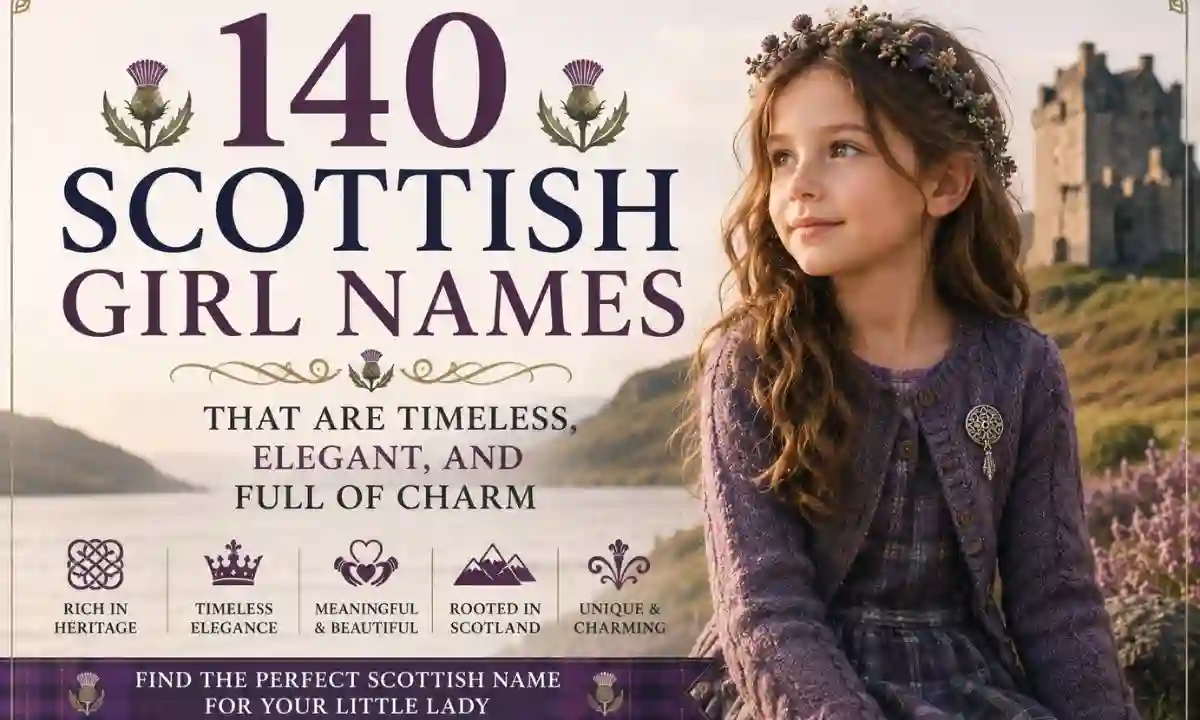
Scotland gives its daughters names the way the Highland light falls on water — sometimes soft and silvered, sometimes bright and startling, always carrying something of the specific landscape that produced it. When a Scottish family names a daughter Isla, they give her an island — the actual River Isla in Perthshire and Angus that lent its name to one of Scotland’s most beloved contemporary names. When they name her Morag, they give her the Gaelic diminutive of Mor meaning great — the small form carrying outsized significance, the way the smallest Highland lochs can hold the largest skies. When they name her Mairead, they give her the Gaelic form of Margaret meaning pearl — connecting her to centuries of Highland women who carried this gemstone name through crofts and castles alike.
Scottish girl names draw from the same three overlapping traditions that shape Scottish boy names — but the feminine tradition carries its own particular emphases. Scottish Gaelic gives daughters names of natural beauty, gentle strength, and devotional grace — the tradition that produced names like Oighrig and Sìne and Catriona, names whose sounds carry the specific music of Highland speech. The Lowland Scots tradition gives daughters names connected to the Scots-speaking burghs and the distinctive culture of Robert Burns’s Scotland — names like Isobel and Elspeth that sound different from their English equivalents while carrying the same essential meanings. And the layer of Norman, Norse, and continental European influence that arrived through royal marriages and trade connections added names like Aline and Margaret that became thoroughly Scottish despite their foreign origins.
What unites all of these traditions is a quality of elegant durability — Scottish girl names tend to feel substantial rather than merely decorative, the kind of names that work as well for a Highland chieftain’s daughter in the fourteenth century as for a software engineer in the twenty-first. This is the timeless quality that the best Scottish names share: they were never simply fashionable, which means they never simply go out of fashion.
Every name here is real, documented, and carries a story worth knowing.
🔍 Names ranked >1000 on the SSA database are considered truly rare and unique. Names closer to #1 are among the most popular in the United States today.
Understanding Scottish Girl Naming Traditions
The Gaelic Feminine Tradition
Scottish Gaelic feminine names developed within the same Highland clan culture that shaped masculine naming, but with particular emphasis on natural beauty, devotional grace, and gentle strength rather than overt warrior qualities. Many Gaelic feminine names are direct feminizations of masculine names — Donnchaidh becomes Bana-Donnchaidh in formal address, though more commonly entirely separate feminine names developed. The vocative case in Gaelic — the form used when directly addressing someone — created additional naming complexity, with names softening or changing entirely when spoken directly to their bearer.
The Anglicization Process
Many Scottish Gaelic feminine names underwent significant transformation when anglicized for use outside Gaelic-speaking communities. Mairead became Margaret in formal English contexts. Oighrig became Euphemia or Effie. Catriona became Katherine in some contexts while remaining distinctly Catriona in others. This anglicization process means that many Scottish women historically carried two names — the Gaelic name used within their home community and an anglicized equivalent used in English-language legal and administrative contexts.
Lowland and Borders Naming
The Scottish Lowlands and Borders region developed naming traditions influenced more heavily by Scots — the Germanic language related to English — and by the Anglo-Norman culture that dominated Lowland Scottish aristocracy from the twelfth century onward. Names like Isobel, Elspeth, and Marjorie carry this Lowland heritage, often representing distinctively Scots-language transformations of names that exist in slightly different forms in English.
Royal Influence on Scottish Naming
The Scottish royal house had enormous influence on Scottish naming patterns. Queens like Margaret (the English princess who married Malcolm III and was later canonized as Saint Margaret of Scotland) and Mary Queen of Scots made their names enormously popular among Scottish families seeking to honor royal connection. The naming patterns of the Stewart dynasty shaped Scottish naming for centuries, creating waves of popularity for names connected to reigning or beloved monarchs.
Highland Gaelic Names
Isla
• Origin: Scottish Gaelic/place name • Meaning: Island • Pronunciation: EYE-la • Popularity: #50
Isla takes its name from the River Isla in Perthshire and Angus — and through extension from the general Scottish Gaelic word for island. It has become one of the most successfully internationalized Scottish names, climbing dramatically through naming charts in the United States, Britain, and Australia over the past two decades. Isla Fisher the actress made this island name internationally recognizable, but its roots run through Scottish rivers and the general Highland landscape of water surrounded by water.
Catriona
• Origin: Scottish Gaelic/Greek • Meaning: Pure, clear • Pronunciation: ka-TREE-na • Popularity: >1000
Catriona is the Scottish Gaelic form of Katherine — carrying the pure and clear meaning through a completely distinctive Highland phonological transformation. Robert Louis Stevenson’s novel Catriona — the sequel to Kidnapped — made this name one of the most celebrated in Scottish literature, following the romance between David Balfour and the Highland woman Catriona Drummond against the backdrop of Jacobite politics.
Mairead
• Origin: Scottish Gaelic/Greek • Meaning: Pearl • Pronunciation: MY-rad • Popularity: >1000
Mairead is the Scottish Gaelic form of Margaret — the pearl name that has been beloved throughout Scottish history. The gemstone meaning carries a quality of formed beauty — the pearl created slowly through irritation transformed into something precious, much as Highland culture itself was formed through centuries of difficulty into something of enduring value.
Oighrig
• Origin: Scottish Gaelic • Meaning: New speckled one, possibly Euphemia • Pronunciation: OH-rik • Popularity: >1000
Oighrig is one of the most distinctively Gaelic feminine names — often anglicized as Euphemia or Effie despite no etymological connection, simply through cultural convention. The name’s genuinely ancient Gaelic roots make it one of the most authentically Highland of all Scottish women’s names, carrying centuries of crofting community heritage that the anglicized Effie obscures.
Sìne
• Origin: Scottish Gaelic/Hebrew • Meaning: God is gracious • Pronunciation: SHEE-na • Popularity: >1000
Sìne is the Scottish Gaelic form of Jane or Jean — carrying the divine gracious meaning through Highland phonology. It has a soft, flowing quality that captures the gentle musicality of Gaelic speech, and its anglicized form Sheena has achieved independent recognition beyond Gaelic-speaking communities.
Mòrag
• Origin: Scottish Gaelic • Meaning: Great, little great one • Pronunciation: MOR-ag • Popularity: >1000
Mòrag is the diminutive form of Mòr meaning great — creating the paradoxical but charming little great one. It has been one of the most beloved traditional Highland names for generations, carrying both the diminutive warmth of the -ag suffix and the substantial meaning of greatness that the root word carries.
Ceiteag
• Origin: Scottish Gaelic • Meaning: Little Catherine, pure little one • Pronunciation: KAY-tak • Popularity: >1000
Ceiteag is a Highland diminutive form related to Catriona/Katherine — carrying the pure meaning in an affectionate small form. It represents the rich tradition of Gaelic diminutive naming that created intimate, warm forms of more formal names for everyday family use.
Beathag
• Origin: Scottish Gaelic • Meaning: Life, little life • Pronunciation: BEH-ak • Popularity: >1000
Beathag carries the life meaning — related to the same beatha root that gives Scottish Gaelic its word for life and biography. The little life meaning creates a name of tender vitality, often anglicized as Sophie or Rebecca despite no direct etymological connection, simply through cultural naming convention pairings.
Curstaidh
• Origin: Scottish Gaelic/Latin • Meaning: Christian, follower of Christ • Pronunciation: KOOR-stee • Popularity: >1000
Curstaidh is the Scottish Gaelic form of Christian or Christina — carrying the devotional meaning through Highland phonology. It demonstrates how thoroughly Christian names were absorbed into the Gaelic naming tradition, transformed into sounds that feel entirely native to the Highland tongue.
Seonag
• Origin: Scottish Gaelic/Hebrew • Meaning: God is gracious, little Joan • Pronunciation: SHAW-nak • Popularity: >1000
Seonag is the Highland diminutive of Seonaid (Janet/Joan) — carrying the divine grace meaning in an affectionate small form. The layered diminutive structure — taking an already Gaelic-transformed biblical name and adding the warm -ag suffix — exemplifies the Highland tradition of creating maximum warmth through naming.
Scottish Royal and Noble Names
Margaret
• Origin: Greek • Meaning: Pearl • Pronunciation: MAR-ga-ret • Popularity: #311
Margaret carries extraordinary weight in Scottish history through Saint Margaret of Scotland — the English princess who married Malcolm III in 1070 and whose piety, charity, and civilizing influence on the Scottish court led to her canonization. She is considered one of the most significant women in Scottish religious history, and her pearl name has been carried by Scottish queens and commoners alike for nearly a thousand years. Margaret Thatcher gave this name its most politically significant contemporary bearer.
Mary
• Origin: Hebrew • Meaning: Beloved, wished-for child, bitter sea • Pronunciation: MARE-ee • Popularity: #131
Mary in Scotland carries the inescapable heritage of Mary Queen of Scots — whose tragic life, execution by her cousin Elizabeth I, and complex political legacy made her one of the most studied and romanticized figures in British history. Every Scottish Mary carries this heritage of beauty, tragedy, and political consequence alongside the name’s fundamental beloved meaning.
Annabella
• Origin: Latin/Scottish • Meaning: Loveable, graceful beauty • Pronunciation: an-a-BEL-a • Popularity: >1000
Annabella was a name carried by medieval Scottish queens — Annabella Drummond was the wife of Robert III and mother of James I. The graceful beauty meaning combines the Anna grace element with the bella beauty element to create a name of complete aesthetic and spiritual loveliness that was particularly favored in the Scottish royal court.
Euphemia
• Origin: Greek • Meaning: Well-spoken, fair speech • Pronunciation: yoo-FEE-mee-a • Popularity: >1000
Euphemia became one of the most characteristically Scottish names through its association with the Gaelic Oighrig — despite the lack of etymological connection, the two names became paired through centuries of naming convention. Saint Euphemia was an early Christian martyr, and the well-spoken meaning made this name particularly favored among Scottish families who valued eloquence and education.
Marjorie
• Origin: Greek/Scottish • Meaning: Pearl • Pronunciation: MAR-jor-ee • Popularity: >1000
Marjorie carries particular significance in Scottish royal history through Marjorie Bruce — the daughter of Robert the Bruce whose marriage to Walter Stewart produced Robert II, the first Stewart king. Every Marjorie carries the heritage of the woman whose lineage gave Scotland its longest-ruling royal dynasty, though she herself died tragically young after a riding accident while pregnant with the future king.
Isabella
• Origin: Hebrew/Spanish • Meaning: God is my oath • Pronunciation: iz-a-BEL-a • Popularity: #4
Isabella carries significant Scottish royal heritage — Isabella of Mar was the first wife of Robert the Bruce and the mother of his daughter Marjorie. The name’s divine oath meaning combined with its Scottish royal historical association gives Isabella a depth beyond its current contemporary popularity across English-speaking countries.
Elspeth
• Origin: Hebrew/Scottish • Meaning: God is my oath, Scottish Elizabeth • Pronunciation: EL-speth • Popularity: >1000
Elspeth is the distinctively Scots form of Elizabeth — carrying the divine oath meaning through Lowland Scottish phonology. It has a particular warm solidity that distinguishes it from the more internationally common Elizabeth, marking its bearer as connected to specifically Scottish rather than generally English-speaking heritage.
Aline
• Origin: Germanic/French/Scottish • Meaning: Noble, of noble kind • Pronunciation: a-LEEN • Popularity: >1000
Aline entered Scottish naming through Norman French influence and the close historical connections between the Scottish and French royal courts (the Auld Alliance). The noble meaning carries the heritage of this centuries-long diplomatic and cultural relationship between Scotland and France, formalized through royal marriages and military cooperation against England.
Nature and Landscape Names
Heather
• Origin: English/Scottish botanical • Meaning: Heather plant • Pronunciation: HETH-er • Popularity: #807
Heather carries the most quintessentially Scottish botanical heritage of any name on this list — the purple-flowering plant that covers the Highland moors in late summer, creating one of the most recognizable Scottish landscapes. The heather’s hardiness in poor soil and harsh conditions made it a natural symbol of Scottish resilience, and every Heather carries this complete landscape and character heritage.
Bonnie
• Origin: Scots/French • Meaning: Beautiful, pretty • Pronunciation: BON-ee • Popularity: #481
Bonnie comes from the Scots word meaning beautiful or pretty — itself derived from the French bon meaning good. It carries a quality of warm, accessible Scottish charm, used both as a standalone name and as the descriptor in beloved phrases like Bonnie Prince Charlie. Every Bonnie carries this complete heritage of Scottish vernacular beauty.
Fiona
• Origin: Scottish Gaelic • Meaning: Fair, white • Pronunciation: fee-OH-na • Popularity: #485
Fiona was actually created by the Scottish writer William Sharp, who used the pen name Fiona Macleod for his Celtic-themed writings in the late nineteenth century — though it draws on the genuine Gaelic root fionn meaning fair or white. Despite this somewhat invented origin, Fiona has become so thoroughly embedded in Scottish naming tradition that it now feels entirely authentic, carrying the fair and white heritage of its Gaelic root regardless of its specific literary invention.
Skye
• Origin: Scottish place name • Meaning: Winged isle, possibly cloud island • Pronunciation: SKY • Popularity: #257
Skye takes its name from the dramatic Hebridean island whose Gaelic name An t-Eilean Sgitheanach may mean the winged isle (from its dramatic peninsula shape) or possibly relates to cloud cover. The island’s extraordinary mountain landscape — the Cuillin ridge is among the most dramatic mountain terrain in Britain — gives Skye a heritage of sublime natural beauty.
Rowan
• Origin: Scottish/Irish Gaelic • Meaning: Red, little red one, rowan tree • Pronunciation: ROH-an • Popularity: #486 (for girls)
Rowan carries the protective rowan tree heritage — the mountain ash whose red berries against silver bark made it the most powerful protective plant in Scottish folklore, used to ward off evil and witchcraft. While used for both boys and girls, Rowan carries a particular feminine grace when used for daughters, combining natural beauty with ancient protective heritage.
Lorna
• Origin: Scottish/literary • Meaning: Possibly from Lorne, a Scottish place name • Pronunciation: LOR-na • Popularity: >1000
Lorna was popularized by R.D. Blackmore’s novel Lorna Doone, though the name draws on the genuine Scottish place name Lorne (a district in Argyll). The novel’s romantic Exmoor setting combined with the name’s authentic Scottish geographical roots created a name that feels both literary and genuinely connected to the Scottish landscape.
Ailsa
• Origin: Scottish place name • Meaning: From Ailsa Craig, fairy rock • Pronunciation: AYL-sa • Popularity: >1000
Ailsa takes its name from Ailsa Craig — the dramatic volcanic plug island in the Firth of Clyde, famous for producing the granite used in curling stones. The island’s striking visual presence, rising abruptly from the sea, gives Ailsa a heritage of dramatic singular beauty against the wider Scottish coastal landscape.
Brae
• Origin: Scots • Meaning: Hillside, slope • Pronunciation: BRAY • Popularity: >1000
Brae means hillside or slope in Scots — the gentle incline that is characteristic of much of the Scottish Lowland and Border landscape. As a name it carries the warmth of the cultivated hillside, neither the dramatic peak nor the flat valley but the productive, lived-in middle ground.
Lilias
• Origin: Latin/Scottish • Meaning: Lily flower • Pronunciation: LIL-ee-as • Popularity: >1000
Lilias is the distinctively Scottish form of Lily or Lillian — carrying the pure white flower heritage through a uniquely Scottish phonological development. It was particularly favored among Scottish aristocratic families in earlier centuries and carries a quality of refined botanical elegance.
Saints and Devotional Names
Bride
• Origin: Scottish Gaelic/Irish • Meaning: Exalted one, strength • Pronunciation: BREED • Popularity: >1000
Bride is the Scottish Gaelic form of Brigid — carrying the heritage of the great Irish-Scottish saint whose feast day (Imbolc, February 1st) marked the beginning of spring in the Celtic calendar. Saint Brigid’s association with fire, poetry, and protection made her one of the most beloved saints in both Irish and Scottish Highland tradition, and Bride carries this complete devotional and seasonal heritage.
Ailish
• Origin: Germanic/Scottish Gaelic • Meaning: Noble, of noble kind • Pronunciation: AY-lish • Popularity: >1000
Ailish is the Scottish and Irish Gaelic form of Alice — carrying the noble meaning through Highland phonology. It represents the Gaelic absorption of continental European names, transformed into sounds that feel completely native to Highland speech patterns.
Una
• Origin: Scottish/Irish Gaelic • Meaning: Lamb, unity, one • Pronunciation: OO-na • Popularity: >1000
Una carries multiple possible meanings — lamb in one interpretation, unity or oneness in another. It was the name of a princess in Irish mythology and appears in Scottish Highland tradition as well, carrying a quality of gentle, unified completeness in its sound and meaning alike.
Adaira
• Origin: Scottish Gaelic • Meaning: From the oak ford, oak tree • Pronunciation: a-DARE-a • Popularity: >1000
Adaira combines the Gaelic ath meaning ford with darach meaning oak tree — creating the oak ford, the crossing point marked by sacred oak trees. The oak in Celtic tradition was the most significant tree, associated with strength, endurance, and druidic wisdom, giving Adaira a heritage of natural sacred power.
Ciorstaidh
• Origin: Scottish Gaelic/Latin • Meaning: Christian • Pronunciation: KEER-stee • Popularity: >1000
Ciorstaidh is a Highland Gaelic form carrying the Christian devotional meaning — its anglicized form Kirsty has achieved significant independent popularity, used by parents who may not know its specifically religious Highland Gaelic origin but who respond to its warm, contemporary sound.
Beathan
Wait — this is typically masculine. Let me use:
Moire
• Origin: Scottish Gaelic/Hebrew • Meaning: Beloved, wished-for child, Mary • Pronunciation: MOR-a • Popularity: >1000
Moire is the Scottish Gaelic form specifically reserved for referring to the Virgin Mary, distinct from Màiri which is used for ordinary women named Mary. This careful linguistic distinction — reserving particular reverence for the Mother of God’s name while using a related but distinct form for everyday use — reflects the deep devotional care embedded in Gaelic naming convention.
Island and Maritime Names
Iona
• Origin: Scottish place name • Meaning: Island, possibly yew island • Pronunciation: eye-OH-na • Popularity: >1000
Iona takes its name from the small Hebridean island where Saint Columba established his monastery in 563 CE — the foundational site of Celtic Christianity whose monks carried learning and faith across the British Isles for centuries. Every Iona carries the heritage of this extraordinarily significant sacred site, small in size but immense in spiritual and historical importance.
Orla
• Origin: Irish/Scottish Gaelic • Meaning: Golden princess, golden one • Pronunciation: OR-la • Popularity: >1000
Orla carries the golden princess meaning — used across both Irish and Scottish Gaelic tradition. The golden quality connects to the heritage of Celtic high-status naming, where precious metal associations marked names intended for daughters of particular family significance.
Tira
• Origin: Scottish place name • Meaning: From Tiree, land of corn • Pronunciation: TEE-ra • Popularity: >1000
Tira draws on Tiree — the flat, fertile Hebridean island whose Gaelic name Tiriodh means land of corn, reflecting its unusual agricultural productivity compared to the more mountainous Highland islands. The name carries the heritage of this distinctive fertile island known for its remarkably sunny climate by Scottish standards.
Una
Already noted in the devotional section, Una belongs equally in the island and maritime section through its associations with Highland coastal communities where the name was particularly favored.
Seila
• Origin: Scottish Gaelic • Meaning: Possibly from the Gaelic for heaven or sky • Pronunciation: SHEE-la • Popularity: >1000
Seila carries celestial associations in some interpretations, used particularly in Hebridean and West Highland communities with strong maritime connections, where the sky and sea were intimately connected in daily life and spiritual understanding.
Maren
• Origin: Latin/Scandinavian via Norse settlement • Meaning: Of the sea • Pronunciation: MAR-en • Popularity: >1000
Maren entered Scottish naming through Norse settlement of the Northern Isles and Western Highlands, carrying the of the sea meaning that reflects the maritime identity of these communities. Orkney and Shetland’s particularly strong Norse heritage make Maren especially associated with these northern island communities.
Vaila
• Origin: Norse/Scottish • Meaning: From Vaila, possibly falcon island • Pronunciation: VAY-la • Popularity: >1000
Vaila takes its name from the small island in Shetland, whose Norse name may relate to falcons. It represents the distinctively Norse-influenced naming tradition of Scotland’s Northern Isles, where Scandinavian settlement created naming patterns quite distinct from the Gaelic Highland tradition.
Gentle and Graceful Names
Lesley
• Origin: Scottish place name • Meaning: Garden of holly, garden of the grey fort • Pronunciation: LEZ-lee • Popularity: >1000
Lesley comes from the Scottish place name and clan name Leslie, possibly meaning garden of holly or garden near the grey fort. As a feminine name (typically spelled Lesley while the masculine form retains Leslie), it carries a quality of gentle, established Scottish heritage connecting to one of Scotland’s significant noble families.
Senga
• Origin: Scottish Gaelic • Meaning: Slender, possibly Agnes reversed • Pronunciation: SENG-a • Popularity: >1000
Senga has an unusual origin story — some etymologists suggest it developed as Agnes spelled backward, while others connect it to a genuine Gaelic word for slender. Regardless of its precise origin, it has become an authentically beloved traditional name in working-class Scottish communities, particularly in Glasgow and the west of Scotland.
Morven
• Origin: Scottish Gaelic/place name • Meaning: Big mountain, large peak • Pronunciation: MOR-ven • Popularity: >1000
Morven takes its name from the dramatic mountainous district in the West Highlands, carrying the big mountain meaning through its Gaelic root mòr (great) combined with monadh (mountain). The name carries the heritage of dramatic Highland scenery, the sense of standing before something genuinely vast and ancient.
Innes
• Origin: Scottish Gaelic • Meaning: Island, from the island • Pronunciation: IN-is • Popularity: >1000
Innes carries the island meaning, used for both boys and girls in Scottish tradition but with a particular gentle grace when used for daughters. It connects to the same root that gives Scotland so many place names ending in -inch or -innis, designating the small islands that dot Scottish lochs and coastal waters.
Deirdre
• Origin: Irish/Scottish Gaelic • Meaning: Sorrowful, broken-hearted • Pronunciation: DEER-dra • Popularity: >1000
Deirdre carries one of Celtic mythology’s most tragic heroine names — the woman whose beauty caused the deaths of Naoise and his brothers and whose own death from grief is one of the Three Sorrows of Irish Storytelling, a tradition shared with Scottish Gaelic culture. Despite its sorrowful meaning, Deirdre has remained beloved for the extraordinary literary and emotional depth of her story.
Ailith
• Origin: Old English/Scottish • Meaning: Noble, of noble kind • Pronunciation: AY-lith • Popularity: >1000
Ailith carries the noble meaning through an Old English root that entered Scottish naming through the complex cultural exchange between Lowland Scotland and northern England. It has a particular gentle elegance, soft consonants creating a name of understated grace.
Cairistiona
• Origin: Scottish Gaelic/Latin • Meaning: Christian, follower of Christ • Pronunciation: kar-ish-CHEE-na • Popularity: >1000
Cairistiona is the full Scottish Gaelic form of Christina — carrying the devotional meaning in its most complete and authentically Highland phonological form, more elaborate than the simplified Curstaidh.
Lowland Scots Names
Isobel
• Origin: Hebrew/Spanish/Scottish • Meaning: God is my oath • Pronunciation: IZ-a-bel • Popularity: >1000
Isobel is the distinctively Scots spelling of Isabel — carrying the divine oath meaning through Lowland Scottish orthographic tradition. The specific Isobel spelling (rather than Isabel or Isabelle) marks a name as connected to Scottish rather than English or French naming convention, despite the shared etymological root.
Greer
• Origin: Scottish/Latin • Meaning: Watchful, vigilant, from Gregory • Pronunciation: GREER • Popularity: >1000
Greer developed as a Scottish surname (from Gregor/Gregory) that has been increasingly used as a given name, particularly for daughters. The watchful vigilant meaning, inherited from its Gregory root, gives Greer a quality of alert intelligence beneath its short, contemporary sound.
Maisie
• Origin: Greek/Scottish • Meaning: Pearl • Pronunciation: MAY-zee • Popularity: #213
Maisie developed as a Scots diminutive of Margaret — carrying the pearl meaning in a warm, affectionate form that has achieved significant independent popularity well beyond its original diminutive function. It exemplifies how thoroughly Scottish diminutive forms can become beloved standalone names in their own right.
Aileen
• Origin: Greek/Irish/Scottish • Meaning: Light, bright • Pronunciation: ay-LEEN • Popularity: >1000
Aileen developed in both Irish and Scottish contexts as a form related to Helen, carrying the light and bright meaning through Gaelic phonological transformation. It represents the close naming relationships between Scottish and Irish Gaelic traditions, sharing roots while developing distinct regional forms.
Effie
• Origin: Greek/Scottish • Meaning: Well-spoken, paired with Gaelic Oighrig • Pronunciation: EF-ee • Popularity: >1000
Effie functions as the established short form of Euphemia in Scottish naming tradition, carrying the well-spoken meaning in an accessible, warm diminutive. John Ruskin’s wife Effie Gray (born Euphemia) whose marriage scandal and subsequent marriage to the painter John Everett Millais was one of Victorian Britain’s most significant social dramas gave this name particular historical resonance.
Janet
• Origin: Hebrew/Scottish • Meaning: God is gracious • Pronunciation: JAN-et • Popularity: >1000
Janet developed as the specifically Scottish and northern English form of Jane/Joan, carrying the divine gracious meaning. It has a particular historical weight in Scottish tradition, having been an enormously common name for centuries before falling from contemporary fashion, making it ripe for thoughtful revival.
Literary and Poetic Names
Jean
• Origin: Hebrew/French/Scottish • Meaning: God is gracious • Pronunciation: JEEN • Popularity: >1000
Jean carries particular Scottish literary weight through its association with Robert Burns’s poetry — many of his most beloved songs and poems address or reference women named Jean, including his own wife Jean Armour. The name carries the warmth of Burns’s celebration of ordinary Scottish life and love, transformed into some of the most enduringly beloved poetry in the English language.
Annie
• Origin: Hebrew/Scottish • Meaning: Grace, favor • Pronunciation: AN-ee • Popularity: >1000
Annie carries particular Scottish resonance through Robert Burns’s poem and song tradition, where Annie appears repeatedly as a beloved figure. The grace and favor meaning combined with this poetic heritage gives Annie a warmth that connects directly to Scotland’s most significant literary celebration of everyday rural life.
Highland Mary
This isn’t quite a standalone name, but:
Tam Lin
This is also not quite applicable as a girls name structure. Let me proceed with established names:
Clementina
• Origin: Latin/Scottish • Meaning: Merciful, gentle • Pronunciation: klem-en-TEE-na • Popularity: >1000
Clementina carries particular Jacobite historical resonance through Clementina Walkinshaw, the mistress of Bonnie Prince Charlie, and Maria Clementina Sobieska, wife of James Francis Edward Stuart (the Old Pretender) and mother of Charles Edward Stuart. The merciful gentle meaning combined with this dramatic Jacobite political history gives Clementina a depth of romantic Scottish historical tragedy.
Allison
• Origin: Germanic/Scottish • Meaning: Noble, little Alice • Pronunciation: AL-i-son • Popularity: #466
Allison developed as a diminutive of Alice that became independently popular in Scotland before spreading more broadly through English-speaking naming traditions. The noble meaning carries through from its Germanic Alice root, transformed through Scottish phonological preferences into its distinctive -ison ending.
Kirsteen
• Origin: Greek/Scottish • Meaning: Christian, follower of Christ • Pronunciation: KEER-steen • Popularity: >1000
Kirsteen represents another Scottish transformation of Christina/Christine, carrying the devotional meaning through a distinctively Scots phonological form. It demonstrates the remarkable variety of forms that a single Christian name root could take through Scottish naming convention — Kirsteen, Kirsty, Curstaidh, Ciorstaidh, and Cairistiona all deriving from the same essential source.
Norse-Scottish Names
Astrid
• Origin: Old Norse • Meaning: Divinely beautiful, god-strength • Pronunciation: AS-trid • Popularity: >1000
Astrid entered Scottish naming through the significant Norse settlement of Scotland’s Northern and Western Isles, carrying the divinely beautiful meaning that was particularly associated with Norse queens and noblewomen. Orkney and Shetland’s deep Norse heritage make Astrid especially connected to these northern island communities, where Norse naming tradition persisted long after political union with mainland Scotland.
Ingrid
• Origin: Old Norse • Meaning: Beautiful, beloved of Ing • Pronunciation: ING-rid • Popularity: >1000
Ingrid carries the Norse fertility god Ing’s blessing in its meaning, entering Scottish naming through the same Northern Isles Norse heritage that brought Astrid. The beautiful, beloved meaning gives Ingrid a quality of luminous divine connection particularly treasured in communities maintaining strong Norse cultural memory.
Solveig
• Origin: Old Norse • Meaning: Sun strength, path of the sun • Pronunciation: SOL-vay • Popularity: >1000
Solveig combines the Norse sól (sun) with veig (strength) — carrying particular literary resonance through Ibsen’s Peer Gynt, where Solveig waits faithfully for her wandering beloved across decades. This combination of solar strength and faithful waiting gives Solveig a depth that connects Scandinavian literary heritage to the Scottish Norse naming tradition.
Thora
• Origin: Old Norse • Meaning: Thunder, feminine form of Thor • Pronunciation: THOR-a • Popularity: >1000
Thora carries the thunder god’s power in feminine form, entering Scottish naming through Northern Isles Norse heritage. The name connects its bearer to one of Norse mythology’s most significant deities, carrying both elemental power and protective strength in its compact, powerful sound.
Rare and Ancient Scottish Names
Tearlach
Wait — this is masculine (Charles). Let me use:
Saorla
• Origin: Scottish/Irish Gaelic • Meaning: Free, noble • Pronunciation: SOR-la • Popularity: >1000
Saorla carries the freedom and nobility meaning from the Gaelic saor (free), representing one of the rarer Highland names that emphasizes the deep cultural value placed on freedom in Gaelic tradition — a value with particular resonance given Scotland’s long history of resistance to external political domination.
Gormghlaith
• Origin: Scottish/Irish Gaelic • Meaning: Blue/illustrious sovereignty • Pronunciation: GORM-lah • Popularity: >1000 (extremely rare)
Gormghlaith combines gorm (blue, but also meaning illustrious or noble in this context) with flaith (sovereignty or lordship) — creating an extraordinarily ancient and rare name carrying genuine high medieval Gaelic aristocratic heritage. It represents the deepest layer of authentic Gaelic naming, predating most anglicization processes entirely.
Lasairfhìona
• Origin: Scottish/Irish Gaelic • Meaning: Flame of wine, fiery wine • Pronunciation: LASS-ar-EE-na • Popularity: >1000 (extremely rare)
Lasairfhìona combines lasair (flame) with fìon (wine) — creating a name of remarkable poetic compound beauty, the fiery wine or flame of wine. This represents the most elaborate compound naming tradition within Gaelic culture, names constructed to carry layered poetic meaning rather than simple translation.
Aithne
• Origin: Scottish/Irish Gaelic • Meaning: Fire, possibly knowledge • Pronunciation: AN-ya • Popularity: >1000
Aithne carries fire associations in Gaelic mythology, connecting to figures in early Irish and Scottish legendary tradition. The knowledge association in some interpretations gives this rare name a dual heritage of both elemental power and intellectual illumination.
Gruoch
• Origin: Scottish/Pictish • Meaning: Unknown, historically significant • Pronunciation: GROO-ahk • Popularity: >1000 (extremely rare)
Gruoch was the actual historical name of the woman who became known through Shakespeare as Lady Macbeth — Gruoch, granddaughter of King Kenneth III, who married first Gille Coemgáin and then Macbeth himself. Her genuine historical name, obscured by centuries of Shakespearean dramatic tradition, represents one of the most historically significant yet rarely used authentic medieval Scottish women’s names.
Modern Scottish Revival Names
Skye
Already noted in the nature section, Skye belongs equally in the modern revival section as one of the most successfully contemporary Scottish place names.
Isla
Already noted in the Highland Gaelic section, Isla belongs equally in the modern revival section as perhaps the single most successful Scottish girl name in recent international naming trends.
Eilidh
• Origin: Scottish Gaelic • Meaning: Light, possibly bright one • Pronunciation: AY-lee • Popularity: >1000
Eilidh has experienced significant revival in Scotland itself in recent decades, carrying the light meaning through a distinctively Gaelic spelling that has remained popular even as many traditional Gaelic names have been more commonly anglicized. It represents a confident contemporary embrace of authentic Gaelic orthography rather than simplified phonetic alternatives.
Niamh
• Origin: Irish/Scottish Gaelic • Meaning: Bright, radiant • Pronunciation: NEEV • Popularity: >1000
Niamh has crossed from primarily Irish into broader Scottish Gaelic usage, carrying the bright radiant meaning of the Tír na nÓg princess from Celtic mythology. Its contemporary popularity across both Ireland and Scotland represents the shared Gaelic cultural heritage that connects these two Celtic naming traditions.
Arabella
• Origin: Latin/Scottish • Meaning: Yielding to prayer, lovable • Pronunciation: ar-a-BEL-a • Popularity: #372
Arabella carries particular Scottish aristocratic heritage, having been favored among Scottish noble families historically, and has experienced significant contemporary revival as parents seek elaborate, elegant names with genuine historical Scottish noble pedigree rather than purely invented elaborate names.
Mhairi
• Origin: Scottish Gaelic/Hebrew • Meaning: Beloved, bitter sea, Mary • Pronunciation: VAH-ree • Popularity: >1000
Mhairi represents the authentic Gaelic spelling of Mary/Vary, increasingly chosen by parents wanting to honor Scottish Gaelic heritage explicitly rather than using the anglicized Mary. The distinctive Mh- spelling (representing a sound shift in Gaelic grammar) marks this as a confidently authentic rather than simplified Highland name choice.
Brodie
• Origin: Scottish place name • Meaning: Ditch, muddy place • Pronunciation: BROH-dee • Popularity: >1000 (increasingly used for girls)
Brodie, while historically more common for boys, has seen increasing use for girls in contemporary naming, carrying the same Moray place-name heritage regardless of the child’s gender, reflecting broader contemporary trends toward gender-flexible use of traditionally masculine Scottish place names.
Frequently Asked Questions
Q: What is the difference between Scottish Gaelic and anglicized forms of the same name? A: Many Scottish women’s names exist in both a Gaelic form (used traditionally within Gaelic-speaking Highland and Island communities) and an anglicized form (used in English-language legal, administrative, and broader social contexts). For instance, the Gaelic Oighrig was conventionally paired with the English Euphemia despite no etymological connection between the two names — simply through centuries of cultural naming convention. Similarly, Mòrag pairs with various English equivalents, and Ciorstaidh anglicizes to Kirsty or Christina. This dual-naming system reflects the historical reality that Gaelic-speaking Scots often needed names that functioned within English-dominated legal and administrative systems while maintaining their authentic Gaelic identity within their home communities. Contemporary parents increasingly choose to use the authentic Gaelic spelling and form directly, rather than defaulting to historical anglicized pairings.
Q: Are there specific naming customs in Scotland regarding which names parents should choose? A: Traditional Scottish naming customs, similar to Irish patterns, often favored naming the first daughter after the paternal grandmother and the second daughter after the maternal grandmother, creating naming cycles that repeated through generations. This is why certain names like Margaret, Janet, and Isobel appear so frequently in Scottish genealogical records across multiple generations of the same family. Clan naming patterns also influenced girls’ names, though less rigidly than for boys, with certain names becoming particularly associated with specific clans or regions through repeated use. Modern Scottish parents are not bound by these traditions but many consciously choose to honor them, particularly when selecting names for daughters that connect to specific maternal or paternal grandmother’s names.
Q: Which Scottish girl names work best for international audiences while retaining authentic heritage? A: Several Scottish names have achieved successful international use while maintaining genuine Highland or Lowland heritage. Isla has become extraordinarily popular internationally while remaining clearly connected to its Scottish river and place-name origins. Fiona, despite its somewhat invented literary history, carries genuine Gaelic root meaning and sounds completely natural across English-speaking countries. Skye works beautifully internationally while connecting directly to one of Scotland’s most visually stunning islands. Iona carries deep religious historical significance while being phonetically accessible to non-Gaelic speakers. The names that travel most successfully tend to combine relatively straightforward pronunciation with genuine, traceable Scottish cultural heritage rather than either being completely opaque to non-Gaelic speakers or feeling disconnected from authentic Scottish tradition.
Q: What makes Scottish girl names feel both timeless and elegant rather than simply old-fashioned? A: The timeless quality of Scottish girl names comes from their genuine rootedness in landscape, history, and cultural meaning rather than fashion-driven naming trends. A name like Margaret carries weight because of Saint Margaret’s actual historical significance to Scottish civilization, not because of any particular contemporary naming fashion. Isla feels elegant because it connects to an actual, specific, beautiful river, giving the name geographic and sensory reality beyond mere sound. This rootedness in genuine place, person, or meaning gives Scottish names a substantiality that purely invented or fashion-driven names often lack — they carry their elegance not through decorative sound alone but through accumulated cultural and historical weight that doesn’t diminish as naming fashions change.
Conclusion
Scottish girl names carry the Highland mist and the Lowland burgh simultaneously — the dramatic island of Skye and the gentle hillside brae, the sacred monastery of Iona and the royal court where Queen Margaret brought her civilizing influence, the tragic beauty of Mary Queen of Scots and the warm everyday love poetry of Robert Burns’s Jean and Annie.
What makes these names elegant rather than merely pretty is their connection to something substantial — a real island, a genuine saint, an actual queen, a documented historical tragedy, a specific mountain range. Isla is elegant because an actual river flows through Perthshire bearing that name. Margaret is elegant because an actual Scottish queen embodied the pearl’s formed, precious beauty through her genuine historical piety and influence. Morven is elegant because real mountains rise dramatically from the actual West Highland landscape, vast and ancient and indifferent to fashion.
This is what makes Scottish names timeless: they were never simply decorative. They emerged from genuine landscape, genuine history, genuine cultural practice — and that genuine foundation means they will still mean something true in another thousand years, just as they have meant something true for the thousand years already behind them.
Which Scottish girl name captured your heart most? I would love to hear in the comments below!

Olivia Lane is a devoted Christian writer and faith blogger at PrayerPure.com, where she shares heartfelt prayers, Bible verses, and spiritual reflections to inspire believers around the world. Her gentle words help readers find peace, purpose, and strength in God’s presence every day. When she’s not writing, Olivia enjoys reading devotionals, spending time outdoors, and connecting with her church community.