
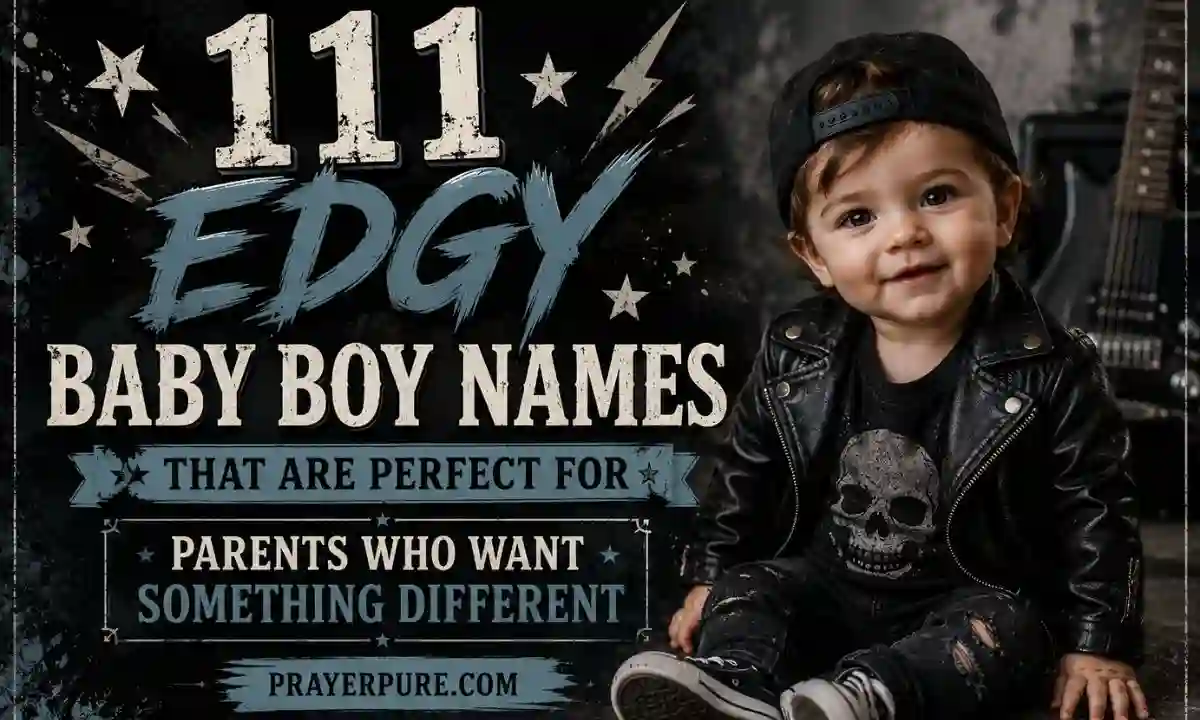
There is a particular kind of boy whose name should not blend into the background. The boy who will grow up to question everything, who will find his own path through the world with a confidence that does not need the approval of a crowd, who will carry his name not as a label but as a declaration. Edgy boy names are made for exactly that kind of person, and giving a boy one from the very beginning is a quiet act of faith in who he is going to become.
What separates a genuinely edgy boy name from simply an unusual one is character. The names on this list do not just sound different, they mean something. They carry the energy of ancient warriors, of Norse gods standing at the edge of the world, of Irish heroes riding into battle, of Sanskrit deities dancing on the threshold between creation and destruction. Some carry the cool, minimal darkness of the natural world at its most elemental. Others carry the fierce, uncompromising energy of mythology’s greatest and most dangerous figures. And some carry a quiet, slightly dangerous literary or artistic legacy that sets them apart from everything else.
Whether you are drawn to the darkly mythological, the fiercely historical, the coolly minimalist, or the wildly natural, this list has 111 edgy baby boy names that are perfect for parents who want something genuinely, authentically different. Popularity rankings are based on the most recent Social Security Administration (SSA) data.
Quick Info: Names ranked >1000 on the SSA database are considered truly rare and unique. Names closer to 1 are among the most popular in the US today.
Darkly Gothic Boy Names
Cain
- Origin: Hebrew
- Meaning: Acquired, possessed, spear
- Popularity: #359
The biblical first murderer whose name has carried a dark, slightly rebellious quality across thousands of years of Western culture, Cain is short, bold, and carries a cool, slightly dangerous energy that has been making it increasingly appealing to parents who want something with genuine edge.
Damien
- Origin: Greek
- Meaning: To tame, to subdue
- Popularity: #222
Forever associated with the child of darkness in The Omen and carrying a slightly ominous quality that has never fully detached itself from that association, Damien has a cool, slightly dark elegance that sits at the perfect intersection of mainstream and edgy.
Dorian
- Origin: Greek
- Meaning: From Doris, child of the sea
- Popularity: #331
Made immortal by Oscar Wilde’s great gothic novel The Picture of Dorian Gray, this name carries the extraordinary legacy of a character who sold his soul for eternal beauty, giving it a dark, slightly decadent literary quality.
Leviathan
- Origin: Hebrew
- Meaning: Twisted, coiled, the great sea monster
- Popularity: >1000
The great sea monster of the Hebrew Bible whose name has become synonymous with overwhelming, chaotic power, Leviathan is one of the most dramatically unusual names available and carries a genuinely formidable, deeply biblical quality.
Obsidian
- Origin: Latin
- Meaning: Dark volcanic glass
- Popularity: >1000
Named after the striking black volcanic glass formed when lava cools rapidly, Obsidian is a bold, unusual gemstone name with a cool, slightly dramatic quality and a genuine rarity that makes it completely one of a kind.
Shade
- Origin: English
- Meaning: Shadow, darkness
- Popularity: >1000
Named after the shadow and darkness itself, Shade is a minimal, cool name with a slightly mysterious, deeply atmospheric quality and a genuine rarity that suits a boy with a quiet, slightly dark, deeply individual spirit.
Crypt
- Origin: Greek/Latin
- Meaning: Hidden vault, underground chamber
- Popularity: >1000
Named after the underground chambers where the dead were interred in ancient churches and catacombs, Crypt is one of the most boldly unusual names available and carries a cool, slightly gothic quality that is genuinely unlike anything else.
Mortis
- Origin: Latin
- Meaning: Of death, death
- Popularity: >1000
The Latin genitive form of mors meaning death, Mortis carries a cool, slightly philosophical quality and a genuine rarity that suits a family drawn to the darker, more existential end of the naming spectrum.
Vesper
- Origin: Latin
- Meaning: Evening star
- Popularity: #614
Named after the evening star that appears at dusk, Vesper carries a cool, slightly mysterious quality and a deep classical heritage, sitting at the edge of gothic darkness and classical elegance in a name of genuine distinction.
Dusk
- Origin: English
- Meaning: The time between day and night
- Popularity: >1000
Named after the twilight hour when day surrenders to night, Dusk is a minimal, cool name with a slightly melancholy, deeply atmospheric quality and a genuine rarity that makes it feel like a name from a darker, more beautiful world.
Fierce Warrior and Historical Names
Ragnar
- Origin: Norse
- Meaning: Warrior of decision, powerful army
- Popularity: >1000
The legendary Viking chieftain Ragnar Lothbrok whose adventures became the stuff of Norse saga, Ragnar carries a fierce, bold, deeply Viking energy and a genuine historical legacy that has been experiencing a remarkable cultural revival.
Ulfric
- Origin: Norse/Germanic
- Meaning: Wolf ruler, power of the wolf
- Popularity: >1000
An ancient Norse and Germanic name meaning wolf ruler, Ulfric carries the fierce, dominating energy of the wolf combined with the authority of a ruler in a name of genuine rarity and a deeply Viking quality.
Alaric
- Origin: Germanic
- Meaning: Noble ruler, all-powerful ruler
- Popularity: >1000
The name of the Visigoth king who sacked Rome in 410 AD, Alaric carries an extraordinary historical weight and a bold, commanding sound that makes it one of the most powerful rare names available.
Attila
- Origin: Gothic/Hunnic
- Meaning: Little father, paternal
- Popularity: >1000
The name of the great Hunnic ruler who became known as the Scourge of God and brought the Roman Empire to its knees, Attila carries a fierce, slightly terrifying historical legacy and a bold, unusual quality.
Cormac
- Origin: Irish Gaelic
- Meaning: Charioteer, son of the raven
- Popularity: >1000
Rugged and deeply Irish, Cormac is the name of ancient kings and modern literary giants, carrying a fierce wild beauty rooted in the oldest layers of Gaelic culture and the untamed Irish landscape.
Wulfric
- Origin: Anglo-Saxon/Germanic
- Meaning: Wolf ruler
- Popularity: >1000
An ancient Anglo-Saxon name meaning wolf ruler, Wulfric carries a fierce, slightly medieval quality and a deep Old English heritage rooted in the early medieval tradition of England before the Norman conquest.
Ivar
- Origin: Norse
- Meaning: Bow warrior, archer
- Popularity: >1000
Associated with Ivar the Boneless, the legendary Viking chieftain who conquered large parts of England, Ivar carries a fierce, cool, deeply Viking quality and a genuine historical legacy.
Boudican
- Origin: Celtic/British
- Meaning: Of Boudica, victorious
- Popularity: >1000
Drawing from the great warrior queen Boudica who led the Celtic Britons against Rome, this masculine form carries the fierce, rebellious, deeply historical warrior energy of that extraordinary legacy.
Sigurd
- Origin: Norse
- Meaning: Victory guardian, victorious protection
- Popularity: >1000
The great hero of the Norse Volsung saga who slew the dragon Fafnir and walked through walls of flame, Sigurd carries an extraordinary mythological legacy and a strong, distinctive sound.
Leofric
- Origin: Anglo-Saxon/Germanic
- Meaning: Dear ruler, beloved power
- Popularity: >1000
An Old English name carried by the Earl of Mercia, husband of Lady Godiva, Leofric has a rugged medieval English character and a warm meaning that makes it feel both strong and surprisingly tender.
Dark Mythological Names
Hades
- Origin: Greek
- Meaning: Unseen, the invisible one
- Popularity: >1000
The god of the underworld in Greek mythology whose name became synonymous with the realm of the dead, Hades carries a cool, slightly dark, deeply powerful quality and an extraordinary mythological legacy.
Loki
- Origin: Norse
- Meaning: Trickster, knot, lock
- Popularity: >1000
The great trickster god of Norse mythology whose mischief brought both gifts and catastrophe to the gods of Asgard, Loki carries a cool, slightly dangerous, deeply charismatic quality and an extraordinary contemporary cultural revival.
Ares
- Origin: Greek
- Meaning: God of war, ruin, bane
- Popularity: >1000
The fierce, bloodthirsty god of war in Greek mythology, Ares carries a bold, slightly aggressive quality and an extraordinary mythological power in a name of cool, minimal beauty.
Fenrir
- Origin: Norse
- Meaning: Fen dweller, the great wolf
- Popularity: >1000
The great wolf of Norse mythology who was bound by the gods but who will break free at Ragnarok and swallow Odin himself, Fenrir carries a fierce, apocalyptic, deeply Norse quality and an extraordinary mythological weight.
Moloch
- Origin: Hebrew/Canaanite
- Meaning: King, ruler
- Popularity: >1000
The ancient Canaanite deity associated with fire and sacrifice, Moloch carries a dark, slightly ominous quality and a deep biblical and historical heritage that makes it one of the most dramatically unusual mythological names available.
Abaddon
- Origin: Hebrew
- Meaning: Destruction, place of destruction
- Popularity: >1000
The Hebrew word for destruction and the name of the angel of the bottomless pit in the Book of Revelation, Abaddon carries a bold, slightly apocalyptic quality and a profound biblical heritage.
Thanatos
- Origin: Greek
- Meaning: Death, the personification of death
- Popularity: >1000
The personification of death in Greek mythology, the twin brother of Hypnos the god of sleep, Thanatos carries a cool, philosophical quality and a deep classical heritage rooted in the Greek understanding of death as a peaceful, inevitable force.
Bael
- Origin: Hebrew/Canaanite
- Meaning: Lord, master, owner
- Popularity: >1000
The ancient Canaanite deity whose worship was condemned by the biblical prophets, Bael carries a cool, slightly dark, deeply ancient quality and one of the most dramatically unusual names rooted in the ancient Near Eastern world.
Cernunnos
- Origin: Celtic/Gaulish
- Meaning: Horned one
- Popularity: >1000
The great horned god of the Celtic world, lord of the wild hunt and the animals of the forest, Cernunnos carries a fierce, slightly mysterious, deeply pagan quality and an extraordinary Celtic religious heritage.
Malphas
- Origin: Latin/Medieval
- Meaning: Unknown, a prince of darkness
- Popularity: >1000
A name from medieval demonology carrying a slightly dark, deeply unusual quality, Malphas is genuinely rare and carries a cool, slightly gothic character that is completely one of a kind.
Cool and Minimal Edgy Names
Hex
- Origin: English/German
- Meaning: Spell, witch
- Popularity: >1000
Named after the word for a magical spell, Hex carries a cool, slightly witchy quality and a crisp, minimal beauty that is genuinely unlike anything else in the modern naming landscape.
Riot
- Origin: English
- Meaning: Violent disturbance, wild disorder
- Popularity: >1000
Bold, slightly provocative, and carrying the raw energy of chaos and disorder in a name of genuine minimalism, Riot is a rare and genuinely distinctive name for a boy with a fierce, wild, completely uncontainable spirit.
Vex
- Origin: English/Latin
- Meaning: To disturb, to trouble
- Popularity: >1000
Named after the English word for disturbance and trouble, Vex is a bold, minimal name with a cool, slightly provocative quality and a genuine rarity that makes it feel like a name for a boy who was never going to follow the rules.
Blaze
- Origin: English/Latin
- Meaning: Fire, flame, blazing light
- Popularity: >1000
Bold and elemental, Blaze carries the raw, bright energy of fire itself in a name that is short, strong, and carries a vivid, dramatic quality that suits a boy with a fierce, fiery, unstoppable spirit.
Zion
- Origin: Hebrew
- Meaning: Highest point, sacred mountain
- Popularity: #178
Carrying both the sacred geography of Jerusalem and the dramatic landscapes of Zion National Park, Zion has a bold, spiritual energy and a clean, strong sound that has been rising strongly and carries a genuine cool factor.
Grim
- Origin: Norse/English
- Meaning: Fierce, grim, masked one
- Popularity: >1000
Carrying the Norse and English meaning of fierce and grim, Grim is a minimal, bold name with a cool, slightly dark quality and a deep Norse heritage through the great god Odin who was sometimes known as Grimr.
Bolt
- Origin: English
- Meaning: Bolt of lightning, arrow
- Popularity: >1000
Named after the bolt of lightning that splits the sky, Bolt is a minimal, dramatic name with a clean, sharp energy and a cool, slightly unusual quality that suits a fast, fierce, independent boy perfectly.
Dagger
- Origin: English/Old French
- Meaning: Short pointed blade
- Popularity: >1000
Named after the short, pointed blade that was the weapon of last resort for medieval knights, Dagger is a bold, slightly provocative name with a cool, slightly dangerous quality and a genuine rarity.
Cipher
- Origin: Arabic/English
- Meaning: Zero, secret code, nothing
- Popularity: >1000
Named after the concept of a secret code and carrying the mathematical meaning of zero, Cipher has a cool, slightly intellectual quality and a genuinely distinctive character that suits a boy with a sharp, analytical, slightly mysterious mind.
Crave
- Origin: English
- Meaning: To desire intensely, to yearn
- Popularity: >1000
Named after the English word for intense desire and yearning, Crave is an unusual, slightly provocative name with a cool, bold quality and a genuine rarity that makes it genuinely one of a kind.
Edgy Nature Names
Storm
- Origin: English
- Meaning: Tempest, storm
- Popularity: >1000
Bold and elemental, Storm carries the raw power of the weather itself in a name that is short, strong, and carries a wild, dramatic energy that suits a boy with a fierce and independent spirit.
Flint
- Origin: English
- Meaning: Flint stone, spark
- Popularity: >1000
Named after the hard, spark-producing stone used by humans since the earliest days of fire-making, Flint is a rugged, minimal name with a sharp, strong energy and a deeply elemental outdoor character.
Ash
- Origin: English
- Meaning: Ash tree
- Popularity: #449
Short, strong, and deeply rooted in both Norse mythology and the English countryside, Ash is one of the most perfectly minimal nature names, carrying enormous natural depth in just three letters.
Wolf
- Origin: Germanic/English
- Meaning: Wolf
- Popularity: >1000
The great apex predator of the northern forests gives this name a fierce, wild, elemental quality and a cool, minimal sound that carries the untamed spirit of the wilderness in just four letters.
Cinder
- Origin: English
- Meaning: Ash, residue of fire
- Popularity: >1000
Named after the ash and cinders left by fire, Cinder carries a cool, slightly dark, deeply atmospheric quality and a genuine warmth rooted in the image of the glowing embers that remain after a fire has burned.
Frost
- Origin: English
- Meaning: Frost, frozen dew
- Popularity: >1000
Named after the frozen crystals that coat the world on cold mornings, Frost carries a cool, crisp, slightly literary quality and a genuinely distinctive natural character.
Tor
- Origin: English/Norse
- Meaning: Rocky hilltop, thunder
- Popularity: >1000
The English word for a rocky hilltop and a form of the Norse thunder god Thor, Tor is one of the most minimal and powerful nature names available, a single syllable of pure elemental strength.
Crag
- Origin: Scottish/Celtic
- Meaning: Steep rugged rock
- Popularity: >1000
A Scottish and Celtic word for a steep, rugged rock face used as a name, Crag is short, strong, and carries a wild Highland energy that is completely unlike anything currently in everyday use.
Onyx
- Origin: Greek
- Meaning: Black gemstone, claw
- Popularity: >1000
Bold, dark, and carrying the cool sophistication of a gemstone name, Onyx has a strong, striking energy and a modern edge that feels genuinely ahead of its time as a boy name.
Rook
- Origin: English
- Meaning: Rook bird, chess piece
- Popularity: >1000
Named after the great black corvid bird and the powerful chess piece that controls the straight lines of the board, Rook is a bold, minimal nature name with a cool, slightly unusual quality.
Edgy Celtic and Viking Names
Morrigan
- Origin: Irish Gaelic
- Meaning: Great king, phantom king
- Popularity: >1000
While primarily associated with the great Irish goddess, Morrigan has been used for boys in Irish families and carries the fierce, shape-shifting, battle-commanding energy of one of mythology’s most powerful figures.
Fenrir
- Origin: Norse
- Meaning: Fen dweller, the great wolf
- Popularity: >1000
Already celebrated in the mythological section, Fenrir belongs here for the sheer, fierce Viking energy he carries, the great apocalyptic wolf who will break his chains at the end of the world.
Cú Chulainn
- Origin: Irish Gaelic
- Meaning: Hound of Culann
- Popularity: >1000
The greatest hero of Irish mythology, the champion of Ulster who single-handedly defended his people while under a curse, Cú Chulainn carries the most ferociously powerful warrior energy in all of Celtic tradition.
Ulfhedinn
- Origin: Norse
- Meaning: Wolf-skin, wolf warrior
- Popularity: >1000
The name for the Norse wolf warriors who wore wolfskins and fought in a battle frenzy alongside the berserkers, Ulfhedinn carries a fierce, wild, deeply Viking quality and an extraordinary warrior heritage.
Bres
- Origin: Irish Gaelic
- Meaning: Beautiful, great, mighty
- Popularity: >1000
The name of a king of the Tuatha De Danann in Irish mythology who was half Fomorian and whose tyrannical reign led to war, Bres carries a cool, slightly unusual Irish quality and a deep mythological heritage.
Skarsgard
- Origin: Norse
- Meaning: From the rocky farm, rocky enclosure
- Popularity: >1000
The great Scandinavian surname carried by the legendary acting dynasty, Skarsgard has a cool, slightly dramatic Norse quality and a deep Scandinavian heritage that has made it one of the most culturally resonant Nordic names.
Baldr
- Origin: Norse
- Meaning: Prince, brave, bold
- Popularity: >1000
The beautiful, beloved god of Norse mythology whose death caused all the world to weep, Baldr carries an extraordinary mythological legacy and a cool, slightly melancholy quality rooted in the most poignant story in the Norse pantheon.
Cuchulainn
- Origin: Irish Gaelic
- Meaning: Hound of Culann
- Popularity: >1000
A variant spelling of Cú Chulainn, this great Irish hero name carries the same extraordinary warrior energy in a slightly more accessible written form that retains every bit of its fierce Gaelic character.
Gunnar
- Origin: Scandinavian/Norse
- Meaning: Bold warrior, battle
- Popularity: >1000
A great Viking warrior name beloved across Scandinavia, Gunnar has a bold, strong energy and a clean, powerful sound that carries the spirit of the old Norse sagas in a name that feels surprisingly wearable today.
Draugr
- Origin: Norse
- Meaning: Undead, one who walks after death
- Popularity: >1000
The name of the undead revenants of Norse mythology who rose from their graves to haunt the living, Draugr carries a cool, slightly terrifying Norse quality and a deeply unusual mythological heritage that is completely one of a kind.
Edgy Literary and Artistic Names
Dorian
- Origin: Greek
- Meaning: From Doris, child of the sea
- Popularity: #331
Already celebrated in the gothic section, Dorian belongs firmly in this literary section through Oscar Wilde’s extraordinary gothic novel and the immortal character whose portrait aged while he remained forever young.
Heathcliff
- Origin: English
- Meaning: From the heath cliff
- Popularity: >1000
The great brooding hero of Emily Brontë’s Wuthering Heights, Heathcliff carries an extraordinary literary legacy and a dark, passionate, deeply romantic quality that makes it one of the most dramatically edgy literary names in English fiction.
Ahab
- Origin: Hebrew
- Meaning: Uncle, father’s brother
- Popularity: >1000
Made immortal by Herman Melville’s obsessive captain in Moby Dick, Ahab carries a dark, slightly monomaniacal literary legacy and a biblical heritage rooted in one of the most complex and morally ambiguous characters in all of American literature.
Raskolnikov
- Origin: Russian
- Meaning: Schismatic, one who breaks away
- Popularity: >1000
The great protagonist of Dostoevsky’s Crime and Punishment whose name means schismatic and whose philosophical journey through murder and redemption is one of the great explorations of guilt and conscience in world literature.
Holden
- Origin: English
- Meaning: From the hollow valley
- Popularity: #399
The great alienated narrator of J.D. Salinger’s The Catcher in the Rye whose name has become synonymous with adolescent rebellion and authentic self-searching, Holden carries a cool, slightly rebellious literary quality.
Stavros
- Origin: Greek
- Meaning: Cross, the cross
- Popularity: >1000
The Greek word for cross used as a name, Stavros carries a deep Orthodox Christian heritage and a warm, slightly Mediterranean quality that has a cool, slightly unusual edge in English-speaking contexts.
Kafka
- Origin: Czech/Slavic
- Meaning: Jackdaw, the black bird
- Popularity: >1000
The surname of Franz Kafka, the great Czech writer whose nightmarish, bureaucratic fictions gave the world the word Kafkaesque, Kafka carries an extraordinary literary legacy and a cool, slightly dark, deeply literary quality.
Rasputin
- Origin: Russian
- Meaning: Debauched, licentious
- Popularity: >1000
The legendary Russian mystic whose extraordinary influence over the Romanov family and whose apparent immortality during his assassination made him one of history’s most fascinating and darkly compelling figures.
Doyle
- Origin: Irish Gaelic
- Meaning: Dark stranger, son of the dark stranger
- Popularity: >1000
The Irish surname meaning dark stranger that has been used as a first name, carrying both a slightly mysterious Irish quality and an association with Arthur Conan Doyle, the great creator of Sherlock Holmes.
Aldous
- Origin: Germanic
- Meaning: Old, noble
- Popularity: >1000
Forever associated with the visionary author Aldous Huxley whose Brave New World and Doors of Perception shaped the cultural landscape of the twentieth century, Aldous carries a literary and intellectual legacy alongside a warm, slightly eccentric distinction.
Edgy Celestial and Elemental Names
Nebula
- Origin: Latin
- Meaning: Cloud, mist, interstellar gas cloud
- Popularity: >1000
Named after the vast clouds of gas and dust in space from which stars are born, Nebula carries a cool, slightly cosmic quality and a genuine rarity that suits a boy destined to create something extraordinary from nothing.
Quasar
- Origin: English/Latin
- Meaning: Quasi-stellar object, most luminous objects in the universe
- Popularity: >1000
Named after the extraordinarily luminous galactic nuclei that are among the most powerful energy sources in the known universe, Quasar is a bold, slightly dramatic astronomical name with a genuine rarity.
Comet
- Origin: Greek/English
- Meaning: Long-haired star, comet
- Popularity: >1000
Named after the spectacular comets that streak across the night sky with their glowing tails, Comet carries a bold, slightly dramatic quality and a cool, slightly unusual astronomical beauty.
Vortex
- Origin: Latin
- Meaning: Whirlpool, spinning mass
- Popularity: >1000
Named after the spinning, churning energy of a vortex, Vortex carries a cool, slightly dramatic quality and a bold, forward-moving energy that is genuinely unlike anything else in the naming world.
Eclipse
- Origin: Greek/English
- Meaning: To abandon, astronomical eclipse
- Popularity: >1000
Named after the breathtaking astronomical event when one celestial body passes in shadow of another, Eclipse carries a cool, slightly dramatic quality and a genuine rarity.
Solstice
- Origin: Latin
- Meaning: Sun standing still, the astronomical solstice
- Popularity: >1000
Named after the astronomical moment when the sun reaches its highest or lowest point in the sky, Solstice carries a cool, slightly ceremonial quality and a genuinely distinctive natural beauty.
Orion
- Origin: Greek
- Meaning: Rising in the sky, hunter constellation
- Popularity: #302
One of the great hunter constellations blazing across the winter sky, Orion has a mythological grandeur and a bold, outdoorsy hunting energy that has been rising strongly among parents who love celestial names with genuine character.
Zephyr
- Origin: Greek
- Meaning: West wind, gentle breeze
- Popularity: >1000
Named after the Greek god of the west wind who brought the gentle warm breezes of spring, Zephyr is a name of extraordinary freshness and a breezy, free-spirited energy unlike anything currently popular.
Aether
- Origin: Greek
- Meaning: Bright upper sky, pure air
- Popularity: >1000
Named after the pure, bright upper air that the Greeks believed filled the space above the clouds where the gods lived, Aether carries a cool, slightly ethereal quality and a deep classical heritage.
Obsidian
- Origin: Latin
- Meaning: Dark volcanic glass
- Popularity: >1000
Already celebrated in the gothic section, Obsidian belongs here for its extraordinary geological and elemental quality, the darkest, sharpest, most volcanic of all the gemstone names.
Edgy Short Names
Grim
- Origin: Norse/English
- Meaning: Fierce, grim, masked one
- Popularity: >1000
Already celebrated above, Grim carries its fierce, masked, slightly dark Norse quality in the most minimal possible package, a name that is completely and utterly its own.
Cain
- Origin: Hebrew
- Meaning: Acquired, possessed, spear
- Popularity: #359
Already celebrated in the gothic section, Cain belongs in this short section as one of the most boldly minimal and genuinely edgy of all the biblical names, carrying maximum impact in four clean, sharp letters.
Vex
- Origin: English/Latin
- Meaning: To disturb, to trouble
- Popularity: >1000
Already noted above, Vex carries its provocative, troublemaking quality in the most minimal possible form, a name that arrives with a quiet warning and a cool, confident edge.
Hex
- Origin: English/German
- Meaning: Spell, witch
- Popularity: >1000
Already celebrated above, Hex carries its magical, slightly dangerous quality in one of the crispest and most genuinely unusual of all the short edgy names.
Ash
- Origin: English
- Meaning: Ash tree
- Popularity: #449
Already celebrated above, Ash carries its cool, quiet, slightly dark natural quality in the most minimal possible package, one of the finest examples of a name that is subtly, confidently edgy.
Bolt
- Origin: English
- Meaning: Bolt of lightning
- Popularity: >1000
Already noted above, Bolt carries its lightning energy in a name of pure, single-syllable power that is completely and brilliantly its own.
Tor
- Origin: English/Norse
- Meaning: Rocky hilltop, thunder
- Popularity: >1000
Already celebrated above, Tor carries its rocky, thunderous, elemental quality in the most minimal possible Nordic package, a single syllable of pure, edgy elemental strength.
Crag
- Origin: Scottish/Celtic
- Meaning: Steep rugged rock
- Popularity: >1000
Already noted above, Crag carries its wild, steep, rugged Highland quality in the shortest, most punchy possible form that is genuinely unlike anything in common use.
Wolf
- Origin: Germanic/English
- Meaning: Wolf
- Popularity: >1000
Already celebrated above, Wolf carries the fierce, wild, apex predator energy of the great northern wolf in the most direct, minimal, boldly elemental name available.
Bael
- Origin: Hebrew/Canaanite
- Meaning: Lord, master
- Popularity: >1000
Already noted in the mythological section, Bael carries its ancient Canaanite power in a minimal, cool form that is genuinely unlike anything currently in common use.
Rare and Distinctive Edgy Names
Spartacus
- Origin: Latin/Thracian
- Meaning: From Sparta, fame of the spear
- Popularity: >1000
The great Thracian gladiator who led the most famous slave rebellion in Roman history, Spartacus carries a fierce, dramatic, deeply historical legacy and a bold, slightly cinematic quality that is completely one of a kind.
Beowulf
- Origin: Anglo-Saxon/Germanic
- Meaning: Bee wolf, bear
- Popularity: >1000
The great Anglo-Saxon hero whose epic poem is the oldest surviving long poem in the English language, Beowulf carries an extraordinary literary legacy and a bold, slightly dramatic quality that belongs to no other name.
Cú Chulainn
- Origin: Irish Gaelic
- Meaning: Hound of Culann
- Popularity: >1000
Already celebrated in the Viking and Celtic section, Cú Chulainn belongs in this rare section as one of the most dramatically unusual and ferociously powerful of all the Irish hero names.
Malphas
- Origin: Latin/Medieval
- Meaning: Unknown, a prince of darkness
- Popularity: >1000
Already noted in the mythological section, Malphas belongs in this rare section as one of the most genuinely unusual and darkly distinctive of all the names available, carrying a cool, gothic quality that is completely one of a kind.
Ulfhedinn
- Origin: Norse
- Meaning: Wolf-skin, wolf warrior
- Popularity: >1000
Already celebrated in the Viking section, Ulfhedinn belongs in this rare section as one of the most dramatically unusual and ferociously powerful of all the Norse warrior names.
Draugr
- Origin: Norse
- Meaning: Undead, one who walks after death
- Popularity: >1000
Already noted in the Viking section, Draugr belongs in this rare section as one of the most genuinely unusual and darkly distinctive of all the Norse mythological names.
Leviathan
- Origin: Hebrew
- Meaning: Twisted, coiled, the great sea monster
- Popularity: >1000
Already celebrated in the gothic section, Leviathan belongs in this rare section as one of the most dramatically unusual and powerfully resonant of all the biblical names, carrying the awesome, terrifying energy of the great sea monster.
Abaddon
- Origin: Hebrew
- Meaning: Destruction, place of destruction
- Popularity: >1000
Already noted in the mythological section, Abaddon belongs in this rare section as one of the most boldly unusual and apocalyptically charged of all the biblical names.
Rasputin
- Origin: Russian
- Meaning: Debauched, licentious
- Popularity: >1000
Already noted in the literary section, Rasputin belongs in this rare section as one of the most dramatically unusual and historically resonant of all the possible historical surname names.
Cernunnos
- Origin: Celtic/Gaulish
- Meaning: Horned one
- Popularity: >1000
Already celebrated in the mythological section, Cernunnos belongs in this rare section as one of the most dramatically unusual and deeply pagan of all the Celtic divine names, the great horned god of the wild hunt.
Frequently Asked Questions
Q: What makes a baby boy name edgy? A: An edgy baby boy name carries a quality of genuine character and distinction that sets it apart from conventional naming. This might be a connection to dark mythology or the natural world’s most powerful elements, a fierce warrior or historical heritage, a cool minimalism that feels unconventional, a slightly dangerous literary legacy, or simply an extraordinary rarity that ensures the name belongs entirely to one boy. Edgy means bold, distinctive, and carrying a genuine character that refuses to blend in.
Q: What are the most popular edgy boy names right now? A: According to the most recent SSA data, Cain, Damien, Dorian, and Zion are among the more popular names with edgy qualities, all sitting in the national charts at varying levels. Orion has been one of the most remarkable risers among edgy celestial names, entering the top three hundred. Holden, Ash, and Blaze have also been gaining momentum. The most genuinely rare edgy names on this list, like Fenrir, Ragnar, and Beowulf, remain virtually uncharted in the SSA data.
Q: Are edgy boy names appropriate for everyday life? A: Most edgy boy names are completely wearable in everyday professional and social contexts. Names like Dorian, Cain, Holden, Orion, and Zion are bold and distinctive while being completely natural in everyday use. Even more unconventional choices like Ragnar, Alaric, and Sigurd have a clarity and strength that makes them easy to carry at any age. The most extreme choices like Leviathan and Abaddon might present more challenges in mainstream contexts.
Q: What edgy boy names have the most powerful meanings? A: Some of the most powerfully meaningful edgy names on this list include Ragnar meaning powerful army, Alaric meaning all-powerful ruler, Beowulf carrying the legacy of the greatest Anglo-Saxon hero, Fenrir meaning the great apocalyptic wolf, Sigurd meaning victory guardian, Spartacus carrying the legacy of the greatest slave revolt in Roman history, and Cernunnos meaning the great horned god of the Celtic world. Each carries a meaning as powerful as the name itself.
Q: Can I use an edgy mythological name for a modern baby boy? A: Absolutely. Mythological names carry an extraordinary depth of meaning and cultural heritage that makes them some of the most rewarding choices for modern parents. Names like Loki, Hades, Ares, Fenrir, and Baldr have been used as given names and are experiencing genuine revivals among parents who want something with mythological power and genuine rare beauty. The key is choosing a name with a clear pronunciation and a strong, positive meaning beneath the dramatic surface.
Conclusion
Edgy baby boy names are not just names that stand out, they are names that stand for something, names with a darkness or a wildness or a fierce, unconventional beauty that announces from the very beginning that this boy was never going to be ordinary. Whether you choose a darkly gothic name like Damien or Dorian, a fierce warrior name like Ragnar or Sigurd, a cool and minimal gem like Wolf or Blaze, a mythologically charged wonder like Loki or Fenrir, a literary legend like Heathcliff or Ahab, or a short and powerful choice like Ash or Grim, you are giving your son a name that carries a genuine, enduring character that will serve him beautifully at every stage of his extraordinary life. Take your time with this list, trust your instincts, and let the right edgy name find you.

Olivia Lane is a devoted Christian writer and faith blogger at PrayerPure.com, where she shares heartfelt prayers, Bible verses, and spiritual reflections to inspire believers around the world. Her gentle words help readers find peace, purpose, and strength in God’s presence every day. When she’s not writing, Olivia enjoys reading devotionals, spending time outdoors, and connecting with her church community.