
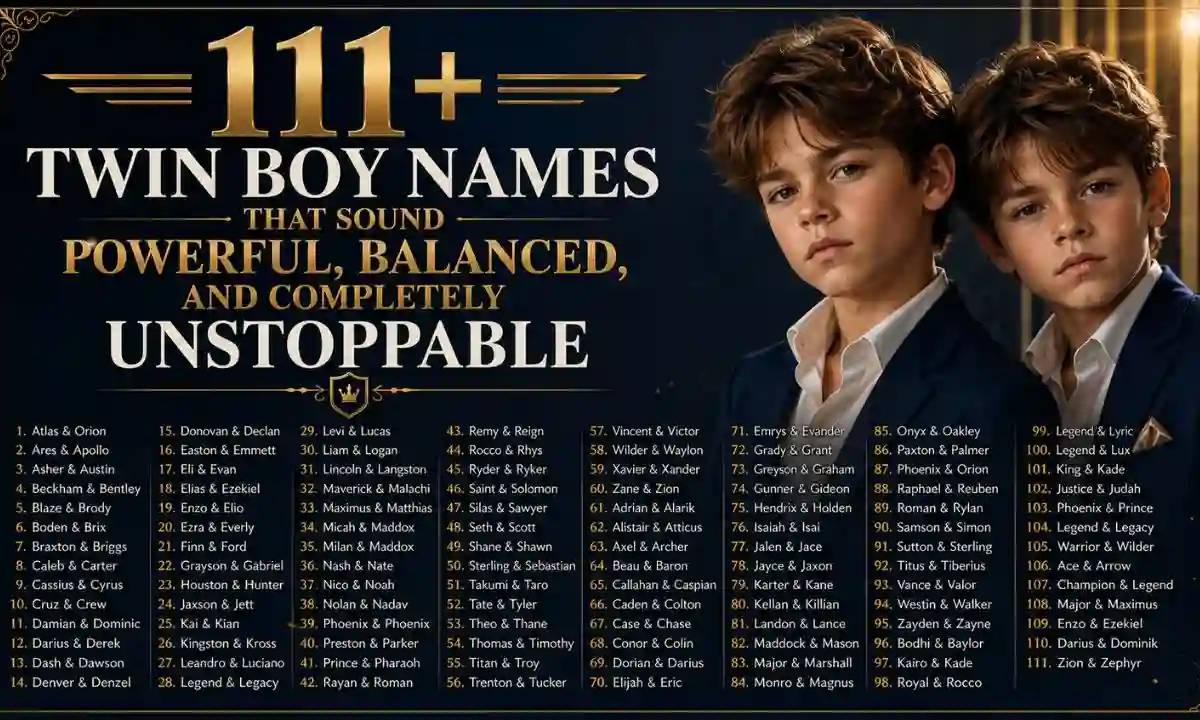
There is a particular challenge that twin naming presents that no other naming situation quite replicates. A single name exists on its own terms. It occupies its own space, carries its own weight, answers only to itself. But twin names exist in permanent relationship. They are always heard together, always compared, always understood as a pair before they are understood as individuals. And that relationship is not a constraint. It is an opportunity. The opportunity to create something that is greater than either name alone, a combination that carries a particular power precisely because the two names know exactly what they are to each other.
The names on this list come from every tradition that has ever produced names of genuine power. They come from the great Norse warrior tradition where a name was a declaration of the qualities a child was expected to grow into. From the Hebrew prophetic tradition where a name carried a relationship with the divine that shaped everything that followed. From the Celtic warrior tradition where a name was a battle cry as much as an identity. From the Sanskrit tradition of South Asia where a name could carry a cosmological meaning that placed the child within the structure of the universe.
Quick Note: Popularity rankings where noted are based on SSA data. Names ranked above 1000 are genuinely rare. The best twin pairs often combine one name with broader recognition and one with genuine rarity, creating a pairing that feels both accessible and distinctive.
Twin Boy Pairs That Sound Like They Were Born to Lead
Caspian and Leander Origins: Persian / Greek Meanings: From the Caspian Sea / Lion man, defender Rarity: Both rare
Caspian carries the vast, slightly mysterious energy of the great inland sea that sits between Europe and Asia, a body of water that has been the boundary of empires and the route of explorers for five thousand years. Leander carries the fierce, warm meaning of the lion man, the defender who combines the fiercest animal in the Greek bestiary with the human quality of protective strength. Together they create a pair of extraordinary geographic and mythological sweep, one name opening outward toward the horizon and the other planting itself firmly in the earth, and the combination is completely, unstoppably powerful.
Atticus and Evander Origins: Greek / Greek-Latin Meanings: From Attica, the Athenian / Good man, benefactor Rarity: Atticus uncommon, Evander rare
Atticus carries the full weight of both the ancient Athenian intellectual tradition and the extraordinary literary legacy Harper Lee gave it in To Kill a Mockingbird, a name forever associated with the particular quality of quiet moral courage that does not need to announce itself because it is simply the condition of the person who carries it. Evander carries the warm, slightly heroic meaning of the good man, the benefactor who came from Greece to Italy and founded the settlement on the Palatine Hill where Rome would eventually rise. These two names together create the pairing of the thinker and the founder, the man of principle and the man of action, and that combination is as old and as powerful as civilization itself.
Magnus and Leif Origins: Latin-Norse / Norse Meanings: The great one / Heir, descendant Rarity: Magnus uncommon, Leif rare
Magnus carries the clean, commanding meaning of the great one in the Norse-Latin tradition, a name borne by kings of Norway and Denmark and Scotland and carried through the Viking age with the particular authority of a name that does exactly what it says. Leif carries the warm, forward-moving meaning of the heir and the descendant, forever associated with Leif Eriksson who reached North America five hundred years before Columbus and whose name carries the particular quality of someone who went further than anyone before them and made it look natural. Magnus and Leif together are the great king and the great explorer, the one who holds the center and the one who finds the edge.
Alistair and Cormac Origins: Scottish Gaelic / Irish Gaelic Meanings: Defender of men / Charioteer, son of the raven Rarity: Alistair uncommon, Cormac rare
Alistair carries the clean, commanding Scottish Gaelic form of Alexander, the defender of men, in a name that has the cold clarity of Highland granite and the particular authority of a name worn by generations of Scottish families who needed to be exactly what the name said. Cormac carries the fierce, slightly dark Irish Gaelic meaning of the charioteer or the son of the raven, associated with Cormac mac Airt, the legendary High King of Ireland whose court was celebrated as a golden age of Irish culture. Together they create the pair of the Scottish defender and the Irish king, two distinct traditions of Celtic power that complement rather than compete.
Theron and Orion Origins: Greek / Greek Meanings: Hunter / The great hunter, the constellation Rarity: Both uncommon
Theron carries the clean, slightly fierce Greek meaning of the hunter, the one who pursues with skill and patience and never returns empty-handed. Orion carries the extraordinary mythological meaning of the great hunter who was placed among the stars, the most recognizable constellation in the winter sky, the hunter whose pursuit of the Pleiades continues for eternity. These two names create the pairing of the earthly hunter and the celestial one, the man and the myth, and their combination of similar meaning expressed through completely different sounds creates a resonance that is genuinely powerful.
Caelum and Zephyr Origins: Latin / Greek Meanings: Heaven, the sky / The west wind Rarity: Both rare
Caelum carries the vast, slightly vertiginous meaning of the sky itself, the Latin word for the heavens that was used by astronomers and poets and theologians alike to describe the limitless space above the world. Zephyr carries the beautiful, slightly wild meaning of the west wind, the gentlest of the classical winds that brought spring to the Mediterranean world and whose name the Greeks gave to the most beloved seasonal change of the year. Together they are the sky and the wind that moves through it, two expressions of the atmospheric world that belong together the way weather belongs to the sky it moves through.
Twin Boy Pairs From the Norse and Viking Tradition
Ragnar and Bjorn Origins: Old Norse / Old Norse Meanings: Warrior’s judgment, decisive warrior / Bear Rarity: Both rare in English-speaking countries
Ragnar carries the fierce, slightly commanding meaning of the warrior who makes decisive judgments, the leader whose authority in battle comes not just from strength but from clarity of thought under pressure. Bjorn carries the clean, powerful meaning of the bear, the animal that the Norse warrior tradition considered the embodiment of strength, courage, and the particular kind of ferocity that is rooted in genuine power rather than aggression. Ragnar and Bjorn are the mind and the body of Norse warrior culture expressed as two names that carry the full weight of a tradition that shaped the history of Europe from Ireland to Russia.
Gunnar and Sigurd Origins: Old Norse / Old Norse Meanings: Battle warrior, the fighting man / Guardian of victory Rarity: Both rare in English-speaking countries
Gunnar carries the fierce, clean meaning of the battle warrior, a name so thoroughly rooted in the Norse fighting tradition that it appears in both the Volsunga Saga and the Nibelungenlied as one of the great warrior heroes. Sigurd carries the equally fierce but more protective meaning of the guardian of victory, the warrior whose purpose is not just to fight but to ensure that the fighting achieves its purpose. Together they create the pairing of the warrior and the strategist, the fighter and the guardian of the outcome, and that combination is as unstoppable as any pairing on this list.
Eirik and Halvard Origins: Old Norse / Old Norse Meanings: Ever powerful, eternal ruler / Guardian of the rock Rarity: Both rare
Eirik carries the extraordinary meaning of the ever powerful and the eternal ruler, a name borne by Erik the Red who founded the Norse settlement in Greenland and whose son Leif went on to reach North America. Halvard carries the slightly unusual but beautifully solid meaning of the guardian of the rock, the protector of the firm foundation, the one whose role is to hold the ground that others have taken. Eirik and Halvard are the explorer and the guardian, the one who goes further and the one who holds what has been found.
Vidar and Fenrir Origins: Old Norse / Old Norse Meanings: Wide warrior / Fen dweller, the great wolf Rarity: Both very rare
Vidar carries the cool, slightly spacious Norse meaning of the wide warrior, the son of Odin who avenges his father’s death at Ragnarok and survives into the new world, representing the continuity of divine power through catastrophe. Fenrir carries the fierce, slightly dark meaning of the great wolf who lives in the fen, the monstrous wolf of Norse mythology who breaks free at Ragnarok and swallows Odin himself, the embodiment of the wild, unchainable power that exists at the edge of every ordered world. Together they are destruction and the survivor of destruction, a pairing that carries the full weight of the Norse mythological imagination.
Torsten and Leifur Origins: Old Norse / Old Norse Meanings: Thor’s stone, the stone of thunder / Heir, the descendant Rarity: Both rare
Torsten carries the fierce, slightly monumental meaning of Thor’s stone, the rock that the thunder god has claimed as his own, a name that combines the divine power of the most active Norse god with the permanent solidity of stone. Leifur carries the warm, slightly forward-moving meaning of the heir and the descendant in its specifically Icelandic form, the version of Leif that was preserved in the Icelandic sagas that kept the Norse literary tradition alive through the medieval centuries. Together they are the immovable and the moving, the stone and the heir who inherits it.
Twin Boy Pairs From Celtic Traditions
Declan and Tiernan Origins: Irish Gaelic / Irish Gaelic Meanings: Man of prayer, full of goodness / Lord, little lord Rarity: Declan uncommon, Tiernan rare
Declan carries the warm, slightly spiritual Irish meaning of the man of prayer and goodness, the name of one of the pre-Patrician saints of Ireland who brought Christianity to Munster before Patrick arrived in the north and whose holy well at Ardmore is still a place of pilgrimage. Tiernan carries the clean, slightly commanding Irish meaning of the little lord, the one who carries authority not through size but through the quality of their presence. Together they create the pairing of the spiritual and the temporal, the man of faith and the man of authority, and in the Irish tradition those two qualities have always been understood as complementary rather than competing.
Finbar and Ronan Origins: Irish Gaelic / Irish Gaelic Meanings: Fair-haired one, white head / Little seal, oath Rarity: Both rare outside Ireland
Finbar carries the warm, slightly luminous Irish meaning of the fair-haired one or the white-headed one, the name of the patron saint of Cork who founded the monastery from which the city grew and whose name has been carried by generations of Cork families as a quiet act of local loyalty. Ronan carries the beautiful, slightly marine Irish meaning of the little seal and the oath, a name that connects its bearer to both the sacred sea creatures of Irish mythology and the solemnity of the spoken promise. Together they are the light and the depth, the luminous surface and the dark water beneath it.
Eamon and Cillian Origins: Irish Gaelic / Irish Gaelic Meanings: Guardian of riches / War, strife, bright-headed Rarity: Both uncommon outside Ireland
Eamon carries the warm, slightly protective Irish meaning of the guardian of riches, the Irish form of Edmund whose quality of protective abundance suits any character whose purpose is to preserve what matters from everything that threatens it. Cillian carries the fierce, slightly unusual Irish meaning that combines the ideas of war and strife with the contrasting quality of bright-headedness, a name that suggests the particular Irish quality of carrying struggle and luminosity in the same breath without finding any contradiction between them. Together they are the guardian and the bright warrior, the keeper and the fighter.
Ossian and Fergal Origins: Irish Gaelic / Irish Gaelic Meanings: Little deer, fawn / Man of valor, courageous man Rarity: Both rare
Ossian carries the beautiful, slightly melancholy Irish meaning of the little deer or fawn, the name of the great legendary Irish poet and warrior who was the son of Fionn mac Cumhaill and whose supposed poems caused one of the great literary controversies of the eighteenth century when James Macpherson published his Ossian translations. Fergal carries the fierce, warm Irish meaning of the man of valor and courage, a name borne by several early Irish kings and carrying a direct, unambiguous statement of the quality it celebrates. Together they are the poet and the warrior, the maker of beauty and the maker of victory, a pairing that captures the Irish cultural ideal of the man who is both.
Caradoc and Brennus Origins: Welsh / Celtic/Gaulish Meanings: Beloved, dear one / King, raven, prince Rarity: Both rare
Caradoc carries the warm, slightly ancient Welsh meaning of the beloved and the dear one, the name of the great British chieftain who resisted the Roman invasion and was carried as a prisoner to Rome where his speech to the Senate was so impressive that Claudius spared his life. Brennus carries the fierce, slightly dark Celtic meaning of the king and the raven prince, the name of the Gaulish chieftain who sacked Rome in 390 BC and whose words Vae victis, woe to the conquered, remain among the most quoted statements of power in Western history. Together they are the beloved leader and the conquering king, and their combination creates a pairing of Celtic power that spans the full range of what that tradition could produce.
Twin Boy Pairs From Hebrew and Biblical Traditions
Ezra and Levi Origins: Hebrew / Hebrew Meanings: Help, helper / Joined, united Rarity: Both uncommon, rising
Ezra carries the clean, slightly scholarly Hebrew meaning of the helper, the one who provides assistance and guidance, forever associated with the great scribe Ezra who led the return of the Jewish people from Babylonian exile and whose reading of the Torah to the assembled people was one of the founding moments of post-exilic Jewish identity. Levi carries the warm, slightly communal Hebrew meaning of the joined and the united, the name of the tribe of Israel set apart for priestly service and whose meaning of connection and belonging suits any child whose life will be defined by their relationships. Together they are the scholar and the priest, the one who teaches and the one who serves, and that combination carries the full weight of the Hebrew spiritual tradition.
Amos and Micah Origins: Hebrew / Hebrew Meanings: Carried by God, burden bearer / Who is like God Rarity: Both uncommon
Amos carries the fierce, slightly prophetic Hebrew meaning of the one carried by God, the burden bearer whose weight is divine in origin, associated with the great shepherd prophet Amos whose book contains some of the most powerful statements of social justice in the Hebrew Bible. Micah carries the rhetorical, slightly philosophical Hebrew meaning of the question who is like God, a name that is itself an argument, a declaration that nothing and no one can be compared to the divine. Together they are the burden bearer and the questioner, the prophet who carries and the prophet who asks, and their combination creates a pairing of extraordinary prophetic depth.
Gideon and Phineas Origins: Hebrew / Hebrew Meanings: Great warrior, one who cuts down / Mouth of brass, oracle Rarity: Gideon uncommon, Phineas rare
Gideon carries the fierce, slightly dramatic Hebrew meaning of the great warrior and the one who cuts down, the judge of Israel who defeated the Midianites with three hundred men and torches hidden in clay pots in one of the most audacious military strategies in the Hebrew Bible. Phineas carries the ancient, slightly mysterious Hebrew meaning of the mouth of brass or the oracle, a name that belongs to the deepest layers of the Israelite priestly tradition. Together they are the warrior and the oracle, the fighter and the seer, and their combination creates a pairing that covers the full range of Hebrew heroic types.
Elijah and Jonah Origins: Hebrew / Hebrew Meanings: My God is Yahweh / Dove, peaceful one Rarity: Both uncommon, rising
Elijah carries the fierce, slightly stormy Hebrew meaning of the declaration my God is Yahweh, the name of the great prophet who called down fire from heaven on Mount Carmel and was taken up to God in a chariot of fire without experiencing death. Jonah carries the beautiful, slightly paradoxical Hebrew meaning of the dove and the peaceful one, the name of the prophet who tried to run from God’s call and ended up inside a great fish before completing his mission and then arguing with God about the outcome. Together they are the fire prophet and the reluctant one, the absolute certainty and the complicated faith, and their pairing carries both the grandeur and the very human difficulty of the prophetic tradition.
Malachi and Ezekiel Origins: Hebrew / Hebrew Meanings: My messenger, my angel / God strengthens Rarity: Both uncommon
Malachi carries the warm, slightly celestial Hebrew meaning of my messenger and my angel, the name of the last of the Hebrew prophets whose book closes the Old Testament in the Christian arrangement and whose prophecy of the returning Elijah connects the two testaments. Ezekiel carries the dramatic, slightly visionary Hebrew meaning of God strengthens, the name of the prophet of the Babylonian exile whose extraordinary visions of the divine chariot and the valley of dry bones are among the most powerful images in all of biblical literature. Together they are the messenger and the visionary, the one who delivers and the one who sees, and their combination is as powerful as the tradition that produced them.
Twin Boy Pairs From Arabic and Islamic Traditions
Tariq and Zaid Origins: Arabic / Arabic Meanings: Morning star, night visitor / Growth, increase Rarity: Both common in the Muslim world
Tariq carries the extraordinary Arabic meaning of the morning star and the night visitor, the name of the star that appears brightest just before dawn and forever associated with Tariq ibn Ziyad, the Berber general who crossed the strait that bears his name Gibraltar, Jabal al-Tariq, and conquered the Iberian Peninsula in a campaign of extraordinary speed and audacity. Zaid carries the warm, forward-moving Arabic meaning of growth and increase, the name of the Prophet Muhammad’s adopted son and one of the earliest converts to Islam. Together they are the brilliant arrival and the steady growth, the star and the flourishing, and their combination is as powerful as the tradition it comes from.
Khalid and Umar Origins: Arabic / Arabic Meanings: Eternal, immortal / Long-lived, flourishing Rarity: Both common in the Muslim world
Khalid carries the clean, commanding Arabic meaning of the eternal and the immortal, forever associated with Khalid ibn al-Walid, the undefeated general of early Islam who was called the Sword of God and who never lost a single battle in his military career. Umar carries the warm, slightly powerful Arabic meaning of the long-lived and flourishing, forever associated with Umar ibn al-Khattab, the second caliph whose administrative genius transformed the early Islamic community into an empire. Together they are the sword and the administrator, the undefeated warrior and the master builder of institutions, and their combination covers the full range of what power means in the Arabic tradition.
Idris and Malik Origins: Arabic / Arabic Meanings: Interpreter, studious one / King, master Rarity: Both uncommon in Western contexts
Idris carries the warm, slightly scholarly Arabic meaning of the interpreter and the studious one, the name of the prophet identified with Enoch in the Islamic tradition who was taken up to heaven without dying and who is associated with the sciences and with writing. Malik carries the clean, commanding Arabic meaning of the king and the master, one of the ninety-nine names of God in Islamic theology and a personal name of extraordinary authority. Together they are the scholar and the king, the one who interprets the world and the one who governs it, and that combination carries the full weight of the Islamic ideal of the ruler who is also a man of learning.
Suleiman and Dawud Origins: Arabic / Hebrew-Arabic Meanings: Peace, man of peace / Beloved Rarity: Both common in the Muslim world
Suleiman carries the extraordinary Arabic form of Solomon, the king of peace, the great Israelite king whose wisdom and wealth were legendary and whose Arabic form was borne by Suleiman the Magnificent, the greatest Ottoman sultan, whose reign represented the peak of Ottoman power and cultural achievement. Dawud carries the warm, intimate Arabic form of David, the beloved one, the shepherd king of Israel whose psalms remain the most widely read poetry in human history. Together they are the great king and the beloved poet, the magnificent and the deeply human, and their pairing carries the weight of three millennia of devotion to these two names.
Twin Boy Pairs From African Traditions
Kwame and Kofi Origins: Akan/Ghanaian / Akan/Ghanaian Meanings: Born on Saturday / Born on Friday Rarity: Common in Ghana
Kwame and Kofi are both Akan day names, names given to children based on the day of the week on which they were born, and their pairing creates an immediate cultural and spiritual connection rooted in the Akan understanding of time as a sacred dimension in which birth is a spiritually significant event. Kwame carries the extraordinary legacy of Kwame Nkrumah, the founding father of Ghana. Kofi carries the distinguished legacy of Kofi Annan, the United Nations Secretary-General whose Nobel Peace Prize recognized a lifetime of work toward human dignity. Together they are two days of the sacred week, two expressions of the Akan understanding that when you were born is as significant as who you were born to.
Chukwuemeka and Obiora Origins: Igbo/Nigerian / Igbo/Nigerian Meanings: God has done great things / The heart of the community Rarity: Common in eastern Nigeria
Chukwuemeka carries the deeply spiritual Igbo meaning of the declaration that God has done great things, a name that is itself an act of praise, a statement of gratitude for something so extraordinary that only divine agency can explain it. Obiora carries the warm, communal Igbo meaning of the heart of the community, the one who sits at the center of the social world and whose presence defines the quality of the life around them. Together they are the divine acknowledgment and the human center, the vertical relationship with God and the horizontal relationship with the community, and their combination carries the full depth of Igbo spiritual and social thought.
Seun and Tunde Origins: Yoruba/Nigerian / Yoruba/Nigerian Meanings: This one has honor / The crown has returned Rarity: Common in western Nigeria
Seun carries the warm, slightly proud Yoruba meaning of this one has honor, a declaration about the child that simultaneously describes and predicts, the name as prophecy and as observation combined. Tunde carries the warm, slightly royal Yoruba meaning of the crown has returned, a name that suggests continuity, the return of something valuable that was temporarily absent. Together they are the honorable and the returning royal, the one who carries dignity and the one who restores what was lost, and their combination creates a pairing of Yoruba values at its most complete.
Amara and Dayo Origins: Igbo/Nigerian / Yoruba/Nigerian Meanings: Grace, mercy / Joy arrives, joy has come Rarity: Both uncommon in Western contexts
Amara carries the beautiful, slightly spiritual Igbo meaning of grace and mercy, the quality of unearned goodness that arrives as a gift rather than as a reward. Dayo carries the warm, celebratory Yoruba meaning of joy arrives or joy has come, the announcement of happiness as a fact. Together they cross the boundary between Igbo and Yoruba tradition to create a pairing that carries both grace and joy, the deep quality and the arriving emotion, and their combination is as complete a statement of what a good life might feel like as any two names could manage.
Twin Boy Pairs From South Asian Traditions
Arjun and Kiran Origins: Sanskrit / Sanskrit Meanings: Bright, silver-white / Ray of light, sunbeam Rarity: Both common in India
Arjun carries the clean, slightly luminous Sanskrit meaning of the bright and silver-white one, the name of the great archer hero of the Mahabharata whose conversation with Krishna forms the Bhagavad Gita, one of the most significant texts in the Hindu tradition. Kiran carries the warm, slightly solar Sanskrit meaning of the ray of light and the sunbeam, a name that describes the quality of illumination that cuts through darkness with a precision and a warmth that the full sun cannot. Together they are the great warrior and the beam of light, the hero and the illumination he carries, and their combination is as powerful as the tradition that produced them.
Devraj and Suresh Origins: Sanskrit / Sanskrit Meanings: King of the gods / Ruler of the gods, Indra Rarity: Common in India
Devraj carries the commanding Sanskrit meaning of the king of the gods, the title that belongs to Indra the lord of heaven and the greatest of the Vedic deities whose thunderbolt shapes the weather and whose authority shapes the divine order. Suresh carries the warm, slightly synonymous Sanskrit meaning of the ruler of the gods, another name for Indra that emphasizes the governing quality of divine authority. Together they are two expressions of the same supreme power, a pairing that creates a resonance through similarity rather than contrast, like two instruments playing the same note in different octaves.
Vikram and Aditya Origins: Sanskrit / Sanskrit Meanings: Valor, stride / Son of Aditi, the sun Rarity: Both common in India
Vikram carries the fierce, clean Sanskrit meaning of valor and the great stride, the name of the legendary king Vikramaditya whose court was celebrated as the golden age of Sanskrit literature and whose name combines the two qualities of courage and the expansive movement that courage makes possible. Aditya carries the warm, slightly solar Sanskrit meaning of the son of the boundless mother Aditi and the name for the sun itself, the source of all light and warmth in the Hindu cosmological tradition. Together they are valor and the sun, the fierce stride forward and the light that illuminates the path, and their combination is as complete as the Sanskrit tradition’s understanding of what heroic existence requires.
Rohan and Ishaan Origins: Sanskrit / Sanskrit Meanings: Ascending, growing / The sun, the northeast direction Rarity: Both common in India
Rohan carries the clean, forward-moving Sanskrit meaning of the one who ascends and grows, the name that describes the permanent upward trajectory of a life that is always becoming more than it was. Ishaan carries the warm, slightly directional Sanskrit meaning of the sun and the auspicious northeast direction from which the sun rises and which is considered the most sacred direction in Hindu cosmology. Together they are the ascending and the direction of ascent, the growth and the light that grows toward, and their combination creates a pairing of extraordinary forward momentum.
Twin Boy Pairs From Greek and Classical Traditions
Apollo and Zephyr Origins: Greek / Greek Meanings: Destroyer, the god of light and arts / West wind Rarity: Both rare
Apollo carries the extraordinary mythological meaning of the destroyer and the god of light, arts, music, and prophecy, the most complex and most completely realized of all the Olympian gods whose domains span the full range of human creative and rational achievement. Zephyr carries the beautiful, slightly wild meaning of the west wind, the gentlest and most beloved of the classical winds. Together they are the god of light and the wind that moves through the light, the creative power and the atmosphere it breathes in, and their combination is as mythologically rich as any pairing available in the Greek tradition.
Orion and Perseus Origins: Greek / Greek Meanings: The great hunter, the constellation / The destroyer, the hero Rarity: Both rare
Orion carries the extraordinary mythological meaning of the great hunter placed among the stars, whose pursuit of the Pleiades continues for eternity and whose constellation is the most recognizable in the winter sky. Perseus carries the fierce, slightly dark Greek meaning of the destroyer, the hero who killed the Gorgon Medusa and the sea monster Cetus and rescued Andromeda, creating the founding myth of the Argive dynasty. Together they are the eternal hunter and the great destroyer, the pursuer and the slayer, and their combination carries the full weight of Greek heroic mythology.
Leonidas and Theseus Origins: Greek / Greek Meanings: Son of the lion / Settler, the one who establishes Rarity: Both rare
Leonidas carries the fierce, slightly magnificent Greek meaning of the son of the lion, forever associated with the Spartan king who held the pass at Thermopylae with three hundred men against the entire Persian army and whose last stand has become the defining image of courage in the face of impossible odds. Theseus carries the warm, slightly civilizing Greek meaning of the settler and the one who establishes, the great Athenian hero who unified Attica, killed the Minotaur, and founded the democratic tradition. Together they are the last stand and the foundation, the warrior and the builder, and their combination covers the full range of what Greek heroism meant.
Frequently Asked Questions
Q: What makes twin boy names feel powerful and balanced simultaneously? A: The most powerful balanced twin boy name pairs share a similar weight but carry different textures. They tend to come from the same tradition or from traditions with a similar depth of history, but they occupy different positions within that tradition. One name might carry a warrior meaning and the other a ruler meaning. One might carry a celestial meaning and the other an earthly one. The balance comes not from matching but from complementing, two names that together tell a larger story than either could tell alone.
Q: Should twin boy names start with the same letter? A: Starting with the same letter creates a superficial matching that can feel more like a costume than a genuine pairing. The most powerful twin name pairs tend to start with different letters and carry different sounds that complement rather than echo each other. Atticus and Evander. Ragnar and Bjorn. Ezra and Levi. These pairs sound nothing alike at the level of individual sound, but they carry the same weight and the same quality of genuine depth, and that invisible similarity is far more powerful than any surface matching.
Q: How important is meaning when choosing twin boy names? A: Meaning is the foundation of everything. A name whose meaning is completely unknown to the people who hear it still carries that meaning in the way a foundation carries a house, invisibly but essentially. The most powerful twin pairings tend to carry meanings that relate to each other in a way that creates a larger story, the warrior and the guardian, the scholar and the king, the hunter and the star. When you know what your sons’ names mean and those meanings create a narrative together, the pairing has a depth that no amount of surface matching can replicate.
Q: Is it better to choose twin names from the same cultural tradition? A: Choosing from the same tradition creates an internal consistency and a shared cultural depth that is genuinely powerful. But some of the most extraordinary twin pairings cross cultural boundaries in ways that reflect a family’s own heritage or simply honor the extraordinary variety of human naming traditions. The test is not cultural consistency but genuine compatibility, two names that carry a similar weight and create a genuine relationship when heard together.
Q: What twin name pairs from this list are the most completely unstoppable? A: The most completely unstoppable pairs tend to be those where both names carry a weight of genuine historical or mythological significance and where the combination creates a meaning larger than either name alone. Atticus and Evander. Khalid and Umar. Leonidas and Theseus. Ragnar and Bjorn. Chukwuemeka and Obiora. These pairs arrive with centuries of accumulated power behind them and a relationship between them that feels inevitable rather than chosen.
Conclusion
Twin boy names that sound powerful, balanced, and completely unstoppable share a single quality that transcends culture, tradition, and era. They carry genuine weight on both sides of the pair. Not the performed weight of names chosen for their impressive sound, but the actual weight of names rooted in real history, real mythology, real human achievement, real spiritual depth. Whether you choose Caspian and Leander from the Greek and Persian traditions, Magnus and Leif from the Norse warrior world, Declan and Tiernan from the Celtic tradition, Ezra and Levi from the Hebrew prophetic tradition, Khalid and Umar from the great age of Islamic civilization, Kwame and Kofi from the Akan tradition of sacred time, Arjun and Kiran from the Sanskrit cosmological tradition, Leonidas and Theseus from the Greek heroic world, or any of the other pairs on this list, you are giving your sons names that will carry each other as naturally as the boys themselves will carry each other through their shared life. The right twin pair does not just name two people. It names a relationship. It names a story. It names something that is greater than either half of it alone, and it does that work from the very first moment it is spoken aloud, and it keeps doing it for as long as the names are carried. Which is a very long time indeed.

Olivia Lane is a devoted Christian writer and faith blogger at PrayerPure.com, where she shares heartfelt prayers, Bible verses, and spiritual reflections to inspire believers around the world. Her gentle words help readers find peace, purpose, and strength in God’s presence every day. When she’s not writing, Olivia enjoys reading devotionals, spending time outdoors, and connecting with her church community.