

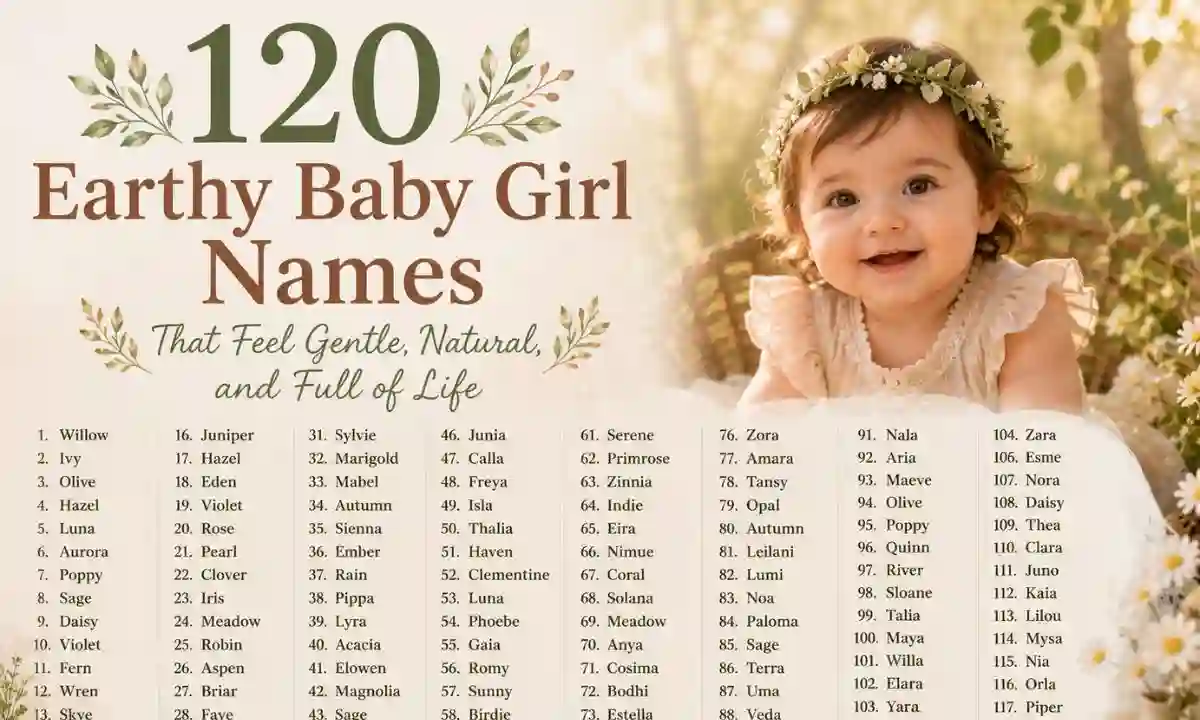
There is something genuinely grounding about a name that comes from the earth. Not the earth as a metaphor or an abstraction, but the actual, physical, beautiful, complicated earth beneath our feet, the one with soil and roots and rivers and stones and the particular quality of light that falls through leaves in the late afternoon. An earthy name for a girl carries that quality into a life, a constant, gentle reminder of where things come from and what sustains them, a name that belongs to the world of growing things and flowing water and the deep, patient processes that keep everything alive.
What makes earthy names for girls so extraordinarily varied is the sheer breadth of the natural world they draw from. The botanical tradition gives us names drawn from trees, herbs, flowers, and the whole rich vocabulary of the plant kingdom. The geological tradition contributes names of stones and minerals and the ancient formations of the earth itself. The seasonal tradition brings names that belong to specific moments in the turning year, the first green of early spring, the heavy abundance of summer, the amber light of autumn, the clean silence of winter. The water tradition gives us names of rivers and springs and rain and the sea. And from the great nature-loving literary traditions of the Romantics and the Transcendentalists, from the indigenous naming traditions that have always understood the natural world as alive and full of meaning, from the long history of botanical naming that has turned the classification of plants into a kind of poetry, earthy names for girls arrive with a particular combination of gentleness, depth, and the kind of quiet, sustaining life that the earth itself embodies.

Quick Info: Names ranked above 1000 on the SSA database are considered truly rare and unique. Names closer to 1 are among the most popular in the US today.
Popular Earthy Girl Names
Violet
- Origin: Latin
- Meaning: The violet flower, purple
- Popularity: #7
One of the great flower names of the English and Latin tradition, Violet has been rising powerfully into the national top ten with a warm, slightly vintage quality and a deep botanical heritage that makes it one of the most genuinely appealing popular earthy names, carrying the delicate purple flower and its sweet, slightly hidden scent in a name of genuine beauty and complete, effortless elegance.
Ivy
- Origin: English
- Meaning: The ivy plant, fidelity
- Popularity: #31
Named after the climbing ivy plant whose tenacious, faithful growth has made it a symbol of fidelity and endurance across cultures for thousands of years, Ivy has been sitting in the national top forty with a warm, minimal quality and a deep English botanical heritage that makes it one of the most genuinely appealing popular earthy names, carrying the green persistence of the ivy in four clean letters.
Aurora
- Origin: Latin
- Meaning: Dawn, the Roman goddess of the dawn
- Popularity: #35
The Roman goddess of the dawn and the scientific name for the northern lights, Aurora carries both the celestial and the natural world in a name of warm, flowing quality that has been rising powerfully into the national top forty, connecting the earthy tradition through the dawn light that touches the landscape with the first warmth of the new day.
Hazel
- Origin: English
- Meaning: The hazel tree, the hazelnut
- Popularity: #30
Named after the hazel tree whose catkins are among the first signs of spring and whose nuts have sustained human communities across Europe for thousands of years, Hazel has been sitting in the national top thirty with a warm, slightly vintage quality and a deep English botanical heritage that makes it one of the most genuinely appealing popular earthy names.
Willow
- Origin: English
- Meaning: The willow tree
- Popularity: #27
Named after the great weeping willow tree whose flowing branches touch the surface of rivers and ponds with a gentle, slightly melancholy grace, Willow has been rising powerfully into the national top thirty with a warm, flowing quality and a deep English botanical heritage that makes it one of the most genuinely beautiful popular earthy names.
Luna
- Origin: Latin
- Meaning: Moon, the Roman goddess of the moon
- Popularity: #10
The Roman goddess of the moon who governs the tides and the growing cycles of the natural world, Luna carries both the celestial and the earthy in a name of warm, flowing quality that has been sitting in the national top ten with a completely effortless appeal, connecting the lunar cycles that govern so much of the natural world.
Sage
- Origin: English/Latin
- Meaning: Wise, the herb sage
- Popularity: #273
Named after the aromatic sage herb whose silvery-green leaves and purple flowers have been used in cooking, medicine, and spiritual practice across Mediterranean and indigenous American cultures for thousands of years, Sage carries both the natural and the philosophical in a name of clean, minimal quality and a deep botanical heritage.
Iris
- Origin: Greek
- Meaning: Rainbow, the iris flower
- Popularity: #95
Named after the rainbow and the beautiful iris flower whose extraordinary range of colors has made it a symbol of diversity and the spectrum of light across cultures, Iris has been rising carefully into the national top one hundred with a warm, clean quality and a deep Greek mythological and botanical heritage.
Flora
- Origin: Latin
- Meaning: Flower, the Roman goddess of flowers and spring
- Popularity: #494
The Roman goddess of flowers and spring whose festival Floralia was one of the most joyful celebrations of the Roman calendar, Flora carries a deep classical and botanical heritage and a warm, slightly vintage quality that has been bringing it carefully back into fashion among parents who want something with genuine mythological depth and botanical beauty.
River
- Origin: English
- Meaning: A flowing body of water, a river
- Popularity: #189
Named after the river itself, one of the most fundamental and life-giving features of the natural landscape, River has been rising carefully in the national rankings with a clean, flowing quality and a deep natural heritage that makes it one of the most genuinely appealing gender-neutral earthy names, carrying the essential movement and sustaining power of water.
Tree and Forest Names
Elm
- Origin: English
- Meaning: The elm tree
- Popularity: above 1000
Named after the great elm tree whose cathedral canopy once defined the English and American landscape before Dutch elm disease transformed it, Elm carries a warm, minimal quality and a deep natural heritage that makes it one of the most quietly distinctive rare tree names, three letters that contain the entire memory of the great arching elm avenues that once lined country roads.
Rowan
- Origin: Scottish Gaelic
- Meaning: The rowan tree, little red one
- Popularity: #308
Named after the rowan tree whose bright red berries in autumn are one of the most spectacular sights of the Scottish and Northern European landscape and whose ancient reputation for protection against evil made it one of the most sacred trees in the Celtic tradition, Rowan carries an extraordinary botanical and mythological heritage.
Acacia
- Origin: Greek
- Meaning: The acacia tree, thorny
- Popularity: above 1000
Named after the acacia tree whose feathery leaves and golden flowers are among the most beautiful in the natural world and whose wood is among the most durable, Acacia carries a warm, flowing quality and a deep classical and botanical heritage that makes it one of the most genuinely appealing rare tree names, carrying the sunlit quality of the acacia in the most flowing syllables.
Juniper
- Origin: Latin
- Meaning: The juniper tree, young
- Popularity: above 1000
Named after the juniper tree and shrub whose blue-grey berries flavor gin and whose resinous, slightly smoky scent is one of the most evocative in the natural world, Juniper has been rising carefully among parents who want something with a genuine botanical heritage and a clean, slightly unusual quality that carries the wild, aromatic spirit of the high mountain shrubland.
Linden
- Origin: Germanic/English
- Meaning: The linden tree, lime tree
- Popularity: above 1000
Named after the linden tree whose fragrant white blossoms fill the summer air with one of the most beautiful scents in the natural world, Linden carries a warm, slightly European quality and a deep Germanic and English heritage that makes it one of the most genuinely appealing rare tree names, used as both a surname and a given name across European traditions.
Aspen
- Origin: English
- Meaning: The aspen tree, trembling poplar
- Popularity: above 1000
Named after the aspen tree whose round leaves tremble in the slightest breeze and whose clonal groves are among the largest and oldest living organisms on earth, Aspen carries a warm, slightly Western American quality and a deep natural heritage that makes it one of the most genuinely appealing rare tree names for a girl of gentle, quivering, quietly extraordinary depth.
Cedar
- Origin: English/Hebrew
- Meaning: The cedar tree
- Popularity: above 1000
Named after the great cedar tree that is one of the most majestic and long-lived trees in the natural world, sacred in both the Hebrew Bible and the ancient traditions of the Middle East where the cedars of Lebanon were considered among the greatest wonders of the natural world, Cedar carries a deep natural and spiritual heritage.
Birch
- Origin: English
- Meaning: The birch tree
- Popularity: above 1000
Named after the birch tree whose white bark glows in the forest like a light of its own and whose thin, papery layers have been used for writing and for making canoes across cultures, Birch carries a warm, minimal quality and a deep natural heritage that makes it one of the most quietly distinctive rare tree names.
Sylva
- Origin: Latin
- Meaning: Forest, woodland
- Popularity: above 1000
Carrying the Latin meaning of forest and woodland, Sylva has a warm, flowing quality and a deep classical heritage rooted in the Roman reverence for the sacred forest that makes it one of the most genuinely appealing rare nature names, carrying the entire mystery and beauty of the woodland world in five clean letters.
Elowen
- Origin: Cornish
- Meaning: Elm tree
- Popularity: above 1000
A rare and beautiful Cornish name meaning elm tree, Elowen has a soft, slightly mysterious quality and a deep Celtic heritage rooted in the Cornish language tradition that is genuinely unlike anything else in contemporary naming, one of the most appealing rare Celtic nature names available, carrying the elm’s quiet grandeur in a name of genuine linguistic rarity.
Flower and Blossom Names
Clover
- Origin: English
- Meaning: The clover plant
- Popularity: above 1000
Named after the cheerful clover whose pink and white flowers carpet meadows and whose lucky four-leafed variety has been sought by children for centuries, Clover carries a warm, slightly whimsical quality and a deep English botanical heritage that makes it one of the most quietly appealing rare flower names, carrying the meadow sweetness of the clover in a name of complete, sunny gentleness.
Primrose
- Origin: English
- Meaning: First rose, the earliest flower of spring
- Popularity: above 1000
Named after the primrose whose pale yellow flowers are among the very first to appear in early spring, pushing up through the fallen leaves with a gentle, determined beauty, Primrose carries a warm, slightly vintage quality and a deep English botanical heritage that makes it one of the most quietly distinguished rare flower names.
Marigold
- Origin: English
- Meaning: Mary’s gold, the marigold flower
- Popularity: above 1000
Named after the marigold whose golden-orange flowers bloom with a warm, cheerful abundance and whose medicinal and culinary uses span every culture that has grown it, Marigold carries a warm, slightly vintage quality and a deep English botanical and religious heritage through its association with the Virgin Mary.
Zinnia
- Origin: Latin/German
- Meaning: Named after Johann Gottfried Zinn, the zinnia flower
- Popularity: above 1000
Named after the brilliant zinnia flower whose intense, saturated colors are among the most vivid in the botanical world and whose ability to thrive in hot, dry conditions gives it a particular quality of fierce, cheerful abundance, Zinnia carries a warm, flowing quality and a deep botanical heritage.
Aster
- Origin: Greek
- Meaning: Star, the aster flower
- Popularity: above 1000
Named after the aster flower whose star-shaped blooms in purple, pink, and white fill the autumn garden with a delicate, slightly celestial beauty and whose Greek name simply means star, Aster carries both the botanical and the celestial in a name of warm, clean quality and a deep classical heritage.
Dahlia
- Origin: Swedish/Botanical
- Meaning: Named after Anders Dahl, the dahlia flower
- Popularity: #497
Named after the spectacular dahlia flower whose vast range of forms and colors from tiny pompons to dinner-plate sized blooms makes it one of the most dramatically varied flowers in the botanical world, Dahlia carries a warm, flowing quality and a deep botanical heritage that has been bringing it carefully into the national rankings.
Clementine
- Origin: French/Latin
- Meaning: Mild, merciful, gentle
- Popularity: above 1000
While primarily a name of classical Latin heritage, Clementine also belongs in the earthy tradition through the clementine fruit whose small, sweet, fragrant quality captures the warmth of the citrus grove, carrying both the linguistic and the botanical in a name of warm, flowing French quality.
Sorrel
- Origin: English/French
- Meaning: Reddish brown, a spring herb
- Popularity: above 1000
Named after the sorrel herb that pushes up bright and sharp in early spring with a tartness that makes it one of the most distinctively flavored of all the wild herbs, Sorrel carries a warm, earthy quality and a deep English and French botanical heritage that makes it one of the most quietly distinctive rare herb names.
Verbena
- Origin: Latin
- Meaning: Sacred bough, the verbena plant
- Popularity: above 1000
Named after the verbena plant whose delicate flowers and aromatic qualities have given it a sacred role in Roman religious ritual and a beloved place in the cottage garden, Verbena carries a warm, flowing quality and a deep Latin botanical and religious heritage that makes it one of the most genuinely appealing rare herb and flower names.
Calendula
- Origin: Latin
- Meaning: Little clock, the pot marigold
- Popularity: above 1000
Named after the calendula or pot marigold whose golden flowers have been used in herbal medicine and cooking across European cultures for centuries and whose Latin name refers to its habit of blooming throughout the calendar, Calendula carries a warm, flowing quality and a deep botanical heritage.
Herb and Garden Names
Lavender
- Origin: English/Latin
- Meaning: The lavender plant, pale purple
- Popularity: above 1000
Named after the lavender plant whose silvery-grey foliage and purple flower spikes fill the summer air with one of the most beloved and evocative scents in the natural world, Lavender carries a warm, flowing quality and a deep English and Provençal botanical heritage that makes it one of the most genuinely appealing rare herb names, carrying the entire sensory world of the lavender field.
Rosemary
- Origin: Latin
- Meaning: Dew of the sea, the rosemary herb
- Popularity: above 1000
Named after the rosemary herb whose resinous, Mediterranean scent is one of the most ancient in culinary and medicinal tradition and whose Latin name means dew of the sea, describing its preference for coastal hillsides, Rosemary carries a warm, slightly vintage quality and a deep botanical and literary heritage.
Thyme
- Origin: Greek/English
- Meaning: The thyme herb, to fumigate
- Popularity: above 1000
Named after the thyme herb whose tiny leaves and pink flowers pack one of the most intense and characteristic flavors in the entire culinary tradition into the smallest possible plant, Thyme carries a warm, minimal quality and a deep Greek and English botanical heritage that makes it one of the most quietly distinctive rare herb names.
Fennel
- Origin: English/Latin
- Meaning: The fennel herb
- Popularity: above 1000
Named after the fennel plant whose feathery fronds and anise-scented seeds have been used in cooking and medicine across Mediterranean cultures for thousands of years and whose tall, golden-flowered presence in a garden is one of the most graceful, Fennel carries a warm, slightly unusual quality and a deep botanical heritage.
Rue
- Origin: English/Greek
- Meaning: The rue herb, regret
- Popularity: above 1000
Named after the rue herb that was used in medicine and in magical tradition across European cultures and that Shakespeare’s Ophelia distributed with such poignant significance, Rue carries both the botanical and the literary in a name of clean, minimal quality and a deep English and Greek heritage that makes it one of the most quietly distinctive rare herb names.
Chamomile
- Origin: Greek/English
- Meaning: Earth apple, ground apple
- Popularity: above 1000
Named after the chamomile herb whose apple-scented flowers have been used for thousands of years as a gentle, calming remedy and whose name from the Greek means earth apple for the low-growing, apple-scented quality of the plant, Chamomile carries a warm, flowing quality and a deep herbal heritage.
Wormwood
- Origin: English
- Meaning: The wormwood plant, bitter herb
- Popularity: above 1000
Named after the wormwood plant whose bitter qualities gave it a role in both medicine and literature, most famously in Tolstoy’s War and Peace where a character’s name Helene is replaced by the bitterness of wormwood, and in the tradition of absinthe, Wormwood carries a slightly dark, deeply literary botanical quality.
Tansy
- Origin: English/Greek
- Meaning: Immortality, the tansy herb
- Popularity: above 1000
Named after the tansy herb whose ferny leaves and button-like yellow flowers have been used across European traditions in ways that reflect its Greek name meaning immortality, Tansy carries a warm, slightly unusual quality and a deep botanical and classical heritage that makes it one of the most quietly distinctive rare herb names.
Marjoram
- Origin: Latin/English
- Meaning: The marjoram herb
- Popularity: above 1000
Named after the marjoram herb whose warm, slightly sweet fragrance has made it one of the most beloved herbs in both the kitchen and the garden since antiquity, Marjoram carries a warm, flowing quality and a deep botanical heritage that makes it one of the most genuinely appealing rare herb names, carrying the Mediterranean warmth of the marjoram field.
Saffron
- Origin: Arabic/English
- Meaning: Yellow, the saffron spice
- Popularity: above 1000
Named after the saffron spice derived from the crocus flower whose extraordinary golden color and delicate flavor have made it the most precious spice in the world, Saffron carries a warm, slightly exotic quality and a deep Arabic and English botanical heritage that makes it one of the most genuinely appealing rare spice names.
Stone and Mineral Names
Flint
- Origin: English
- Meaning: Flint stone, spark maker
- Popularity: above 1000
Named after the flint stone that has been striking sparks and making fire and tipping arrows and shaping tools for hundreds of thousands of years, Flint carries a fierce, elemental quality and a deep natural heritage in just five clean letters that contain the entire history of human relationship with the spark-making stone.
Slate
- Origin: English
- Meaning: Slate stone, grey rock
- Popularity: above 1000
Named after the flat grey slate stone that has roofed cottages and paved pathways and provided writing surfaces and floored kitchens across European cultures for centuries, Slate carries a cool, minimal quality and a deep natural heritage that makes it one of the most quietly distinctive rare geological names.
Pebble
- Origin: English
- Meaning: Small smooth stone
- Popularity: above 1000
Named after the pebble, the small smooth stone worn to its particular roundness by water over time, each one unique in the precise way that water has shaped it, Pebble carries a warm, slightly whimsical quality and a deep natural heritage that makes it one of the most genuinely appealing rare geological names for a girl of gentle, quietly individual spirit.
Beryl
- Origin: Greek
- Meaning: The beryl gemstone, sea-green gem
- Popularity: above 1000
Named after the beryl gemstone whose family includes emerald and aquamarine, making it one of the most important gem mineral families in the natural world, Beryl carries a warm, slightly vintage quality and a deep Greek mineralogical heritage that makes it one of the most quietly distinguished rare gemstone names, a name so thoroughly rested from fashion that it carries a complete freshness.
Jasper
- Origin: Persian/Greek
- Meaning: Treasurer, the jasper stone
- Popularity: above 1000
Named after the jasper stone whose warm, earthy colors from deep red to golden yellow to forest green make it one of the most beautiful and varied of all the semiprecious stones, Jasper carries a warm, slightly unusual quality and a deep Persian and Greek heritage that has been crossing carefully to girls.
Topaz
- Origin: Greek
- Meaning: The topaz gemstone, fire
- Popularity: above 1000
Named after the topaz gemstone whose warm golden colors capture the light of autumn sunsets, Topaz carries a warm, slightly unusual quality and a deep Greek mineralogical heritage that makes it one of the most genuinely appealing rare gemstone names for a girl whose spirit has the warm, clear, slightly golden quality of the stone.
Obsidian
- Origin: Latin
- Meaning: The obsidian stone, volcanic glass
- Popularity: above 1000
Named after the obsidian stone, the volcanic glass formed when lava cools so rapidly that it becomes a perfect, jet-black natural glass that was used for blades and mirrors and ritual objects across ancient cultures from Mexico to the Mediterranean, Obsidian carries a fierce, slightly dramatic quality and a deep geological heritage.
Garnet
- Origin: English/Latin
- Meaning: The garnet gemstone, pomegranate seed
- Popularity: above 1000
Named after the garnet gemstone whose deep, wine-red color and the resemblance of its crystals to pomegranate seeds gave it its name from the Latin for pomegranate, Garnet carries a warm, slightly vintage quality and a deep mineralogical and botanical heritage that makes it one of the most genuinely appealing rare gemstone names.
Mica
- Origin: Latin
- Meaning: Crumb, grain, the mica mineral
- Popularity: above 1000
Named after the mica mineral whose thin, shimmering sheets of natural transparency have given it a role in everything from ancient window panes to modern electronics, Mica carries a warm, clean quality and a deep geological heritage that makes it one of the most quietly distinctive rare mineral names, carrying the particular quality of light that only mica creates.
Shale
- Origin: English/Germanic
- Meaning: Shell, the shale rock
- Popularity: above 1000
Named after the shale rock whose layered, compressed quality preserves the fossils of ancient life more completely than almost any other geological formation, Shale carries a cool, minimal quality and a deep natural heritage that makes it one of the most quietly distinctive rare geological names.
Water and Weather Names
Brook
- Origin: English
- Meaning: A small stream, a brooklet
- Popularity: above 1000
Named after the brook, the small freshwater stream that moves through the landscape with a gentle, persistent music that has inspired poets from Tennyson to Wordsworth, Brook carries a warm, minimal quality and a deep English natural heritage that makes it one of the most quietly appealing rare water names.
Rain
- Origin: English
- Meaning: Water falling from the sky
- Popularity: above 1000
Named after rain itself, one of the most fundamental and life-giving phenomena in the natural world, Rain carries a clean, minimal quality and a deep natural heritage that makes it one of the most quietly distinctive rare weather names, carrying the essential generosity of rainfall in four simple letters.
Mist
- Origin: English
- Meaning: Fine water droplets in the air
- Popularity: above 1000
Named after the mist that covers the landscape in the early morning and makes everything soft and uncertain, Mist carries a cool, minimal quality and a deep natural heritage that makes it one of the most quietly distinctive rare weather names, carrying the gentle, slightly mysterious quality of the morning mist.
Delta
- Origin: Greek
- Meaning: The triangular mouth of a river, the fourth letter of the Greek alphabet
- Popularity: above 1000
Named after the delta of a river, the extraordinary triangular landscape formed where a great river meets the sea and spreads into channels and marshes and wetlands of extraordinary ecological richness, Delta carries a warm, clean quality and a deep Greek and geographical heritage.
Soleil
- Origin: French
- Meaning: Sun, sunshine
- Popularity: above 1000
The French word for the sun used as a name, Soleil carries the warmth and light of the sun in a word of genuine French elegance, connected to the earthy tradition through the sunlight that makes everything grow, a name of warm, flowing quality and a deep French cultural heritage.
Dew
- Origin: English
- Meaning: Moisture condensed on surfaces, morning dew
- Popularity: above 1000
Named after the morning dew that covers the landscape with a fine, trembling moisture each dawn, Dew carries a warm, minimal quality and a deep natural heritage that makes it one of the most quietly distinctive rare weather names, carrying the particular freshness of early morning in three clean letters.
Torrent
- Origin: Latin/English
- Meaning: A fast-flowing stream, rushing water
- Popularity: above 1000
Named after the torrent, the rushing, fast-flowing stream that carries everything before it with an unstoppable energy, Torrent carries a fierce, slightly dramatic quality and a deep Latin and English natural heritage that makes it one of the most genuinely powerful rare water names for a girl of rushing, abundant, unstoppable energy.
Estuary
- Origin: Latin/English
- Meaning: The tidal mouth of a river, meeting of fresh and salt water
- Popularity: above 1000
Named after the estuary, the extraordinary tidal landscape where the river meets the sea and fresh water and salt water merge in a constantly shifting, ecologically rich environment, Estuary carries a warm, slightly unusual quality and a deep geographical heritage that makes it one of the most genuinely distinctive rare water names.
Rill
- Origin: English
- Meaning: A small stream, a tiny brook
- Popularity: above 1000
Named after the rill, the smallest of all the water courses, the thin trickle of water that runs across a field after rain or springs from a hillside source, Rill carries a warm, minimal quality and a deep English natural heritage that makes it one of the most quietly distinctive rare water names, four letters that carry the entire delicacy of a tiny stream.
Tempest
- Origin: Latin/English
- Meaning: A violent windstorm, a tempest
- Popularity: above 1000
Named after the tempest, the most dramatic and powerful of all weather phenomena, Tempest carries a fierce, slightly dramatic quality and a deep Latin and literary heritage through Shakespeare’s great late play whose title this is, connecting the natural and the artistic in a name of genuine elemental power.
Season and Time Names
Solstice
- Origin: Latin
- Meaning: Sun stands still, the turning point of the solar year
- Popularity: above 1000
Named after the great turning points of the solar year when the sun appears to stand still before reversing its course, Solstice carries a warm, slightly astronomical quality and a deep Latin heritage that makes it one of the most genuinely appealing rare seasonal names for a girl whose arrival marked a turning point.
Equinox
- Origin: Latin
- Meaning: Equal night, the balance of day and night
- Popularity: above 1000
Named after the equinox when day and night are in perfect balance, a moment of extraordinary natural harmony that occurs twice a year as the earth moves through its annual cycle, Equinox carries a cool, slightly dramatic quality and a deep Latin astronomical heritage.
Autumn
- Origin: Latin/English
- Meaning: The season of autumn, harvest time
- Popularity: #73
Named after the season of harvest and golden light and the turning of leaves, Autumn carries a warm, flowing quality and a deep Latin and English seasonal heritage that has been bringing it carefully into the national rankings among parents who want something with genuine seasonal beauty and a sound that carries the entire amber warmth of autumn in its syllables.
Winter
- Origin: English
- Meaning: The winter season
- Popularity: above 1000
Named after the winter season whose particular qualities of stillness, clarity, and the beauty of cold have inspired poets and artists across every culture that experiences it, Winter carries a cool, clean quality and a deep English seasonal heritage that makes it one of the most quietly distinctive rare seasonal names.
Harvest
- Origin: English
- Meaning: The gathering of crops, the harvest season
- Popularity: above 1000
Named after the harvest season whose ancient associations of abundance, community, and the completion of the year’s agricultural cycle have made it one of the most fundamentally human of all seasonal moments, Harvest carries a warm, slightly unusual quality and a deep English natural and cultural heritage.
Vesper
- Origin: Latin
- Meaning: Evening star, the evening
- Popularity: above 1000
Carrying the Latin meaning of the evening and the evening star, the planet Venus as it appears in the darkening sky, Vesper connects the time of day to the natural world through the particular quality of the evening light that falls across the landscape at the end of the day, a warm, slightly mysterious name of genuine classical depth.
Dawn
- Origin: English
- Meaning: The first light of day, the beginning of the day
- Popularity: above 1000
Named after the dawn, the first light of the new day that touches the landscape with a particular quality of pink and golden light that has inspired more poetry than perhaps any other natural phenomenon, Dawn carries a warm, minimal quality and a deep English natural heritage that makes it one of the most quietly appealing rare time names.
Eventide
- Origin: English
- Meaning: The time of evening, the evening tide
- Popularity: above 1000
Named after the eventide, the old English word for the evening that carries a warmth and gravity that the simpler word evening does not quite match, Eventide carries a warm, flowing quality and a deep English literary and natural heritage that makes it one of the most quietly distinctive rare time names.
Meridian
- Origin: Latin
- Meaning: Midday, the highest point of the sun
- Popularity: above 1000
Named after the meridian, the moment of midday when the sun is at its highest point in the sky and casts the shortest shadows, Meridian carries a warm, slightly unusual quality and a deep Latin heritage that makes it one of the most genuinely distinctive rare time names, connecting the solar and the earthy through the moment of the sun’s greatest power.
Soleil
- Origin: French
- Meaning: Sun, sunshine
- Popularity: above 1000
Already celebrated above, Soleil belongs in this seasonal section through its connection to the sun that drives all the seasons and whose quality of light defines each one, carrying the warmth and life-giving energy of the sun in a name of genuine French beauty.
Animal and Bird Names
Wren
- Origin: English
- Meaning: The wren bird, king of birds in Celtic tradition
- Popularity: above 1000
Named after the tiny, fiercely energetic wren that was once considered the king of all birds in the Celtic tradition for its cunning in outwitting the eagle, Wren carries a warm, minimal quality and a deep natural and mythological heritage that makes it one of the most quietly distinctive rare bird names, carrying the fierce, small, completely underestimated quality of the wren in four clean letters.
Robin
- Origin: English/French
- Meaning: The robin bird, bright fame
- Popularity: above 1000
Named after the robin whose red breast has made it the most beloved bird in the English tradition and whose arrival signals the end of winter across the northern hemisphere, Robin carries a warm, slightly vintage quality and a deep natural and English cultural heritage that makes it one of the most genuinely appealing rare bird names.
Lark
- Origin: English
- Meaning: The lark bird, a carefree adventure
- Popularity: above 1000
Named after the lark whose extraordinary, pouring song is delivered in flight from high above the ground, making it one of the most joyful and exuberant of all natural sounds and one of the most celebrated birds in the English poetic tradition from Shakespeare to Shelley, Lark carries a warm, minimal quality.
Finch
- Origin: English
- Meaning: The finch bird
- Popularity: above 1000
Named after the finch family of birds whose extraordinary diversity of beak shapes, from the tiny wren finch to the massive hawfinch, was one of the observations that led Darwin toward his theory of evolution, Finch carries a warm, clean quality and a deep natural heritage that makes it one of the most quietly distinctive rare bird names.
Fawn
- Origin: English
- Meaning: Young deer, pale brown color
- Popularity: above 1000
Named after the young deer whose gentle beauty and soft brown color and complete, trusting openness have made the word fawn one of the most warmly evocative in the English language, Fawn carries a warm, slightly unusual quality and a deep natural heritage that makes it one of the most quietly appealing rare animal names.
Heron
- Origin: English/Old French
- Meaning: The heron bird
- Popularity: above 1000
Named after the heron whose tall, still, patient presence at the water’s edge is one of the most characteristic and meditative sights in the natural landscape, Heron carries a warm, slightly elegant quality and a deep natural heritage that makes it one of the most quietly distinctive rare bird names, carrying the heron’s quality of patient, watchful stillness.
Sparrow
- Origin: English
- Meaning: The sparrow bird
- Popularity: above 1000
Named after the sparrow, the most common and therefore the most overlooked of all birds whose cheerful resilience and adaptability have made it a global citizen and a symbol of the ordinary life lived well, Sparrow carries a warm, slightly unusual quality and a deep natural heritage.
Doe
- Origin: English
- Meaning: A female deer
- Popularity: above 1000
Named after the doe, the female deer whose gentle, large-eyed beauty and quiet, watchful grace have made her one of the most universally beloved creatures in the natural world, Doe carries a warm, minimal quality and a deep natural heritage that makes it one of the most quietly appealing rare animal names.
Teal
- Origin: English
- Meaning: The teal bird, blue-green color
- Popularity: above 1000
Named after the teal duck whose iridescent blue-green head feathers are among the most beautiful in the bird world and gave their color to the shade of blue-green that bears the duck’s name, Teal carries a warm, clean quality and a deep natural heritage that makes it one of the most quietly distinctive rare color and bird names.
Vixen
- Origin: English
- Meaning: A female fox
- Popularity: above 1000
Named after the vixen, the female fox whose fierce intelligence and fierce protectiveness of her cubs have made her one of the most compelling figures in the natural world, Vixen carries a fierce, slightly unusual quality and a deep natural heritage that makes it one of the most genuinely distinctive rare animal names.
Landscape and Place Names
Meadow
- Origin: English
- Meaning: A field of grass and wildflowers
- Popularity: above 1000
Named after the meadow, the traditional field of grass and wildflowers that was once the most common feature of the English and European landscape and that has become, through agricultural change, one of the most endangered, Meadow carries a warm, flowing quality and a deep natural and cultural heritage that makes it one of the most genuinely appealing rare landscape names.
Prairie
- Origin: French
- Meaning: Meadow, grassland, the American prairie
- Popularity: above 1000
Named after the great American grasslands that once stretched from the Mississippi River to the Rocky Mountains in one of the most spectacular ecosystems on earth, Prairie carries a warm, slightly dramatic quality and a deep French and American natural heritage that makes it one of the most genuinely distinctive rare landscape names.
Vale
- Origin: English/Latin
- Meaning: A valley, the valley between hills
- Popularity: above 1000
Named after the vale or valley, the gentle depression between hills that is often the most fertile and sheltered of all landscapes and carries through the English literary tradition a sense of pastoral beauty and quiet abundance, Vale carries a warm, minimal quality and a deep English and Latin heritage.
Briar
- Origin: English
- Meaning: A thorny plant, a wild rose bush
- Popularity: above 1000
Named after the briar, the wild rose bush whose sharp thorns and fragrant pink flowers create one of the most characteristic features of the English hedgerow, Briar carries a warm, slightly wild quality and a deep natural heritage that makes it one of the most genuinely appealing rare plant names, carrying the wild rose’s combination of fierce protection and genuine beauty.
Heath
- Origin: English
- Meaning: A heathland, an open uncultivated landscape
- Popularity: above 1000
Named after the heath, the open, windswept landscape of heather and gorse and bilberry that is one of the most characteristic British natural environments and the setting of some of the most dramatic moments in English literature, Heath carries a warm, clean quality and a deep English natural heritage.
Moor
- Origin: English
- Meaning: Open upland country, moorland
- Popularity: above 1000
Named after the moor, the open, often wild and windswept upland landscape that is one of the most dramatic and distinctive features of the British landscape from Dartmoor to the Yorkshire Moors to the Scottish Highlands, Moor carries a cool, minimal quality and a deep English natural heritage.
Fen
- Origin: English
- Meaning: Low-lying wetland, a marsh
- Popularity: above 1000
Named after the fen, the low-lying wetland landscape of the eastern English tradition that was once a vast, mysterious, richly diverse ecosystem before much of it was drained for agriculture, Fen carries a warm, minimal quality and a deep English natural heritage that makes it one of the most quietly distinctive rare landscape names.
Glen
- Origin: Scottish Gaelic
- Meaning: A narrow mountain valley
- Popularity: above 1000
Named after the glen, the narrow mountain valley that is one of the most characteristic features of the Scottish Highland landscape and carries a sense of sheltered, slightly mysterious natural beauty, Glen carries a warm, minimal quality and a deep Scottish Gaelic heritage that makes it one of the most quietly appealing rare landscape names.
Cove
- Origin: English
- Meaning: A small, sheltered bay
- Popularity: above 1000
Named after the cove, the small, sheltered bay tucked into a coastline that offers protection from the sea while still belonging entirely to it, Cove carries a warm, minimal quality and a deep natural heritage that makes it one of the most quietly distinctive rare coastal names, carrying the sheltered, private beauty of the cove in four clean letters.
Summit
- Origin: English
- Meaning: The highest point, a mountain peak
- Popularity: above 1000
Named after the summit, the highest point of a mountain where the world opens out and the view encompasses everything that was hidden on the climb, Summit carries an aspirational, slightly dramatic quality and a deep natural heritage that makes it one of the most genuinely distinctive rare landscape names.
Elemental and Ancient Names
Terra
- Origin: Latin
- Meaning: Earth, the earth itself
- Popularity: above 1000
Carrying the Latin meaning of the earth itself, the most fundamental of all the elements in the ancient tradition, Terra has a warm, clean quality and a deep classical heritage that makes it one of the most genuinely appealing rare elemental names, carrying the entire weight and warmth and sustaining power of the earth in five clean letters.
Gaia
- Origin: Greek
- Meaning: Earth, the earth goddess
- Popularity: above 1000
The primordial earth goddess of Greek mythology whose body is the earth itself and who is the mother of all life, Gaia carries an extraordinary mythological heritage and a warm, clean quality that has been attracting attention from parents who want something with both natural and spiritual depth.
Zephyra
- Origin: Greek
- Meaning: West wind, the gentle breeze
- Popularity: above 1000
The feminine form of Zephyr carries the Greek meaning of the west wind, the gentle, warm breeze that brings spring to the Mediterranean world and whose name has been associated with the most pleasant of all winds across the Western tradition, Zephyra has a warm, flowing quality and a deep classical heritage.
Aura
- Origin: Greek/Latin
- Meaning: Breeze, luminous radiation, the field of energy surrounding a person
- Popularity: above 1000
Carrying the Greek and Latin meanings of the breeze and the luminous energy that surrounds a living being, Aura has a warm, slightly ethereal quality and a deep classical heritage that connects the elemental and the spiritual in a name of genuine natural depth.
Solara
- Origin: Latin
- Meaning: Of the sun, solar
- Popularity: above 1000
Carrying the Latin meaning of the sun and the solar in a warm, flowing form, Solara connects the earthy tradition through the sunlight that makes everything grow and the warmth that sustains all life, a name of genuine warmth and light-giving quality.
Verdant
- Origin: Latin/English
- Meaning: Green, lush with vegetation, full of growing things
- Popularity: above 1000
Carrying the Latin and English meaning of the green and lush, the quality of a landscape fully alive with growing things, Verdant has a warm, slightly unusual quality and a deep classical heritage that makes it one of the most genuinely distinctive rare nature names, carrying the quality of full, lush, abundant growth in its very meaning.
Loam
- Origin: English
- Meaning: Rich soil, fertile earth
- Popularity: above 1000
Named after the loam, the rich, well-balanced soil that combines clay and sand and organic matter in the proportions that allow the greatest diversity of plant life to flourish, Loam carries a warm, minimal quality and a deep natural heritage that makes it one of the most quietly distinctive rare geological names, carrying the fertility of the earth in four clean letters.
Ember
- Origin: English
- Meaning: Burning coal, glowing ash, the part of the fire that refuses to die
- Popularity: #253
Named after the ember, the glowing coal that remains after the fire and from which new flames can always be kindled, Ember carries a warm, fiercely gentle quality and a deep natural heritage that makes it one of the most genuinely appealing rare elemental names, the part of the fire that endures.
Vesper
- Origin: Latin
- Meaning: Evening star, the evening
- Popularity: above 1000
Already celebrated above, Vesper belongs in this elemental section through its connection to the evening star, the planet Venus whose appearance in the western sky at dusk is one of the most beautiful and reliable natural events of the day.
Solstice
- Origin: Latin
- Meaning: Sun stands still, the turning point of the year
- Popularity: above 1000
Already celebrated above, Solstice belongs emphatically in this elemental section as a name that connects the solar and the earthy through the great turning points of the year, the moments when the sun’s relationship with the earth shifts and the entire natural world begins to change.
Rare and Unusual Earthy Names
Bryony
- Origin: Greek/English
- Meaning: The bryony plant, to sprout
- Popularity: above 1000
Named after the bryony plant whose climbing tendrils and small white flowers make it one of the most characteristic plants of the English hedgerow and whose Greek name means simply to sprout, Bryony carries a warm, slightly unusual quality and a deep botanical heritage that makes it one of the most quietly distinctive rare British plant names.
Celandine
- Origin: Greek/English
- Meaning: The swallow herb, yellow wildflower
- Popularity: above 1000
Named after the celandine wildflower whose bright yellow flowers bloom with the arrival of the swallows in spring and whose name from the Greek connects it to the swallow, Celandine carries a warm, slightly poetic quality and a deep botanical heritage that makes it one of the most beautifully unusual rare flower names.
Elspeth
- Origin: Scottish
- Meaning: Pure, clear
- Popularity: above 1000
While primarily a name of linguistic heritage, Elspeth belongs in the earthy tradition through its deep Scottish Highland roots and its association with the clear, pure quality of Highland water and the clean, unspoiled landscapes of Scotland, carrying a warm, slightly Highland quality that connects the human and the natural.
Niamh
- Origin: Irish Gaelic
- Meaning: Bright, radiant, shining
- Popularity: above 1000
While carrying the bright and radiant meaning of light rather than earth, Niamh belongs in the earthy tradition through the Irish mythological landscape from which it comes, the landscape of Tír na nÓg across the western sea whose eternal youth and beauty makes it the ultimate earthy paradise.
Fen
- Origin: English
- Meaning: Low-lying wetland
- Popularity: above 1000
Already celebrated above, Fen deserves emphasis as one of the most purely elemental landscape names available, carrying the ancient wetland ecosystem in three clean letters.
Breck
- Origin: Scottish/Gaelic
- Meaning: Freckled, speckled hillside
- Popularity: above 1000
Carrying the Scottish Gaelic meaning of a freckled or speckled hillside, the particular pattern of light and shadow and vegetation that gives a hillside its individual character, Breck has a cool, minimal quality and a deep Scottish heritage that makes it one of the most quietly distinctive rare landscape names.
Woad
- Origin: English
- Meaning: The woad plant, the blue dye
- Popularity: above 1000
Named after the woad plant whose leaves produce the deep blue dye that Pictish warriors used to color their skin and that served as the primary blue dye of Northern European textiles for thousands of years before indigo arrived, Woad carries a fierce, slightly dramatic quality and a deep historical botanical heritage.
Foxglove
- Origin: English
- Meaning: The foxglove plant, fairy glove
- Popularity: above 1000
Named after the tall, dramatic foxglove plant whose purple and white tubular flowers are one of the most spectacular sights of the English summer hedgerow and from whose leaves the heart medicine digitalis was first extracted, Foxglove carries a warm, slightly dramatic botanical quality.
Nightshade
- Origin: English
- Meaning: The nightshade plant, shade of the night
- Popularity: above 1000
Named after the nightshade plant whose dark berries and dangerous beautiful quality have made it one of the most dramatically compelling plants in the English botanical tradition, Nightshade carries a fierce, slightly mysterious quality and a deep natural heritage that is offered here for the family who wants something genuinely at the edge of the earthy tradition.
Sedge
- Origin: English
- Meaning: The sedge grass, a grass-like wetland plant
- Popularity: above 1000
Named after the sedge, the grass-like plants that fringe rivers and ponds and boggy ground with their sharp-edged leaves and architectural forms, Sedge carries a cool, minimal quality and a deep natural heritage that makes it one of the most quietly distinctive rare botanical names, carrying the particular quality of the water’s edge where sedge grows.
Frequently Asked Questions
Q: What are the most popular earthy girl names right now?
A: According to the most recent SSA data, Violet sits in the national top ten with a warm, botanical beauty that suits the contemporary moment perfectly, while Willow and Hazel have both been rising powerfully into the national top thirty with a genuine English tree heritage. Ivy holds a firm place in the national top forty, Iris has been rising into the national top one hundred, and Sage, River, and Autumn have all been making careful, consistent gains among parents who want something with genuine natural depth. Flora and Dahlia have both been rising among parents drawn to the botanical tradition.
Q: What are the rarest earthy girl names on this list?
A: The rarest choices on this list include Woad, Sedge, Foxglove, Nightshade, Wormwood, Bryony, Marjoram, Chamomile, Calendula, and Eventide, all of which rank well above 1000 in SSA data or do not appear at all in contemporary records. These names carry extraordinary botanical, geological, and natural heritage while being virtually unknown on modern birth certificates, making them the most genuinely distinctive choices for parents who want something completely their own.
Q: What earthy girl names have the most beautiful meanings?
A: Some of the most beautifully meaningful earthy girl names on this list include Elowen meaning elm tree in the ancient Cornish language, Gaia meaning the earth goddess herself, Clover carrying the meadow sweetness and fidelity of the clover plant, Primrose meaning the first flower of spring, Zephyra meaning the gentle west wind that brings spring, Bryony meaning to sprout and carrying the entire impulse of new growth, Celandine connecting the swallow bird and the spring flower, Loam carrying the fertility of the richest earth, and Verdant meaning the full, lush abundance of everything in green growth. Each carries a meaning as beautiful and resonant as the natural world it comes from.
Q: What short earthy girl names work best?
A: The best short earthy girl names combine a clear natural meaning with a clean, grounded sound. Top choices include Fern, Elm, Wren, Rue, Ivy, Dew, Fen, Doe, Rill, Moor, and Glen. All of these carry genuine natural depth in a minimal package that works beautifully as both a standalone name and alongside a wide variety of middle and last names.
Q: What is a good middle name to pair with an earthy first name?
A: Earthy names tend to pair beautifully with both nature-inspired and classic middle names. Consider pairing Willow with Rose or Jane, Hazel with Grace or Pearl, Violet with May or Wren, or Juniper with Claire or Eve. For the longer earthy names like Celandine or Chamomile, a shorter middle name like Rue, Fern, or Mae creates the best rhythm. For the shorter earthy names like Elm or Wren, a longer middle name like Rosalind, Josephine, or Clementine creates a beautiful and well-balanced combination that carries the natural world in both names.
Conclusion
Earthy baby girl names carry a richness, a gentleness, and a deep, sustaining connection to the natural world that makes them some of the most genuinely meaningful names you can give a daughter. Whether you choose a beloved classic like Violet or Hazel, a rising favorite like Willow or Sage, a tree name like Rowan or Juniper, a flower name like Clover or Primrose, an herb name like Lavender or Rosemary, a geological name like Flint or Garnet, a water name like Brook or Rain, a seasonal name like Autumn or Solstice, a bird name like Wren or Lark, a landscape name like Meadow or Vale, an elemental name like Terra or Gaia, or a rare and unusual name like Bryony or Celandine, you are giving your daughter a name that carries the depth, the gentleness, and the genuine, sustaining life of the natural world into everything she does.
Take your time with this list, let the names settle into your mind the way good soil settles around new roots, and trust that the right earthy name will find you in exactly the way the best names always do, not with a loud announcement but with a quiet, deep certainty that feels as natural and as inevitable as rain.

Olivia Lane is a devoted Christian writer and faith blogger at PrayerPure.com, where she shares heartfelt prayers, Bible verses, and spiritual reflections to inspire believers around the world. Her gentle words help readers find peace, purpose, and strength in God’s presence every day. When she’s not writing, Olivia enjoys reading devotionals, spending time outdoors, and connecting with her church community.