
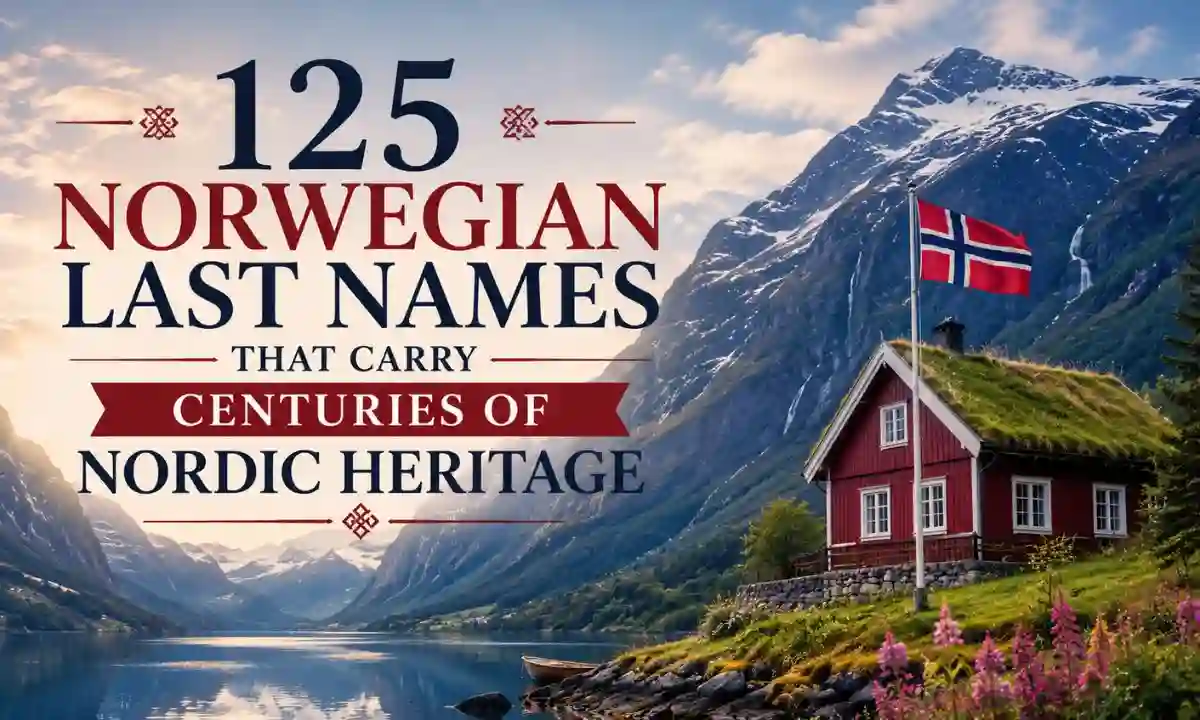
Norwegian surnames carry the landscape inside them. This is not metaphorical — it is literally true. When a Norwegian family bears the name Bakke, they carry the word for hillside in their surname. When they bear Strand, they carry the word for beach or shore. When they bear Hagen, they carry the word for enclosure or garden. When they bear Fjeld, they carry the mountain plateau. The great majority of Norwegian surnames are directly derived from the Norwegian landscape — from the farms where families lived, the geographical features that defined their location, the natural elements that shaped their daily existence. Norwegian surnames are, in the most precise possible sense, addresses from a thousand years ago that have been transformed into permanent family identities.
This connection between surname and landscape reflects the specific history of Norwegian naming. For most of Norwegian history — until the nineteenth century — Norwegians used the patronymic system: the son of Erik was Eriksen and the daughter of Erik was Eriksdatter. When Norway modernized its administrative systems in the nineteenth century and then when the Naming Act of 1923 required fixed hereditary surnames, Norwegian families needed to choose permanent family names. The most natural source was the farm name — the name of the farm where the family lived or from which they came. Norwegian farms had been named for centuries for their specific landscape features, and those farm names became family surnames.
The result is a naming tradition of extraordinary geographical precision. Norwegian surnames do not simply evoke nature — they designate specific types of nature, specific landscape positions, specific relationships between human habitation and the Norwegian terrain. The difference between Bakke hillside and Haug mound and Åsen ridge tells you not just about nature but about the precise topographical position of a family’s ancestral farm. Norwegian surnames are essentially descriptive addresses in an ancient cadastral system, transformed over time into family identifiers that carry that geographical heritage across generations.
This list covers 125 Norwegian surnames across their full range — the patronymic surnames, the farm name surnames, the nature landscape surnames, the occupational surnames, the surnames of the Norwegian coastal and maritime tradition, and the genuinely rare finds that few people outside Norway encounter. Every name here is real, documented, and carries a story worth knowing.
📌 Norwegian surnames often carry meanings that exist in multiple layers — the Old Norse linguistic root, the specific farm or place from which the name derives, and the cultural heritage of the Norwegian landscape tradition. The meanings given here attempt to capture all available layers.
Understanding Norwegian Surname Traditions
The Patronymic System
For most of Norwegian history, Norwegians identified themselves through the patronymic system — their surname was derived from their father’s first name plus either -sen meaning son of or -datter meaning daughter of. The son of Lars was Larssen or Larsen. The daughter of Lars was Larsdatter. This meant that siblings had different surnames — brothers had the same surname as each other but not the same as their sisters, and children had different surnames from their mother. The system was purely functional — identifying whose child you were — rather than marking hereditary family membership.
The patronymic system meant that Norwegian surnames shifted with every generation, creating genealogical records that follow the father’s first name through the generations rather than a fixed family name. Norwegian genealogical research therefore requires knowing both the father’s name and the farm name — the two identifiers that together placed a person in Norwegian society.
The Farm Name System
Parallel to the patronymic system, Norwegian farms had names — gårdsnavn — that designated specific pieces of land. These farm names were stable across generations while the patronymics changed, making them crucial genealogical identifiers. A person might be identified as Ole Larsen of Bakke — Ole son of Lars from the Bakke farm — combining both systems.
When fixed hereditary surnames became required in the nineteenth and early twentieth centuries, Norwegian families typically chose their ancestral farm name as their fixed family name. This is why Norwegian surnames are so overwhelmingly landscape-derived — the farm names themselves were landscape-derived, and those farm names became family names.
The Naming Act of 1923
Norway’s Naming Act of 1923 required all Norwegian citizens to have fixed hereditary surnames. The Act also regulated which surnames were available — creating some standardization while allowing most families to maintain their traditional farm names or patronymics as fixed surnames. The Act was a significant moment in Norwegian cultural history — transforming a flexible patronymic system into the fixed hereditary surname system common across Europe.
Norwegian versus Danish Surnames
Norway was under Danish rule from 1397 to 1814 and Danish cultural influence was significant — particularly among the educated and urban classes. Many Norwegian surnames show Danish linguistic features — the Danish tendency toward -sen rather than -son, the Danish pronunciation of certain vowel sounds. The -sen endings that dominate Norwegian surnames are actually Danish in origin — the pure Norwegian form would be -son in the Nynorsk tradition. This Danish influence is one of the most significant layers in Norwegian surname history.
Patronymic Surnames
Hansen
- Origin: Hebrew/Norse patronymic
- Meaning: Son of Hans, son of Johannes, son of God is gracious
- Frequency: One of Norway’s most common surnames
Hansen means son of Hans — and Hans is the Norse and Germanic form of Johannes meaning God is gracious. It is one of the two or three most common surnames in Norway, carried by a significant percentage of the Norwegian population. The Danish influence is visible in the -sen form rather than the Norwegian -son. Every Hansen carries the divine gracious heritage of the John name tradition through the Norse masculine form.
Olsen
- Origin: Norse patronymic
- Meaning: Son of Ole, son of Olaf, son of the ancestor’s relic
- Frequency: One of Norway’s most common surnames
Olsen means son of Ole — and Ole is the Norwegian form of Olaf meaning the ancestor’s relic or ancestor descendant. Several Norwegian kings bore the name Olaf — including Olaf Haraldsson who became Saint Olaf the patron saint of Norway after his death at the Battle of Stiklestad in 1030. Every Olsen carries the heritage of the most significant name in Norwegian royal and religious history.
Larsen
- Origin: Latin/Norse patronymic
- Meaning: Son of Lars, son of Laurentius, from Laurentum
- Frequency: One of Norway’s most common surnames
Larsen means son of Lars — and Lars is the Scandinavian form of Laurentius meaning from Laurentum the ancient Italian city associated with the laurel tree. The laurel meaning and the Italian city heritage travel through the Norse Lars to create one of Norway’s most common surnames.
Andersen
- Origin: Greek/Norse patronymic
- Meaning: Son of Anders, son of Andreas, manly
- Frequency: Very common Norwegian surname
Andersen means son of Anders — and Anders is the Scandinavian form of Andreas meaning manly. Hans Christian Andersen — the Danish fairy tale author — made this son-of-Anders name one of the most internationally recognized Scandinavian surnames through The Little Mermaid, The Ugly Duckling, and Thumbelina.
Eriksen
- Origin: Norse patronymic
- Meaning: Son of Erik, son of the ever-ruler
- Frequency: Common Norwegian surname
Eriksen means son of Erik — and Erik comes from the Old Norse Eirikr meaning ever-ruler or the sole ruler. Leif Erikson — whose name appears in many variant spellings — the Norse explorer who reached North America centuries before Columbus bore the son-of-Erik name. Every Eriksen carries this explorer heritage.
Nilsen
- Origin: Greek/Norse patronymic
- Meaning: Son of Nils, son of Nicholas, people’s victory
- Frequency: Common Norwegian surname
Nilsen means son of Nils — and Nils is the Scandinavian form of Nicholas meaning people’s victory. The victory of the people meaning in the Greek Nikolaos tradition travels through Scandinavian phonology to create this common Norwegian surname.
Kristiansen
- Origin: Greek/Norse patronymic
- Meaning: Son of Kristian, son of the follower of Christ
- Frequency: Common Norwegian surname
Kristiansen means son of Kristian — the anointed follower of Christ. The Christian heritage in Norwegian naming reflected both the Christianization of Norway under Olaf Haraldsson in the eleventh century and the ongoing importance of Christian identity in Norwegian culture.
Pettersen
- Origin: Greek/Norse patronymic
- Meaning: Son of Petter, son of Peter, son of the rock
- Frequency: Common Norwegian surname
Pettersen means son of Petter — and Petter is the Norwegian form of Peter meaning rock. The apostle Peter’s rock name traveled through the Christian tradition to become one of Norway’s significant patronymic surnames.
Johansen
- Origin: Hebrew/Norse patronymic
- Meaning: Son of Johan, son of God is gracious
- Frequency: One of Norway’s most common surnames
Johansen means son of Johan — the Norwegian form of John meaning God is gracious. Like Hansen, it carries the divine gracious heritage of the apostolic name through the Norse tradition.
Halvorsen
- Origin: Norse patronymic
- Meaning: Son of Halvor, son of the high guardian
- Frequency: Common Norwegian surname
Halvorsen means son of Halvor — and Halvor combines the Norse elements hálf meaning high and varr meaning guardian or cautious — the high guardian. The guardian heritage gives Halvorsen a name of protective careful watching.
Thomassen
- Origin: Aramaic/Norse patronymic
- Meaning: Son of Thomas, son of the twin
- Frequency: Moderately common Norwegian surname
Thomassen means son of Thomas — the twin apostle whose doubt and then complete belief made him one of the most humanly accessible figures in the New Testament. The Aramaic twin meaning travels through the Norse tradition.
Sørensen
- Origin: Norse patronymic
- Meaning: Son of Søren, son of the stern one
- Frequency: Common Norwegian/Danish surname
Sørensen means son of Søren — and Søren is the Danish-Norwegian form of Severinus meaning stern or strict. Søren Kierkegaard the Danish philosopher who founded existentialism gave this stern name its most intellectually significant bearer.
Mountain and Highland Surnames
Berg
- Origin: Old Norse
- Meaning: Mountain, hill
- Frequency: Very common Norwegian surname
Berg simply means mountain or hill in Norwegian — the most fundamental geographical feature of the Norwegian landscape. The fjord country of western Norway is defined by its dramatic mountains, and Berg as a surname designates families from mountain farms or settlements. It appears in dozens of compound surnames and stands alone as one of Norway’s most recognizable single-element surnames.
Fjeld
- Origin: Old Norse
- Meaning: Mountain plateau, high mountain
- Frequency: Common Norwegian surname
Fjeld means the mountain plateau in Norwegian — the high flat-topped mountain that is characteristic of the Norwegian landscape. The fjeld is distinct from the berg because it specifically designates the high treeless plateau above the treeline — the exposed mountain top where reindeer graze and where the light in summer never fully disappears.
Haug
- Origin: Old Norse
- Meaning: Mound, hill, burial mound
- Frequency: Common Norwegian surname
Haug means mound or hill in Norwegian — and specifically carries the heritage of the burial mound. The Viking Age burial mounds — the høvdinghauger — the chief’s mounds — were significant features of the Norse landscape and many Norwegian farms were located near ancient burial mounds, taking their names from this archaeological feature.
Åsen
- Origin: Old Norse
- Meaning: Ridge, the ridge
- Frequency: Common Norwegian surname
Åsen means the ridge in Norwegian — the elongated elevated feature that runs along the top of a hill or mountain. The ridge is one of the most specific topographical designations in Norwegian landscape vocabulary — the families who lived along the ridge took its name.
Bakke
- Origin: Old Norse
- Meaning: Slope, hillside
- Frequency: Common Norwegian surname
Bakke means slope or hillside — the inclined land between the flat valley floor and the mountain above. The bakke farm was positioned on the slope — neither in the exposed heights nor in the potentially flooded valley bottom but on the productive middle ground between extremes.
Lie
- Origin: Old Norse
- Meaning: Hillside meadow, sheltered slope
- Frequency: Common Norwegian surname
Lie means hillside meadow or sheltered slope in Norwegian — a more specific landscape term than bakke designating the grassy slope that was sheltered from the worst weather and used for grazing or hay production. Trygve Lie who became the first Secretary-General of the United Nations bore this hillside meadow name.
Nygaard
- Origin: Old Norse
- Meaning: New farm, new enclosure
- Frequency: Common Norwegian surname
Nygaard combines ny meaning new with gaard meaning farm or enclosure — the new farm. Throughout Norwegian history, as population grew and new land was cleared, new farms were established and named Nygaard — the new farm that differentiated it from the older settlement in the valley.
Tangen
- Origin: Old Norse
- Meaning: The point, the spit of land
- Frequency: Moderately common Norwegian surname
Tangen means the point or the narrow spit of land — the geographical feature where land narrows to a point extending into water. It is a specific and beautiful Norwegian landscape designation.
Berge
- Origin: Old Norse
- Meaning: From the mountain, mountain place
- Frequency: Common Norwegian surname
Berge is the locative form of berg — indicating origin from the mountain or designation of the mountain place. It is slightly more specific than Berg itself, indicating the place on or near the mountain.
Knutsen
- Origin: Norse patronymic
- Meaning: Son of Knut, son of the knot
- Frequency: Common Norwegian surname
Knutsen means son of Knut — and Knut comes from the Old Norse knútr meaning knot. Knut Hamsun the Nobel Prize-winning Norwegian novelist bore this knot name — his Hunger, Pan, and Growth of the Soil are considered the foundations of Norwegian modernist literature.
Coastal and Maritime Surnames
Strand
- Origin: Old Norse
- Meaning: Beach, shore, strand
- Frequency: Common Norwegian surname
Strand means beach or shore — the land at the water’s edge. The Norwegian coast with its extraordinary length — over 25,000 kilometers including all the fjords and islands — created enormous numbers of farms in the strand position, and those farms’ names became the most characteristic Norwegian coastal surname.
Vik
- Origin: Old Norse
- Meaning: Bay, inlet, cove
- Frequency: Common Norwegian surname
Vik means bay or inlet — the same element that gives Viking its Norse root (the bay people or the people of the inlets). The Norwegian coast’s extraordinary indentation with its thousands of bays and inlets created hundreds of Vik farms, and those names became one of the most Norwegian of all surnames. Every Vik carries the Viking heritage in the most literal possible sense.
Øen
- Origin: Old Norse
- Meaning: Island, the island
- Frequency: Common Norwegian surname
Øen means the island — the definite form of øy meaning island. Norway’s thousands of coastal islands created island farms whose names followed their bearers into the hereditary surname system.
Holm
- Origin: Old Norse
- Meaning: Small island, islet, riverside meadow
- Frequency: Common Norwegian surname
Holm means small island or the small piece of land surrounded or partially surrounded by water. The holme — the small riverside or coastal island — was a characteristic feature of Norwegian waterscapes. It also appears in the name Stockholm — the holm or island of the Stock or log.
Moe
- Origin: Old Norse
- Meaning: Heath, sandy flatland near a river
- Frequency: Common Norwegian surname
Moe means heath or the sandy flatland near a river — the specific type of flat open land that appears near rivers and the sea. Jørgen Moe who collaborated with Peter Christen Asbjørnsen on the Norwegian folk tale collection that became Norway’s most significant cultural document bore this heath name.
Nøst
- Origin: Old Norse
- Meaning: Boat house, place to pull up boats
- Frequency: Moderately common Norwegian surname
Nøst means the boat house or the place where boats were pulled up from the water — one of the most specifically maritime Norwegian landscape designations. The nøst was an essential feature of any coastal Norwegian farm — the covered or uncovered slip where boats were stored and maintained.
Skar
- Origin: Old Norse
- Meaning: Rocky crevice, cleft in the rock
- Frequency: Moderately common Norwegian surname
Skar means rocky crevice or cleft — the narrow passage between rocks that was characteristic of Norwegian coastal and mountain landscapes. The skar farm was positioned near such a cleft, using it as a natural shelter or passage.
Sandvik
- Origin: Old Norse
- Meaning: Sandy bay, sand inlet
- Frequency: Common Norwegian surname
Sandvik combines sand with vik meaning bay — the sandy bay. It is one of the compound coastal surnames that describes the specific character of the bay — not simply any inlet but the sandy-bottomed inlet.
Kvam
- Origin: Old Norse
- Meaning: Narrow valley, sheltered valley
- Frequency: Common western Norwegian surname
Kvam means narrow valley or sheltered valley — the enclosed valley that provided protection from weather. It is particularly common in western Norway where the dramatic fjord landscape creates many such sheltered valleys.
Bergsvik
- Origin: Old Norse
- Meaning: Mountain bay, rocky inlet
- Frequency: Moderately common Norwegian surname
Bergsvik combines berg mountain with vik bay — the mountain bay or rocky inlet. The compound creates a precise geographical description — the bay at the base of the mountain.
Forest and Valley Surnames
Dalen
- Origin: Old Norse
- Meaning: The valley, the dale
- Frequency: Common Norwegian surname
Dalen means the valley — the enclosed lower ground between hills or mountains. Dale — the English cognate — appears in place names throughout the English-speaking world from the Norse settlements. Dalen designates the family from the valley, the people of the enclosed lower ground.
Skogen
- Origin: Old Norse
- Meaning: The forest, the wood
- Frequency: Common Norwegian surname
Skogen means the forest or wood — the definite form of skog meaning forest. The Norwegian forest — the boreal coniferous forest that covers much of inland Norway — created forest farms whose names followed their bearers. Every Skogen carries the heritage of the Norwegian forest.
Lien
- Origin: Old Norse
- Meaning: Hillside meadow, the slope
- Frequency: Common Norwegian surname
Lien is a variant of Lie — the hillside meadow or sheltered slope — in its definite form. The -en suffix creates the definite article in Norwegian, making Lien the slope or the hillside meadow rather than simply a slope.
Gran
- Origin: Old Norse
- Meaning: Spruce tree, Norway spruce
- Frequency: Common Norwegian surname
Gran means the Norway spruce — the characteristic tree of the Norwegian boreal forest. The spruce farm — the farm surrounded by or defined by spruce trees — took this tree name. The Norway spruce is both the Christmas tree of European tradition and the defining tree of the Norwegian interior forest.
Birk
- Origin: Old Norse
- Meaning: Birch tree
- Frequency: Moderately common Norwegian surname
Birk means birch tree — the silver-barked tree that is the first to colonize disturbed or cleared land and that defines the transition zone between the lowland forest and the mountain birch woodland. The birch’s association with spring — it is among the first trees to leaf out — gives Birk a name of renewal and beginnings.
Aasen
- Origin: Old Norse
- Meaning: The ridge, from the ridge
- Frequency: Common Norwegian surname
Aasen is a variant of Åsen — the ridge — with the historical aa spelling that represented the Norwegian å sound. Ivar Aasen the nineteenth century linguist who created the Nynorsk written form of Norwegian bore this ridge name — the man who built a language for a ridge country.
Hagen
- Origin: Old Norse
- Meaning: Enclosure, garden, enclosed field
- Frequency: Common Norwegian surname
Hagen means enclosure or garden — the enclosed piece of land around a farm. The hage — the enclosed kitchen garden or farmyard — was an essential feature of any Norwegian farm, and families from hage farms carried this enclosed-garden surname.
Lund
- Origin: Old Norse
- Meaning: Grove of trees, sacred grove
- Frequency: Common Norwegian/Scandinavian surname
Lund means grove of trees — particularly the small sacred grove that in the pre-Christian Norse tradition was a place of worship. The lund — the sacred grove — was the outdoor sanctuary before the church building replaced it. Every Lund carries the heritage of the pre-Christian Norse worship tradition in its grove meaning.
Moen
- Origin: Old Norse
- Meaning: Heath, the heath
- Frequency: Common Norwegian surname
Moen is the definite form of Mo — the heath or sandy flatland. It designates the family from the specific heath rather than any heath. The Norwegian heath — the open moorland covered with heather — is one of the most evocative features of the Norwegian landscape.
Aas
- Origin: Old Norse
- Meaning: Ridge, hillside, slope
- Frequency: Common Norwegian surname
Aas — the historical spelling of Ås — means ridge or hillside slope. Ås is a very common Norwegian place name element and appears in dozens of Norwegian farm names that became surnames.
Water and River Surnames
Strøm
- Origin: Old Norse
- Meaning: Current, stream, flow
- Frequency: Common Norwegian surname
Strøm means current or stream — the flowing water of a river or the current in a fjord. The water current was a significant feature of Norwegian farms near rivers or tidal waterways. Erling Strøm the champion skier carried this current name through one of Norway’s most celebrated winter sports careers.
Ness
- Origin: Old Norse
- Meaning: Headland, promontory
- Frequency: Common Norwegian surname
Ness means headland or promontory — the land that extends into the water. The Norse nes element appears in place names across the entire Norse world — from Inverness in Scotland to Caithness to Furness. Every Norwegian Ness carries the heritage of this ancient geographic designation.
Foss
- Origin: Old Norse
- Meaning: Waterfall
- Frequency: Common Norwegian surname
Foss means waterfall — the dramatic plunging water that is one of the most spectacular features of the Norwegian landscape. Norway has more waterfalls than virtually any other country — the dramatic elevation changes of the fjord country create cascades of extraordinary power and beauty. Every Foss carries the heritage of the Norwegian waterfall in one of the most visually evocative surnames in any language.
Elv
- Origin: Old Norse
- Meaning: River
- Frequency: Moderately common Norwegian surname
Elv means river in Norwegian — the flowing water that drains the mountains and valleys. The Norwegian rivers — the Glomma, the Drammenselva, the Numedalslågen — define the Norwegian landscape and gave their names to farms along their banks.
Broen
- Origin: Old Norse
- Meaning: The bridge
- Frequency: Moderately common Norwegian surname
Broen means the bridge — the constructed crossing over water. The farm near the bridge was a significant location in Norwegian settlement geography — bridges were essential infrastructure that controlled movement and trade.
Vatne
- Origin: Old Norse
- Meaning: Water place, place by the water
- Frequency: Common western Norwegian surname
Vatne means water place — the farm near the water. It is particularly common in western Norway where the fjord landscape creates countless water-adjacent farm sites.
Sund
- Origin: Old Norse
- Meaning: Sound, narrow strait of water
- Frequency: Common Norwegian surname
Sund means sound — the narrow passage of water between two land masses. The Norwegian coast’s complex geography of islands and mainland created many sound positions, and farms near these narrows took the Sund name.
Elvebakken
- Origin: Old Norse
- Meaning: Riverbank slope, riverside hill
- Frequency: Moderately common Norwegian surname
Elvebakken combines elv river with bakke slope — the riverside slope or riverbank hill. The compound creates an extremely precise topographical designation — the hillside immediately adjacent to the river.
Brekke
- Origin: Old Norse
- Meaning: Slope, hillside with a brook
- Frequency: Common Norwegian surname
Brekke means slope or the hillside with a brook — the hillside that had a small stream running down it. The water feature distinguishes brekke from the simpler bakke.
Neset
- Origin: Old Norse
- Meaning: The headland, the promontory
- Frequency: Moderately common Norwegian surname
Neset is the definite form of nes — the headland or promontory. The -et suffix creates the definite article, designating the specific headland.
Farm and Settlement Surnames
Gaard
- Origin: Old Norse
- Meaning: Farm, farmstead, enclosure
- Frequency: Common element in compound surnames
Gaard — the Norwegian form of gard — means farm or farmstead. It appears in dozens of compound Norwegian surnames: Nygaard new farm, Vestgaard western farm, Søndre Gaard southern farm. The gaard element is the most fundamental Norwegian landscape designation — the farm itself as the organizing unit of Norwegian rural life.
Thorp
- Origin: Old Norse
- Meaning: Small settlement, hamlet
- Frequency: Moderately common Norwegian surname
Thorp means small settlement or hamlet — the cluster of farms smaller than a village. The Norse þorp element appears throughout Scandinavian place names and in English place names ending in -thorpe from Norse settlement areas.
Tvedt
- Origin: Old Norse
- Meaning: Piece of cleared land, small farm
- Frequency: Common Norwegian surname
Tvedt means a piece of cleared land or small farm — from the Old Norse þveit meaning a small piece of land. It appears in English as -thwaite in Scandinavian-settled areas of northern England: Braithwaite, Threlkwaite. Every Tvedt carries the heritage of the cleared land — the land made productive by human effort.
Kvaal
- Origin: Old Norse
- Meaning: Whale, whale-catching place
- Frequency: Moderately common Norwegian surname
Kvaal comes from the Norse hvalr meaning whale — designating a farm that had rights to whale strandings or was near a whale-catching area. The whale in Norwegian coastal culture was an enormously significant economic resource and the whale-farm designation marks a family’s historical connection to this maritime tradition.
Skjold
- Origin: Old Norse
- Meaning: Shield
- Frequency: Moderately common Norwegian surname
Skjold means shield in Old Norse — the defensive weapon that also functioned as a symbol of protection and warrior identity. As a farm name it may have designated a farm on a hillside that sheltered like a shield.
Vold
- Origin: Old Norse
- Meaning: Field, plain, open land
- Frequency: Common Norwegian surname
Vold means field or plain — the open flat land suitable for cultivation or grazing. The voll — the flat field — was the most productive agricultural land and farms on such land were among the most valuable.
Tveit
- Origin: Old Norse
- Meaning: Small piece of land, clearing
- Frequency: Common Norwegian surname
Tveit is a variant spelling of Tvedt — the same piece of cleared land. The -veit form is more common in some regions of Norway. It appears as the -thwaite element in many English place names from Norse settlement.
Holt
- Origin: Old Norse
- Meaning: Small wood, copse
- Frequency: Common Norwegian surname
Holt means small wood or copse — the cluster of trees smaller than a full forest. The English word holt — Shakespeare’s Ariel spirits in the holt — comes from the same Norse root. Every Holt carries the heritage of the small woodland.
Bø
- Origin: Old Norse
- Meaning: Farm, settlement
- Frequency: Common Norwegian surname
Bø means farm or settlement in Norwegian — related to the Scandinavian bу meaning town or settlement. It is one of the most basic farm designation surnames.
Solberg
- Origin: Old Norse
- Meaning: Sun mountain, sunny mountain
- Frequency: Common Norwegian surname
Solberg combines sol meaning sun with berg meaning mountain — the sunny mountain or the mountain that catches the sun. In Norway where mountain farms compete for limited sunlight hours, the sol-berg designation was one of the most desirable — the farm on the south-facing slope that received the most sun. Erna Solberg who served as Prime Minister of Norway bore this sunny mountain name.
Viking and Old Norse Heritage Surnames
Vikdal
- Origin: Old Norse
- Meaning: Viking valley, bay valley
- Frequency: Rare compound surname
Vikdal combines vik meaning bay or Viking with dal meaning valley — the valley of the bay or the Viking valley. The compound creates an evocative geographical name with direct Norse heritage.
Gunnarsen
- Origin: Old Norse patronymic
- Meaning: Son of Gunnar, son of the bold warrior
- Frequency: Moderately common Norwegian surname
Gunnarsen means son of Gunnar — and Gunnar combines the Norse elements gunnr meaning war and arr meaning warrior — the bold warrior. The saga hero Gunnar of Hlíðarendi who played his harp while dying in the snake pit is one of Norse mythology’s most celebrated warriors.
Sigurdsen
- Origin: Old Norse patronymic
- Meaning: Son of Sigurd, son of the victory guardian
- Frequency: Moderately common Norwegian surname
Sigurdsen means son of Sigurd — the Norse hero who killed the dragon Fáfnir and whose story is told in the Völsunga saga. Sigurd combines sigr meaning victory with varðr meaning guardian — the victory guardian.
Ragnarsen
- Origin: Old Norse patronymic
- Meaning: Son of Ragnar, son of the counsel warrior
- Frequency: Moderately common Norwegian surname
Ragnarsen means son of Ragnar — and Ragnar combines regin meaning counsel or the gods with arr meaning warrior — the counsel warrior. Ragnar Lothbrok the legendary Viking whose history and legend merged in the sagas gave this counsel warrior name its most famous bearer.
Thorsen
- Origin: Old Norse patronymic
- Meaning: Son of Thor, son of the thunder god
- Frequency: Common Norwegian surname
Thorsen means son of Thor — the thunder god. Thor the Norse god of thunder, strength, and protection was one of the most significant pre-Christian divine figures. Every Thorsen carries the heritage of the thunder god’s lineage.
Leif
- Origin: Old Norse given name used as surname
- Meaning: Heir, descendant
- Frequency: Moderately common as surname
Leif means heir or descendant in Old Norse. Leif Erikson the Norse explorer who reached North America around 1000 CE bore this heir name. As a surname it carries the explorer heritage directly.
Harald
- Origin: Old Norse given name used as surname
- Meaning: Army ruler, war power
- Frequency: Moderately common as surname
Harald combines herr meaning army with valdr meaning ruler — the army ruler. Multiple Norwegian kings bore this name — Harald Fairhair who first unified Norway, Harald Hardrada who died at Stamford Bridge — giving this army-ruler name extraordinary Norwegian royal heritage.
Ivarsen
- Origin: Old Norse patronymic
- Meaning: Son of Ivar, son of the bow warrior
- Frequency: Moderately common Norwegian surname
Ivarsen means son of Ivar — the bow warrior whose Norse name combines the bow element with warrior. Ivar the Boneless the Viking chieftain who led the Great Heathen Army that invaded England gave this bow-warrior name its most formidable historical bearer.
Snorre
- Origin: Old Norse
- Meaning: Spinning, twisting
- Frequency: Rare as surname
Snorre is most famous as the name of Snorri Sturluson — the Icelandic historian who compiled the Prose Edda preserving Norse mythology. As a Norwegian surname it carries the heritage of the most significant recorder of Viking Age knowledge.
Bodvarsen
- Origin: Old Norse patronymic
- Meaning: Son of Bodvar, son of the battle bear
- Frequency: Rare Norwegian surname
Bodvarsen means son of Bodvar — and Bodvar combines boð meaning battle with varr meaning bear or guardian — the battle bear. Bodvar Bjarki the great saga warrior whose bear spirit fought even as he meditated is one of the Norse literary tradition’s most extraordinary figures.
Nature Element Surnames
Storm
- Origin: Old Norse
- Meaning: Storm, tempest
- Frequency: Common Norwegian surname
Storm means storm or tempest in Norwegian — the elemental weather phenomenon that was particularly significant in the Norwegian maritime landscape. Edvard Storm the Norwegian poet carried this tempest name. The Norse conception of the storm as an expression of divine power — Thor’s thunder, Odin’s wild hunt — gives Storm a name of elemental grandeur.
Snø
- Origin: Old Norse
- Meaning: Snow
- Frequency: Rare as surname
Snø means snow in Norwegian — the element that defines the Norwegian winter landscape for months each year. As a surname it is rare but carries the complete heritage of the Norwegian snow landscape — the white silence of the Norwegian winter.
Sol
- Origin: Old Norse
- Meaning: Sun
- Frequency: Rare as standalone; common in compounds
Sol means sun in Norwegian — the celestial body whose return in spring after the dark Norwegian winter was the most significant seasonal event. The Norwegian concept of the sun as the most precious gift — the festivals and celebrations that mark its return after the polar night — gives Sol a name of extraordinary cultural significance.
Frost
- Origin: Old Norse
- Meaning: Frost, frozen
- Frequency: Moderately common Norwegian surname
Frost means frost in Norwegian — the frozen condition that arrives each autumn and transforms the Norwegian landscape. The frost is both a practical agricultural reality — the frost-free season determines what can be grown — and an aesthetic phenomenon — the frost crystals on windows and leaves.
Regn
- Origin: Old Norse
- Meaning: Rain
- Frequency: Rare as surname
Regn means rain in Norwegian — the precipitation that in western Norway is one of the most constant features of the climate. Bergen on the western coast averages more than two meters of rain per year. As a surname Regn is rare but carries the heritage of Norway’s extraordinarily wet western climate.
Eld
- Origin: Old Norse
- Meaning: Fire, flame
- Frequency: Rare as surname
Eld means fire in Old Norse — the element that was the center of every Norse household and that in the pre-Christian tradition was sacred. The hearth fire that was never allowed to go out, the signal fires that warned of Viking raids, the fire that forged weapons — all these significances gather in the Eld name.
Vind
- Origin: Old Norse
- Meaning: Wind
- Frequency: Moderately common Norwegian surname
Vind means wind in Norwegian — the moving air that was essential for Norse sailing and that shaped the landscape through erosion and the distribution of vegetation. The sailing tradition that made Norway a maritime power depended absolutely on the wind.
Is
- Origin: Old Norse
- Meaning: Ice
- Frequency: Rare as standalone
Is means ice in Norwegian — the frozen water that defines the Norwegian winter landscape and that in the form of glaciers has shaped the entire Norwegian topography. The fjords themselves were carved by glacial ice. Every Is carries the heritage of the ice that made Norway.
Stein
- Origin: Old Norse
- Meaning: Stone, rock
- Frequency: Common element in Norwegian surnames
Stein means stone in Norwegian — the geological material that defines so much of the Norwegian landscape. Norway’s mountains are primarily rock, its coastline is primarily rock, and the stone in Norwegian culture carries the heritage of permanence and endurance.
Hegg
- Origin: Old Norse
- Meaning: Bird cherry tree
- Frequency: Moderately common Norwegian surname
Hegg means bird cherry tree — the small flowering tree that blooms in Norwegian spring and is one of the most celebrated signs of seasonal change. The bird cherry’s white blossoms in spring and its dark berries in late summer make it a complete seasonal marker.
Occupational Surnames
Smed
- Origin: Old Norse
- Meaning: Smith, blacksmith
- Frequency: Moderately common Norwegian surname
Smed means smith or blacksmith — the craftsman who worked with iron and metal. The Norse smith tradition was significant — the smith who forged the weapons and tools of Viking society held a position of semi-sacred status in Norse culture.
Fisker
- Origin: Old Norse
- Meaning: Fisher, fisherman
- Frequency: Common Norwegian surname
Fisker means fisherman — the person who caught fish. Norwegian fishing culture is one of the oldest and most significant in the world — Norwegian fishermen have been harvesting the seas of the North Atlantic for thousands of years. The fisherman surname carries this maritime heritage.
Skipper
- Origin: Old Norse/Low German
- Meaning: Ship’s captain, navigator
- Frequency: Moderately common Norwegian surname
Skipper means ship’s captain or navigator — the person who commanded the vessel. In the Norse maritime tradition, the skipper was one of the most skilled and respected positions. The word skipper — adopted into English — comes from this Norse maritime tradition.
Bondevik
- Origin: Old Norse
- Meaning: Farmer’s bay, peasant’s inlet
- Frequency: Moderately common Norwegian compound surname
Bondevik combines bonde meaning farmer or peasant with vik meaning bay — the farmer’s bay. Kjell Magne Bondevik who served as Norwegian Prime Minister bore this farmer’s bay name — the humble agricultural heritage combined with the maritime bay designation.
Prest
- Origin: Old Norse/Latin
- Meaning: Priest
- Frequency: Moderately common Norwegian surname
Prest means priest — the religious leader of the Christian community. Norwegian priests had significant social standing and their descendants carried the priestly surname. The Reformation of the sixteenth century made the priesthood hereditary in some Norwegian communities — Lutheran pastors married and had children who carried the priestly identity.
Lærken
- Origin: Old Norse/Germanic
- Meaning: Teacher, scholar
- Frequency: Rare Norwegian surname
Lærken relates to the word for learner or teacher — the educated person who taught others. The scholarly surname in Norwegian tradition designates a family with educational heritage.
Kjelberg
- Origin: Old Norse
- Meaning: Kettle mountain, cauldron hill
- Frequency: Moderately common Norwegian surname
Kjelberg combines kjel meaning kettle or cauldron with berg meaning mountain — the kettle-shaped hollow in the mountain. The geographical feature of the natural basin or hollow in a mountainside gave this surname its specific topographical heritage.
Skomaker
- Origin: Germanic/Norwegian
- Meaning: Shoemaker, cobbler
- Frequency: Rare as standalone surname
Skomaker means shoemaker in Norwegian — the craftsman who made and repaired shoes. As a surname it designates families in the cobbling trade.
Tømmermann
- Origin: Old Norse/Germanic
- Meaning: Carpenter, timber man
- Frequency: Moderately common Norwegian surname
Tømmermann means carpenter or timber man — the craftsman who worked with wood. In Norwegian construction culture, the timber craftsman who built the stave churches and the Viking longships was one of the most significant artisans.
Bonde
- Origin: Old Norse
- Meaning: Farmer, free peasant
- Frequency: Common element in Norwegian surnames
Bonde means farmer or free peasant — the independent farmer who owned his own land. The Norwegian bonde was historically distinct from the serf — Norwegian peasants maintained a tradition of legal independence that distinguished them from most of medieval European peasantry.
Color and Descriptive Surnames
Hvit
- Origin: Old Norse
- Meaning: White
- Frequency: Rare as standalone; more common in compounds
Hvit means white in Norwegian — the color of snow and the Norwegian winter landscape. It appears most commonly in compound names. Erik the Red’s father Thorvald Asvaldsson was exiled for manslaughter — his son was called Erik the Red for his red hair, distinguishing him from the white-description tradition.
Rød
- Origin: Old Norse
- Meaning: Red, red-haired
- Frequency: Common Norwegian surname
Rød means red in Norwegian — both the color and the red-haired physical description. Erik Rød — Erik the Red — the Norse explorer who colonized Greenland bore this red surname (or rather its equivalent in his era). Every Rød carries the physical description heritage of the red-complexioned or red-haired ancestor.
Svart
- Origin: Old Norse
- Meaning: Black, dark
- Frequency: Moderately common Norwegian surname
Svart means black or dark in Norwegian — the physical description for a dark-haired or dark-complexioned ancestor. The black-dark designator in Norse naming tradition was not negative but simply descriptive.
Blå
- Origin: Old Norse
- Meaning: Blue
- Frequency: Rare as surname
Blå means blue in Norwegian — the color that in Old Norse had a broader meaning including blue-black and grey-blue, often describing the color of the sea or the sky or iron weapons.
Grå
- Origin: Old Norse
- Meaning: Grey
- Frequency: Rare as surname
Grå means grey in Norwegian — the color of winter skies, of Norwegian rock faces, and of the grey-haired elder. As a surname it may designate a grey-haired ancestor or a family from a particularly grey landscape.
Lang
- Origin: Old Norse
- Meaning: Long, tall
- Frequency: Common Norwegian surname
Lang means long or tall — the physical description for a tall ancestor. Physical description surnames of this type were common in the Norse tradition — the descriptive epithet that distinguished individuals of the same name.
Stor
- Origin: Old Norse
- Meaning: Great, large, big
- Frequency: Moderately common Norwegian surname
Stor means great or large — the physical description for a big-built ancestor or the designation of a large farm. Alexander den Store — Alexander the Great — was Alexander Stor in the Norse tradition.
Liten
- Origin: Old Norse
- Meaning: Small, little
- Frequency: Rare as surname
Liten means small or little — the physical description for a small-statured ancestor. The contrast between Stor and Liten as surnames creates the range of size description in the Norse physical designation tradition.
Rare and Extraordinary Surnames
Hegdahl
- Origin: Old Norse
- Meaning: Valley of the ridge, ridge valley
- Frequency: Rare compound Norwegian surname
Hegdahl combines hegg or heg possibly meaning ridge with dahl meaning valley — the ridge valley or the sheltered valley on the ridge. It is one of the more specific compound Norwegian topographical surnames.
Kielland
- Origin: Old Norse/Danish
- Meaning: From Kielland, possibly from kil meaning wedge-shaped bay
- Frequency: Rare Norwegian surname
Kielland is associated with Alexander Lange Kielland the Norwegian novelist and social critic whose Garman og Worse is one of Norwegian literature’s significant works. The wedge-bay meaning designates a specific coastal feature.
Undset
- Origin: Old Norse
- Meaning: Under the promontory, below the headland
- Frequency: Rare Norwegian surname
Undset combines under with set possibly meaning headland — below the headland or under the promontory. Sigrid Undset who won the Nobel Prize in Literature for her medieval trilogy Kristin Lavransdatter bore this under-headland name. Her historical novels about medieval Norwegian life are considered among the greatest Scandinavian literary achievements.
Hamsun
- Origin: Old Norse
- Meaning: From Hamsund, hammer sound or hammer strait
- Frequency: Rare Norwegian surname
Hamsun is associated with Knut Hamsun the Nobel Prize-winning Norwegian novelist who transformed European literature with Hunger and Growth of the Soil. The name may derive from the Hamsund area combining hamre meaning hammer with sund meaning strait. The most significant Norwegian literary name of the twentieth century.
Bjørnsen
- Origin: Old Norse patronymic
- Meaning: Son of Bjørn, son of the bear
- Frequency: Moderately common Norwegian surname
Bjørnsen means son of Bjørn — and Bjørn means bear. Bjørnstjerne Bjørnson who won the Nobel Prize in Literature in 1903 and wrote the Norwegian national anthem bore this son-of-bear name.
Wergeland
- Origin: Old Norse/Norwegian
- Meaning: From Wergeland, possibly the land of defense
- Frequency: Rare Norwegian surname
Wergeland is associated with Henrik Wergeland the nineteenth century Norwegian poet and nationalist who is considered Norway’s greatest Romantic poet. The name carries the heritage of the man whose literary and political work helped define Norwegian national identity during the period of Swedish union.
Asbjørnsen
- Origin: Old Norse patronymic
- Meaning: Son of Asbjørn, son of the divine bear
- Frequency: Rare Norwegian surname
Asbjørnsen means son of Asbjørn — the divine bear whose name combines ás meaning the Norse gods with bjørn meaning bear. Peter Christen Asbjørnsen who collected Norwegian folk tales with Jørgen Moe bore this divine bear name — the collector of Askeladden stories and the other tales that define Norwegian folk culture.
Holberg
- Origin: Old Norse
- Meaning: Holly mountain, mountain island
- Frequency: Rare Norwegian surname
Holberg combines holm or hol with berg — the mountain island or hollow mountain. Ludvig Holberg the eighteenth century Norwegian-Danish playwright who is considered the father of Scandinavian literature bore this name — his comedies established the theatrical tradition in both Norway and Denmark.
Nansen
- Origin: Old Norse patronymic
- Meaning: Son of Nans, uncertain origin
- Frequency: Rare Norwegian surname
Nansen is associated with Fridtjof Nansen the Norwegian explorer, scientist, and humanitarian who crossed Greenland on skis, attempted the North Pole, and won the Nobel Peace Prize for his work with refugees after World War One. The Nansen passport — issued to stateless refugees — carries his name as one of the most humanitarian documents in modern international law.
Amundsen
- Origin: Old Norse patronymic
- Meaning: Son of Amund, son of the ancestor’s protection
- Frequency: Rare Norwegian surname
Amundsen is associated with Roald Amundsen the explorer who led the first expedition to reach the South Pole in December 1911 — beating Scott’s British expedition by thirty-four days through superior planning and dog-sledding technique. Every Amundsen carries the heritage of the most precisely planned and executed polar achievement in history.
Norwegian Diaspora Surnames
Thorvaldsen
- Origin: Old Norse patronymic
- Meaning: Son of Thorvald, son of Thor’s ruler
- Frequency: Moderately common Norwegian surname
Thorvaldsen means son of Thorvald — and Thorvald combines Thor the thunder god with valdr meaning ruler. Bertel Thorvaldsen the Danish-Norwegian sculptor whose neoclassical works are among the most significant in European art history made this son-of-Thor’s-ruler name famous in the artistic world.
Grundset
- Origin: Old Norse
- Meaning: Green settlement, grassy place
- Frequency: Rare Norwegian surname
Grundset combines grunn meaning ground or green with set — the grassy or green settlement. It represents the type of Norwegian compound farm name that became a diaspora surname.
Vikstrom
- Origin: Old Norse/Swedish
- Meaning: Bay stream, Viking stream
- Frequency: Moderately common in Norwegian-Swedish border communities
Vikstrom combines vik bay with strøm stream — the stream from the bay or the bay stream. It is a surname found in border communities where Norwegian and Swedish naming traditions blended.
Lofthus
- Origin: Old Norse
- Meaning: Upper house, loft house
- Frequency: Moderately common Norwegian surname
Lofthus combines loft meaning upper floor or loft with hus meaning house — the house with an upper floor or the house on the high ground. Christian Jensen Lofthus was a significant eighteenth century Norwegian peasant leader whose rebellion against Danish authorities became a milestone in Norwegian history.
Rølvaag
- Origin: Old Norse
- Meaning: Reindeer bay, moose bay
- Frequency: Rare Norwegian surname
Rølvaag comes from a combination of possibly rein meaning reindeer with våg meaning bay — the reindeer bay. Ole Edvart Rølvaag the Norwegian-American novelist whose Giants in the Earth describes Norwegian immigrant experience in the American Midwest made this rare bay name famous in Norwegian-American literature.
Frequently Asked Questions
Q: Why do Norwegian surnames ending in -sen differ from Swedish surnames ending in -son?
A: The -sen ending is characteristic of Norwegian and Danish surnames while the -son ending is more characteristic of Swedish surnames and reflects a difference in how the patronymic suffix was spelled in these closely related languages. The -sen ending came to dominate Norwegian surnames through Danish cultural influence during the period of Danish rule from 1397 to 1814. During this period the Danish written and administrative language shaped Norwegian naming conventions. The Norwegian Nynorsk tradition — the written form of Norwegian developed to preserve the indigenous Norwegian language against Danish influence — uses -son rather than -sen, reflecting the pre-Danish indigenous Norwegian form. Icelanders, who maintained more independence from Danish influence, use -son consistently and uniquely also maintain the female patronymic -dóttir meaning daughter of.
Q: What is the difference between Norwegian farm name surnames and patronymic surnames?
A: Norwegian patronymic surnames like Hansen, Olsen, and Larsen derive from the father’s first name plus -sen, while farm name surnames like Bakke, Strand, and Foss derive from the name of the ancestral farm or geographical feature. Patronymics indicate whose son or daughter someone was while farm names indicate where a family lived or originated. In traditional Norwegian genealogical research both types of name are essential — the patronymic tells you the father’s name and the farm name tells you which specific property the family inhabited. When fixed hereditary surnames became required in the nineteenth and early twentieth centuries, some families chose their patronymic as their fixed surname while others chose their farm name, resulting in the mixture of types visible in contemporary Norwegian surnames. The farm name surnames are generally considered more distinctive and specifically Norwegian while the patronymic surnames are shared with Danish, Swedish, and other Scandinavian traditions.
Q: How did Norwegian emigration affect Norwegian surnames in countries like the United States?
A: Norwegian emigration — particularly the massive waves of the 1860s through 1910s — brought Norwegian surnames to North America where they underwent various transformations. Some patronymic surnames that were still fluid in the patronymic system became fixed in America — an emigrant who was Ole Eriksen in Norway might have his children become Erickson permanently rather than taking new patronymics in the next generation. Some surnames were anglicized — Bakke became Baker, Strand became Strong, Bjørnsen became Burns. Some were shortened or simplified — Thorvaldsen became Thorwald. The Norwegian diaspora communities of the upper Midwest — Minnesota, Wisconsin, the Dakotas — maintained many Norwegian surnames more intact than communities that dispersed more widely. Norwegian-American genealogical research often requires knowing both the Norwegian and the American form of the surname, as well as the ancestral farm name which was often not preserved in America.
Q: Why are so many Norwegian surnames derived from landscape features?
A: Norwegian surnames are so overwhelmingly landscape-derived because they were primarily adopted from farm names, and Norwegian farm names were developed to describe the specific geographical position of each farm in the extraordinarily varied Norwegian landscape. Norway’s terrain — mountains, fjords, valleys, coasts, forests — is extremely varied even over short distances, and the farm name system developed highly specific vocabulary to designate each farm’s particular position. A farmer needed to be able to tell someone precisely where their farm was located, and the most efficient way to do this was to name the farm for its most distinctive geographical feature — the waterfall, the ridge, the south-facing sunny slope, the bay. This landscape-naming system predated Christianity and became deeply embedded in Norwegian culture before surnames were formally required. When surnames became mandatory, the natural choice was the already-established farm name, and those farm names were landscape names. Norwegian surnames are therefore essentially ancient addresses that have been preserved as family names.
Conclusion
Norwegian surnames carry the Norwegian landscape across generations — the mountain and the fjord, the waterfall and the ridge, the sandy bay and the birch grove, the headland and the valley. They carry the Viking heritage of Thor’s-son and Battle-warrior and Bear-king through the patronymic tradition. They carry the agricultural heritage of the cleared land and the new farm and the farmer’s bay through the farm name tradition. They carry the maritime heritage of the beach and the sound and the boat house and the fisherman through the coastal tradition.
What makes Norwegian surnames extraordinary is precisely their specificity — they are not vague nature names but precise topographical designations. Bakke is not simply nature — it is the specific slope, neither valley nor mountain but the productive middle ground. Foss is not simply water — it is the plunging waterfall, the dramatic cascade that is one of Norway’s most spectacular landscape features. Vik is not simply coast — it is the specific enclosed bay that the Norse called vik and that gave the Viking tradition its name.
These surnames carry centuries of Nordic heritage because they were formed from the landscape itself — the landscape that shaped Norwegian character, Norwegian culture, and the Norse civilization that left its mark on half the world. Every Norwegian surname is a piece of that landscape, preserved in language and carried through generations.
Which Norwegian surname resonates most with you? I would love to hear in the comments below!

Olivia Lane is a devoted Christian writer and faith blogger at PrayerPure.com, where she shares heartfelt prayers, Bible verses, and spiritual reflections to inspire believers around the world. Her gentle words help readers find peace, purpose, and strength in God’s presence every day. When she’s not writing, Olivia enjoys reading devotionals, spending time outdoors, and connecting with her church community.