
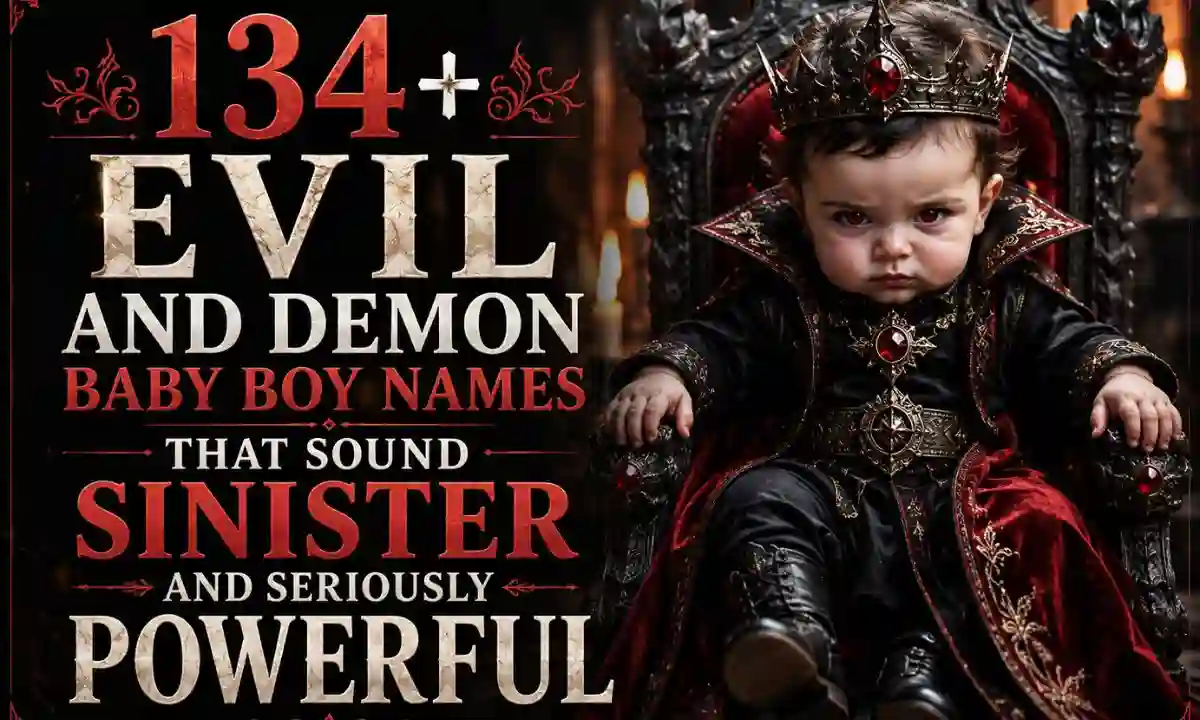
There is a certain kind of parent who hears a name like Sebastian and thinks it sounds too soft. Who hears Maximilian and wants something with more shadow in it. Who is drawn not to the golden, the pastoral, or the warmly familiar but to names that carry the weight of old darkness, mythological menace, and the kind of power that civilizations built entire religions around containing. If that sounds like you, you have found exactly the right list.
Dark names have a long and entirely legitimate history in human naming traditions. Across every culture that has ever told stories about the forces that oppose creation, those forces were given names. And those names, forged in the oldest furnaces of human imagination, tend to be extraordinary. They carry centuries of narrative weight, linguistic complexity, and a haunting beauty that softer names simply cannot match. A name drawn from demonology, dark mythology, or the shadow traditions of ancient civilizations is not a name that apologizes for itself. It arrives fully formed, entirely serious, and completely unforgettable.
Whether you are a parent drawn to the gothic and the grand, a writer building a villain of real mythological depth, or simply someone who believes that the most powerful names have always lived on the darker side of the spectrum, this collection gives you 134 of the most sinister, powerful, and genuinely compelling dark names ever documented across human history and mythology. Popularity rankings are based on the most recent Social Security Administration (SSA) data.
Quick Note on Popularity: Names ranked above 1000 on the SSA database are considered truly rare and unique. Names closer to 1 are among the most popular in the United States today.
Dark but Usable Names
Damien
- Origin: Greek
- Meaning: To tame, to overpower
- Popularity: #162
Forever shadowed by the Antichrist of The Omen, Damien is the dark name that has crossed fully into mainstream use without losing a single degree of its sinister edge, belonging to a child who will always carry a certain magnetic, slightly unsettling energy in every room he enters.
Dorian
- Origin: Greek
- Meaning: From the sea, descendant of Doros
- Popularity: #237
Oscar Wilde gave this name to the most beautifully corrupt character in Victorian literature, a man whose portrait aged while he remained eternally young, and Dorian has never fully recovered from that association, which is precisely what makes it so completely irresistible.
Draven
- Origin: Old English/invented
- Meaning: Of the ravens, hunter
- Popularity: >1000
Made famous by The Crow’s brooding resurrected antihero Eric Draven, this name carries the dark romanticism of a man who came back from the dead purely for vengeance and accomplished it with considerable style, a genuinely unforgettable name for a genuinely unforgettable child.
Lucian
- Origin: Latin
- Meaning: Light, born at dawn
- Popularity: #326
The darkest irony in naming is giving the name of light to a child of shadow, and Lucian does exactly that, carrying the Latin root of Lucifer while remaining entirely acceptable in every social setting, a name of hidden depths and quietly dangerous elegance.
Cain
- Origin: Hebrew
- Meaning: Acquired, spear, smith
- Popularity: >1000
The world’s first murderer and the inventor of fratricide gave the entire Western tradition its most enduring symbol of jealousy and fatal violence, and Cain as a name belongs to a child who will spend their life being underestimated by everyone who fails to look closely enough.
Killian
- Origin: Irish/Gaelic
- Meaning: Little warrior, church, strife
- Popularity: #201
The tension between the saint’s origin and the warrior meaning makes Killian one of the most dramatically interesting dark names in the mainstream acceptable range, belonging to a boy whose gentleness and ferocity exist in permanent and entirely productive tension with each other.
Desmond
- Origin: Irish/Gaelic
- Meaning: From south Munster, man of the world
- Popularity: #389
Carrying the weight of Irish clan history and the unexpected darkness of a name that sounds warm but holds a cold interior geography, Desmond belongs to a character who is completely charming in company and entirely different when the room finally empties.
Silas
- Origin: Latin/Aramaic
- Meaning: Of the forest, man of three
- Popularity: #104
The albino assassin monk of The Da Vinci Code made Silas the most chillingly effective religious villain of modern fiction, and this ancient name carries that association alongside a forest darkness that makes it feel simultaneously biblical and deeply unsettling.
Malachy
- Origin: Hebrew/Irish
- Meaning: Messenger of God, my angel
- Popularity: >1000
The Irish prophet whose apocalyptic list of popes predicted the end of the papacy gave this name a doomsday association so complete and so specific that it belongs to a boy who arrives in the world with an air of having already seen exactly how the story ends.
Samael
- Origin: Hebrew
- Meaning: Venom of God, blindness of God
- Popularity: >1000
In Jewish mystical tradition, Samael is the accusing angel and the angel of death, a figure of enormous cosmic authority who exists on the precise boundary between divine servant and cosmic adversary, a name of staggering theological darkness for a boy of equally staggering presence.
Zephyrus
- Origin: Greek
- Meaning: West wind, dark wind
- Popularity: >1000
While Zephyr is known as a gentle breeze, Zephyrus in Greek mythology was responsible for the accidental death of Hyacinthus, making this full form of the name carry a beauty that conceals a tragedy, a wind that destroys the thing it loves most.
Donatien
- Origin: Latin/French
- Meaning: Given, gift
- Popularity: >1000
The Marquis de Sade’s full name was Donatien Alphonse Francois, and this French form of Donation carries the full weight of history’s most infamous libertine, a name for a boy whose gift to the world will be both extraordinary and deeply uncomfortable for everyone around him.
Vespasian
- Origin: Latin
- Meaning: From the west, evening
- Popularity: >1000
The Roman emperor who destroyed Jerusalem, besieged Masada, and built the Colosseum on the site of Nero’s golden palace, Vespasian carries the iron pragmatism of a man who understood that power is built on ruins and had absolutely no objection to that arrangement.
Alaric
- Origin: Germanic
- Meaning: Ruler of all, noble ruler
- Popularity: >1000
The Visigoth king who sacked Rome in 410 AD and ended four centuries of the city’s invulnerability, Alaric is a name of barbaric grandeur and historical catastrophe, belonging to a boy who will one day walk into a room that has never been walked into before and change it permanently.
Corvus
- Origin: Latin
- Meaning: Raven, crow
- Popularity: >1000
Named directly for the raven, the bird of ill omen in nearly every Western tradition, Corvus belongs to a boy who sees what others prefer not to look at, who arrives at the scene of important events slightly before everyone else, and who carries the darkness with complete equanimity.
Malachite
- Origin: Greek
- Meaning: Green stone, mallow plant
- Popularity: >1000
A deep green mineral associated with transformation, the underworld, and the ancient Egyptian goddess Hathor in her darker aspects, Malachite as a name belongs to a boy whose beauty is mineral, cold, and of a depth that surface examination will never adequately explain.
Obsidian
- Origin: Latin
- Meaning: From Obsidius, volcanic black glass
- Popularity: >1000
The volcanic glass formed when lava meets water so rapidly there is no time for crystals to form, Obsidian belongs to a boy whose character was formed under similar conditions, extreme heat, sudden cold, and the result is something with razor edges and complete opacity.
Demon and Devil Names
Azazel
- Origin: Hebrew
- Meaning: Scapegoat, God strengthens
- Popularity: >1000
In the Book of Enoch, Azazel was the fallen angel who taught humanity the arts of war and the vanities of cosmetics, leading to the corruption that necessitated the Flood, a demon of knowledge and beauty whose gifts to humanity were also their undoing.
Belial
- Origin: Hebrew
- Meaning: Worthlessness, without worth, lord of chaos
- Popularity: >1000
One of the four crown princes of Hell in demonological tradition and a figure of considerable authority in the Dead Sea Scrolls, Belial belongs to a boy whose name announces immediately that conventional moral frameworks are unlikely to contain him for very long.
Abaddon
- Origin: Hebrew
- Meaning: Place of destruction, angel of the bottomless pit
- Popularity: >1000
In the Book of Revelation, Abaddon is the angel of the abyss who leads an army of locusts out of the bottomless pit, and this name carries the apocalyptic authority of something that was always going to arrive and that no amount of preparation was ever going to stop.
Mephistopheles
- Origin: Hebrew/Greek
- Meaning: He who loves not the light, destroyer and liar
- Popularity: >1000
The demon who bargained with Faust and gave Western literature its defining portrait of a deal with the devil, Mephistopheles is the longest and most elaborately constructed dark name on this list, belonging to a boy for whom the ordinary rules of human transaction will never quite apply.
Asmodeus
- Origin: Hebrew/Persian
- Meaning: Creature of judgment, demon of lust
- Popularity: >1000
The king of demons in Jewish demonology and the spirit of lust in the Testament of Solomon, Asmodeus was bound by the archangel Raphael using a fish’s liver and subsequently forced to help build the Temple, a satisfyingly humiliating fate for one of hell’s most senior residents.
Baal
- Origin: Hebrew/Canaanite
- Meaning: Lord, master, owner
- Popularity: >1000
The storm god of the Canaanites who became the primary idol condemned throughout the Hebrew Bible, Baal carries the weight of an entire civilization’s religious system that was deliberately suppressed, a name of enormous ancient authority for a boy of similarly enormous eventual presence.
Mammon
- Origin: Aramaic
- Meaning: Wealth, riches, material greed
- Popularity: >1000
The demon of avarice in Christian demonology and the force Christ warned his followers they could not serve alongside God, Mammon belongs to a boy who will understand money, power, and the precise price of every transaction he ever enters into with a clarity that borders on supernatural.
Moloch
- Origin: Hebrew/Canaanite
- Meaning: King, the devouring god
- Popularity: >1000
The ancient Canaanite deity to whom children were sacrificed in fire according to biblical accounts, Moloch became Allen Ginsberg’s symbol for industrial capitalism in Howl and carries a darkness that moves across millennia without losing a single degree of its consuming intensity.
Beelzebub
- Origin: Hebrew/Philistine
- Meaning: Lord of the flies, lord of the high place
- Popularity: >1000
One of the most senior princes of Hell in Christian demonology and the presiding spirit of William Golding’s Nobel Prize-winning novel about the darkness inside human nature, Beelzebub is a name of extraordinary mythological weight for a boy of extraordinary eventual significance.
Belphegor
- Origin: Hebrew/Moabite
- Meaning: Lord of the opening, lord of the gap
- Popularity: >1000
The demon of discovery and invention who tempts humans with ideas and clever solutions in order to corrupt them through their own ingenuity, Belphegor belongs to a boy who will spend his life finding solutions to problems that no one else thought to look at directly.
Sammael
- Origin: Hebrew
- Meaning: Poison of God, severity of God
- Popularity: >1000
A variant form of Samael found in Gnostic and Kabbalistic texts where he serves as the blind creator god of the material world rather than a simple devil, Sammael belongs to a boy whose darkness is not evil but something far more philosophically complicated and interesting.
Naamah
- Origin: Hebrew
- Meaning: Pleasant, beautiful
- Popularity: >1000
In later Jewish tradition, Naamah became a demon of seduction and one of the four queens of the demonic realm, a name whose meaning of pleasant beauty creates a deliberate and deeply unsettling contradiction with what the tradition says she actually does.
Andras
- Origin: Welsh/Demonological
- Meaning: Manly, androgenic, marquis of discord
- Popularity: >1000
In the Ars Goetia, Andras is the seventy-third demon, a grand marquis of Hell who rides a black wolf and carries a bright sword, sowing discord and destruction among everyone unfortunate enough to attract his attention.
Gaap
- Origin: Demonological
- Meaning: Void, emptiness
- Popularity: >1000
One of the mighty princes of Hell in the Ars Goetia, Gaap rules over four demonic kings and sixty-six legions of spirits, teaching philosophy and liberal sciences while also causing love and hatred, a demon of considerable intellectual range and catastrophic emotional consequences.
Phenex
- Origin: Greek/Demonological
- Meaning: Phoenix, dark flame
- Popularity: >1000
A marquis of Hell who appears in the form of a phoenix singing sweet songs of terrible content, Phenex belongs to a boy whose gifts are genuine and extraordinary and whose use of those gifts will always carry a certain underlying darkness that the beauty of the performance never entirely conceals.
Vepar
- Origin: Demonological
- Meaning: Duke of the sea, water ruler
- Popularity: >1000
A grand duke of Hell who governs the waters and guides warships in the Ars Goetia, Vepar belongs to a boy whose element is water in its most dangerous form, not the still lake or the gentle river but the open ocean at the precise moment a storm arrives unexpectedly from the north.
Valac
- Origin: Demonological/Hebrew
- Meaning: President of Hell, wanderer
- Popularity: >1000
Made famous to modern audiences by The Conjuring Universe as a child-faced demon of extraordinary menace, Valac in the Ars Goetia is a president of Hell who appears as a small winged boy riding a two-headed dragon and reveals the locations of hidden serpents and treasures.
Mythological Dark Names
Thanatos
- Origin: Greek
- Meaning: Death, personification of death
- Popularity: >1000
The Greek personification of death himself, twin brother of Hypnos the sleep god, Thanatos was depicted as a gentle, winged figure who escorted souls to the underworld, making this a name of death that is simultaneously terrible and unexpectedly compassionate.
Erebus
- Origin: Greek
- Meaning: Deep darkness, shadow
- Popularity: >1000
One of the first entities to emerge from primordial Chaos in Greek cosmology, Erebus is the deep darkness that fills the space between earth and Hades, a name of absolute primordial shadow for a boy who carries an atmosphere of gravity wherever he goes.
Nemesis
- Origin: Greek
- Meaning: To give what is due, righteous anger
- Popularity: >1000
The Greek goddess of divine retribution who punished hubris and ensured that no mortal prosperity exceeded what the gods considered appropriate, Nemesis belongs to a boy who has an exceptionally precise and entirely unforgiving relationship with the concept of fairness.
Typhon
- Origin: Greek
- Meaning: Smoky, whirlwind, monster of chaos
- Popularity: >1000
The last great monster of Greek mythology, a hundred-headed serpentine giant so terrifying that the Olympian gods fled to Egypt in terror, Typhon nearly defeated Zeus in their battle and remains the most catastrophically powerful monster in the entire classical tradition.
Nyx
- Origin: Greek
- Meaning: Night, personification of night
- Popularity: >1000
The primordial goddess of night who was so powerful that even Zeus feared to anger her, Nyx emerged directly from Chaos and gave birth to death, sleep, strife, and doom, making this three-letter name one of the most concentrated sources of mythological darkness in the entire classical world.
Cronus
- Origin: Greek
- Meaning: Time, crow
- Popularity: >1000
The Titan king who swallowed his own children to prevent a prophecy of his overthrow, Cronus is the mythological figure of consuming, paranoid paternal power, a name for a boy whose ambition is so complete that he will eventually have to confront what it costs him.
Set
- Origin: Egyptian
- Meaning: Instigator, one who dazzles
- Popularity: >1000
The Egyptian god of chaos, storms, the desert, and violence who murdered his brother Osiris and was defeated by his nephew Horus, Set is one of the oldest dark deities in recorded human religion and carries a mythology of desert heat and absolute destructive power.
Apep
- Origin: Egyptian
- Meaning: To slither, the uncreator
- Popularity: >1000
The great serpent of Egyptian mythology who existed before creation and spent eternity attempting to swallow the sun god Ra during his nightly journey through the underworld, Apep is the personification of chaos and the void that existed before existence itself.
Mot
- Origin: Canaanite/Ugaritic
- Meaning: Death itself
- Popularity: >1000
The Canaanite god of death and the underworld who swallowed the storm god Baal whole and ruled the dead in his absence, Mot is three letters of absolute finality, one of the oldest and most direct death-deity names in the entire ancient Near Eastern tradition.
Angra Mainyu
- Origin: Avestan/Zoroastrian
- Meaning: Evil spirit, destructive spirit
- Popularity: >1000
The supreme evil in Zoroastrian cosmology, the force of destruction and lies who has battled the god of truth and light since before the creation of the world, Angra Mainyu belongs to a boy from a family that understands the oldest human articulation of the problem of evil.
Ahriman
- Origin: Persian/Zoroastrian
- Meaning: Evil spirit, the dark one
- Popularity: >1000
The Persian form of Angra Mainyu who became a significant figure in Gnostic thought and later influenced the Western understanding of Satan, Ahriman carries the full philosophical weight of a culture that understood evil not as an absence of good but as an active and equal opposing force.
Loki
- Origin: Old Norse
- Meaning: Knot, tangle, possibly trickster
- Popularity: >1000
The Norse trickster god who began as a mischievous ally of the gods and ended as the agent of Ragnarok itself, Loki carries the most complex moral trajectory in Norse mythology, a name for a boy whose charm is genuine, whose intelligence is extraordinary, and whose loyalty is conditional on whether the arrangement still serves his purposes.
Fenrir
- Origin: Old Norse
- Meaning: Fen dweller, marsh creature
- Popularity: >1000
The monstrous wolf son of Loki who was prophesied to swallow Odin at Ragnarok, Fenrir was bound by the gods using a magical ribbon and waits for the end of the world in chains, a name of imprisoned cosmic violence for a boy of similarly contained but unmistakable power.
Surtr
- Origin: Old Norse
- Meaning: Black, the swarthy one
- Popularity: >1000
The fire giant of Norse mythology who guards Muspelheim with a flaming sword and whose flames will consume the world at Ragnarok, Surtr is a name of elemental destructive power belonging to a being who has been waiting at the end of the world since before the world began.
Nidhogg
- Origin: Old Norse
- Meaning: Malice striker, he who strikes with malice
- Popularity: >1000
The great dragon who gnaws eternally at the roots of Yggdrasil, the world tree, attempting to bring down the entire Norse cosmos through patient, relentless destruction from below, Nidhogg is a name of dark patience and foundational threat that belongs to a boy who understands that the most powerful attacks begin at the roots.
Underworld and Death Names
Hades
- Origin: Greek
- Meaning: Unseen, the invisible one
- Popularity: >1000
The Greek god of the dead and ruler of the underworld who carried the helmet of invisibility and guarded his kingdom with absolute and entirely inflexible authority, Hades is a name of sovereign underworld power for a boy who will eventually govern whatever domain he chooses with the same complete and non-negotiable command.
Pluto
- Origin: Latin/Greek
- Meaning: Rich, wealthy
- Popularity: >1000
The Roman form of Hades whose name refers to the mineral wealth beneath the earth rather than death itself, Pluto belongs to a boy whose power comes from what lies underground, what most people prefer not to look at, and what turns out to be worth considerably more than anything visible on the surface.
Charon
- Origin: Greek
- Meaning: Fierce brightness, sharp gaze
- Popularity: >1000
The ferryman of the dead who carried souls across the River Styx to Hades in exchange for a coin placed on the tongue or eye of the deceased, Charon belongs to a boy whose service is essential, whose terms are non-negotiable, and whose patience with people who have not brought payment is famously and completely nonexistent.
Orcus
- Origin: Latin
- Meaning: The punisher, the netherworld
- Popularity: >1000
The Roman god of the underworld and punisher of broken oaths, Orcus was the deity who enforced the promises the living made to the dead and the divine, a name for a boy with an exceptionally long memory and a very specific relationship to the concept of keeping one’s word.
Moros
- Origin: Greek
- Meaning: Doom, fate, impending death
- Popularity: >1000
The Greek personification of doom and the force that drives mortals toward their fated death, Moros was a child of Nyx and existed before the Olympians, a name of primordial inevitability for a boy whose presence in any situation immediately clarifies what was always going to happen.
Ker
- Origin: Greek
- Meaning: Death spirit, doom, female death
- Popularity: >1000
The Keres were the female spirits of violent death in Greek mythology who hovered over battlefields drinking the blood of the slain, and Ker as a masculine given name carries that battlefield darkness in a form brief enough to be spoken in one breath and remembered permanently.
Osiris
- Origin: Egyptian
- Meaning: Powerful, mighty
- Popularity: >1000
The Egyptian god of the dead, resurrection, and the afterlife who was murdered by his brother Set, reassembled by his wife Isis, and became the judge of souls in the underworld, Osiris belongs to a boy whose story involves both profound loss and extraordinary reconstruction.
Anubis
- Origin: Egyptian
- Meaning: Royal child, to decay
- Popularity: >1000
The jackal-headed Egyptian god who weighed the hearts of the dead against the feather of truth and guided souls through the underworld, Anubis is a name of funerary authority and careful judgment, belonging to a boy with an extremely precise and entirely unsentimental understanding of what things are actually worth.
Yama
- Origin: Sanskrit
- Meaning: The restrainer, twin
- Popularity: >1000
The Hindu god of death and the first mortal to die, Yama rules the underworld and judges the dead with absolute fairness according to the record kept by his scribe Chitragupta, a name of cosmic judicial authority for a boy who will spend his life insisting that things be done correctly.
Izanami
- Origin: Japanese
- Meaning: Female who invites, the one who pulls
- Popularity: >1000
The Japanese goddess of creation and death who became the ruler of the underworld after dying in childbirth and subsequently threatened to kill a thousand people per day when her husband broke his promise not to look at her decaying form, a name of devastating mythological power from Japan’s oldest religious tradition.
Baron Samedi
- Origin: Haitian Creole/Vodou
- Meaning: Baron Saturday, lord of the dead
- Popularity: >1000
The loa of the dead in Haitian Vodou who stands at the crossroads between the living and the dead, Baron Samedi is depicted in a top hat and sunglasses and is known for crude humor and an absolute refusal to let anyone die before their time, the most stylish death deity in any world mythology.
Mictlantecuhtli
- Origin: Nahuatl/Aztec
- Meaning: Lord of Mictlan, lord of the land of the dead
- Popularity: >1000
The Aztec god of the dead who ruled the lowest and most distant level of the underworld and received the dead after a four-year journey through nine levels of the underworld, Mictlantecuhtli is the longest and most phonetically extraordinary death-deity name in the entire pre-Columbian tradition.
Sinister Short Names
Vex
- Origin: Latin
- Meaning: To trouble, to distress, to torment
- Popularity: >1000
A verb turned into a name of extraordinary compressed menace, Vex belongs to a boy who has spent his entire life being told he is difficult and has decided to make that assessment completely accurate, wearing the label as a declaration rather than an apology.
Bane
- Origin: Old English
- Meaning: Cause of death, destroyer, poison
- Popularity: >1000
The word for the cause of someone’s destruction turned into a name, Bane carries both the Old English tradition of meaningful naming and the modern pop culture weight of Batman’s most physically and intellectually formidable villain, a name for a boy who is someone’s specific and inevitable undoing.
Dusk
- Origin: Old English
- Meaning: The darkening of the sky, between day and night
- Popularity: >1000
Named for the moment when the light fails and shapes become uncertain, Dusk belongs to a boy who exists in the threshold space between opposites, not fully dark and not fully light, inhabiting the ambiguous territory where the most interesting things always happen.
Dirge
- Origin: Latin
- Meaning: A funeral song, a lament for the dead
- Popularity: >1000
Named for the mournful song sung over the dead, Dirge belongs to a boy whose presence in any situation carries a gravity that others feel without being able to explain, someone who makes rooms quieter simply by entering them.
Mal
- Origin: Latin/Old French
- Meaning: Bad, evil, ill
- Popularity: >1000
Three letters of pure Latin negativity that somehow became a perfectly usable name, Mal carries its meaning with a directness that most names work very hard to obscure, belonging to a boy who has decided that transparency about his nature is both more efficient and more honest than pretending otherwise.
Nox
- Origin: Latin
- Meaning: Night, darkness
- Popularity: >1000
The Latin night goddess equivalent of the Greek Nyx, Nox is three letters of complete nocturnal authority, belonging to a boy who is most fully himself after dark and who understands the night as a domain of possibility rather than a simple absence of light.
Wrath
- Origin: Old English
- Meaning: Extreme anger, violent rage
- Popularity: >1000
One of the seven deadly sins elevated to a given name, Wrath belongs to a boy from a world where virtue names and vice names exist in equivalent traditions, a child who carries the most energetic and least patient of all human failings permanently in his identity.
Hex
- Origin: German/Old English
- Meaning: Witch, curse, magical spell
- Popularity: >1000
Short, hard-edged, and carrying the Old German tradition of witchcraft in a single syllable, Hex belongs to a boy who understands that the most powerful forces in any world are the ones that most people refuse to acknowledge as real.
Ruin
- Origin: Latin
- Meaning: Collapse, destruction, fallen state
- Popularity: >1000
The state of something after it has been destroyed, Ruin belongs to a boy who was named for what happens at the end of things, whose presence suggests to those with sufficient imagination that whatever they are currently building will eventually be beautiful in a completely different and much less functional way.
Void
- Origin: Old French/Latin
- Meaning: Empty space, nothingness
- Popularity: >1000
Named for the absolute absence of everything, Void belongs to a boy whose inner life is so completely his own that outsiders experience his presence as a kind of blankness, an emptiness that turns out to contain multitudes arranged in an order no one else has the key to read.
Kael
- Origin: Celtic/Gaelic
- Meaning: Slender, narrow
- Popularity: >1000
Short, Celtic, and carrying a sharpness in its sound that matches its meaning, Kael belongs to a boy of precise and narrow intensity, someone whose focus is so complete that everything outside its beam of attention effectively ceases to exist for the duration.
Dark Slavic and Norse Names
Veles
- Origin: Slavic
- Meaning: Cattle god, god of the underworld
- Popularity: >1000
The Slavic god of the underworld, cattle, magic, and the arts who eternally battled the thunder god Perun across the sky, Veles belongs to a boy who operates in the shadows beneath the visible world and whose power over what lies underground is absolute and entirely unchallenged.
Chernobog
- Origin: Slavic
- Meaning: Black god, dark deity
- Popularity: >1000
The dark god of Slavic mythology who appeared in Disney’s Fantasia as the demon summoning the dead on Bald Mountain, Chernobog is a name of Slavic mythological darkness so extreme and so visually potent that it has become one of fiction’s most recognizable evil deity images.
Stribog
- Origin: Slavic
- Meaning: God of winds, the scattering one
- Popularity: >1000
The Slavic god of wind, air, and sky whose breath scattered the winds across the world, Stribog belongs to a boy whose influence is invisible, omnipresent, and completely impossible to stop once it has decided to go somewhere, a force of atmospheric disruption on a cosmic scale.
Perun
- Origin: Slavic
- Meaning: Thunder, lightning bolt
- Popularity: >1000
The Slavic thunder god and chief deity of the pantheon who eternally battles Veles across the sky, Perun carries the percussive authority of thunder in his name itself, belonging to a boy whose anger, when it finally arrives, is indistinguishable from a natural catastrophe.
Marzanna
- Origin: Slavic
- Meaning: Goddess of death and winter
- Popularity: >1000
The Slavic goddess of death, winter, and nightmares whose effigy is traditionally burned and drowned at the end of winter to drive away death and cold, Marzanna belongs to a boy whose departure from any situation is always cause for genuine relief among those left behind.
Hel
- Origin: Old Norse
- Meaning: Hidden, the realm of the dead
- Popularity: >1000
The Norse goddess of the realm of the dead who was half living and half corpse, ruling over all those who died of illness and old age rather than in battle, Hel belongs to a boy from the Norse tradition where the unglamorous deaths outnumber the heroic ones and someone has to govern the majority.
Jormungandr
- Origin: Old Norse
- Meaning: Great beast, earth’s serpent
- Popularity: >1000
The Midgard Serpent who encircles the entire world biting its own tail and will release it at Ragnarok to battle Thor, Jormungandr is the most physically enormous entity in Norse mythology, a name of world-scale power for a boy whose ambitions are similarly without conventional boundary.
Skoll
- Origin: Old Norse
- Meaning: Treachery, one who mocks
- Popularity: >1000
The wolf who chases the sun across the sky in Norse mythology and will swallow it at Ragnarok, Skoll belongs to a boy of relentless pursuit and dark purpose, someone whose entire existence is oriented toward a single catastrophic goal that the entire world is trying to prevent him from reaching.
Utgard
- Origin: Old Norse
- Meaning: Outer realm, the world beyond the boundary
- Popularity: >1000
The realm of the frost giants in Norse mythology that lies beyond the boundaries of the known world, Utgard belongs to a boy from outside the established order, someone who arrived from beyond the edge of the map and has no particular interest in following rules that were written before he got there.
Surma
- Origin: Finnish
- Meaning: Death, sudden death
- Popularity: >1000
The Finnish personification of death itself, a creature of absolute finality in the mythology of the Kalevala tradition, Surma belongs to a boy whose name in Finnish is the word for what ends things, five letters of complete mythological inevitability.
Arabic and Persian Dark Names
Iblis
- Origin: Arabic
- Meaning: Despair, he who despaired
- Popularity: >1000
The Islamic equivalent of Satan who refused to bow before Adam when God commanded it and was cast out of paradise for his refusal, Iblis belongs to a boy whose pride is so complete that even divine authority is insufficient to override it, a name of cosmic defiance with genuinely ancient theological roots.
Shaitan
- Origin: Arabic
- Meaning: Adversary, the one who strays
- Popularity: >1000
The Arabic name for the adversarial force in Islamic theology, corresponding to Satan in the Abrahamic tradition, Shaitan belongs to a boy who has made a philosophical decision to exist in opposition to whatever the established consensus happens to be at any given moment.
Ahriman
- Origin: Avestan/Persian
- Meaning: Evil spirit, the destructive one
- Popularity: >1000
The supreme dark deity of Zoroastrian cosmology whose battle with the god of light, Ahura Mazda, defines the entire structure of that ancient faith, Ahriman belongs to a boy whose name carries the oldest recorded theological articulation of the problem of evil in human religious history.
Dajjal
- Origin: Arabic
- Meaning: The deceiver, the false messiah
- Popularity: >1000
The Islamic figure of the false messiah who will appear before the Day of Judgment to mislead humanity, Dajjal belongs to a boy in a fictional tradition where the most dangerous figures are not those who oppose truth but those who imitate it with sufficient skill to fool everyone who is not paying extremely close attention.
Ifrit
- Origin: Arabic
- Meaning: Powerful spirit, rebellious fire spirit
- Popularity: >1000
A class of powerful and dangerous jinn in Islamic mythology who are made of smokeless fire and are associated with strength, cunning, and a deep resentment of human authority over them, Ifrit belongs to a boy of volcanic interior life and considerable impatience with the assumption that he should follow instructions.
Pazuzu
- Origin: Akkadian/Babylonian
- Meaning: King of wind demons, lord of fever winds
- Popularity: >1000
The Mesopotamian demon king of the wind who brought disease and famine on the hot desert winds, most familiar to modern audiences as the entity possessing Regan in The Exorcist, Pazuzu is the oldest named demon in recorded human history and carries that distinction with considerable cinematic menace.
Nergal
- Origin: Sumerian
- Meaning: Lord of the great city, lord of the underworld
- Popularity: >1000
The Mesopotamian god of death, plague, and the underworld who descended to the land of the dead and became its king, Nergal is one of the oldest deity names in human recorded history and carries the full weight of the world’s first civilization’s darkest theological imagination.
Ereshkigal
- Origin: Sumerian
- Meaning: Queen of the great earth, lady of the great below
- Popularity: >1000
The Sumerian queen of the underworld whose grief at her husband’s death caused all life on earth to cease reproducing, Ereshkigal is the oldest named underworld ruler in human recorded religion, a name of absolute subterranean authority from the very beginning of human storytelling.
Lilitu
- Origin: Akkadian/Sumerian
- Meaning: Storm spirit, night demon
- Popularity: >1000
The Akkadian demon of storms from whom the later figure of Lilith was derived, Lilitu belongs to a boy whose nature is atmospheric, violent when provoked, and impossible to contain using any of the ordinary methods that work reasonably well on more straightforward kinds of danger.
Humbaba
- Origin: Sumerian
- Meaning: Guardian of the cedar forest
- Popularity: >1000
The terrifying monster guardian of the Cedar Forest who was slain by Gilgamesh and Enkidu in the world’s oldest surviving epic narrative, Humbaba belongs to a boy whose role is to guard something that heroes will always try to take, a name from the very first story humanity thought important enough to write down.
Gothic and Victorian Dark Names
Malachar
- Origin: Invented/Gothic
- Meaning: Created
- Popularity: >1000
Constructed with the ceremonial weight of a Gothic villain name, Malachar belongs to a character in a gaslit world of carriages and fog, someone who presides over something enormous and terrible in a house at the end of a very long lane that most people prefer to walk past without looking at directly.
Thaddeus
- Origin: Aramaic/Greek
- Meaning: Heart, courageous heart
- Popularity: >1000
The apostle whose name sounds like it belongs to a Victorian gentleman of considerable shadow, Thaddeus carries a weight of antique formality that makes it perfect for a character defined by the gap between their distinguished exterior and the genuinely complicated interior that exterior was built to conceal.
Corvinus
- Origin: Latin
- Meaning: Of the crow, raven-like
- Popularity: >1000
The Latin crow-name that gave Hungarian king Matthias Corvinus his famous raven heraldry, Corvinus belongs to a Gothic character of considerable aristocratic menace, someone whose family crest involves birds of ill omen and whose library contains books that most libraries refuse to catalog.
Aldric
- Origin: Germanic
- Meaning: Noble ruler, old power
- Popularity: >1000
A name from the deepest Germanic noble tradition that sounds as though it belongs to a man presiding over a vast estate in a valley where the fog never entirely lifts and where the servants have all been there so long that no one can quite remember when any of them were hired.
Balthazar
- Origin: Babylonian/Greek
- Meaning: Baal protects the king, God protects the king
- Popularity: >1000
One of the three Magi and a name of Babylonian royal authority that sounds simultaneously sacred and deeply ominous, Balthazar belongs to a Victorian gothic character who has studied things in Eastern libraries that European universities do not acknowledge the existence of.
Vesper
- Origin: Latin
- Meaning: Evening star, evening prayer
- Popularity: >1000
Named for the evening, the hour when darkness begins its advance, Vesper belongs to a boy who comes alive at the precise moment when most people are retreating indoors, whose energy and clarity increase as the natural light fails and the artificial light creates shadows in all the most interesting places.
Lazarus
- Origin: Hebrew
- Meaning: God has helped, my God is my helper
- Popularity: >1000
The man raised from the dead by Jesus in the Gospel of John whose name has become the universal symbol of returning from death, Lazarus belongs to a boy who survives things that should not be survivable and returns from each experience slightly harder to read than he was before.
Mordecai
- Origin: Hebrew/Babylonian
- Meaning: Servant of Marduk, follower of Mars
- Popularity: >1000
A biblical hero’s name that sounds like a Victorian villain’s, Mordecai carries the unusual combination of genuine heroic scriptural origins and a sound so antiquated and slightly gloomy that modern audiences hear it entirely as menace, proving that context changes everything.
Absalom
- Origin: Hebrew
- Meaning: Father of peace, my father is peace
- Popularity: >1000
King David’s most beautiful and most treacherous son, who led a rebellion against his own father and died when his magnificent hair caught in a tree during his escape, Absalom belongs to a boy of extraordinary beauty, genuine talent, and a relationship with authority figures that will require considerable careful management from all involved.
Obadiah
- Origin: Hebrew
- Meaning: Servant of God, worshipper of God
- Popularity: >1000
A minor prophet of the Hebrew Bible whose name sounds, in the Gothic tradition, like someone who was a servant of something rather more sinister than the deity specified, Obadiah belongs to a Victorian gothic character of considerable dark piety whose devotion is entirely genuine and entirely terrifying.
Cornelius
- Origin: Latin
- Meaning: Horn, cornelian stone
- Popularity: >1000
A name of Roman patrician gravity that the Victorian gothic tradition claimed entirely as its own, Cornelius belongs to a patriarch of enormous personal authority who runs a household where the rules are absolute, the history is complicated, and the attic has been locked for reasons that no one currently living has been given a satisfactory explanation of.
Leander
- Origin: Greek
- Meaning: Lion man, strong as a lion
- Popularity: >1000
The young man of Greek myth who swam the Hellespont every night to visit Hero until a storm extinguished the light she used to guide him and he drowned in the crossing, Leander belongs to a boy whose love is so extreme that it eventually destroys the very thing it is devoted to.
Frequently Asked Questions
Q: Are demon and dark mythology names appropriate for real babies?
A: Many dark mythology names have crossed into mainstream use because parents are drawn to their historical depth, linguistic beauty, and the rich stories behind them rather than any literal association with evil. Names like Loki, Cain, Dorian, and Damien are all used regularly and belong to children who define themselves rather than being defined by their names. The key is choosing a name you love for its sound, history, and meaning and that your child can carry with confidence through every stage of their life.
Q: Which of these dark names are most usable in everyday settings?
A: Names like Damien, Dorian, Silas, Lucian, Killian, Corvus, Lazarus, and Leander are genuinely usable in everyday school and professional settings while still carrying their dark associations. Names like Mephistopheles, Abaddon, Beelzebub, and Mictlantecuhtli are better suited to fictional characters, game characters, or families who specifically want a name with maximum dramatic impact and minimum concern for how it plays at a job interview.
Q: What is the difference between an evil name and a dark name?
A: Evil names are those drawn directly from figures identified as forces of harm in religious or mythological traditions, like Belial, Asmodeus, or Moloch. Dark names are those that carry sinister associations through their meaning, sound, or cultural history without being specifically demonic, like Dorian, Erebus, or Dusk. For most parents, dark names offer all the gothic and powerful energy they are looking for without the specific theological weight of the demon category.
Q: Can dark mythology names from non-Western traditions be used by families outside those traditions?
A: This requires thoughtful consideration. Names from living religious traditions, particularly from Indigenous, African, and Asian spiritual systems that have experienced colonial suppression, carry a weight of cultural ownership that names from ancient Greek, Roman, or Norse mythology generally do not, since those traditions no longer have active religious communities whose beliefs would be affected by the name’s use. Researching the specific cultural context of any name from a living tradition is both respectful and practically useful.
Q: Which dark name has the most powerful literary or cinematic history?
A: Damien carries the most concentrated pop culture darkness through The Omen franchise. Dorian carries the heaviest literary darkness through The Picture of Dorian Gray. Loki carries the richest mythological darkness through the Norse tradition and the Marvel Cinematic Universe simultaneously. Leviathan carries the most ancient biblical darkness. The answer depends entirely on which tradition you consider most significant, and all four are defensible choices for a family that values a name with a genuinely extraordinary story behind it.
Conclusion
Dark names are not a category that requires an apology or an explanation. They are the names that civilizations gave to the forces they feared most, which means they are also the names that those civilizations thought about most carefully, invested with the greatest imaginative energy, and crafted with the most serious linguistic and mythological intention. A child given one of these names inherits a story that has been told for centuries, a name with genuine weight, genuine history, and a genuine refusal to be ordinary. Whether your choice is a mainstream dark name like Damien or Dorian, a mythological giant like Typhon or Fenrir, or a demonological rarity like Azazel or Phenex, you are choosing a name that will never be forgotten and never be mistaken for someone else’s. Which name is your favorite? I would love to hear in the comments below!

Olivia Lane is a devoted Christian writer and faith blogger at PrayerPure.com, where she shares heartfelt prayers, Bible verses, and spiritual reflections to inspire believers around the world. Her gentle words help readers find peace, purpose, and strength in God’s presence every day. When she’s not writing, Olivia enjoys reading devotionals, spending time outdoors, and connecting with her church community.