
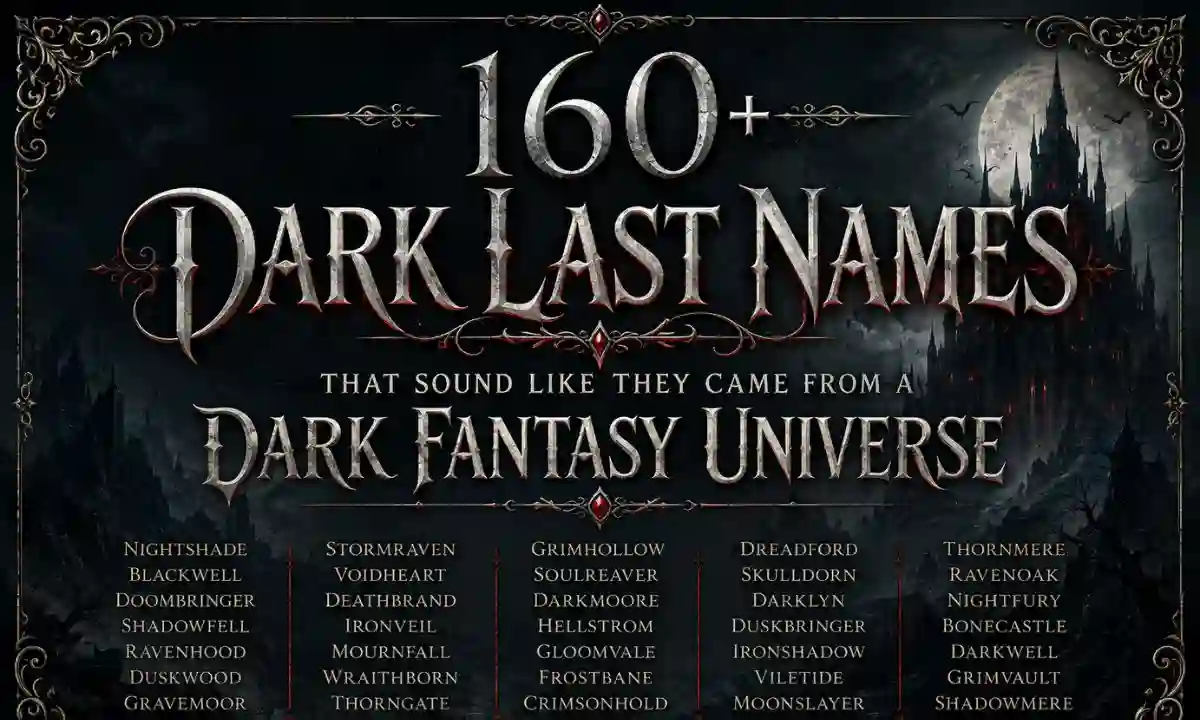
There is a particular kind of surname that does something to the air around it the moment it is spoken. It does not announce itself loudly. It does not shout for attention. It simply settles into the room with a quiet, cold authority that makes everyone present feel that something significant has just arrived. Dark fantasy surnames have that quality at its absolute most concentrated. They carry the weight of old bloodlines and older curses. They carry the smell of stone corridors and burned parchment and iron that has been used for purposes nobody writes down in official records. They carry the particular combination of beauty and threat that the greatest dark fantasy has always understood to be inseparable.
What makes dark last names so richly extraordinary is the remarkable depth of real linguistic tradition they draw from. The darkest and most compelling surnames are almost never invented whole cloth from nothing. They are English surnames built from the old words for shadow and blood and stone. They are German surnames carrying the fierce compound meanings of the medieval warrior tradition. They are Slavic surnames rooted in the dark forests and the old gods of the pre-Christian Eastern European world. They are Latin surnames carrying the formal, slightly menacing precision of a civilization that built its power on law and the threat of what happened when law failed. And from every corner of the naming world, dark surnames arrive with their particular combination of genuine historical depth and the cold, beautiful energy of something that has been waiting in the dark for a very long time.
Quick Info: Last names in this list are drawn from real documented surnames across multiple cultural traditions. Some are common, some are rare, all carry genuine documented meanings and origins.
Dark English Last Names
Blackwood
- Origin: English
- Meaning: From the dark forest, dark wood
- Cultural Roots: Old English
Named after the dark, ancient forest that stood at the edge of settled land where things happened that people preferred not to discuss, Blackwood carries a slightly ominous quality and a deep English heritage that makes it one of the most naturally dark fantasy surnames.
Grimshaw
- Origin: English
- Meaning: Dark thicket, grim grove
- Cultural Roots: Old English
Named after the dark, grim thicket where light does not easily penetrate, Grimshaw carries both the English word grim and the old word for a small wood and has a cold, slightly threatening quality that suits a dark fantasy character of genuine menace.
Ravenscroft
- Origin: English
- Meaning: Field of the ravens, raven enclosure
- Cultural Roots: Old English
Named after the enclosed field where ravens gathered, Ravenscroft carries a bold, slightly ominous quality and a deep English ornithological heritage and has a dark, flowing sound that makes it one of the most naturally dark fantasy English surnames.
Morley
- Origin: English
- Meaning: Moor clearing, dark meadow
- Cultural Roots: Old English
Named after the clearing on the dark moor, Morley carries a slightly desolate quality and a genuine English landscape heritage and has a clean, slightly cold sound that suits a dark fantasy character who comes from bleak, windswept places.
Gravestone
- Origin: English
- Meaning: Stone of the grave, marker stone
- Cultural Roots: Old English
Named after the stone that marks a grave, Gravestone carries a bold, slightly funereal quality and a genuine English memorial heritage and has a cold, slightly dramatic sound that makes it feel completely at home in a dark fantasy universe.
Nighthollow
- Origin: English
- Meaning: Hollow of the night, dark valley
- Cultural Roots: Old English
Named after the dark hollow that fills with night before anywhere else, Nighthollow carries a cool, slightly atmospheric quality and a genuine English landscape heritage and has a flowing, slightly ominous sound that suits a dark fantasy setting.
Coldwell
- Origin: English
- Meaning: Cold spring, cold stream
- Cultural Roots: Old English
Named after the cold, dark well or spring whose water never quite warms even in summer, Coldwell carries a cool, slightly chilling quality and a genuine English landscape heritage that makes it feel like the name of someone from a place where warmth never quite arrives.
Ashencroft
- Origin: English
- Meaning: Enclosure of ash trees, ashen field
- Cultural Roots: Old English
Named after the enclosure of ash trees and the ashen, grey quality of the ash tradition, Ashencroft carries a cool, slightly funereal quality and a genuine English botanical heritage and has a flowing sound that suits a dark fantasy bloodline.
Blackthorn
- Origin: English / Irish
- Meaning: The blackthorn tree, dark thorny shrub
- Cultural Roots: Old English / Irish
Named after the blackthorn tree whose thorns are used as weapons and whose dark berries carry a bitter, slightly poisonous quality in folklore, Blackthorn carries a bold, slightly fierce botanical quality that is completely unforgettable.
Mournfield
- Origin: English
- Meaning: Field of mourning, sorrowful meadow
- Cultural Roots: Old English
Named after the field where mourning gathers like weather, Mournfield carries a cold, slightly elegiac quality and a genuine English landscape heritage and has a flowing, sorrowful sound that suits a dark fantasy character of tragic dimension.
Gallows
- Origin: English
- Meaning: The gallows, place of execution
- Cultural Roots: Old English
Named after the place of public execution, Gallows carries a stark, slightly brutal quality and a genuine English judicial heritage and has a cold, minimal sound that makes it one of the most immediately dark fantasy surnames available.
Dreadmoor
- Origin: English
- Meaning: Dreadful moor, feared moorland
- Cultural Roots: Old English
Named after the feared and dreadful moorland that people avoided after dark, Dreadmoor carries a bold, slightly ominous quality and a genuine English landscape heritage and has a flowing sound that suits a dark fantasy setting perfectly.
Ashcroft
- Origin: English
- Meaning: Enclosure by the ash trees
- Cultural Roots: Old English
Named after the enclosure beside the ash trees, Ashcroft carries a cool, slightly grey quality and a genuine English landscape heritage and has a clean, slightly cold sound that suits a dark fantasy character who moves through ashen, grey landscapes.
Nightingale
- Origin: English
- Meaning: Night singer, the nightingale bird
- Cultural Roots: Middle English
Named after the great nightingale who sings in the dark, Nightingale carries a warm, slightly poetic quality and a deep English ornithological heritage and has a beautiful, flowing sound that makes it one of the most elegantly dark fantasy surnames.
Grimwood
- Origin: English
- Meaning: Dark forest, grim woods
- Cultural Roots: Old English
Named after the dark, grim woods where travelers lose their way, Grimwood carries a cold, slightly ominous quality and a genuine English landscape heritage and has a clean, slightly threatening sound that suits a dark fantasy character perfectly.
Craven
- Origin: English
- Meaning: Defeated, cowardly, from Craven in Yorkshire
- Cultural Roots: Old English
Named after both the quality of cowardice and the ancient Yorkshire region, Craven carries a complex, slightly dark quality and a genuine English geographical and linguistic heritage that suits a dark fantasy character of complicated, morally compromised nature.
Gothic and Germanic Last Names
Schwarzkopf
- Origin: German
- Meaning: Black head, dark-haired one
- Cultural Roots: Germanic
Named after the black head and dark-haired quality in the German tradition, Schwarzkopf carries a cool, slightly ominous quality and a genuine Germanic heritage and has a bold, slightly blunt sound that suits a dark fantasy character of cold, decisive nature.
Totenkopf
- Origin: German
- Meaning: Death’s head, skull
- Cultural Roots: Germanic
Named after the skull and death’s head in the German tradition, Totenkopf carries a stark, slightly macabre quality and a genuine Germanic heritage and has a bold, cold sound that makes it one of the most immediately dark fantasy German surnames.
Blutstein
- Origin: German
- Meaning: Blood stone, red stone
- Cultural Roots: Germanic
Named after the blood stone in the German tradition, connecting the dual meanings of blood and stone in a single cold compound, Blutstein carries a stark, slightly ritual quality and a genuine Germanic heritage.
Nachtkind
- Origin: German
- Meaning: Child of the night, night’s child
- Cultural Roots: Germanic
Named after the child of the night in the German tradition, Nachtkind carries a cool, slightly ominous quality and a genuine Germanic heritage and has a flowing, slightly lyrical sound that suits a dark fantasy character born to darkness.
Dunkelmann
- Origin: German
- Meaning: Dark man, man of darkness
- Cultural Roots: Germanic
Named after the dark man in the German tradition, Dunkelmann carries a stark, slightly ominous quality and a genuine Germanic heritage and has a flowing, slightly formal sound that suits a dark fantasy character who prefers the shadows.
Schattenwald
- Origin: German
- Meaning: Shadow forest, forest of shadows
- Cultural Roots: Germanic
Named after the shadow forest in the German tradition, Schattenwald carries a cool, flowing quality and a genuine Germanic heritage and has a beautiful, slightly ominous sound that suits a dark fantasy setting of deep, lightless woodlands.
Blutmond
- Origin: German
- Meaning: Blood moon, the red moon
- Cultural Roots: Germanic
Named after the blood moon in the German tradition, Blutmond carries a stark, slightly ritualistic quality and a genuine Germanic heritage and has a bold, cold sound that makes it feel completely at home in a dark fantasy universe.
Eisenherz
- Origin: German
- Meaning: Iron heart, cold heart of iron
- Cultural Roots: Germanic
Named after the iron heart in the German tradition, connecting the cold, unyielding quality of iron with the center of the person, Eisenherz carries a stark, slightly mechanical quality and a genuine Germanic heritage.
Grimmelshausen
- Origin: German
- Meaning: Dark grey houses, grim settlement
- Cultural Roots: Germanic
Named after the grim, dark grey settlement in the German tradition, Grimmelshausen carries a cold, slightly atmospheric quality and a genuine Germanic landscape heritage and has a flowing, elaborate sound that suits a dark fantasy aristocratic bloodline.
Nachtfalke
- Origin: German
- Meaning: Night falcon, nocturnal hawk
- Cultural Roots: Germanic
Named after the night falcon in the German tradition, Nachtfalke carries a cool, slightly predatory quality and a genuine Germanic heritage and has a flowing sound that suits a dark fantasy character who hunts in the hours before dawn.
Totenwald
- Origin: German
- Meaning: Forest of the dead, death forest
- Cultural Roots: Germanic
Named after the forest of the dead in the German tradition, Totenwald carries a stark, slightly funereal quality and a genuine Germanic heritage and has a bold, cold sound that makes it one of the most immediately dark fantasy German surnames.
Wulfsberg
- Origin: German / Norse
- Meaning: Wolf mountain, mountain of wolves
- Cultural Roots: Germanic / Norse
Named after the wolf mountain in the Germanic and Norse tradition, Wulfsberg carries a fierce, slightly wild quality and a genuine cross-cultural heritage and has a bold, clean sound that suits a dark fantasy character of savage, wolfish nature.
Schwarzenberg
- Origin: German / Austrian
- Meaning: Black mountain, dark hill
- Cultural Roots: Germanic
Named after the black mountain in the Germanic and Austrian tradition, Schwarzenberg carries a bold, slightly dramatic quality and a genuine heritage and has a flowing, grand sound that suits a dark fantasy aristocratic bloodline of considerable power.
Blutfeuer
- Origin: German
- Meaning: Blood fire, the fire of blood
- Cultural Roots: Germanic
Named after the blood fire in the German tradition, connecting the fierce energy of fire with the dark power of blood, Blutfeuer carries a stark, slightly ritualistic quality and a genuine Germanic heritage.
Graustein
- Origin: German
- Meaning: Grey stone, dark grey rock
- Cultural Roots: Germanic
Named after the grey stone in the German tradition, Graustein carries a cool, slightly elemental quality and a genuine Germanic heritage and has a clean, cold sound that suits a dark fantasy character of stone-hard, uncompromising nature.
Dunkelburg
- Origin: German
- Meaning: Dark castle, fortress of darkness
- Cultural Roots: Germanic
Named after the dark castle in the German tradition, Dunkelburg carries a stark, slightly architectural quality and a genuine Germanic heritage and has a bold, flowing sound that makes it feel completely at home as the name of a dark fantasy noble house.
Slavic and Eastern European Last Names
Volkov
- Origin: Russian
- Meaning: Wolf, from the wolf
- Cultural Roots: Slavic / Russian
Named after the great wolf in the Russian tradition, Volkov carries a bold, slightly fierce quality and a genuine Slavic heritage and has a clean, slightly sharp sound that makes it one of the most naturally dark and powerful Russian surnames.
Mracnik
- Origin: Croatian / Slavic
- Meaning: Dark one, gloomy one
- Cultural Roots: South Slavic
Named after the dark and gloomy one in the Croatian and Slavic tradition, Mracnik carries a cool, slightly ominous quality and a genuine South Slavic heritage and has a slightly unusual sound that makes it feel completely distinctive.
Krasnikov
- Origin: Russian
- Meaning: Red one, blood-red, beautiful
- Cultural Roots: Slavic / Russian
Named after the red one in the Russian tradition, where the word for red and beautiful share the same root, Krasnikov carries a complex, slightly ambiguous quality and a genuine Russian heritage that suits a dark fantasy character.
Cerny
- Origin: Czech / Slovak
- Meaning: Black, the black one
- Cultural Roots: West Slavic
Named after the black one in the Czech and Slovak tradition, Cerny carries a clean, slightly stark quality and a genuine West Slavic heritage and has a cool, minimal sound that makes it one of the most elegantly dark Slavic surnames.
Temnikov
- Origin: Russian
- Meaning: Dark, from the darkness
- Cultural Roots: Slavic / Russian
Named after the darkness in the Russian tradition, Temnikov carries a cold, slightly ominous quality and a genuine Russian heritage and has a flowing sound that suits a dark fantasy character who comes from deep darkness.
Krvavac
- Origin: Serbian / Croatian
- Meaning: Bloody, blood-stained
- Cultural Roots: South Slavic
Named after the bloody and blood-stained quality in the Serbian and Croatian tradition, Krvavac carries a stark, slightly brutal quality and a genuine South Slavic heritage that makes it one of the most immediately dark Slavic surnames.
Nocnik
- Origin: Czech / Polish
- Meaning: Night creature, child of the night
- Cultural Roots: West Slavic
Named after the night creature of Slavic folklore, a being that torments sleeping children, Nocnik carries an extraordinary folkloric legacy and a cool, slightly ominous quality and has a clean sound that suits a dark fantasy character.
Strigoi
- Origin: Romanian
- Meaning: Vampire, troubled spirit, witch
- Cultural Roots: Romanian / Slavic
Named after the strigoi of Romanian folklore, the vampiric creature that returns from the dead to plague the living, Strigoi carries an extraordinary Eastern European folklore legacy and a stark, slightly supernatural quality.
Morozov
- Origin: Russian
- Meaning: Frost, bitter cold, from the frost
- Cultural Roots: Slavic / Russian
Named after the frost and bitter cold in the Russian tradition, Morozov carries a cold, slightly elemental quality and a genuine Russian heritage and has a flowing sound that suits a dark fantasy character of cold, relentless nature.
Vukovic
- Origin: Serbian / Croatian
- Meaning: Son of the wolf, wolf’s descendant
- Cultural Roots: South Slavic
Named after the son of the wolf in the Serbian and Croatian tradition, Vukovic carries a fierce, slightly wild quality and a genuine South Slavic heritage and has a bold sound that suits a dark fantasy character of wolfish, predatory nature.
Prokletiy
- Origin: Russian / Slavic
- Meaning: Cursed, damned, the accursed one
- Cultural Roots: Slavic
Named after the cursed and damned one in the Slavic tradition, Prokletiy carries a stark, slightly supernatural quality and a genuine Slavic heritage and has a bold, cold sound that makes it one of the most immediately dark Slavic surnames.
Nochnik
- Origin: Russian
- Meaning: Night worker, creature of the night
- Cultural Roots: Slavic / Russian
Named after the creature of the night in the Russian folklore tradition, Nochnik carries a cool, slightly supernatural quality and a genuine Russian heritage and has a flowing sound that suits a dark fantasy character who operates after dark.
Zlodeyev
- Origin: Russian
- Meaning: Villain, wrongdoer, criminal
- Cultural Roots: Slavic / Russian
Named after the villain and wrongdoer in the Russian tradition, the word used for the archetypal bad person, Zlodeyev carries a stark, slightly moral quality and a genuine Russian heritage and suits a dark fantasy villain of genuine menace.
Chernov
- Origin: Russian
- Meaning: Black, the black one
- Cultural Roots: Slavic / Russian
Named after the black one in the Russian tradition, Chernov carries a clean, slightly stark quality and a genuine Russian heritage and has a bold, cold sound that makes it one of the most naturally dark and distinctive Russian surnames.
Grudinsky
- Origin: Russian / Ukrainian
- Meaning: Chest, breast, from the chest
- Cultural Roots: East Slavic
Named after the chest and breast in the Russian and Ukrainian tradition, with connections to the hard, resistant quality of bone, Grudinsky carries a cold, slightly physical quality and a genuine East Slavic heritage.
Ubiytsa
- Origin: Russian
- Meaning: Killer, murderer, the one who kills
- Cultural Roots: Slavic / Russian
Named after the killer in the Russian tradition, one of the most starkly direct dark surnames available, Ubiytsa carries a cold, slightly brutal quality and a genuine Russian heritage that makes it one of the most immediately dark surnames.
Dark Latin and Roman Last Names
Mortem
- Origin: Latin
- Meaning: Death, of death
- Cultural Roots: Classical Latin
Named after death itself in the Latin tradition, the accusative form of mors meaning death, Mortem carries a stark, slightly funereal quality and a genuine classical heritage and has a cold, minimal sound that makes it one of the most immediately dark Latin surnames.
Cruciatus
- Origin: Latin
- Meaning: Torture, torment, the torturing one
- Cultural Roots: Classical Latin
Named after the torment and torture in the Latin tradition, Cruciatus carries a stark, slightly brutal quality and a genuine classical heritage and has a flowing, formal sound that suits a dark fantasy villain of refined, methodical cruelty.
Infernus
- Origin: Latin
- Meaning: Infernal, of the underworld, hellish
- Cultural Roots: Classical Latin
Named after the infernal and the underworld in the Latin tradition, Infernus carries a stark, slightly supernatural quality and a genuine classical heritage and has a flowing, slightly grand sound that suits a dark fantasy character of infernal power.
Malefica
- Origin: Latin
- Meaning: Witch, one who does evil, malefic
- Cultural Roots: Classical Latin
Named after the witch and evildoer in the Latin tradition, Malefica carries a stark, slightly supernatural quality and a genuine classical heritage and has a flowing, slightly elegant sound that suits a dark fantasy character of genuine magical menace.
Tenebris
- Origin: Latin
- Meaning: Darkness, shadow, the dark one
- Cultural Roots: Classical Latin
Named directly after the Latin word for darkness and shadow, Tenebris carries a bold, slightly dramatic quality and a genuine classical heritage and has a flowing, cold sound that makes it one of the most elegantly dark Latin surnames.
Nocturnus
- Origin: Latin
- Meaning: Of the night, nocturnal, belonging to darkness
- Cultural Roots: Classical Latin
Named after the night and the nocturnal in the Latin tradition, Nocturnus carries a cool, slightly atmospheric quality and a genuine classical heritage and has a flowing, slightly formal sound that suits a dark fantasy character of the night.
Sepulcrum
- Origin: Latin
- Meaning: Tomb, sepulcher, burial place
- Cultural Roots: Classical Latin
Named after the tomb and burial place in the Latin tradition, Sepulcrum carries a stark, slightly funereal quality and a genuine classical heritage and has a bold, cold sound that makes it feel completely at home in a dark fantasy universe.
Maleficus
- Origin: Latin
- Meaning: Harmful, doing evil, wicked
- Cultural Roots: Classical Latin
Named after the harmful and wicked in the Latin tradition, Maleficus carries a stark, slightly formal quality and a genuine classical heritage and has a flowing, slightly elegant sound that suits a dark fantasy villain of educated, refined wickedness.
Perditio
- Origin: Latin
- Meaning: Destruction, ruin, perdition
- Cultural Roots: Classical Latin
Named after the destruction and perdition in the Latin tradition, Perditio carries a cold, slightly theological quality and a genuine classical heritage and has a flowing, formal sound that suits a dark fantasy character of destructive, inevitable power.
Caligo
- Origin: Latin
- Meaning: Darkness, mist, obscurity
- Cultural Roots: Classical Latin
Named after the darkness and mist in the Latin tradition, Caligo carries a cool, slightly atmospheric quality and a genuine classical heritage and has a clean, slightly cold sound that suits a dark fantasy character who moves through fog and darkness.
Nox
- Origin: Latin
- Meaning: Night, the goddess of night
- Cultural Roots: Classical Latin
Named after the night itself and the Roman goddess of night in the Latin tradition, Nox carries a stark, minimal quality and a genuine classical heritage and has a cold, sharp sound that makes it one of the most elegantly minimal dark Latin surnames.
Funeris
- Origin: Latin
- Meaning: Of the funeral, funereal, of death
- Cultural Roots: Classical Latin
Named after the funeral and death in the Latin tradition, Funeris carries a stark, slightly ceremonial quality and a genuine classical heritage and has a flowing, cold sound that suits a dark fantasy character associated with death rituals.
Umbra
- Origin: Latin
- Meaning: Shadow, shade, ghost
- Cultural Roots: Classical Latin
Named after the shadow and shade in the Latin tradition, Umbra carries a cool, slightly spectral quality and a genuine classical heritage and has a clean, minimal sound that makes it one of the most elegantly dark Latin surnames available.
Mors
- Origin: Latin
- Meaning: Death, the goddess of death
- Cultural Roots: Classical Latin
Named after death itself and the Roman goddess of death, Mors carries a stark, minimal quality and a genuine classical heritage and has a cold, sharp sound that makes it one of the most immediately dark one-syllable Latin surnames.
Venenum
- Origin: Latin
- Meaning: Poison, venom, harmful substance
- Cultural Roots: Classical Latin
Named after the poison and venom in the Latin tradition, Venenum carries a cold, slightly dangerous quality and a genuine classical heritage and has a flowing, formal sound that suits a dark fantasy character of quiet, patient lethality.
Cruoris
- Origin: Latin
- Meaning: Gore, blood, spilled blood
- Cultural Roots: Classical Latin
Named after the spilled blood and gore in the Latin tradition, Cruoris carries a stark, slightly brutal quality and a genuine classical heritage and has a flowing, formal sound that suits a dark fantasy character of bloody, martial power.
Celtic and Norse Dark Names
Morrigan
- Origin: Irish
- Meaning: Phantom queen, great queen
- Cultural Roots: Irish Gaelic
Named after the great phantom queen of Irish mythology, the goddess of fate, war, and death who appeared to warriors before battle as a crow or raven, Morrigan carries an extraordinary mythological legacy and a bold, slightly ominous quality.
Fenrir
- Origin: Norse
- Meaning: Fen dweller, the great wolf
- Cultural Roots: Norse
The great wolf of Norse mythology who is destined to swallow Odin at the end of the world, Fenrir carries an extraordinary mythological weight and a fierce, slightly dangerous quality that suits a dark fantasy villain or monster name perfectly.
Hel
- Origin: Norse
- Meaning: Hidden, the goddess of the dead
- Cultural Roots: Norse
Named after the Norse goddess of the dead whose domain is the realm of those who die without glory, Hel carries a profound mythological legacy and a stark, minimal quality and has a cold, sharp sound that makes it one of the most immediately dark Norse surnames.
Nidhogg
- Origin: Norse
- Meaning: Malice striker, the dragon who gnaws
- Cultural Roots: Norse
The great dragon of Norse mythology who gnaws eternally at the roots of the World Tree Yggdrasil, Nidhogg carries an extraordinary mythological weight and a fierce, slightly menacing quality that suits a dark fantasy monster bloodline perfectly.
Donn
- Origin: Irish
- Meaning: Dark, brown, the lord of the dead
- Cultural Roots: Irish Gaelic
Named after the Irish lord of the dead and the dark one in the Irish tradition, Donn carries a stark, slightly supernatural quality and a genuine Gaelic heritage and has a minimal, cold sound that suits a dark fantasy character of death-touched nature.
Grendel
- Origin: Old English / Norse
- Meaning: Grinder, destroyer, the monster of Beowulf
- Cultural Roots: Old English / Norse
The great monster of the Beowulf epic whose nocturnal attacks on Heorot define one of the oldest dark fantasy narratives in English literature, Grendel carries an extraordinary literary and mythological legacy.
Balor
- Origin: Irish
- Meaning: The deadly one, the fatal eye
- Cultural Roots: Irish Gaelic
The great Fomorian king of Irish mythology whose deadly eye could kill anyone it rested upon, Balor carries a profound mythological legacy and a stark, slightly supernatural quality that suits a dark fantasy villain of devastating power.
Crom
- Origin: Irish / Celtic
- Meaning: Bent, crooked, the dark god
- Cultural Roots: Irish / Celtic
Named after the ancient dark deity Crom Cruach, the crooked one to whom human sacrifices were made in pre-Christian Ireland, Crom carries a stark, slightly ancient quality and a genuine Celtic heritage of terrible power.
Skoll
- Origin: Norse
- Meaning: Treachery, the wolf who chases the sun
- Cultural Roots: Norse
The great wolf of Norse mythology who chases the sun across the sky every day and will eventually catch and devour it at Ragnarok, Skoll carries an extraordinary mythological weight and a fierce, slightly predatory quality.
Hati
- Origin: Norse
- Meaning: He who hates, the wolf who chases the moon
- Cultural Roots: Norse
The great wolf of Norse mythology who chases the moon and will devour it at the end of the world, Hati carries an extraordinary mythological legacy and a fierce, slightly dangerous quality that suits a dark fantasy character of relentless pursuit.
Mordred
- Origin: Welsh / Arthurian
- Meaning: Great judgment, extreme judgment
- Cultural Roots: Welsh / Arthurian
The great antagonist of the Arthurian legend who brings the Round Table to its catastrophic end, Mordred carries an extraordinary literary legacy and a dark, slightly dramatic quality that suits a dark fantasy character of tragic, destructive dimension.
Cailleach
- Origin: Scottish / Irish
- Meaning: Veiled one, old woman, hag
- Cultural Roots: Scottish Gaelic / Irish
Named after the great divine hag of Scottish and Irish mythology who shaped the mountains with her hammer and controlled the winter storms, Cailleach carries an extraordinary mythological legacy and a cold, slightly ancient quality.
Sluagh
- Origin: Irish / Scottish
- Meaning: Host of the unforgiven dead, restless dead
- Cultural Roots: Irish Gaelic / Scottish Gaelic
Named after the host of the unforgiven dead in Irish and Scottish folklore, the spirits of those who died in sin and were rejected by heaven and earth alike, Sluagh carries a profound folkloric legacy and a cold, slightly spectral quality.
Utgard
- Origin: Norse
- Meaning: Outer enclosure, the realm beyond
- Cultural Roots: Norse
Named after the great realm beyond the known world in Norse mythology, the place where the giants lived beyond the boundaries of civilization, Utgard carries an extraordinary mythological depth and a cold, slightly vast quality.
Hrimthurs
- Origin: Norse
- Meaning: Frost giant, rime thurse
- Cultural Roots: Norse
Named after the frost giants of Norse mythology who embody the cold, destructive power of winter and stand in opposition to the gods, Hrimthurs carries an extraordinary mythological weight and a fierce, cold quality.
Dark Nature and Elemental Names
Ashenveil
- Origin: English
- Meaning: Veil of ash, ash curtain
- Cultural Roots: Old English
Named after the veil of ash that falls after a great burning, Ashenveil carries a cool, slightly atmospheric quality and a genuine English heritage and has a flowing, slightly melancholy sound that suits a dark fantasy character wrapped in the aftermath of destruction.
Cindergrave
- Origin: English
- Meaning: Grave of cinders, ash burial
- Cultural Roots: Old English
Named after the grave filled with cinders, the final resting place of something that burned, Cindergrave carries a stark, slightly funereal quality and a genuine English heritage and has a flowing sound that suits a dark fantasy bloodline.
Frostmourne
- Origin: English
- Meaning: Mourning frost, cold grief
- Cultural Roots: Old English
Named after the mourning frost in the English tradition, the cold that settles over grief, Frostmourne carries a cool, slightly elegiac quality and a genuine English heritage and has a flowing sound that suits a dark fantasy character of cold sorrow.
Thornwick
- Origin: English
- Meaning: Thorny village, thorn settlement
- Cultural Roots: Old English
Named after the settlement among the thorns, Thornwick carries a slightly fierce, slightly uncomfortable quality and a genuine English geographical heritage and has a clean, cold sound that suits a dark fantasy character from a harsh, unwelcoming place.
Grimwater
- Origin: English
- Meaning: Dark water, grim stream
- Cultural Roots: Old English
Named after the dark, grim water of marshland and deep pools, Grimwater carries a cold, slightly ominous quality and a genuine English landscape heritage and has a flowing sound that suits a dark fantasy character of murky, dangerous nature.
Stonegrave
- Origin: English
- Meaning: Stone grave, rocky burial
- Cultural Roots: Old English
Named after the stone grave in the English tradition, Stonegrave carries a stark, slightly funereal quality and a genuine English memorial heritage and has a clean, cold sound that suits a dark fantasy character connected to death and burial.
Ironblight
- Origin: English
- Meaning: Iron blight, metal disease
- Cultural Roots: Old English
Named after the blight that corrupts even iron in the English tradition, Ironblight carries a stark, slightly corrupted quality and a genuine English heritage and has a bold, cold sound that suits a dark fantasy character of industrial, corrupting power.
Ashfall
- Origin: English
- Meaning: The falling of ash, ash descent
- Cultural Roots: Old English
Named after the falling of ash after a great fire or volcanic event, Ashfall carries a cool, slightly catastrophic quality and a genuine English heritage and has a clean, slightly ominous sound that suits a dark fantasy character born of destruction.
Bloodthorn
- Origin: English
- Meaning: Thorn of blood, blood-drawing thorn
- Cultural Roots: Old English
Named after the thorn that draws blood in the English botanical tradition, Bloodthorn carries a stark, slightly painful quality and a genuine English heritage and has a bold, cold sound that suits a dark fantasy character of sharp, wounding nature.
Voidmere
- Origin: English
- Meaning: Lake of void, empty waters
- Cultural Roots: Old English
Named after the lake of nothing, the waters that reflect nothing and lead nowhere, Voidmere carries a cool, slightly nihilistic quality and a genuine English heritage and has a flowing, cold sound that suits a dark fantasy character of emptiness and absence.
Grimfrost
- Origin: English / Norse
- Meaning: Grim frost, dark cold
- Cultural Roots: Old English / Norse
Named after the dark, grim frost that kills and does not relent, Grimfrost carries a cold, slightly relentless quality and a genuine cross-cultural heritage and has a clean, cold sound that suits a dark fantasy character of killing cold.
Thornmere
- Origin: English
- Meaning: Lake of thorns, thorn water
- Cultural Roots: Old English
Named after the lake surrounded by thorns where no one can easily reach the water, Thornmere carries a slightly inaccessible, slightly forbidding quality and a genuine English landscape heritage that suits a dark fantasy bloodline.
Mysterious and Arcane Names
Hexenwald
- Origin: German
- Meaning: Witch forest, forest of witches
- Cultural Roots: Germanic
Named after the witch forest in the German tradition where the old magic lives, Hexenwald carries a cool, slightly supernatural quality and a genuine Germanic heritage and has a flowing sound that suits a dark fantasy character of forest magic.
Occultus
- Origin: Latin
- Meaning: Hidden, concealed, occult
- Cultural Roots: Classical Latin
Named after the hidden and concealed in the Latin tradition, the root of the English word occult, Occultus carries a cool, slightly arcane quality and a genuine classical heritage and has a flowing, formal sound that suits a dark fantasy scholar of forbidden knowledge.
Arcanum
- Origin: Latin
- Meaning: Secret, mystery, hidden knowledge
- Cultural Roots: Classical Latin
Named after the secret and hidden knowledge in the Latin tradition, the root of the English word arcane, Arcanum carries a cool, slightly mysterious quality and a genuine classical heritage that suits a dark fantasy character of secret power.
Nethermoor
- Origin: English
- Meaning: Lower moor, beneath the moor
- Cultural Roots: Old English
Named after the lower moorland that exists beneath the surface world, Nethermoor carries a cold, slightly subterranean quality and a genuine English landscape heritage and has a flowing sound that suits a dark fantasy character from the world below.
Cryptwell
- Origin: English / Latin
- Meaning: Well of the crypt, hidden spring
- Cultural Roots: Old English / Latin
Named after the well within the crypt, the hidden source of dark water beneath the burial place, Cryptwell carries a stark, slightly subterranean quality and a genuine cross-cultural heritage that suits a dark fantasy character of underground power.
Runemoor
- Origin: English / Norse
- Meaning: Moor of runes, runic wasteland
- Cultural Roots: Old English / Norse
Named after the moor covered in runes in the English and Norse tradition, Runemoor carries a cool, slightly arcane quality and a genuine cross-cultural heritage and has a flowing sound that suits a dark fantasy setting of inscribed, ancient power.
Shadowmend
- Origin: English
- Meaning: Mender of shadows, shadow healer
- Cultural Roots: Old English
Named after the one who mends and shapes shadows in the English tradition, Shadowmend carries a cool, slightly paradoxical quality and a genuine English heritage and has a flowing sound that suits a dark fantasy character of shadow manipulation.
Vexmortem
- Origin: Latin
- Meaning: Torment of death, death’s vexation
- Cultural Roots: Classical Latin
A compound of the Latin vex meaning to torment and mortem meaning death, Vexmortem carries a stark, slightly theatrical quality and a genuine classical heritage and has a bold, flowing sound that suits a dark fantasy villain of tormented, death-touched nature.
Grimoire
- Origin: French / Latin
- Meaning: Grammar, book of spells, magic book
- Cultural Roots: Old French / Latin
Named after the book of spells in the French and Latin tradition, the word for the great magical texts of the medieval European occult tradition, Grimoire carries a cool, slightly literary quality and a genuine heritage that suits a dark fantasy scholar.
Necros
- Origin: Greek
- Meaning: Dead, corpse, of the dead
- Cultural Roots: Classical Greek
Named after the dead and the corpse in the Greek tradition, the root of the English words necromancy and necropolis, Necros carries a stark, slightly supernatural quality and a genuine classical heritage that suits a dark fantasy necromancer bloodline.
Phantasm
- Origin: Greek / Latin
- Meaning: Phantom, apparition, ghost
- Cultural Roots: Greek / Latin
Named after the phantom and apparition in the Greek and Latin tradition, Phantasm carries a cool, slightly spectral quality and a genuine classical heritage and has a flowing, slightly dramatic sound that suits a dark fantasy character of ghostly nature.
Malevolence
- Origin: Latin
- Meaning: Ill will, wishing harm, malevolent desire
- Cultural Roots: Classical Latin
Named after the ill will and malevolent desire in the Latin tradition, Malevolence carries a stark, slightly threatening quality and a genuine classical heritage and has a flowing, elaborate sound that suits a dark fantasy villain of cold, purposeful evil.
Dark Aristocratic Names
Blackmoore
- Origin: English
- Meaning: Black moor, dark moorland estate
- Cultural Roots: Old English / Norman
Named after the black moorland estate in the English and Norman tradition, Blackmoore carries a slightly aristocratic quality and a genuine English landscape heritage and has a clean, flowing sound that suits a dark fantasy noble house of considerable ancient power.
Deathmarch
- Origin: English
- Meaning: March of death, border of the dead
- Cultural Roots: Old English
Named after the march or border territory where death is the constant companion, Deathmarch carries a stark, slightly martial quality and a genuine English heritage and has a bold, cold sound that suits a dark fantasy house that controls the boundary.
Nightshade
- Origin: English
- Meaning: The deadly nightshade plant, shade of night
- Cultural Roots: Old English
Named after the beautiful and deadly nightshade plant whose berries kill and whose beauty deceives, Nightshade carries a cool, slightly poisonous quality and a genuine English botanical heritage that suits a dark fantasy aristocratic family.
Gravemore
- Origin: English
- Meaning: More graves, additional death
- Cultural Roots: Old English
Named after the greater graves in the English tradition, Gravemore carries a stark, slightly funereal quality and a genuine English heritage and has a flowing, cold sound that suits a dark fantasy noble house with deep connections to death.
Ravenmore
- Origin: English
- Meaning: More ravens, raven moor
- Cultural Roots: Old English
Named after the raven moor and the abundance of ravens, Ravenmore carries a dark, slightly atmospheric quality and a genuine English ornithological heritage and has a clean, flowing sound that suits a dark fantasy aristocratic bloodline.
Ashmoore
- Origin: English
- Meaning: Ashen moor, grey moorland
- Cultural Roots: Old English
Named after the ashen, grey moorland in the English tradition, Ashmoore carries a cool, slightly desolate quality and a genuine English landscape heritage and has a flowing sound that suits a dark fantasy noble family from grey, ashen lands.
Coldstone
- Origin: English
- Meaning: Cold stone, the cold rock
- Cultural Roots: Old English
Named after the cold stone in the English tradition, the rock that never warms even in summer, Coldstone carries a stark, slightly elemental quality and a genuine English heritage and has a clean, cold sound that suits a dark fantasy family.
Bloodmoore
- Origin: English
- Meaning: Blood moor, red moorland
- Cultural Roots: Old English
Named after the blood-red moorland in the English tradition, Bloodmoore carries a stark, slightly violent quality and a genuine English landscape heritage and has a flowing, cold sound that suits a dark fantasy noble house of martial, blood-soaked history.
Darkhollow
- Origin: English
- Meaning: Dark hollow, shadowed valley
- Cultural Roots: Old English
Named after the dark hollow that fills with shadow before anywhere else, Darkhollow carries a cool, slightly atmospheric quality and a genuine English landscape heritage and has a flowing sound that suits a dark fantasy noble house from shadowed lands.
Mournstead
- Origin: English
- Meaning: Homestead of mourning, sorrowful estate
- Cultural Roots: Old English
Named after the estate of mourning in the English tradition, Mournstead carries a cold, slightly elegiac quality and a genuine English heritage and has a flowing sound that suits a dark fantasy aristocratic family of tragedy and loss.
Grimcastle
- Origin: English
- Meaning: Grim castle, dark fortress
- Cultural Roots: Old English
Named after the grim, dark castle in the English tradition, Grimcastle carries a stark, slightly architectural quality and a genuine English heritage and has a clean, bold sound that suits a dark fantasy noble house whose seat is a fortress of considerable menace.
Stoneblood
- Origin: English
- Meaning: Blood of stone, stone’s blood
- Cultural Roots: Old English
Named after the blood of stone in the English tradition, connecting the cold, hard quality of stone with the living force of blood, Stoneblood carries a stark, slightly paradoxical quality and a genuine English heritage.
Shadow and Night Names
Umbraveil
- Origin: Latin / English
- Meaning: Shadow veil, curtain of darkness
- Cultural Roots: Latin / Old English
Named after the veil of shadow in the Latin and English tradition, Umbraveil carries a cool, flowing quality and a genuine cross-cultural heritage and has a slightly lyrical, slightly ominous sound that suits a dark fantasy character who wraps themselves in shadow.
Noctisfall
- Origin: Latin / English
- Meaning: Fall of night, night’s descent
- Cultural Roots: Latin / Old English
Named after the descent of night in the Latin and English tradition, Noctisfall carries a cool, slightly atmospheric quality and a genuine cross-cultural heritage and has a flowing, slightly dramatic sound that suits a dark fantasy character of night energy.
Duskmantle
- Origin: English
- Meaning: Mantle of dusk, cloak of twilight
- Cultural Roots: Old English
Named after the mantle or cloak of dusk in the English tradition, Duskmantle carries a cool, slightly theatrical quality and a genuine English heritage and has a flowing sound that suits a dark fantasy character whose power grows in the twilight hours.
Shadowvane
- Origin: English
- Meaning: Weathervane of shadow, shadow direction
- Cultural Roots: Old English
Named after the direction of shadow in the English tradition, Shadowvane carries a cool, slightly mysterious quality and a genuine English heritage and has a flowing sound that suits a dark fantasy character who follows and shapes shadows.
Voidfall
- Origin: English
- Meaning: Fall of void, emptiness descending
- Cultural Roots: Old English
Named after the descent of the void in the English tradition, Voidfall carries a cold, slightly nihilistic quality and a genuine English heritage and has a clean, flowing sound that suits a dark fantasy character of emptiness and absence.
Midnightmore
- Origin: English
- Meaning: Moor of midnight, midnight wasteland
- Cultural Roots: Old English
Named after the midnight moorland in the English tradition, Midnightmore carries a cool, slightly atmospheric quality and a genuine English landscape heritage and has a flowing sound that suits a dark fantasy character from absolute darkness.
Darkenmere
- Origin: English
- Meaning: Lake that darkens, darkening waters
- Cultural Roots: Old English
Named after the lake that darkens in the English tradition, the waters that grow darker as you approach them, Darkenmere carries a cool, slightly ominous quality and a genuine English heritage that suits a dark fantasy character.
Shadowgrasp
- Origin: English
- Meaning: Grasping shadow, shadow that takes hold
- Cultural Roots: Old English
Named after the grasping shadow in the English tradition, the darkness that takes hold of what it touches, Shadowgrasp carries a cold, slightly predatory quality and a genuine English heritage that suits a dark fantasy character of shadow magic.
Nightcroft
- Origin: English
- Meaning: Night enclosure, dark small field
- Cultural Roots: Old English
Named after the small enclosure of night in the English tradition, Nightcroft carries a cool, slightly intimate quality and a genuine English landscape heritage and has a flowing sound that suits a dark fantasy character from a small, dark place.
Dimmoore
- Origin: English
- Meaning: Dim moor, dark wasteland
- Cultural Roots: Old English
Named after the dim, dark moorland in the English tradition, Dimmoore carries a cold, slightly desolate quality and a genuine English landscape heritage and has a clean, flowing sound that suits a dark fantasy character from grey, lightless places.
Gloomhaven
- Origin: English
- Meaning: Haven of gloom, dark shelter
- Cultural Roots: Old English
Named after the haven or shelter of gloom in the English tradition, Gloomhaven carries a cool, slightly paradoxical quality and a genuine English heritage and has a flowing sound that suits a dark fantasy noble house whose seat is a place of deliberate darkness.
Shadowfen
- Origin: English
- Meaning: Fen of shadow, dark marshland
- Cultural Roots: Old English
Named after the shadowed fen or marshland in the English tradition, Shadowfen carries a cool, slightly atmospheric quality and a genuine English landscape heritage and has a flowing sound that suits a dark fantasy character from dark, watery places.
Rare and Ancient Dark Names
Malphas
- Origin: Hebrew / Demonological
- Meaning: Destroyer, from the demonic tradition
- Cultural Roots: Hebrew / Medieval European
Named after the great demon Malphas from the medieval European demonological tradition, a powerful figure said to build fortresses and towers, Malphas carries an extraordinary folkloric legacy and a bold, slightly supernatural quality.
Abaddon
- Origin: Hebrew
- Meaning: Destruction, the angel of the abyss
- Cultural Roots: Hebrew / Biblical
Named after the angel of the abyss in the Hebrew and biblical tradition, the figure of destruction whose name means the place of the dead, Abaddon carries a profound biblical legacy and a stark, cold quality that is completely unlike anything else.
Azazel
- Origin: Hebrew
- Meaning: Scapegoat, the fallen angel
- Cultural Roots: Hebrew / Biblical
Named after the fallen angel of the Hebrew tradition, the figure to whom the scapegoat was sent into the wilderness on the Day of Atonement, Azazel carries a profound biblical and folkloric legacy and a stark quality.
Moloch
- Origin: Hebrew / Semitic
- Meaning: King, the consuming deity
- Cultural Roots: Hebrew / Ancient Semitic
Named after the ancient Semitic deity to whom children were sacrificed in the ancient world, Moloch carries an extraordinary ancient religious legacy and a stark, cold quality and has a minimal sound that makes it one of the most immediately dark names.
Belial
- Origin: Hebrew
- Meaning: Worthlessness, without worth, wickedness
- Cultural Roots: Hebrew / Biblical
Named after the spirit of worthlessness and wickedness in the Hebrew and biblical tradition, Belial carries a profound biblical legacy and a stark, minimal quality and has a cold, clean sound that makes it one of the most immediately dark biblical surnames.
Asmodeus
- Origin: Hebrew / Persian
- Meaning: Demon of wrath, the destroyer
- Cultural Roots: Hebrew / Persian
Named after the great demon of wrath in the Hebrew and Persian tradition, the king of the demons in Jewish folklore, Asmodeus carries an extraordinary folkloric legacy and a bold, flowing quality that suits a dark fantasy villain of demonic power.
Leviathan
- Origin: Hebrew
- Meaning: Twisted, coiled, the great sea monster
- Cultural Roots: Hebrew / Biblical
Named after the great sea monster of the Hebrew Bible, the twisted, coiling creature of the deep that represents chaos and the limits of human power, Leviathan carries an extraordinary biblical depth and a fierce, slightly massive quality.
Mammon
- Origin: Hebrew / Aramaic
- Meaning: Wealth, riches, the demon of greed
- Cultural Roots: Hebrew / Aramaic
Named after the demon of greed and wealth in the Hebrew and Aramaic tradition, the personification of the corrupting power of money, Mammon carries a profound biblical and folkloric legacy and a stark, minimal quality.
Samael
- Origin: Hebrew
- Meaning: Poison of God, venom of God
- Cultural Roots: Hebrew / Jewish Mysticism
Named after the angel of death and poison in the Hebrew mystical tradition, the accusing angel and the angel of death in Kabbalistic texts, Samael carries an extraordinary mystical legacy and a bold, slightly ominous quality.
Mephistopheles
- Origin: Hebrew / German
- Meaning: He who does not love the light, scatter and destroy
- Cultural Roots: Hebrew / Germanic
The great demonic figure of the Faust legend whose pact with the scholar Faust is one of the most enduring stories in European literature, Mephistopheles carries an extraordinary literary legacy and a bold, elaborate quality.
Apollyon
- Origin: Greek
- Meaning: Destroyer, the destroyer angel
- Cultural Roots: Greek / Biblical
Named after the destroying angel of the Book of Revelation whose name means destroyer in Greek, Apollyon carries a profound biblical legacy and a bold, flowing quality and has a grand, slightly theatrical sound that suits a dark fantasy figure of apocalyptic power.
Orcus
- Origin: Latin
- Meaning: Underworld, the punisher of oathbreakers
- Cultural Roots: Classical Latin
Named after the Roman god of the underworld who punished those who broke their oaths, Orcus carries an extraordinary mythological legacy and a stark, minimal quality and gave the English language the word orc for its dark, underground creatures.
Frequently Asked Questions
Q: What makes a last name sound dark and fantasy-appropriate? A: A dark fantasy surname typically carries one or more of these qualities: a direct meaning connected to darkness, death, shadow, blood, or destruction in any language, a connection to a mythological figure of darkness or chaos, a compound structure that combines two dark or threatening elements, a flowing, slightly formal sound that carries the weight of ancient lineage, or a stark, minimal quality that arrives with cold authority. The best dark fantasy surnames feel simultaneously rooted in real linguistic tradition and completely at home in an imagined world of genuine menace.
Q: What are the best dark last names for fantasy villains? A: For primary villains with genuine menace, the most effective dark surnames tend to carry either a direct threatening meaning or a cold, formal quality that suggests deep, old power. Names like Mortem, Tenebris, Volkov, Morrigan, Abaddon, and Grimshaw all work powerfully as villain surnames because they carry both real etymological depth and an immediately ominous quality. The key is choosing a name whose sound and meaning reinforce the villain’s particular brand of darkness.
Q: What are the rarest dark last names on this list? A: The rarest and most distinctive choices include Prokletiy, Krvavac, Mracnik, Hexenwald, Vitantonio, Nidhogg, Hrimthurs, Vexmortem, Blutfeuer, and Grimmelshausen. These surnames are genuinely rare as modern surnames while carrying documented etymological meanings and a genuine sense of dark heritage and distinctive menace that makes them completely unforgettable.
Q: Can these dark last names be used for protagonists as well as villains? A: Absolutely. Some of the most compelling dark fantasy protagonists carry surnames that reflect the darkness of their world or their own complicated relationship with it. Names like Ashcroft, Coldwell, Thornwick, Umbra, Grimwood, and Volkov work beautifully for morally complex heroes who carry darkness within them without being defined entirely by it. A dark surname on a protagonist creates immediate tension and depth that a lighter name cannot achieve in the same way.
Q: What first names pair well with dark fantasy last names? A: Classic, slightly formal first names tend to pair beautifully with the cold, weighted energy of dark fantasy surnames. Consider pairing Blackwood with Elias or Marcus, Volkov with Ivan or Nikolai, Tenebris with Lucius or Cassius, or Morrigan with Cael or Bran. For very long dark surnames like Mephistopheles or Grimmelshausen, a short, sharp first name like Kael, Dax, or Tor creates the best rhythm and makes the full name feel both balanced and completely memorable.
Conclusion
Dark last names carry a cold authority, an ancient menace, and a genuinely extraordinary depth of linguistic and cultural heritage that makes them some of the most compelling names to explore for any writer, creator, or naming enthusiast who wants something that carries genuine darkness alongside genuine substance. Whether you choose a bold English name like Blackwood or Ravenscroft, a stark German name like Totenkopf or Schattenwald, a fierce Slavic name like Volkov or Prokletiy, an elegant Latin name like Tenebris or Umbra, a mythological Celtic name like Morrigan or Fenrir, a dark nature name like Nightshade or Bloodthorn, an arcane name like Occultus or Arcanum, a dark aristocratic name like Nightshade or Mournstead, a shadow name like Umbraveil or Duskmantle, or a rare ancient name like Abaddon or Leviathan, you are choosing a name that carries the weight of genuine darkness, real cultural heritage, and a quality that will stay with anyone who hears it long after the lights go out. Take your time with this list, let the names settle into the cold places of your imagination, and trust that the right dark name will find you.

Olivia Lane is a devoted Christian writer and faith blogger at PrayerPure.com, where she shares heartfelt prayers, Bible verses, and spiritual reflections to inspire believers around the world. Her gentle words help readers find peace, purpose, and strength in God’s presence every day. When she’s not writing, Olivia enjoys reading devotionals, spending time outdoors, and connecting with her church community.