

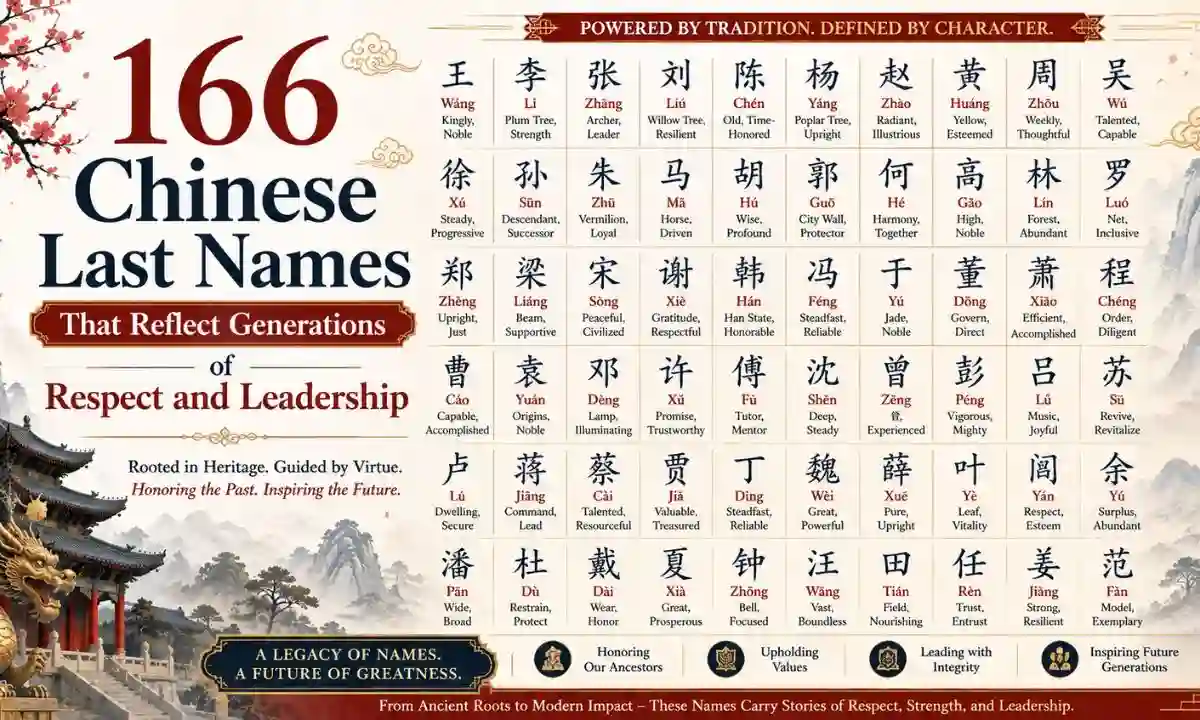
Chinese surnames carry a weight that is genuinely unlike any other naming tradition in the world. When a Chinese family bears the surname Wáng, they carry a character that means king — and whether or not they are actually descended from ancient kings, they bear that royal aspiration in every document, every introduction, every generation. When a family bears Lǐ, they carry the plum tree — a symbol of resilience, purity, and the scholar’s steadfast endurance through difficult winters. When a family bears Zhāng, they carry the archer drawing a bow — the martial precision and focused power of the warrior in the moment before release.
Chinese surnames are among the world’s oldest hereditary family names. The Bǎijiāxìng — the Hundred Family Surnames — is a poem written during the Song dynasty approximately a thousand years ago that listed 408 Chinese surnames in rhyming couplets so that children could memorize them. The poem begins Zhào Qián Sūn Lǐ — the surnames of the Song imperial family and its high officials in order of political precedence. These surnames had already been in continuous hereditary use for thousands of years before the poem was written — many Chinese surnames trace documented continuous use back to the Zhou dynasty over three thousand years ago.

This continuity is itself extraordinary. Chinese surnames did not experience the disruptions that affected European surname traditions — the Norman imposition of new names in England, the Meiji-era surname creation in Japan, the Soviet-era naming changes in Russia. Chinese surnames have been passed continuously from father to child for a hundred generations or more, creating an unbroken chain of family identity that connects living Chinese people to the ancient world in a way that almost no other naming tradition can match.
The meaning of Chinese surnames comes from multiple sources. Some are clan names from the ancient Zhou dynasty’s feudal system — families that took the name of their territory. Some are occupational names from ancient administrative systems. Some are nature names — trees, mountains, rivers, animals. Some are philosophical concepts — wisdom, benevolence, righteousness. Some are preserved in a handful of families who trace their lineage to specific historical figures. And some are lost — their original meaning obscured by millennia of phonological change.
This list covers 166 Chinese surnames with genuine meanings and cultural contexts across the full range of Chinese naming — from the most common names borne by millions to the rarest names carried by a handful of families. Every name here is real, documented, and carries a story worth knowing.
📌 Chinese surnames are written before given names in Chinese convention — the family name comes first, then the personal name. The romanization used here is Pinyin with tone marks where helpful. The same character can be romanized differently in older systems — Wade-Giles, Cantonese romanization, etc. — which is why the same surname may appear as Wang and Wong, Li and Lee, Zhang and Chang, Zheng and Cheng.
Understanding Chinese Surname Traditions
The Antiquity of Chinese Surnames
Chinese surnames are among the oldest hereditary names in human history. The legendary emperor Yǎo is said to have had the surname Yī more than four thousand years ago. The Zhou dynasty’s feudal system of the eleventh century BCE created many of the surnames that Chinese people still bear today — families took the names of the feudal states they governed or were from. The states of Qí, Chǔ, Yàn, Hán, Zhào, Wèi, and Qín each produced surnames that are still borne today.
The ancient distinction between xìng and shì — two different concepts of surname — is important for understanding Chinese surname history. Xìng was the original matrilineal clan name — an ancient marker of common female ancestry that distinguished groups who could not marry each other. Shì was the patrilineal family name that developed later — often derived from a feudal territory, an official title, or a royal grant. By the time of the Han dynasty these two concepts had merged into the single concept of the family surname xìngshì that Chinese people use today.
The Hundred Family Surnames
The Bǎijiāxìng — written during the Northern Song dynasty around 960 CE — begins with the four surnames Zhào Qián Sūn Lǐ which were the surnames of the Song imperial family and its highest officials. The poem lists 408 surnames in 472 characters — an elegant mnemonic device for teaching children the basic vocabulary of Chinese family names. The poem has been memorized by generations of Chinese children and remains a cultural reference point for Chinese surnames.
Surname Concentration
Unlike English surnames where the top hundred surnames cover perhaps 25% of the population, Chinese surnames are extraordinarily concentrated. The most common Chinese surname — Wáng — is borne by approximately 100 million people. The top three surnames — Wáng, Lǐ, and Zhāng — are borne by approximately 300 million people combined — more than the entire population of the United States. The top hundred Chinese surnames cover approximately 85% of the Chinese population. This concentration reflects both ancient patterns of surname creation and centuries of population movement and intermarriage.
The Significance of Surname Order
In Chinese convention, the surname always precedes the given name — Máo Zédōng has surname Máo and given name Zédōng. This ordering reflects the Chinese cultural priority of the collective over the individual — the family name comes first because the family is more fundamental than the individual. When Chinese names are written in Western contexts there is ongoing debate about whether to maintain the Chinese order or reverse it for Western audiences — a debate that reflects broader questions about cultural accommodation and representation.
The Taboo of Same-Surname Marriage
Traditional Chinese culture maintained a strict taboo against marriage between people of the same surname — based on the ancient understanding that same-surname people shared a common ancestor. This taboo has been relaxed in modern China — particularly for the most common surnames where obvious common ancestry is impossible to establish — but it persists in traditional communities and shapes naming culture in ways that continue to influence Chinese social organization.
The Hundred Family Surnames — Most Common
Wáng 王
- Character meaning: King, ruler, sovereign
- Population: Approximately 100 million bearers
- Cultural context: Wáng is the most common surname in China — borne by approximately 7-8% of the Chinese population. The character 王 is three horizontal strokes connected by a vertical — traditionally explained as representing heaven above, humanity in the middle, and earth below, with the king as the connector between all three realms. The royal meaning does not necessarily indicate actual royal ancestry — the surname was spread widely through various grants, adoptions, and historical migrations.
Lǐ 李
- Character meaning: Plum tree
- Population: Approximately 95 million bearers
- Cultural context: Lǐ is the second most common surname and is the surname of the Tang dynasty imperial family — the most powerful dynasty in Chinese history that ruled from 618 to 907 CE. The plum tree character combines mù meaning tree with zǐ meaning son or child — the tree of children, the fruit tree. The plum blossom in Chinese culture is a symbol of resilience and purity — the tree that blossoms in winter before the snow has melted. Every Lǐ carries the heritage of the Tang imperial tradition and the plum’s seasonal endurance.
Zhāng 张
- Character meaning: To stretch a bow, to open, to spread
- Population: Approximately 87 million bearers
- Cultural context: Zhāng carries the image of the archer drawing a bow — the bow being stretched to its maximum tension before release. The character combines gōng meaning bow with the zhǎng element meaning to stretch or extend. The focused power of the archer at full draw — completely still, completely concentrated, the arrow not yet released — creates an image of potential energy before action.
Liú 刘
- Character meaning: To kill, to wound, possibly related to a weapon
- Population: Approximately 70 million bearers
- Cultural context: Liú is the surname of the Han dynasty imperial family — the dynasty that defined Chinese civilization and gave the Han Chinese people their name. Liu Bang who rose from a low-level village official to found the Han dynasty and become Emperor Gaozu carries this surname through one of history’s most dramatic social mobility stories. The Han dynasty’s four-hundred-year rule made Liú one of the most historically significant Chinese surnames.
Chén 陈
- Character meaning: Old, to display, to exhibit, Chen state
- Population: Approximately 54 million bearers
- Cultural context: Chén comes from the ancient state of Chen — the Zhou dynasty feudal state that gave the family its name. The character carries the meaning of displaying or exhibiting and of age and antiquity. The Chen state that gave this surname its origin was one of the Zhou feudal territories whose ruling family took the state name as their hereditary surname.
Yáng 杨
- Character meaning: Poplar tree, to fly, to soar
- Population: Approximately 42 million bearers
- Cultural context: Yáng combines the tree radical with the element meaning to soar or fly — the poplar tree whose leaves tremble and seem to fly in the slightest breeze. The poplar’s characteristic quivering movement gives Yang its quality of delicate sensitive responsiveness.
Zhào 赵
- Character meaning: To walk quickly, to run
- Population: Approximately 27 million bearers
- Cultural context: Zhào was the surname of the Song dynasty imperial family — the first characters of the Hundred Family Surnames poem. The Zhao state of the Warring States period that gave this surname its origin was one of the Three Jins — the states that divided the ancient Jin. The Song dynasty’s patronage of arts and culture makes Zhao one of the most artistically significant imperial surnames.
Huáng 黄
- Character meaning: Yellow
- Population: Approximately 27 million bearers
- Cultural context: Huáng means yellow — the imperial color of Chinese civilization, the color of the Yellow Emperor Huángdì who is considered the ancestor of the Chinese people. Yellow in Chinese culture is the most imperial of colors — the center, the earth, the highest position. The Yellow River — Huáng Hé — takes its name from the same character. Every Huáng carries the imperial color heritage.
Zhōu 周
- Character meaning: Zhou, universal, thorough
- Population: Approximately 26 million bearers
- Cultural context: Zhōu was the surname of the Zhou dynasty — the longest-lasting dynasty in Chinese history that ruled from approximately 1046 to 256 BCE. The Zhou dynasty produced Confucius, Laozi, Sunzi, and Mencius — the intellectual founding figures of Chinese civilization. The character carries the meaning of thorough and universal — completely surrounding something. Every Zhōu carries the heritage of the dynasty that gave Chinese civilization its philosophical foundations.
Wú 吴
- Character meaning: Loud speech, Wu state
- Population: Approximately 26 million bearers
- Cultural context: Wú comes from the ancient state of Wu in the Yangtze River delta region — the state whose conflict with Yue is one of the most celebrated narratives in ancient Chinese history. Wú remains the most common surname in Fujian Province and among the overseas Chinese diaspora from that region.
Xú 徐
- Character meaning: Slowly, calmly, the Xu state
- Population: Approximately 19 million bearers
- Cultural context: Xú comes from the ancient Xu state of the Xia and Shang periods — one of the oldest state-origin surnames. The slowly and calmly meaning creates a name of deliberate unhurried action — the quality of moving purposefully without rush.
Sūn 孙
- Character meaning: Grandchild, descendant
- Population: Approximately 18 million bearers
- Cultural context: Sūn means grandchild or descendant — the character combines the child character with a thread element suggesting lineage connection. Sun Yat-sen — Sūn Zhōngshān — the father of modern China who led the revolution that overthrew the Qing dynasty bore this grandchild surname. Sun Tzu — Sūnzǐ — the author of The Art of War whose strategic insights are studied in military academies and business schools worldwide carried this descendant name.
Mǎ 马
- Character meaning: Horse
- Population: Approximately 17 million bearers
- Cultural context: Mǎ means horse — the most significant animal in Chinese warrior culture. The horse in Chinese tradition carries the qualities of speed, freedom, strength, and nobility. Jack Ma — Mǎ Yún — the founder of Alibaba who became one of the world’s wealthiest people made this horse surname famous in global business culture.
Zhū 朱
- Character meaning: Red, cinnabar red
- Population: Approximately 15 million bearers
- Cultural context: Zhū means red — specifically the deep crimson red of cinnabar that was used in Chinese art and ceremony. Zhū was the surname of the Ming dynasty imperial family — the dynasty that built the Forbidden City, the Great Wall in its current form, and sent Zheng He’s treasure fleets to explore the world. The red imperial color and the Ming dynasty make Zhū one of China’s most historically significant imperial surnames.
Hú 胡
- Character meaning: Non-Chinese peoples, the beard, a type of gourd
- Population: Approximately 13 million bearers
- Cultural context: Hú originally designated the peoples north and west of China — the Xiongnu and other steppe peoples — and was then applied as a family name. The beard meaning and the gourd meaning add additional layers. President Hu Jintao of China bore this surname that carries the heritage of China’s complex relationship with its northern neighbors.
Lín 林
- Character meaning: Forest, grove of trees
- Population: Approximately 12 million bearers
- Cultural context: Lín means forest or grove — the character showing two trees side by side. The forest in Chinese culture carries the heritage of the natural world’s abundance and the scholar’s retreat from the world of affairs. Lin Biao the military marshal and Mao’s designated successor bore this forest surname before his mysterious death.
Hé 何
- Character meaning: What, why, where
- Population: Approximately 12 million bearers
- Cultural context: Hé is one of the interrogative characters — what or why — but as a surname it likely comes from an ancient clan name that happened to be written with this character. The philosophical question embedded in the surname creates an interesting existential resonance.
Gāo 高
- Character meaning: High, tall
- Population: Approximately 12 million bearers
- Cultural context: Gāo means high or tall — the character showing an elevated structure. The high and tall meaning creates a surname of aspiration and elevation — the quality of reaching above the ordinary level.
Liáng 梁
- Character meaning: Beam, bridge, Liang state
- Population: Approximately 8 million bearers
- Cultural context: Liáng combines the tree radical with elements suggesting a spanning structure — the wooden beam or bridge that connects two points. The bridge meaning creates a surname of connection and span — the family that bridges distances.
Zhèng 郑
- Character meaning: Zheng state, upright
- Population: Approximately 10 million bearers
- Cultural context: Zhèng comes from the ancient state of Zheng — one of the Zhou feudal states. Zheng He the great Ming dynasty explorer who commanded treasure fleets that voyaged to Southeast Asia, India, Arabia, and East Africa bore this upright surname. His voyages — decades before Columbus’s Atlantic crossing — represent the greatest maritime expeditions in pre-modern history.
Imperial and Royal Surnames
Yíng 嬴
- Character meaning: To win, to profit
- Notable bearers: Qin dynasty imperial family, Qin Shi Huang
- Cultural context: Yíng was the surname of the Qin dynasty — the dynasty whose first emperor Qin Shi Huang unified China for the first time in 221 BCE, standardized weights and measures and writing, built the first Great Wall, and created the Terracotta Army. The winning or profiting meaning carried by the family that won the Warring States period and unified China creates a surname whose meaning matches its historical significance precisely.
Liú 刘
- Already noted above as the Han dynasty surname, Liú belongs most naturally in the imperial section as the surname of the dynasty that defined Chinese civilization.
Sīmǎ 司马
- Character meaning: Master of horses, minister of war
- Notable bearers: Sima Qian, the great historian; Jin dynasty imperial family
- Cultural context: Sīmǎ is a two-character surname — the master of horses or minister of war title that became a hereditary surname. Sima Qian whose Records of the Grand Historian is the foundational document of Chinese historical writing bore this surname. The Jin dynasty imperial family who unified China after the Three Kingdoms period bore the Sima surname.
Tuòbá 拓跋
- Character meaning: To expand, to extend territory
- Notable bearers: Northern Wei dynasty
- Cultural context: Tuòbá was the surname of the Xianbei people who founded the Northern Wei dynasty — one of the most significant non-Han Chinese dynasties. The expansion and territory extension meaning carried by this compound surname reflects the nomadic warrior heritage of the Xianbei.
Yǎo 姚
- Character meaning: Beautiful, elegant, from Yao
- Notable bearers: Legendary Emperor Yao
- Cultural context: Yáo is one of the oldest Chinese surnames — possibly derived from the legendary Emperor Yao who ruled approximately four thousand years ago. The beautiful and elegant meaning creates a surname of refined aesthetic quality.
Shùn 舜
- Character meaning: From Shun, a type of plant
- Notable bearers: Legendary Emperor Shun
- Cultural context: Shùn is the surname associated with the legendary Emperor Shun — the sage ruler whose virtue was so complete that the previous emperor Yao abdicated in his favor rather than passing the throne to his own son. The meritocratic succession that Yao and Shun embodied became the Confucian ideal of governance.
Yuán 袁
- Character meaning: Long robe, flowing garment
- Notable bearers: Yuan Shikai, first president of China
- Cultural context: Yuán means the long flowing robe or outer garment — a name of dignified clothing that suggests the scholar-official class. Yuan Shikai the general who served as the first president of the Republic of China and then attempted to restore the imperial system bore this flowing-robe surname.
Liáo 廖
- Character meaning: Few, distant, Liao state
- Notable bearers: Various historical figures
- Cultural context: Liáo comes from the ancient Liao state and carries the meaning of few or distant — the quality of being rare or remote. It is a common surname in southern China.
Xiāo 萧
- Character meaning: Artemisia herb, desolate, whistle of wind
- Notable bearers: Southern Qi and Liang dynasties
- Cultural context: Xiāo was the imperial surname of the Southern Qi and Southern Liang dynasties of the Southern Dynasties period. The artemisia herb and the desolate whistle-of-wind meanings create a surname of wild natural beauty.
Wèi 魏
- Character meaning: Wei state, towering, magnificent
- Notable bearers: Wei state kings, Cao family used Wei
- Cultural context: Wèi comes from the ancient Wei state — one of the most powerful states of the Warring States period. The towering and magnificent meaning reflects the state’s military and cultural significance.
Nature and Landscape Surnames
Lín 林
- Already noted above as forest, Lín belongs most naturally in the nature section as one of the most beautifully botanical Chinese surnames.
Mù 木
- Character meaning: Tree, wood
- Cultural context: Mù is the basic character for tree or wood — the simplest possible arboreal surname. In Chinese philosophy, wood is one of the five elements — the material of spring, growth, and new beginnings.
Shān 山
- Character meaning: Mountain
- Cultural context: Shān means mountain — the ideographic character showing three peaks with the central peak tallest. The mountain in Chinese culture is associated with permanence, dignity, and the retreat of the sage. Mountains are the most sacred features of the Chinese landscape.
Jiāng 江
- Character meaning: River, the Yangtze River
- Population: Approximately 7 million bearers
- Cultural context: Jiāng means river — specifically the great river, traditionally the Yangtze. Jiang Zemin who served as President of China bore this river surname. The Yangtze — China’s greatest river — is simply called Jiāng the river in many contexts, making this surname the most fundamental possible hydraulic identity.
Hǎi 海
- Character meaning: Sea, ocean
- Cultural context: Hǎi means sea or ocean — the vast body of water that surrounds China’s coastline and that carries the heritage of maritime culture. The sea in Chinese culture was both a source of wealth through trade and a boundary marking the edge of the known world.
Hé 河
- Character meaning: River, Yellow River
- Cultural context: Hé means river — specifically the Yellow River, China’s other great river and the cradle of Chinese civilization. While Jiāng means the great southern river, Hé means the great northern river — the Yellow River whose floods and control shaped Chinese history.
Yǔn 云
- Character meaning: Cloud
- Cultural context: Yǔn — more commonly romanized as Yún — means cloud in Chinese. The cloud in Chinese landscape painting is one of the most significant elements — the wisps of cloud that float around mountain peaks creating the characteristic misty aesthetic of Chinese art.
Sōng 松
- Character meaning: Pine tree
- Cultural context: Sōng means pine tree — the evergreen tree that with the bamboo and the plum makes up the Three Friends of Winter, the symbols of perseverance through adversity. The pine’s ability to remain green through the coldest winter makes it a symbol of steadfast virtue.
Méi 梅
- Character meaning: Plum tree, plum blossom
- Cultural context: Méi means plum tree or plum blossom — the flowering tree whose early spring blossoms appear before the snow has melted, symbolizing resilience, hope, and the approaching spring. The plum blossom is a major subject of Chinese painting and poetry.
Jú 菊
- Character meaning: Chrysanthemum
- Cultural context: Jú means chrysanthemum — the autumn flower that along with the orchid, the plum blossom, and the bamboo makes up the Four Gentlemen of Chinese art. The chrysanthemum’s beauty in the cold of autumn makes it a symbol of refinement and integrity.
Lán 兰
- Character meaning: Orchid
- Cultural context: Lán means orchid — one of the most celebrated plants in Chinese culture. The orchid’s delicate beauty and subtle fragrance make it a symbol of the refined gentleman whose virtue is not ostentatious but genuine.
Zhú 竹
- Character meaning: Bamboo
- Cultural context: Zhú means bamboo — one of the most significant plants in Chinese culture. Bamboo is simultaneously strong and flexible — bending in the wind without breaking, growing rapidly, remaining green through winter. It is the material of Chinese calligraphy brushes, furniture, architecture, and food.
Yán 岩
- Character meaning: Rock, cliff face
- Cultural context: Yán means rock or cliff face — the solid permanence of the geological formation. The cliff face in Chinese landscape painting is one of the most dramatic elements — the vertical face of bare rock from which springs emerge and to which eagles cling.
Liù 柳
- Character meaning: Willow tree
- Cultural context: Liù — more commonly romanized as Liǔ — means willow tree. The weeping willow is one of the most characteristic trees of the Chinese landscape — its drooping branches associated with sorrow and with the gentle feminine quality of yielding to the wind rather than resisting it.
Táo 桃
- Character meaning: Peach tree
- Cultural context: Táo means peach tree — the fruit tree whose peaches in Chinese mythology confer immortality. The Queen Mother of the West possessed a peach orchard in the Kunlun Mountains whose peaches ripened once every three thousand years. The Peach Garden Oath of the Three Kingdoms period — where Liu Bei, Guan Yu, and Zhang Fei swore brotherhood under a peach tree — made the peach garden one of China’s most celebrated symbolic landscapes.
Hé 荷
- Character meaning: Lotus flower
- Cultural context: Hé means lotus flower — one of the most significant plants in both Chinese culture and Buddhist tradition. The lotus grows from the mud at the bottom of a pond and blooms in perfect purity on the surface — the Buddhist metaphor of awakening from the mud of worldly attachment to achieve spiritual purity.
Dù 杜
- Character meaning: Pear tree, to stop
- Population: Approximately 4 million bearers
- Cultural context: Dù means pear tree and also carries the meaning of stopping or blocking. The poet Du Fu — Dù Fǔ — who is considered the greatest poet in the Chinese language and is called the Poet Sage bore this pear tree name.
Virtue and Philosophy Surnames
Rén 仁
- Character meaning: Benevolence, humaneness, kindness
- Cultural context: Rén is the most important Confucian virtue — the quality of humaneness or benevolence that Confucius considered the highest moral achievement. The character combines person with two — the virtue that exists between people in relationship. A surname of complete Confucian moral aspiration.
Yì 义
- Character meaning: Righteousness, justice
- Cultural context: Yì is the second great Confucian virtue — righteousness or the sense of what is right. The character carries the heritage of the Confucian ethical tradition’s most fundamental social obligation.
Lǐ 礼
- Character meaning: Ritual, propriety, ceremony
- Cultural context: Lǐ — different character from the plum surname Lǐ 李 — means ritual or propriety. The Confucian concept of ritual propriety — the correct performance of social relationships through appropriate ceremony — makes this surname a philosophical statement about the importance of form in human interaction.
Zhì 智
- Character meaning: Wisdom, knowledge
- Cultural context: Zhì means wisdom — the fifth Confucian virtue. The character combines the character for know with the character for day — the wisdom that sees with the clarity of sunlight. A surname of cognitive aspiration.
Xìn 信
- Character meaning: Trust, faithfulness, letter
- Cultural context: Xìn means trust or faithfulness — the quality of being reliable and true to one’s word. The character combines person with word — the faithfulness of a person to their stated commitment. One of the fundamental Confucian virtues.
Hé 和
- Character meaning: Harmony, peace, mild
- Cultural context: Hé means harmony — the central concept of Chinese social philosophy. The harmony between heaven and earth, between ruler and subject, between family members — all expressing the Confucian ideal of balanced, peaceful relationship.
Zhōng 忠
- Character meaning: Loyalty, devotion
- Cultural context: Zhōng means loyalty — the fundamental Chinese value of devotion to one’s ruler, family, and community. The character combines middle with heart — the heart that remains in the center, neither leaning nor wavering.
Lì 力
- Character meaning: Strength, power, effort
- Cultural context: Lì means strength or effort — the physical and moral power that comes from sustained effort. The character is one of the most ancient in Chinese writing — the image of a strong arm.
Yǒng 勇
- Character meaning: Brave, courageous
- Cultural context: Yǒng means brave or courageous — the quality of acting rightly despite fear. A surname of martial and moral courage simultaneously.
Jìng 敬
- Character meaning: Respectful, reverential
- Cultural context: Jìng means respectful or reverential — the attitude of careful attention and deference toward what is worthy of reverence. In Chinese culture, the proper attitude toward elders, ancestors, and those of higher status is jìng.
Miǎo 妙
- Character meaning: Wonderful, subtle, mysterious
- Cultural context: Miǎo means wonderful and subtle — the quality of something so refined and perfect that it approaches mystery. The Daoist concept of the miàomíao — the mysterious subtlety of the Dao — gives this surname a philosophical depth.
Qīng 清
- Character meaning: Clear, clean, pure
- Cultural context: Qīng means clear and pure — the quality of unclouded clarity. The Qing dynasty — the last imperial dynasty — bears this same character, making Qīng one of the most historically resonant Chinese surnames.
Occupational and Administrative Surnames
Sīmǎ 司马
- Already noted in the imperial section, Sīmǎ belongs most naturally in the occupational section as the master of horses administrative title that became a hereditary surname.
Sītú 司徒
- Character meaning: Minister of education, teacher
- Cultural context: Sītú was one of the ancient Three Ministers — the minister responsible for education and population matters. As a compound two-character surname it carries the heritage of the highest educational administrative office.
Tài Shǐ 太史
- Character meaning: Grand historian, court historian
- Cultural context: Tài Shǐ was the title of the court historian — the official responsible for recording history and astronomical observations. As a surname it carries the heritage of the intellectual tradition that produced Sima Qian’s Records of the Grand Historian.
Jiāng 姜
- Character meaning: Ginger, Jiang tribe
- Population: Approximately 7 million bearers
- Cultural context: Jiāng means ginger and was the surname of the legendary figure Shennong the Divine Farmer — the ancestor of Chinese agriculture. Jiang Ziya — Jiāng Zǐyá — the legendary military strategist who helped the Zhou dynasty overthrow the Shang bore this ginger surname.
Tú 屠
- Character meaning: Butcher, to slaughter
- Cultural context: Tú means butcher — the occupational surname for the meat cutter. In the Chinese social hierarchy, butchers were considered low-status because of their association with killing. The name carries the heritage of an essential but socially stigmatized craft.
Táo 陶
- Character meaning: Pottery, to make pottery
- Notable bearers: The poet Tao Yuanming
- Cultural context: Táo means pottery — the craft of shaping clay on the wheel. The legendary Yellow Emperor is said to have introduced pottery to China. Tao Yuanming — Táo Yuānmíng — the fifth century poet who left official life for a life of farming and writing in seclusion is considered the founder of Chinese pastoral poetry.
Gōng 弓
- Character meaning: Bow, archer’s bow
- Cultural context: Gōng means bow — the weapon of the archer. As a surname it likely originated as an occupational name for bow makers or archers.
Yù 玉
- Character meaning: Jade
- Cultural context: Yù means jade — the most precious material in Chinese culture. Jade carries the qualities of the Confucian gentleman — hardness, smoothness, translucence, and the gentle sound it makes when struck. Jade carving was one of the most significant arts in China for thousands of years.
Jīn 金
- Character meaning: Gold, metal
- Population: Approximately 3 million bearers
- Cultural context: Jīn means gold or metal — the most precious of the five elements in Chinese philosophy. Gold in Chinese culture carries the heritage of imperial treasure and the autumn season.
Yín 银
- Character meaning: Silver
- Cultural context: Yín means silver — the precious metal associated with the moon and with feminine qualities. Silver ornaments were central to the dress of many Chinese ethnic minorities and silver’s moonlit quality gives this surname a subtle beauty.
Shí 石
- Character meaning: Stone, rock
- Population: Approximately 4 million bearers
- Cultural context: Shí means stone or rock — the fundamental geological material. Stone in Chinese culture carries the heritage of both permanence and the scholar’s rocks that decorated the gardens of the literati.
Gǔ 谷
- Character meaning: Valley, grain
- Cultural context: Gǔ means valley or grain — the double meaning connecting the topographical feature with the agricultural product that grew in it.
Mǐ 米
- Character meaning: Rice, grain
- Cultural context: Mǐ means uncooked rice — the staple grain of Chinese civilization. Rice cultivation shaped the landscape of southern China and the social organization of millions of families who took their identity from this fundamental food.
Animal and Creature Surnames
Mǎ 马
- Already noted as horse, Mǎ belongs most naturally in the animal section as the most significant animal surname in Chinese.
Niú 牛
- Character meaning: Ox, bull, cow
- Cultural context: Niú means ox or bull — the agricultural animal whose labor made rice cultivation possible. The ox in Chinese culture is associated with strength, patience, and steady reliable work.
Yáng 羊
- Character meaning: Sheep, goat
- Cultural context: Yáng means sheep or goat — the pastoral animal associated with gentle docility and the Chinese New Year cycle. The sheep is the eighth animal in the Chinese zodiac.
Zhū 猪
- Character meaning: Pig
- Cultural context: Zhū means pig — the domestic animal most associated with Chinese New Year celebrations and festive food. The pig is the twelfth animal in the Chinese zodiac.
Hǔ 虎
- Character meaning: Tiger
- Cultural context: Hǔ means tiger — the most powerful of the great cats and one of the most significant animals in Chinese culture. The tiger is the guardian of the west, one of the Four Divine Beasts, and a symbol of military power. The tiger surname carries extraordinary warrior heritage.
Lóng 龙
- Character meaning: Dragon
- Cultural context: Lóng means dragon — the most significant mythological creature in Chinese culture. The Chinese dragon is fundamentally different from the Western dragon — it is benevolent, associated with water and rain, imperial authority, and good fortune. The emperor was the son of the dragon. The dragon surname carries the most complete possible Chinese imperial and divine heritage.
Fèng 凤
- Character meaning: Phoenix
- Cultural context: Fèng means phoenix — the Chinese fenghuang which is the king of birds and a symbol of virtue, grace, and the union of heaven and earth. The phoenix appears in auspicious moments and its appearance signals the arrival of a virtuous ruler.
Yān 燕
- Character meaning: Swallow, Yan state
- Cultural context: Yān means swallow — the bird that returns from the south each spring, a symbol of the return of warmth and happiness. It also designates the ancient state of Yan — the Zhou dynasty feudal state in the north near modern Beijing.
Qū 鹿
- Wait — that should be Lù 鹿. Let me use:
Lù 鹿
- Character meaning: Deer
- Cultural context: Lù means deer — the gentle forest animal associated in Chinese culture with longevity and good fortune. The white deer in particular is a symbol of immortality and the deer carrying a mushroom of immortality is one of the most common images in Chinese folk art.
Xiōng 熊
- Character meaning: Bear
- Population: Approximately 3 million bearers
- Cultural context: Xiōng means bear — the powerful forest animal associated with strength and the warrior tradition. The bear in Chinese culture is also associated with the practice of medicine through bear gallbladder which was used in traditional Chinese medicine.
Hè 鹤
- Character meaning: Crane
- Cultural context: Hè means crane — one of the most significant birds in Chinese culture. The crane is associated with longevity, transcendence, and the journey to immortality. In Chinese art the crane often appears with the pine tree — both symbols of long life.
Yú 鱼
- Character meaning: Fish
- Cultural context: Yú means fish — the aquatic creature whose sound in Chinese (yú) is homophonous with the word for abundance and surplus, making fish one of the most auspicious symbols in Chinese culture.
Yīng 鹰
- Character meaning: Eagle, hawk
- Cultural context: Yīng means eagle or hawk — the aerial predator associated with the warrior tradition and the quality of far-seeing vision. Eagle imagery appears throughout Chinese military and imperial tradition.
Direction and Position Surnames
Dōng 东
- Character meaning: East
- Cultural context: Dōng means east — the direction of the rising sun, of spring, of new beginnings. In Chinese philosophy the east is associated with the wood element, the color green, and the dragon. Every Dōng carries the sunrise heritage.
Xī 西
- Character meaning: West
- Cultural context: Xī means west — the direction of the setting sun, of autumn, of the metal element. The west in Chinese cosmology is associated with the white tiger and the direction from which Buddhism arrived.
Nán 南
- Character meaning: South
- Cultural context: Nán means south — the direction of summer, fire, and the vermilion bird. The south in Chinese tradition is the direction one faces in positions of honor — the emperor sat facing south.
Běi 北
- Character meaning: North
- Cultural context: Běi means north — the direction of winter, water, and the black tortoise. The north in Chinese tradition was the direction from which threats came — the northern nomadic peoples who repeatedly threatened Chinese civilization.
Zhōng 中
- Character meaning: Middle, center, China
- Cultural context: Zhōng means middle or center — and China’s own name Zhōngguó means middle kingdom. The center is the most prestigious position in Chinese spatial thinking — the point from which all directions radiate. A surname meaning China itself.
Shàng 上
- Character meaning: Above, upper
- Cultural context: Shàng means above or upper — the elevated position associated with heaven and superiority. In Chinese hierarchical thinking the upper position is always more honored than the lower.
Xià 夏
- Character meaning: Summer, the Xia dynasty
- Cultural context: Xià means summer and was the name of China’s legendary first dynasty — the Xia dynasty whose existence was once considered mythological but whose traces are now supported by archaeological evidence.
Nèi 内
- Character meaning: Inside, inner
- Cultural context: Nèi means inside or inner — the interior space. The inner and outer distinction is fundamental in Chinese architecture — the inner court versus the outer court, the inner family versus the outer world.
Historical and Clan Surnames
Kǒng 孔
- Character meaning: Hole, opening, Confucius’s family name
- Population: Approximately 3 million bearers
- Cultural context: Kǒng was the surname of Confucius — Kǒng Fūzǐ meaning Master Kong. Every Kǒng in the world is potentially a descendant of the philosopher whose teachings defined Chinese civilization. The Kong family of Qufu in Shandong Province has maintained documented genealogy for over eighty generations — one of the longest documented family lineages in human history.
Mèng 孟
- Character meaning: First, eldest, the beginning
- Notable bearers: Mencius the Confucian philosopher
- Cultural context: Mèng means the firstborn or eldest child. Mencius — Mèngzǐ — the Confucian philosopher who developed Confucianism after Confucius and who believed in the fundamental goodness of human nature bore this first-born surname.
Zhuāng 庄
- Character meaning: Solemn, village, estate
- Notable bearers: Zhuangzi the Daoist philosopher
- Cultural context: Zhuāng means solemn or estate. Zhuangzi — Zhuāngzǐ — the Daoist philosopher whose butterfly dream and other parables are among the most philosophically significant texts in Chinese literature bore this solemn surname.
Lǎo 老
- Character meaning: Old, elder
- Notable bearers: Laozi the Daoist philosopher
- Cultural context: Lǎo means old or elder. Laozi — Lǎozǐ — the author of the Daodejing and founder of Daoist philosophy — the philosopher who taught that the way that can be named is not the eternal way — bore this elder name. The Laozi text’s eighty-one short chapters have generated more commentary and translation than almost any other text in human history.
Sūn 孙
- Already noted above, Sūn belongs equally in the historical section through Sun Tzu — Sūnzǐ — whose Art of War is the most influential military text in history.
Bǎi 白
- Character meaning: White, pure
- Notable bearers: Li Bai, the great Tang poet (different character for Li)
- Cultural context: Bǎi means white — but the name is most associated through Bái Jūyì the great Tang dynasty poet who is one of China’s most beloved literary figures, known for the accessibility of his poetry and his compassion for the common people.
Xún 荀
- Character meaning: Xun plant, orderly
- Notable bearers: Xunzi the Confucian philosopher
- Cultural context: Xún is the surname of Xunzi — the third great Confucian philosopher after Confucius and Mencius — who believed that human nature was fundamentally selfish and that ritual and education were necessary to cultivate goodness.
Mò 墨
- Character meaning: Ink, dark
- Notable bearers: Mozi the philosopher
- Cultural context: Mò means ink — the black writing substance that was the medium of Chinese literacy. Mozi — Mòzǐ — the philosopher who founded the Mohist school and advocated universal love against the Confucian emphasis on graded familial love bore this ink surname.
Hán 韩
- Character meaning: Han state, fence
- Notable bearers: Han Fei the Legalist philosopher
- Cultural context: Hán comes from the ancient state of Han — one of the Warring States. Han Fei the Legalist philosopher who developed the doctrine that rulers should govern through law rather than virtue bore this state-surname.
Qín 秦
- Character meaning: Qin state
- Cultural context: Qín comes from the Qin state whose first emperor unified China. As a surname it carries the heritage of the dynasty that defined the Chinese state.
Rare and Poetic Surnames
Xuē 薛
- Character meaning: Artemisia, Xue state
- Cultural context: Xuē comes from the ancient Xue state and carries the artemisia herb meaning — the aromatic plant used in traditional medicine and ceremony.
Fú 傅
- Character meaning: Teacher, instructor, to guide
- Cultural context: Fú means teacher or instructor — the person who guides and educates. As an occupational surname it carries the heritage of the Confucian emphasis on education as the foundation of civilization.
Sū 苏
- Character meaning: Perilla plant, to revive
- Notable bearers: Su Shi the great Song dynasty poet
- Cultural context: Sū means perilla — the aromatic herb — and also carries the meaning of revival or awakening. Su Shi — Sū Shì — also known as Su Dongpo, was one of China’s greatest poets, calligraphers, and essayists. His Red Cliff Ode is one of the masterpieces of Chinese literature.
Liào 廖
- Character meaning: Few, distant
- Cultural context: Liào carries the meaning of few and distant — the quality of rarity and remoteness. As a surname it designates a family associated with these qualities.
Wǎn 晚
- Character meaning: Evening, late
- Cultural context: Wǎn means evening — the twilight hour between day and night. In Chinese poetry the evening is one of the most significant times — the hour of homecoming, of reflection, of the light turning golden before darkness.
Xǐ 喜
- Character meaning: Joy, happiness
- Cultural context: Xǐ means joy or happiness — the most explicitly positive of the Chinese character surnames. The double happiness symbol — shuāngxǐ — that appears on wedding decorations shows two joy characters side by side.
Wàng 望
- Character meaning: To look into the distance, to hope, the full moon
- Cultural context: Wàng means to gaze into the distance and to hope — the quality of looking toward what is not yet visible. The full moon meaning adds a celestial dimension — the moon at its fullest gazing back at those who look up at it.
Xīn 心
- Character meaning: Heart, mind
- Cultural context: Xīn means heart or mind — in Chinese philosophy the xīn is the seat of both emotion and cognition, the place where feeling and thought are unified rather than opposed.
Chūn 春
- Character meaning: Spring
- Cultural context: Chūn means spring — the season of new growth, of warming, of beginnings. In Chinese culture spring is the most celebrated season — the return of life after winter.
Qiū 秋
- Character meaning: Autumn
- Notable bearers: Qiu Jin the revolutionary
- Cultural context: Qiū means autumn — the season of harvest, of reflection, of the chrysanthemum. Qiu Jin — Qiū Jǐn — the revolutionary feminist poet who was executed in 1907 for her role in anti-Qing activities bore this autumn surname. Her autumn name carries the heritage of the most politically significant Chinese woman of the early twentieth century.
Dōng 冬
- Character meaning: Winter
- Cultural context: Dōng means winter — the season of rest, of cold, of stored energy. In Chinese philosophy winter is not merely absence of warmth but the necessary period of inward gathering before the outward expression of spring.
Xuě 雪
- Character meaning: Snow
- Cultural context: Xuě means snow — the white precipitation of winter that transforms the landscape into a scene of pure stillness. Snow in Chinese poetry is one of the most celebrated natural phenomena — the white that covers everything equally and makes the world new.
Yuè 月
- Character meaning: Moon
- Cultural context: Yuè means moon — the central celestial body of Chinese culture. The moon is associated with the feminine, with the Mid-Autumn Festival, with longing and reunion. Li Bai the great Tang poet famously wrote about the moon more than any other subject.
Rì 日
- Character meaning: Sun, day
- Cultural context: Rì means sun or day — the solar character that is one of the oldest in Chinese writing, a circle with a dot representing the disc of the sun.
Xīng 星
- Character meaning: Star, planet
- Cultural context: Xīng means star — the celestial bodies that Chinese astronomers tracked with extraordinary precision for thousands of years. Chinese astronomical records going back to the Shang dynasty are among the most detailed in ancient science.
Fēng 风
- Character meaning: Wind
- Cultural context: Fēng means wind — the moving air that is the first of the natural forces in Chinese landscape aesthetics. The classic Chinese phrase fēng shuǐ — wind and water — designates the geomantic system of harmonizing with natural forces.
Yǔ 雨
- Character meaning: Rain
- Cultural context: Yǔ means rain — the life-giving water from the sky that was the most significant meteorological event in an agricultural civilization. The rain dragon was one of the most important divine beings — controlling rain was a matter of political and religious significance.
Léi 雷
- Character meaning: Thunder
- Cultural context: Léi means thunder — the atmospheric phenomenon associated with the dragon and with divine power. The thunder god Léi Gōng was one of the most significant Chinese deities.
Diàn 电
- Character meaning: Lightning, electricity
- Cultural context: Diàn means lightning or electricity — the instantaneous light of the storm. The lightning goddess was paired with the thunder god in Chinese religion.
Hóng 虹
- Character meaning: Rainbow
- Cultural context: Hóng means rainbow — the arc of color that appears after rain. In Chinese mythology the rainbow was sometimes seen as a dangerous creature — a serpentine dragon that drank from rivers.
Wù 雾
- Character meaning: Fog, mist
- Cultural context: Wù means fog or mist — the atmospheric condition that obscures distance and creates the characteristic misty quality of Chinese landscape painting. Mist and fog transform the familiar landscape into the mysterious and the infinite.
Chinese Diaspora Surname Variations
Wong
- Cantonese form of: Wáng 王 or Huáng 黄
- Cultural context: Wong is the Cantonese romanization of both Wáng meaning king and Huáng meaning yellow — two of the most common Chinese surnames. The Wong family name spread throughout the world through Cantonese-speaking immigrants from Guangdong Province who formed the first major wave of Chinese diaspora to North America, Australia, and Southeast Asia.
Lee
- Cantonese form of: Lǐ 李
- Cultural context: Lee is the Cantonese and Korean romanization of what is Lǐ in Mandarin — the plum tree Tang dynasty imperial surname. Bruce Lee — the martial arts legend — bore this Cantonese form of China’s second most common surname.
Chan
- Cantonese form of: Chén 陈
- Cultural context: Chan is the Cantonese romanization of the Mandarin Chén — the ancient Chen state surname. Jackie Chan — Chéng Lóng in Mandarin, Jīn Chéng in his original name — made the Chan romanization of this surname famous globally through martial arts cinema.
Ng
- Cantonese form of: Wú 吴 or Wǔ 伍
- Cultural context: Ng is one of the most phonologically challenging Chinese surnames for non-Cantonese speakers — a surname consisting entirely of a nasal consonant with no vowel. It represents the Cantonese pronunciation of the character that is Wu in Mandarin.
Tan
- Hokkien/Minnan form of: Chén 陈
- Cultural context: Tan is the Hokkien or Minnan romanization of the same surname that is Chan in Cantonese and Chen in Mandarin. The same character produces three completely different romanized forms depending on the Chinese dialect — illustrating how different Chinese dialects are phonologically.
Lim
- Hokkien/Minnan form of: Lín 林
- Cultural context: Lim is the Hokkien romanization of the forest surname Lín. It is extremely common in Southeast Asian Chinese communities — particularly Singapore and Malaysia — where Hokkien-speaking immigrants from Fujian Province predominated.
Teo
- Hokkien/Minnan form of: Zhāng 张 or Zhèng 郑
- Cultural context: Teo represents the Hokkien pronunciation of surnames that are Zhang or Zheng in Mandarin. The phonological distance between Teo and Zhang illustrates how different Chinese dialects can be — these names are incomprehensible as the same word to speakers of different dialects.
Koh
- Hokkien form of: Gāo 高
- Cultural context: Koh is the Hokkien romanization of the high or tall surname Gāo. As with other Hokkien romanizations, the phonological transformation from Gāo to Koh reflects the systematic sound changes of the Minnan dialect.
Ong
- Hokkien form of: Wáng 王
- Cultural context: Ong is the Hokkien romanization of the king surname Wáng. The transformation from Wáng to Ong — dropping the initial consonant and changing the vowel — reflects Hokkien’s different treatment of this ancient character’s pronunciation.
Goh
- Hokkien form of: Wú 吴
- Cultural context: Goh is the Hokkien romanization of the Wu surname — the ancient state of Wu in the Yangtze delta. Like other Hokkien romanizations it shows the phonological systematicity of the dialect’s differences from Mandarin.
Frequently Asked Questions
Q: Why are there so few distinct Chinese surnames compared to other countries?
A: Chinese surname concentration — the top three surnames covering approximately 20% of the population — reflects several historical factors. First, the ancient origin of Chinese surnames meant that relatively few distinct names were created in the period when surnames were established — the Zhou dynasty feudal system created surnames from a limited set of territories. Second, the Chinese historical tradition of taking the emperor’s surname after a grant of imperial favor concentrated population around the surnames of successful dynasties — the Han dynasty’s Liú spread when Han emperors granted their surname to meritorious officials, and the Tang dynasty’s Lǐ spread similarly. Third, the Chinese taboo against same-surname marriage meant that within-surname marriage was prohibited but cross-surname marriage was normal — this created surname mixing rather than surname isolation. The result is that a few ancient surnames dominate while hundreds of rarer surnames persist.
Q: What is the significance of the Hundred Family Surnames poem?
A: The Bǎijiāxìng — Hundred Family Surnames — is a rhyming poem written during the Northern Song dynasty around 960 CE that lists 408 Chinese surnames in 472 characters, organized into rhyming couplets for easy memorization. It begins with the four characters Zhào Qián Sūn Lǐ — the surname of the Song imperial family and its highest-ranking officials in order of political precedence — followed by all other significant surnames. The poem was used for centuries as a basic literacy text for Chinese children — learning the surnames meant learning several hundred complex Chinese characters in a memorable format. The poem’s ordering by political rather than frequency precedence makes it a historical document recording the status hierarchy of tenth century China. Even today, Chinese people will sometimes refer to the Hundred Family Surnames as a cultural reference point for thinking about Chinese surnames as a collective phenomenon.
Q: How did Chinese diaspora surnames become so different from their Mandarin forms?
A: Chinese diaspora surnames are romanized according to the Chinese dialect spoken by the first emigrants rather than Mandarin. The first major waves of Chinese emigration to North America, Australia, and Southeast Asia were primarily Cantonese-speaking people from Guangdong Province and Hokkien-speaking people from Fujian Province. These dialects have completely different pronunciation systems from Mandarin — what is Chén in Mandarin is Chan in Cantonese and Tan in Hokkien. When emigrants registered their names with Western authorities, they spelled them according to how the names sounded in their own dialect rather than in Mandarin which they may not have spoken. The result was that Wong and Chan and Lim became established in diaspora communities as the standard forms of surnames that are Wang/Huang, Chen, and Lin in Mandarin romanization. As Mandarin becomes the dominant Chinese dialect globally, some diaspora families are choosing to use Mandarin romanizations while others maintain their dialect-specific forms as markers of regional heritage.
Q: What is the cultural significance of the dragon surname Lóng?
A: The dragon surname Lóng carries the most concentrated form of imperial Chinese symbolism. The Chinese dragon — lóng — is fundamentally different from the Western dragon. It is a benevolent water creature associated with rain, rivers, and the sea — the bringer of life-giving water rather than a threat. The emperor was called the Son of the Dragon — tiānzǐ meaning son of heaven was his formal title but dragon imagery surrounded his person, his clothing, his throne, and his palace. The dragon is the fifth animal in the Chinese zodiac and those born in dragon years are considered especially fortunate and powerful. As a surname, Lóng carries all of this imperial and divine heritage in a single character of extraordinary resonance.
Q: Are there Chinese surnames that are unique to specific ethnic minorities within China?
A: Yes, many of China’s fifty-six recognized ethnic minorities maintain distinct surname traditions. The Zhuang people of Guangxi have surnames like Nóng that are uncommon among Han Chinese. The Yi people of Yunnan and Sichuan have traditional surnames in their own language. The Tibetan people traditionally used patronymics rather than hereditary surnames, though hereditary surnames have become more common in modern Tibet. The Uyghur people of Xinjiang traditionally used patronymics following the Turkic naming system — Mahmet ibn Ibrahim — and their surnames reflect this heritage. The Manchu people who ruled China during the Qing dynasty had compound multi-syllable surnames — Aisin Gioro was the imperial family’s surname — and after the fall of the Qing many Manchu families adopted single-character Chinese surnames, often taking the first character of their Manchu surname as their new Chinese one.
Conclusion
Chinese surnames carry the weight of the world’s oldest continuous civilization — the weight of four thousand years of documented history, of empires that rose and fell and whose names became the family names of the millions who served them, of philosophers whose teachings shaped the moral life of a billion people and whose personal names became the surnames of their descendants and admirers.
The plum tree endurance of Lǐ. The royal aspiration of Wáng. The archer’s focused power of Zhāng. The Han dynasty’s foundational Liú. The philosopher Kong’s eight thousand generations of documented descendants. The dragon of Lóng. The Confucian virtue of Rén. The poet’s brush of Sū. The mountain’s permanence of Shān. The phoenix’s grace of Fèng.
These are not simply pleasant sounds or interesting characters — they are the compressed record of how Chinese civilization understood the most fundamental things about human identity, family connection, and the relationship between the present generation and all the generations that came before. They carry respect because respect was built into them — the respect of a child for a parent, of a person for their ancestors, of a family for the civilization that gave them their name.
Every Chinese surname is a thread in a tapestry that has been woven for a hundred generations. The tapestry is the Chinese people themselves.
Which Chinese surname resonates most deeply with you? I would love to hear in the comments below!

Olivia Lane is a devoted Christian writer and faith blogger at PrayerPure.com, where she shares heartfelt prayers, Bible verses, and spiritual reflections to inspire believers around the world. Her gentle words help readers find peace, purpose, and strength in God’s presence every day. When she’s not writing, Olivia enjoys reading devotionals, spending time outdoors, and connecting with her church community.