
There is a particular quality that old surnames carry that modern invented names simply cannot replicate. It is the quality of having been earned rather than chosen, of having accumulated meaning across generations of real people living real lives in real places. Medieval surnames did not arrive from nowhere. They were given to people by their communities, descriptions of where a man lived or what work he did or what he looked like or who his father was. They were pressed into official records by clerks who sometimes spelled them differently every time, giving us the extraordinary variety of forms that survive today. And they were carried through plague and famine and war and migration until they arrived in the present moment still bearing the marks of everything they had traveled through.
What makes medieval surnames so compelling to modern ears is precisely that combination of strangeness and familiarity. Many of them contain words we still recognize, but assembled in ways that feel archaic and slightly mysterious. Others come from languages that are no longer spoken, from Norman French or Middle English or Anglo-Saxon or Latin, and carry sounds that feel genuinely ancient. And some come from place names that still exist, from rivers and hills and villages that people have been naming themselves after for a thousand years.
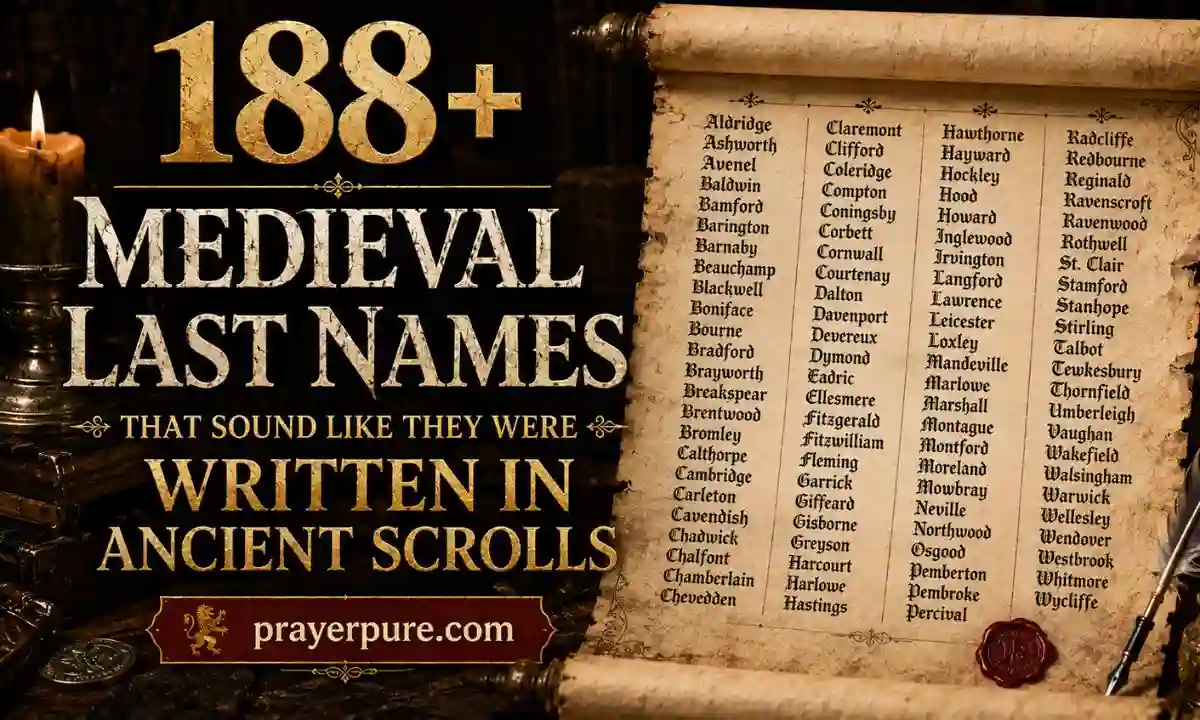
Whether you are looking for a surname for a fantasy novel, a historical fiction project, a gaming character, a genealogical exploration, or simply the pleasure of reading names that feel genuinely ancient and beautiful, this list has 188+ medieval last names that sound as though they were written in ancient scrolls. Historical context is provided for each name.
Norman and Anglo-French Medieval Surnames
Beaumont
- Origin: Norman French
- Meaning: Beautiful mountain, fair hill
- Historical context: A Norman surname brought to England with the Conquest of 1066, carried by one of the most powerful Norman noble families who became Earls of Leicester. The name comes from any of several places in Normandy called Beaumont.
Mortimer
- Origin: Norman French
- Meaning: Dead sea, still water
- Historical context: One of the great Norman baronial families of medieval England, the Mortimers held the lordship of Wigmore Castle in the Welsh Marches and produced Roger Mortimer who became the lover of Queen Isabella and effectively ruled England in the 1320s.
Beauchamp
- Origin: Norman French
- Meaning: Beautiful field, fair plain
- Historical context: Pronounced BEECHAM, this great Norman family became Earls of Warwick and were among the most powerful magnates of medieval England, their name gracing countless records in the French-influenced Latin of the medieval chancery.
Montacute
- Origin: Norman French
- Meaning: Pointed mountain, sharp hill
- Historical context: A distinguished Norman family who became Earls of Salisbury, the Montacutes appear in chronicles from the twelfth century onward and left their name on the beautiful priory at Montacute in Somerset.
Ferrers
- Origin: Norman French
- Meaning: Ironworker, blacksmith, from Ferrières
- Historical context: The great Norman family of Ferrers came from Ferrières-Saint-Hilaire in Normandy and became Earls of Derby, their name reflecting the ironworking tradition of their home region.
Quincy
- Origin: Norman French
- Meaning: Fifth estate, from Cuinchy
- Historical context: The de Quincy family became Earls of Winchester and were among the barons who forced King John to sign Magna Carta in 1215, their name appearing prominently in that foundational document of English liberty.
Bigod
- Origin: Norman French
- Meaning: Uncertain, possibly by God, an oath
- Historical context: The Bigod family were Earls of Norfolk and among the most powerful Norman magnates in England, their unusual name appearing throughout the records of medieval England.
Malet
- Origin: Norman French
- Meaning: Little bag, wallet, uncertain
- Historical context: William Malet was among the Norman knights at the Battle of Hastings and the family became significant landholders in Suffolk, their name appearing in Domesday Book as one of the earliest recorded surnames in England.
Lacey
- Origin: Norman French
- Meaning: From Lassy in Normandy
- Historical context: The de Lacy family held vast estates in both England and Ireland, becoming Earls of Lincoln and lords of Meath, one of the most powerful Norman dynasties on both islands.
Bohun
- Origin: Norman French
- Meaning: From Bohon in Normandy
- Historical context: The de Bohun family became Earls of Hereford and Constables of England, their name appearing throughout the greatest chronicles of medieval English history including their role as hereditary Constables at the coronation.
Anglo-Saxon and Old English Surnames
Blackwood
- Origin: Old English
- Meaning: Dark forest, black woodland
- Historical context: A topographic surname given to those who lived near or in a dark, densely wooded area, Blackwood appears in English records from the thirteenth century onward and was common across the northern counties.
Whitmore
- Origin: Old English
- Meaning: White moor, pale moorland
- Historical context: Given to those who lived near pale or light-colored moorland, Whitmore was recorded in the Subsidy Rolls of the thirteenth and fourteenth centuries and was particularly common in Staffordshire.
Ashford
- Origin: Old English
- Meaning: Ford by the ash trees
- Historical context: A locative surname given to those from any of the several places called Ashford in England, these crossings by ash trees were common enough landmarks to give rise to a widespread surname.
Strongbow
- Origin: Old English
- Meaning: One with a powerful bow, strong archer
- Historical context: The nickname of Richard de Clare, Earl of Pembroke, who led the Norman invasion of Ireland in 1170, Strongbow became one of the most famous epithets in medieval Anglo-Irish history.
Goldsworthy
- Origin: Old English
- Meaning: Goldsmith’s enclosure, gold worker’s settlement
- Historical context: An occupational topographic surname combining the Old English words for gold working and an enclosed settlement, appearing in records from Devon and Cornwall where mining traditions ran deep.
Thurston
- Origin: Old English/Norse
- Meaning: Thor’s stone, stone of the thunder god
- Historical context: A surname derived from the personal name Thurstan, itself from the Norse god Thor, Thurston appears in Domesday Book and was widespread across the Danelaw counties of eastern and northern England.
Alderton
- Origin: Old English
- Meaning: Settlement of Aldhere, old army town
- Historical context: A locative surname from any of several places called Alderton in England, the name combines an Anglo-Saxon personal name with the common Old English suffix for a settlement or farmstead.
Grimshaw
- Origin: Old English
- Meaning: Grim’s copse, dark thicket
- Historical context: A topographic surname combining the Norse name Grim, an epithet of Odin, with the Old English word shaw meaning a small wood, appearing in Lancashire records from the fourteenth century.
Stanwick
- Origin: Old English
- Meaning: Stone settlement, stony farm
- Historical context: Given to those from any settlement built on stony ground, Stanwick appears in the records of northern England where rocky terrain made such descriptive surnames especially common.
Wulfric
- Origin: Old English
- Meaning: Wolf ruler, power of the wolf
- Historical context: A surname derived from the ancient Anglo-Saxon personal name Wulfric, combining the words for wolf and power, this name appears in pre-Conquest English records and survived as a surname into the medieval period.
Medieval Occupational Surnames
Chandler
- Origin: Old French/Latin
- Meaning: Candle maker, candlestick seller
- Historical context: The chandler made and sold candles, essential items in any medieval household, church, or hall, and the surname appears in guild records and tax rolls throughout the fourteenth and fifteenth centuries.
Fletcher
- Origin: Old French
- Meaning: Arrow maker, feather worker
- Historical context: The fletcher made arrows, one of the most important occupations in medieval England where archery was both a military requirement and a legal obligation for men of certain ages and income levels.
Thatcher
- Origin: Old English
- Meaning: Roof thatcher, one who thatches
- Historical context: The thatcher repaired and laid the thatched roofs that covered most buildings in medieval England, a skilled craft that was essential to every village and that gave rise to this widespread occupational surname.
Mercer
- Origin: Old French
- Meaning: Cloth merchant, dealer in fine fabrics
- Historical context: The mercers dealt in fine textiles and luxury goods and were among the most prosperous of medieval merchants, organizing themselves into powerful guilds including the Worshipful Company of Mercers in London.
Wainwright
- Origin: Old English
- Meaning: Wagon maker, cart builder
- Historical context: The wainwright built and repaired wagons and carts, essential vehicles in medieval agriculture and commerce, and the surname appears throughout the manorial records of the thirteenth and fourteenth centuries.
Goldsmith
- Origin: Old English
- Meaning: Worker in gold, goldsmith
- Historical context: The goldsmiths were among the most skilled and prosperous artisans of the medieval world, working precious metals into jewelry and religious objects and eventually becoming important bankers and financiers.
Draper
- Origin: Old French
- Meaning: Cloth seller, draper
- Historical context: The draper sold cloth and textiles, one of the most important commodities in medieval commerce, and the surname appears in the records of every major English town where the cloth trade flourished.
Tanner
- Origin: Old English
- Meaning: Leather tanner, one who tans hides
- Historical context: The tanner transformed raw animal hides into leather through a lengthy chemical process using tannin from oak bark, an essential but unpleasant trade that was usually confined to the outskirts of medieval towns.
Falconer
- Origin: Old French
- Meaning: Falconer, keeper of hawks
- Historical context: The falconer kept and trained the hawks and falcons used in hunting, one of the most prestigious pastimes of the medieval nobility, and was a valued member of any great household.
Glazier
- Origin: Old French/English
- Meaning: Glass worker, window glass maker
- Historical context: The glazier made and fitted glass windows, an increasingly important craft from the twelfth century onward as Gothic architecture demanded ever-larger stained glass windows for the great cathedrals of Europe.
Arrowsmith
- Origin: Old English
- Meaning: Arrow maker, smith who makes arrows
- Historical context: The arrowsmith forged the iron tips and fittings for arrows, a specialized branch of the blacksmith’s trade that was essential to the military needs of medieval England.
Plowman
- Origin: Old English
- Meaning: One who plows, agricultural laborer
- Historical context: The plowman was the fundamental agricultural worker of medieval England, guiding the heavy plow through the open fields that surrounded every village, immortalized by William Langland in his great poem Piers Plowman.
Cooper
- Origin: Old English/Latin
- Meaning: Barrel maker, cask maker
- Historical context: The cooper made the barrels, casks, and tubs essential to every aspect of medieval life from brewing to storage, and was one of the most widespread and essential of all medieval craftsmen.
Sawyer
- Origin: Old English
- Meaning: One who saws wood, woodcutter
- Historical context: The sawyer cut timber with a great two-handled saw, working in sawpits where one man stood above and one below the log, an essential trade in any medieval town or estate that was building or repairing structures.
Skinner
- Origin: Old Norse/English
- Meaning: One who skins animals, furrier
- Historical context: The skinner prepared animal furs and skins, an important trade in medieval England where furs were both practical garments and status symbols indicating wealth and rank.
Medieval Topographic Surnames
Moorfield
- Origin: Old English
- Meaning: Open marshland field, moor and field
- Historical context: Given to those who lived on or near marshy, open land combined with arable fields, topographic surnames like Moorfield were common in areas where drainage was poor and the landscape was distinctive.
Clearwater
- Origin: Old English
- Meaning: Clear stream, bright water source
- Historical context: Given to those who lived near a particularly clear spring or stream, water sources being among the most important landmarks in medieval landscape navigation.
Dunmore
- Origin: Scottish Gaelic/Old English
- Meaning: Dark moor, great fortress hill
- Historical context: A name given to those from any of the several places called Dunmore in Scotland and Ireland, the name combining the Gaelic word for a fort or hill with the English word for moorland.
Greenleaf
- Origin: Old English
- Meaning: Green foliage, fresh leaves
- Historical context: A nature-inspired topographic surname that may have been given to those who lived near a particularly distinctive green woodland or who worked with fresh green plant materials.
Ridgeway
- Origin: Old English
- Meaning: Path along a ridge, ridge road
- Historical context: Given to those who lived near or on one of the ancient ridgeways that followed the high ground across the English landscape, some of these ancient paths having been in use since prehistoric times.
Thornton
- Origin: Old English
- Meaning: Thorn bush settlement, thorny enclosure
- Historical context: One of the most common medieval English place-names and surnames, Thornton was given to those from any of the numerous villages surrounded by defensive thorn hedges.
Ashby
- Origin: Old Norse/English
- Meaning: Farm by the ash trees, ash tree settlement
- Historical context: A Scandinavian-influenced place-name that became a surname, reflecting the heavy Norse settlement of the Danelaw in eastern and northern England where ash trees were common landmarks.
Westbrook
- Origin: Old English
- Meaning: Western stream, brook to the west
- Historical context: Given to those who lived near a stream to the west of a settlement, directional topographic surnames were common in medieval England where orientation relative to a village or town defined local geography.
Holloway
- Origin: Old English
- Meaning: Hollow road, sunken lane
- Historical context: Given to those who lived near or on a sunken lane, the holloways being the ancient paths worn deep into the landscape by centuries of foot and animal traffic, many of which still survive in the English countryside.
Whitfield
- Origin: Old English
- Meaning: White open land, pale field
- Historical context: Given to those from any of several places called Whitfield in England, the name describing open land that appeared white or pale, possibly due to chalk or limestone underlying the soil.
Ravenswood
- Origin: Old English
- Meaning: Raven’s woodland, wood frequented by ravens
- Historical context: A topographic surname given to those who lived near a woodland known for its population of ravens, these intelligent birds being associated with wisdom, death, and the supernatural in medieval folklore.
Standish
- Origin: Old English
- Meaning: Stony pasture, stone enclosure
- Historical context: From the village of Standish in Lancashire, the name was borne by the ancient family who held the manor there and became one of the notable families of medieval Lancashire.
Crossthwaite
- Origin: Old Norse
- Meaning: Clearing with a cross, cross-marked clearing
- Historical context: A Norse topographic surname from the Lake District of northern England where Scandinavian settlers cleared woodland and marked their boundaries with crosses, leaving a landscape scattered with Norse place-names.
Brackenridge
- Origin: Old English/Norse
- Meaning: Bracken-covered ridge, fern ridge
- Historical context: Given to those who lived on or near a ridge covered with bracken fern, a common sight on the upland moorland of northern England and Scotland where this hardy plant colonized open ground.
Fenwick
- Origin: Old English
- Meaning: Fen farm, marsh settlement
- Historical context: From any of the several places called Fenwick in northern England, the name describing a farm or settlement on or near marshy fenland, a landscape that shaped both agriculture and settlement patterns.
Medieval Scottish Clan and Highland Surnames
MacGregor
- Origin: Scottish Gaelic
- Meaning: Son of Gregor, son of the watchful one
- Historical context: One of the great Highland clans whose history was so turbulent that the name itself was formally proscribed by the Scottish government in the seventeenth century, the clan’s members forced to adopt other surnames under pain of death.
MacKinnon
- Origin: Scottish Gaelic
- Meaning: Son of Findgan, son of fair born
- Historical context: An ancient clan of the Isle of Mull and Skye with origins going back to the ancient kingdom of Dalriada, the MacKinnons were hereditary abbots of Iona and keepers of the Laws of the Isles.
Dunbar
- Origin: Scottish Gaelic
- Meaning: Fort on the heights, summit fortress
- Historical context: Both a place and a surname of great antiquity in Scotland, the Dunbar family were Earls of Dunbar and March for centuries and were among the most powerful magnates in medieval Scotland.
Innes
- Origin: Scottish Gaelic
- Meaning: Island, river meadow
- Historical context: The Innes family held their lands on the River Spey in Moray from the twelfth century and their name, meaning a water meadow or island of land, appears in Scottish charters from that period.
Ruthven
- Origin: Scottish Gaelic/Norse
- Meaning: Red river, ruddy stream
- Historical context: The Ruthven family were Lords and later Earls of Gowrie in Perthshire, their name becoming infamous through the Gowrie Conspiracy of 1600 when the Earl of Gowrie was killed in a mysterious confrontation with King James VI.
Abernethy
- Origin: Scottish Gaelic
- Meaning: Mouth of the Nethy river
- Historical context: One of the oldest recorded surnames in Scotland, the Abernethy family appear in twelfth-century Scottish records and their name comes from the ancient Pictish settlement at the mouth of the River Nethy.
Colquhoun
- Origin: Scottish Gaelic
- Meaning: Narrow wood, hazel corner
- Historical context: Pronounced kuh-HOON, the Colquhoun clan held lands on the western shore of Loch Lomond from the thirteenth century and were frequently in conflict with their neighbors the MacGregors.
Glamis
- Origin: Scottish Gaelic
- Meaning: Wide valley, the hollows
- Historical context: The Glamis family held the great castle of Glamis in Angus, one of the oldest inhabited castles in Scotland, the name appearing in Scottish records from the twelfth century and most famously associated with Macbeth.
Sinclair
- Origin: Norman French/Scottish
- Meaning: From Saint-Clair-sur-Epte in Normandy
- Historical context: The Sinclair family, originally de Saint-Clair, became one of the most powerful noble families in Scotland and built the extraordinary Rosslyn Chapel near Edinburgh in the fifteenth century.
Moncreiffe
- Origin: Scottish Gaelic
- Meaning: Hill of the sacred branch, tree hill
- Historical context: One of the oldest families in Scotland with lands at the Hill of Moncreiffe in Perthshire from which the name derives, appearing in Scottish records from the twelfth century as one of the country’s most ancient families.
Medieval Irish Gaelic Surnames
O’Donoghue
- Origin: Irish Gaelic
- Meaning: Descendant of Donnchadh, descendant of the dark warrior
- Historical context: An ancient Irish clan of County Kerry, the O’Donoghues ruled as kings of Desmond before the Norman invasion and their name appears in the great Irish genealogical texts as one of the royal families of Munster.
MacMurrough
- Origin: Irish Gaelic
- Meaning: Son of Murchadh, son of the sea warrior
- Historical context: Diarmait Mac Murchada, King of Leinster, whose invitation to Norman mercenaries brought Richard de Clare Strongbow to Ireland in 1169, making him one of the most consequential figures in Irish medieval history.
O’Rourke
- Origin: Irish Gaelic
- Meaning: Descendant of Ruarc, descendant of the king
- Historical context: The O’Rourkes were kings of Breifne in what is now County Leitrim and their name appears throughout the annals of Irish history, particularly through Tigernán Ua Ruairc whose wife Derbforgaill was carried off by Diarmait Mac Murchada.
MacCarthy
- Origin: Irish Gaelic
- Meaning: Son of Carthach, son of the loving one
- Historical context: The MacCarthys were kings of Munster and Desmond, one of the great royal dynasties of medieval Ireland, their name appearing throughout the Annals of Inisfallen as the dominant family of Munster.
O’Brennan
- Origin: Irish Gaelic
- Meaning: Descendant of Braonán, descendant of the teardrop
- Historical context: An ancient Irish family name derived from the personal name Braonán meaning teardrop or sorrow, the O’Brennans were an important ecclesiastical family associated with the church traditions of County Kilkenny.
Ó Ceallaigh
- Origin: Irish Gaelic
- Meaning: Descendant of Ceallach, descendant of the bright-headed one
- Historical context: Anglicized as O’Kelly, the Ó Ceallaigh family were kings of Uí Maine in Connacht and one of the most significant families in medieval Connacht, their name appearing throughout the Irish annals.
MacNamara
- Origin: Irish Gaelic
- Meaning: Son of Cú Mara, son of the hound of the sea
- Historical context: The MacNamaras were lords of Clancuilein in County Clare and powerful supporters of the O’Briens of Thomond, their unusual name meaning son of the hound of the sea reflecting the ancient Irish tradition of naming warriors after hunting dogs.
O’Flaherty
- Origin: Irish Gaelic
- Meaning: Descendant of Flaithbheartach, descendant of the bright ruler
- Historical context: The O’Flahertys were kings of Iar Connacht in the west of Ireland and a family whose fierce independence earned them the famous inscription on the gates of Galway warning God that he protect us from the ferocious O’Flahertys.
MacEgan
- Origin: Irish Gaelic
- Meaning: Son of Aodhagán, son of little fire
- Historical context: The MacEgans were one of the great brehon law families of medieval Ireland, hereditary lawyers and judges who preserved and administered the ancient Brehon legal system and whose manuscripts survive as important legal texts.
Ó Faoláin
- Origin: Irish Gaelic
- Meaning: Descendant of the little wolf, wolf cub
- Historical context: Anglicized as O’Phelan or Whelan, the Ó Faoláin family were a sept of the Déisi in County Waterford, their name meaning descendant of the little wolf, a creature of particular significance in Irish mythology.
Medieval Welsh Patronymic Surnames
Llewelyn
- Origin: Welsh
- Meaning: Lion-like, leader
- Historical context: The name of two of the greatest Welsh princes, Llewelyn ap Iorwerth and Llewelyn ap Gruffudd, the last native Prince of Wales, Llewelyn became both a surname and a symbol of Welsh national identity.
ap Gruffudd
- Origin: Welsh
- Meaning: Son of Gruffudd, son of the strong lord
- Historical context: The patronymic ap Gruffudd appears throughout medieval Welsh records, the Welsh system of naming through the father’s name producing surnames that were fluid and changing with each generation rather than fixed family names.
Meredith
- Origin: Welsh
- Meaning: Great lord, magnificent ruler
- Historical context: From the Welsh personal name Maredudd meaning great lord, Meredith became a surname across the Welsh borderlands and was carried by several noble Welsh families in the medieval period.
Vaughan
- Origin: Welsh
- Meaning: Small, junior, the lesser
- Historical context: From the Welsh fychan meaning small or junior, Vaughan was used to distinguish a son from his father of the same name and became one of the most common Welsh surnames, appearing throughout the medieval records of Wales and the Marches.
Cadwallader
- Origin: Welsh
- Meaning: Battle leader, war arranger
- Historical context: From the great legendary Welsh king Cadwaladr whose return was prophesied by Geoffrey of Monmouth, the name became a powerful symbol of Welsh resistance to English domination.
Traherne
- Origin: Welsh
- Meaning: Very strong, iron strength
- Historical context: From the Welsh iron meaning strong, Traherne was a surname used by noble families in medieval Wales and became associated with the bardic traditions of Welsh literary culture.
Penrhyn
- Origin: Welsh
- Meaning: Headland, promontory
- Historical context: A topographic Welsh surname given to those from the various headlands around the Welsh coast, the name appearing in the records of medieval Wales where coastal geography shaped both settlement and identity.
Bledri
- Origin: Welsh
- Meaning: Wolf ruler, strong wolf
- Historical context: From the ancient Welsh personal name Bledrys meaning wolf ruler, Bledri became a surname associated with the native Welsh aristocracy before the Norman conquest reshaped Welsh noble culture.
Cyfnerth
- Origin: Welsh
- Meaning: Strength together, mutual strength
- Historical context: The name of a medieval Welsh lawgiver whose code formed the basis of Welsh law in parts of Wales, Cyfnerth is one of the most genuinely ancient and historically significant Welsh names.
Gwynfardd
- Origin: Welsh
- Meaning: Blessed bard, fair poet
- Historical context: A compound Welsh name meaning blessed or fair bard, Gwynfardd was a name associated with the great bardic tradition of medieval Wales where poets held a position of honor and ritual significance.
Medieval German and Holy Roman Empire Surnames
Hofmeister
- Origin: Middle High German
- Meaning: Master of the court, steward
- Historical context: The Hofmeister was the chief steward of a noble household, responsible for managing its day-to-day administration, a position of great importance in the complex hierarchy of medieval German noble households.
Waldemar
- Origin: Germanic
- Meaning: Famous ruler, powerful in rule
- Historical context: A distinguished Germanic name combining the words for rule and fame, Waldemar was borne by several medieval kings of Denmark and became a surname across the Holy Roman Empire.
Schwarzenberg
- Origin: German
- Meaning: Black mountain, dark hill
- Historical context: One of the great noble families of the Holy Roman Empire, the Schwarzenbergs rose from Franconian knights to Imperial Princes over the medieval period, their name reflecting the dark forested hills of their original territory.
Hohenstaufen
- Origin: German
- Meaning: High stone, tall rock
- Historical context: The great imperial dynasty of the Holy Roman Empire from the twelfth to the thirteenth century, the Hohenstaufens included Frederick Barbarossa and Frederick II, their name coming from their ancestral castle in Swabia.
Brandenstein
- Origin: German
- Meaning: Brand stone, fire stone
- Historical context: A noble family name from the German lands, the Brandensteins were Franconian knights whose name combined the German words for fire or sword and stone, a name with a genuine martial resonance.
Kronenberg
- Origin: German
- Meaning: Crown mountain, crowned hill
- Historical context: A German topographic surname given to those from any of the places called Kronenberg, meaning a hill or mountain that resembled a crown, a name that carried obvious royal and noble associations.
Eisenhardt
- Origin: German
- Meaning: Iron strong, hard as iron
- Historical context: A German surname combining the words for iron and strong or hard, Eisenhardt reflects the medieval German admiration for qualities of physical strength and endurance associated with the iron of the smith’s forge.
Wolfsberg
- Origin: German
- Meaning: Wolf mountain, wolves’ hill
- Historical context: A topographic surname from any of the several places called Wolfsberg in the German-speaking world, the name reflecting the real danger posed by wolf packs to medieval livestock and occasionally to people.
Tannenberg
- Origin: German
- Meaning: Fir tree mountain, pine forest hill
- Historical context: Made famous by two great battles, including the 1410 Battle of Tannenberg where the Teutonic Knights were defeated by the Polish-Lithuanian forces, the name itself comes from the dark fir forests of the eastern European landscape.
Rabenstein
- Origin: German
- Meaning: Raven stone, gallows stone
- Historical context: A German surname that literally referred to the stone on which ravens perched near the gallows, reflecting the dark medieval understanding that ravens gathered where the dead were exposed.
Medieval Italian and Florentine Surnames
Malaspina
- Origin: Italian
- Meaning: Bad thorn, evil spine
- Historical context: One of the great noble families of medieval Liguria and Tuscany, the Malaspinas were lords of a vast territory in the Apennines and were renowned patrons of troubadour poetry, hosting Dante Alighieri at their court.
Visconti
- Origin: Italian/Latin
- Meaning: Viscount, deputy count
- Historical context: The ruling family of Milan from the thirteenth to the fifteenth century, the Viscontis built one of the most powerful principalities in medieval Italy and were known for both their political ruthlessness and their patronage of the arts.
Pazzi
- Origin: Italian
- Meaning: Madmen, the crazy ones
- Historical context: The great Florentine banking family whose 1478 conspiracy against the Medici, the Pazzi Conspiracy, resulted in the attempted assassination of Lorenzo and Giuliano de Medici in Florence Cathedral.
Sforza
- Origin: Italian
- Meaning: Strength, force
- Historical context: The dynasty that ruled Milan after the Viscontis, the Sforzas were originally condottieri, mercenary soldiers, whose name literally means strength or force, reflecting their origins as military men who seized power.
Colonna
- Origin: Italian
- Meaning: Column, pillar
- Historical context: One of the great Roman noble families of the medieval period, the Colonnas were perennial rivals of the Orsini family and produced several cardinals and one pope, their name referring to the stone column on their coat of arms.
Orsini
- Origin: Italian
- Meaning: Little bear, bear cub
- Historical context: The great Roman noble family whose bear emblem gave them their name, the Orsinis were one of the most powerful dynasties of medieval Rome and produced three popes and numerous cardinals.
Rucellai
- Origin: Italian
- Meaning: Dyers, those who dye cloth
- Historical context: A prominent Florentine merchant family who made their fortune in the cloth trade, the Rucellais were patrons of the great Renaissance architect Leon Battista Alberti who built their famous palazzo.
Strozzi
- Origin: Italian
- Meaning: Uncertain, possibly strangler or extortioner
- Historical context: One of the great banking families of medieval and Renaissance Florence, the Strozzis were rivals of the Medici and built the magnificent Palazzo Strozzi that stands as one of the finest examples of Renaissance architecture.
Frescobaldi
- Origin: Italian
- Meaning: Fresh and bold, cool boldness
- Historical context: A great Florentine banking family of the thirteenth and fourteenth centuries who were the primary bankers to the English crown under Edward I and Edward II, their name appearing in the records of the English Exchequer.
Bardi
- Origin: Italian
- Meaning: Uncertain, possibly bard or poet
- Historical context: The Bardi family were among the greatest bankers of medieval Europe, extending enormous loans to Edward III of England whose failure to repay them contributed to the family’s spectacular bankruptcy in 1346.
Medieval Jewish and Sephardic Surnames
Abravanel
- Origin: Hebrew/Spanish
- Meaning: Father is God, father of dew
- Historical context: One of the great Jewish intellectual and financial families of medieval Iberia, the Abravanels produced Isaac Abravanel who served as treasurer to Ferdinand and Isabella before the expulsion of the Jews from Spain in 1492.
Maimonides
- Origin: Hebrew/Greek
- Meaning: Son of Maimon, blessed son
- Historical context: The family name of Moses ben Maimon, the greatest Jewish philosopher and scholar of the medieval world, whose works on Jewish law and philosophy shaped both Jewish and Christian thought.
Cresques
- Origin: Catalan/Hebrew
- Meaning: One who grows, flourishing
- Historical context: The name of the great fourteenth-century Jewish cartographer Abraham Cresques of Majorca who created the extraordinary Catalan Atlas of 1375, one of the most important maps of the medieval world.
Halevi
- Origin: Hebrew
- Meaning: The Levite, of the tribe of Levi
- Historical context: A surname indicating descent from the tribe of Levi, the priestly tribe of Israel, Halevi was borne by the great medieval Hebrew poet Judah Halevi whose religious and philosophical poetry is among the finest in the medieval Jewish tradition.
Nachmanides
- Origin: Hebrew/Greek
- Meaning: Son of Nachman, comforting son
- Historical context: The family name of Moses ben Nachman, the great thirteenth-century Rabbi and scholar of Catalonia who debated with the Dominicans in the Barcelona Disputation of 1263 and subsequently emigrated to Palestine.
Crescas
- Origin: Catalan/Hebrew
- Meaning: One who grows, flourishing
- Historical context: Hasdai Crescas was one of the greatest Jewish philosophers of the fourteenth century, a Rabbi of Barcelona who survived the massacre of 1391 and wrote important works challenging Aristotelian philosophy.
Luria
- Origin: Hebrew/Italian
- Meaning: From Luria, a place in Italy
- Historical context: The name of Isaac Luria, the great sixteenth-century Kabbalist of Safed whose mystical teachings profoundly influenced Jewish spirituality, the family name derived from the Italian town of Loria.
Tibbon
- Origin: Hebrew/Arabic
- Meaning: Careful one, cautious
- Historical context: The great translating family of medieval Provence who produced generations of scholars who translated Arabic philosophical and scientific works into Hebrew, making the learning of the Islamic world accessible to European Jews.
Medieval Byzantine and Eastern European Surnames
Palaiologos
- Origin: Greek
- Meaning: Old word speaker, ancient speaker
- Historical context: The last ruling dynasty of the Byzantine Empire who held the imperial throne from 1261 until the fall of Constantinople in 1453, the Palaiologoi were simultaneously one of history’s most distinguished and most tragic dynasties.
Kantakouzenos
- Origin: Greek
- Meaning: From Kantakouze, the shining one
- Historical context: One of the great Byzantine aristocratic families who produced the Emperor John VI Kantakouzenos, a scholar and warrior whose civil war against the legitimate Palaiologos dynasty weakened Byzantium fatally.
Komnenos
- Origin: Greek
- Meaning: From Komne, possibly the lord’s
- Historical context: The great Byzantine imperial dynasty that ruled from 1081 to 1185 and restored the empire after the disasters of the late eleventh century, the Komnenoi included Alexios I whose appeals to the Pope helped trigger the First Crusade.
Doukas
- Origin: Greek
- Meaning: Leader, duke
- Historical context: One of the great aristocratic families of the Byzantine Empire who produced an imperial dynasty in the eleventh century, the Doukas family were rivals of the Komnenoi and shaped Byzantine politics across several generations.
Laskaris
- Origin: Greek
- Meaning: From Laskaris, possibly the ragged one
- Historical context: The ruling dynasty of the Empire of Nicaea, the Byzantine successor state established after the Fourth Crusade sacked Constantinople in 1204, the Laskarids preserved Byzantine civilization until 1261.
Asanides
- Origin: Bulgarian/Greek
- Meaning: Son of Asen, bear king
- Historical context: A family name derived from the great Asen dynasty of Bulgaria who led the Second Bulgarian Empire from the late twelfth century, the Asanides were among the most powerful rulers of the medieval Balkans.
Dragases
- Origin: Serbian/Greek
- Meaning: From Dragas, precious
- Historical context: The family name of Constantine XI Dragases Palaiologos, the last Emperor of Byzantium who died defending Constantinople on May 29, 1453, his mother’s surname incorporated into his name as was Byzantine custom.
Branković
- Origin: Serbian
- Meaning: Son of Branko, son of the protector
- Historical context: The great Serbian noble family who became despots of Serbia in the fifteenth century and navigated the impossibly difficult position between the Ottoman Empire and the Christian powers of Europe.
Medieval Scandinavian and Viking-Era Surnames
Lodbrok
- Origin: Old Norse
- Meaning: Shaggy breeches, leather trousers
- Historical context: The epithet of the legendary Viking chieftain Ragnar Lodbrok whose name literally meant shaggy breeches, supposedly referring to the hairy or leather trousers he wore, a figure at the intersection of history and legend.
Sigurdsson
- Origin: Old Norse
- Meaning: Son of Sigurd, son of the victory guardian
- Historical context: A patronymic surname meaning son of Sigurd, after the great Norse hero who slew the dragon Fafnir, Sigurdsson appears in the Icelandic sagas and the historical records of the Norwegian kingdom.
Haraldsson
- Origin: Old Norse
- Meaning: Son of Harald, son of the army ruler
- Historical context: A patronymic surname meaning son of Harald, the name of several Norwegian kings, Haraldsson appears throughout the Norse sagas and historical records as the name of some of the most important figures in Viking age Scandinavia.
Eiriksson
- Origin: Old Norse
- Meaning: Son of Eirik, son of the eternal ruler
- Historical context: Most famously the surname of Leif Eiriksson who reached North America around the year 1000, Eiriksson appears throughout the Vinland Sagas as the name of the family that explored the western Atlantic.
Bjornsson
- Origin: Old Norse
- Meaning: Son of Bjorn, son of the bear
- Historical context: A patronymic surname meaning son of Bjorn, after the bear name common among Norse warriors, Bjornsson appears in the Icelandic sagas and the records of the Norwegian and Danish kingdoms.
Grimsson
- Origin: Old Norse
- Meaning: Son of Grim, son of the masked one
- Historical context: A patronymic surname meaning son of Grim, one of the many names of Odin who was sometimes called Grimr meaning the masked or hooded one, appearing throughout the Norse sagas.
Ulfsson
- Origin: Old Norse
- Meaning: Son of Ulf, son of the wolf
- Historical context: A patronymic surname meaning son of Ulf, the wolf being one of the most powerful animal symbols in Norse culture, Ulfsson appears in the records of Sweden and the Norse world.
Stormsson
- Origin: Old Norse
- Meaning: Son of Storm, son of tempest
- Historical context: A dramatic Norse surname meaning son of storm, whether derived from a personal name or an epithet, reflecting the Norse culture’s comfort with the elemental forces of nature as sources of identity and power.
Ravnkilde
- Origin: Danish
- Meaning: Raven spring, raven source
- Historical context: A Danish topographic surname combining the raven, sacred to Odin and deeply significant in Norse mythology, with the word for a spring or source of water, appearing in medieval Danish records.
Skjoldung
- Origin: Old Norse
- Meaning: Descendant of Skjold, of the shield dynasty
- Historical context: The name of the legendary Danish royal dynasty descended from the mythological king Skjold, the Skjoldungs appear in the great Anglo-Saxon poem Beowulf as the Scyldings, ancestors of the Danish kings.
Medieval Crusader and Holy Land Surnames
de Lusignan
- Origin: Norman French
- Meaning: From Lusignan, associated with the fairy Melusine
- Historical context: The great crusading family from Poitou who became Kings of Jerusalem and Cyprus, the Lusignans were associated in legend with the fairy Melusine who supposedly founded their dynasty, one of the most romantically storied families of the crusading era.
de Montfort
- Origin: Norman French
- Meaning: From the strong mountain, fortified hill
- Historical context: One of the great crusading families of medieval Europe, the Montforts included Simon de Montfort the Elder who led the Albigensian Crusade and Simon de Montfort the Younger who created the first English Parliament.
de Bouillon
- Origin: Norman French
- Meaning: From Bouillon, bubbling spring
- Historical context: The family of Godfrey de Bouillon, the leader of the First Crusade who became the first Christian ruler of Jerusalem in 1099, one of the great names of the crusading movement.
d’Ibelin
- Origin: Norman French/Latin
- Meaning: From Ibelin, a town in the Holy Land
- Historical context: The great crusader family who became lords of Ibelin and Ramla in the Kingdom of Jerusalem, the Ibelins were among the most influential noble families of the crusading states.
de Brienne
- Origin: Norman French
- Meaning: From Brienne in Champagne
- Historical context: A crusading family from Champagne who became Kings of Jerusalem and later Emperors of Constantinople, the de Briennes were among the most remarkable dynasties of the Latin East.
de Chatillon
- Origin: Norman French
- Meaning: From Chatillon, little castle
- Historical context: Reynald de Chatillon was one of the most notorious crusaders, his provocative attacks on Muslim caravans helping to trigger Saladin’s reconquest of Jerusalem in 1187.
de Joinville
- Origin: Norman French
- Meaning: From Joinville, joining settlement
- Historical context: Jean de Joinville was the biographer and companion of King Louis IX of France on the Seventh Crusade, his Vie de Saint Louis being one of the most important personal accounts of the crusading era.
de Villehardouin
- Origin: Norman French
- Meaning: From Villehardouin, hard settlement
- Historical context: Geoffrey de Villehardouin was both a leader of the Fourth Crusade that sacked Constantinople in 1204 and the chronicler of that campaign, his account being one of the earliest prose works in the French language.
Medieval English Baronial Surnames
de Clare
- Origin: Norman French
- Meaning: From Clare in Normandy, bright place
- Historical context: One of the most powerful Norman families in both England and Ireland, the de Clares included the Earls of Gloucester and Hertford and Richard de Clare Strongbow who invaded Ireland in 1170.
de Vere
- Origin: Norman French
- Meaning: From Ver in Normandy, alder tree place
- Historical context: The de Vere family were Earls of Oxford for twenty generations from 1141 to 1625, one of the longest unbroken successions of any English earldom and among the most ancient of all English noble families.
de Percy
- Origin: Norman French
- Meaning: From Percy-en-Auge in Normandy
- Historical context: The great northern baronial family who held vast estates in Yorkshire and Northumberland, the Percys became Earls of Northumberland and were among the most powerful magnates of the medieval north.
FitzAlan
- Origin: Norman French
- Meaning: Son of Alan, son of the high one
- Historical context: The FitzAlans became Earls of Arundel and were among the most important noble families of medieval England, their name combining the Norman prefix Fitz meaning son with the Breton personal name Alan.
FitzWalter
- Origin: Norman French
- Meaning: Son of Walter, son of the powerful ruler
- Historical context: Robert FitzWalter was one of the leading barons who forced King John to grant Magna Carta in 1215, his family name appearing prominently in the records of that foundational moment in English constitutional history.
de Warenne
- Origin: Norman French
- Meaning: From Varenne in Normandy, game park
- Historical context: The de Warennes were Earls of Surrey and among the greatest Norman magnates in England, holding vast estates and playing important roles in the political history of medieval England.
de Braose
- Origin: Norman French
- Meaning: From Briouze in Normandy
- Historical context: The de Braose family were Lords of Bramber and Brecon in the Welsh Marches and were notorious for their conflicts with King John, who seized their estates and drove the family into exile.
Neville
- Origin: Norman French
- Meaning: From Néville in Normandy, new settlement
- Historical context: The Nevilles rose from relatively obscure Norman origins to become one of the greatest families of fifteenth-century England, culminating in Richard Neville the Kingmaker whose power during the Wars of the Roses was extraordinary.
Medieval Spanish Reconquista Surnames
de Aragón
- Origin: Spanish/Latin
- Meaning: From the Kingdom of Aragon
- Historical context: The royal house of Aragon was one of the driving forces of the Reconquista, the centuries-long campaign to retake the Iberian Peninsula from Muslim rulers, culminating in the reign of Ferdinand of Aragon who married Isabella of Castile.
de Guzmán
- Origin: Spanish/Germanic
- Meaning: From Guzman, man of the good
- Historical context: One of the great noble families of medieval Castile, the de Guzmáns gave their name to the town of Guzmán in Burgos province and produced several important figures in medieval Spanish history.
de Mendoza
- Origin: Spanish/Basque
- Meaning: Cold mountain, from Mendoza
- Historical context: One of the most distinguished noble families of medieval Castile, the Mendozas produced generations of military commanders, statesmen, and cardinals and were among the most powerful families in fifteenth-century Spain.
Cisneros
- Origin: Spanish
- Meaning: From Cisneros, swans
- Historical context: The family name of Francisco Jiménez de Cisneros, the great Cardinal Archbishop of Toledo and Regent of Castile, one of the most powerful figures in Spain at the turn of the sixteenth century.
Velasco
- Origin: Spanish/Basque
- Meaning: Crow, raven
- Historical context: A powerful Castilian noble family who served as hereditary Constables of Castile for generations, the Velascos were among the greatest magnates of medieval and early modern Spain.
Zurita
- Origin: Spanish/Arabic
- Meaning: The little fox, foxes
- Historical context: The family name of Jerónimo Zurita, the great sixteenth-century Aragonese chronicler whose Anales de la Corona de Aragón is one of the most important works of medieval Spanish historiography.
de Córdoba
- Origin: Spanish/Latin
- Meaning: From Córdoba, city of great learning
- Historical context: A distinguished Spanish family name associated with the great city of Córdoba which was for centuries the most cultured and sophisticated city in western Europe under Muslim rule.
Medieval French and Burgundian Surnames
de Valois
- Origin: French
- Meaning: From Valois, valley forest
- Historical context: The French royal dynasty that ruled from 1328 to 1589, the Valois kings included some of the most dramatic figures in French medieval history and guided France through the Hundred Years War.
de Bourbon
- Origin: French
- Meaning: From Bourbon, muddy water
- Historical context: The great French noble family who became kings of France in 1589 and whose name, originally from the town of Bourbon-l’Archambault, became synonymous with French royal power and excess.
de Villon
- Origin: French
- Meaning: From a small town, little town dweller
- Historical context: The family name of François Villon, the great medieval French lyric poet whose turbulent life and extraordinary verse made him one of the most compelling figures in French literary history.
de Montluc
- Origin: French
- Meaning: From Montluc, hill of the grove
- Historical context: A distinguished French noble family from Gascony who produced Blaise de Monluc, one of the great military commanders of the sixteenth century whose Commentaires is an important memoir of medieval warfare.
de Commynes
- Origin: French/Flemish
- Meaning: From Comines in Flanders
- Historical context: Philippe de Commynes was one of the greatest political writers of the late medieval period, his Mémoires providing an extraordinary eyewitness account of French and Burgundian politics in the fifteenth century.
de la Marche
- Origin: French
- Meaning: From the march, border region
- Historical context: A surname given to those from the border regions, the marches, that lay between great medieval territories, the term march itself coming from the Germanic word for a boundary or frontier.
Froissart
- Origin: French
- Meaning: Noisy, crashing, from the verb froisser
- Historical context: Jean Froissart was the great chronicler of the Hundred Years War whose Chronicles provide the most vivid and extensive account of fourteenth-century aristocratic life and warfare in medieval Europe.
Fictional and Fantasy-Inspired Medieval Surnames
Grimthorn
- Origin: Old English compound
- Meaning: Fierce thorn, grim and thorny
- Historical context: A compound surname combining the Old English words for fierce or grim with the thorn bush, evoking both the defensive hedges of medieval settlements and the darker aspects of the medieval natural world.
Ashvale
- Origin: Old English compound
- Meaning: Ash tree valley, vale of ashes
- Historical context: A topographic compound name combining the ash tree, sacred in Norse tradition as the world tree Yggdrasil, with the valley, evoking the wooded valleys of medieval England.
Stormcrow
- Origin: Old English compound
- Meaning: Storm raven, bird of ill omen
- Historical context: A compound surname combining storm and crow or raven, evoking the medieval belief that ravens and crows were birds of ill omen who presaged death and disaster, appearing in battlefields where they fed on the fallen.
Darkhollow
- Origin: Old English compound
- Meaning: Dark sunken valley, shadowed hollow
- Historical context: A topographic compound describing a dark, sunken valley or hollow in the landscape, the kind of shadowy geographical feature that acquired supernatural associations in medieval folklore.
Whitcastle
- Origin: Old English compound
- Meaning: White fortress, pale castle
- Historical context: A compound topographic name describing a pale or white-colored fortification, possibly referring to a castle built of limestone or chalk, a distinctive landmark in any medieval landscape.
Ironwood
- Origin: Old English compound
- Meaning: Iron forest, hard and strong woodland
- Historical context: A compound name combining iron and wood, evoking both the strength of iron and the deep, hard forests of medieval Europe, a name with genuinely ancient resonances in Norse mythology where Járnviðr the Iron Wood was the forest of the giants.
Gravenmoor
- Origin: Old English compound
- Meaning: Graven moorland, carved moor
- Historical context: A topographic compound describing moorland marked by ancient carvings or engravings, possibly referring to prehistoric cup and ring marks or other ancient markings found on moorland stones.
Silverbane
- Origin: Old English compound
- Meaning: Silver destroyer, silver killer
- Historical context: An evocative compound name combining silver, the precious metal associated with purity and the defeat of supernatural evil, with bane meaning killer or destroyer, suggesting both precious value and deadly purpose.
Crowfield
- Origin: Old English compound
- Meaning: Field of crows, corvid’s open land
- Historical context: A topographic name describing a field frequented by crows, these birds being associated in medieval culture with death, prophecy, and the aftermath of battle, giving any field they haunted a distinctly ominous character.
Thornwall
- Origin: Old English compound
- Meaning: Thorn hedge wall, defensive thorn barrier
- Historical context: A name describing the defensive thorn hedges that surrounded medieval settlements, the hawthorn and blackthorn walls that protected livestock and people from wolves and raiders before stone walls became common.
Frequently Asked Questions
Q: Were medieval surnames fixed from generation to generation like modern surnames? A: Not always. The adoption of fixed, hereditary surnames was a gradual process in the medieval period. Norman noble families brought fixed surnames to England after 1066, but in areas like Wales, Ireland, and Scandinavia, patronymic naming systems meant surnames changed every generation. In Wales, a man might be called Rhys ap Gruffudd, son of Gruffudd, while his son would be called Dafydd ap Rhys, son of Rhys. Fixed hereditary surnames became standard in most of England by the fourteenth century but took longer elsewhere.
Q: What were the main types of medieval surnames? A: Medieval surnames fell into four main categories. Locative or topographic surnames described where a person lived or came from, such as Ashford or Beaumont. Occupational surnames described what a person did, such as Fletcher or Chandler. Patronymic surnames described who a person’s father was, such as Johnson or FitzWalter. And descriptive or nickname surnames described physical or personal characteristics, such as Strongbow or Grimshaw. Many surnames combine elements from more than one category.
Q: Which languages contributed most to medieval English surnames? A: English surnames draw from an extraordinarily diverse range of languages reflecting the complex history of the British Isles. Old English contributed the largest base of occupational and topographic names. Old Norse contributed many names from the Danelaw regions of eastern and northern England. Norman French brought the great baronial surnames of the post-Conquest nobility. Latin was used in church and legal records and influenced many formal surnames. Welsh, Irish Gaelic, and Scottish Gaelic each contributed their own distinct traditions to the surnames of their regions.
Q: How can I use medieval surnames in fiction or gaming? A: Medieval surnames work particularly well in historical fiction, fantasy, and role-playing games because they carry genuine historical resonance while feeling authentically distant from modern naming conventions. Locative surnames like Ashford or Ravenswood immediately evoke a landscape. Occupational surnames like Fletcher or Chandler ground a character in a specific social role. Patronymics like Haraldsson or FitzWalter suggest lineage and heritage. Mixing genuine medieval surnames from different categories can create names that feel completely authentic to the period.
Q: What is the difference between a surname and a byname in the medieval period? A: A byname was an informal additional name used to distinguish one person from another with the same first name, which might or might not be passed on to children and descendants. A surname was a fixed, hereditary name that was consistently passed from parent to child. Many medieval surnames began as bynames that gradually became fixed through consistent use across several generations. The distinction between the two was not always clear to contemporaries and the process of a byname becoming a fixed surname could take anywhere from two to five generations.
Conclusion
Medieval surnames are one of the great underappreciated treasures of linguistic and cultural history, each one a compressed story of where people lived, what they did, who their ancestors were, and what the world around them looked like. Whether you are drawing on this list for historical fiction, for genealogical research, for gaming characters, or simply for the pleasure of reading names that carry the genuine weight of centuries, every name here is rooted in real history, real languages, and real human experience. From the great Norman baronial surnames that arrived with the Conquest to the ancient Celtic patronymics of Wales and Ireland, from the Viking age Scandinavian names to the Byzantine imperial dynasties, the medieval world was extraordinarily rich in the art of naming. Take your time with this list, follow the historical threads that interest you most, and let the names speak across the centuries.

Olivia Lane is a devoted Christian writer and faith blogger at PrayerPure.com, where she shares heartfelt prayers, Bible verses, and spiritual reflections to inspire believers around the world. Her gentle words help readers find peace, purpose, and strength in God’s presence every day. When she’s not writing, Olivia enjoys reading devotionals, spending time outdoors, and connecting with her church community.