
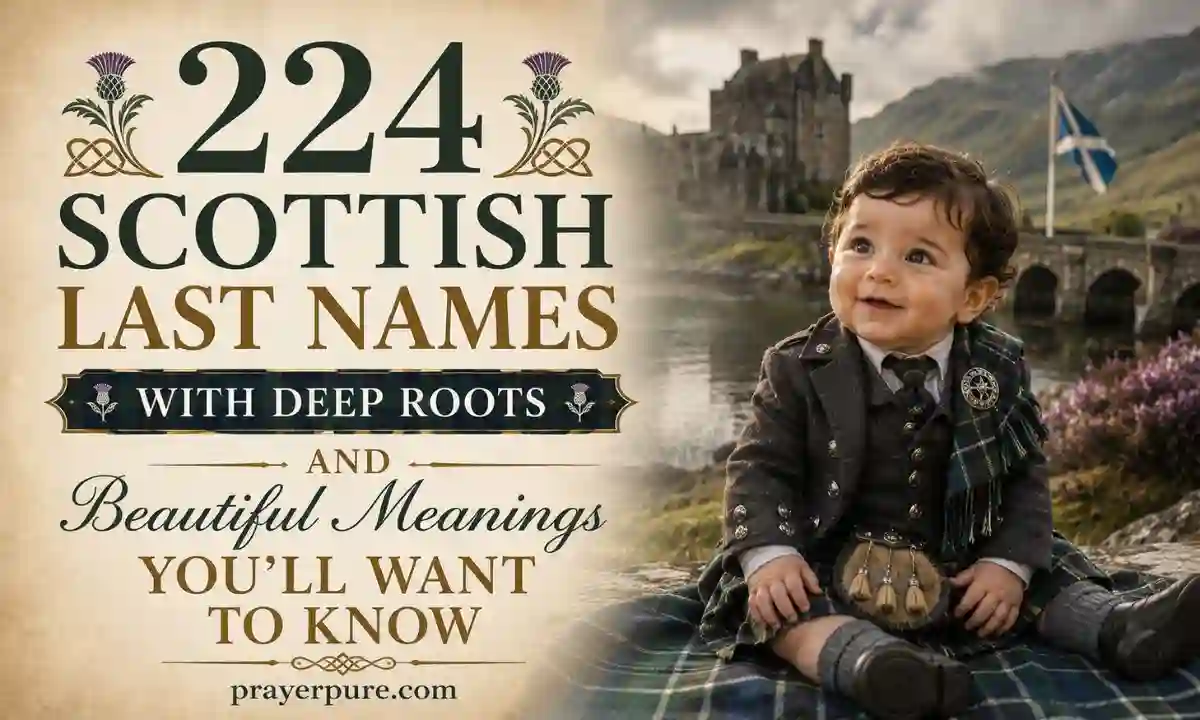
There is a particular quality to Scottish surnames that no other national naming tradition quite replicates. They arrive carrying the full weight of a landscape that has spent ten thousand years making people tough, beautiful, and permanently in argument with whoever is trying to govern them at any given moment. They carry the Gaelic of the Highlands, the Norse of the Western Isles, the Scots of the Lowlands, the Norman French of the medieval court, the Latin of the church, and occasionally the Pictish of a people so ancient that their language left almost no trace except in the stones they carved and the names they gave to rivers and hills that still bear those names today.
Scottish surnames are not simply labels. They are statements of origin so specific that they encode the precise hillside, the exact river valley, the particular clan allegiance, or the specific quality of character that an ancestor was known for so completely that the description became the identity. A MacDonald is quite literally a son of Donald, but more specifically a member of the most powerful clan in the Highlands whose history of dominance, conflict, and eventual dispossession is one of the central narratives of Scottish civilization. A Campbell is a crooked mouth or a person from a crooked field, but more significantly a member of the clan whose alliance with the British crown and whose role in the Massacre of Glencoe makes the name itself a provocation in certain Highland communities three hundred years after the event.
This collection gives you 224 Scottish surnames organized by their linguistic origins and social worlds, from the great Highland clans to the Norse island communities to the Norman-influenced Lowland gentry to the occupational names that encode the working life of medieval Scotland in their syllables. Every name includes its linguistic root, its historical associations, and a note on the world it carries. Frequency data is based on Scottish census records and diaspora surname databases.
Quick Note on Frequency: Scottish surnames vary enormously in frequency. The most common appear hundreds of thousands of times across the Scottish diaspora. The rarest survive in single family lines. For character and research purposes, rarer surnames often carry the most specific regional and historical associations.
Table of Contents
- Great Highland Clan Names
- Norse and Island Names
- Lowland and Border Names
- Norman and Medieval Names
- Occupational Names
- Landscape and Nature Names
- Diminutive and Descriptive Names
- Religious and Ecclesiastical Names
- Rare and Beautiful Names
- Frequently Asked Questions
Great Highland Clan Names
MacDonald
- Origin: Scottish Gaelic
- Meaning: Son of Donald, son of the world-ruler
- Frequency: Very Common
The most numerous of all Scottish clans whose name derives from Domhnall, meaning ruler of the world, the MacDonalds were Lords of the Isles who controlled the entire western seaboard of Scotland from their base in the Inner Hebrides for nearly two centuries before their lordship was broken by the Scottish crown, and their name carries the weight of the most powerful Gaelic civilization that Scotland ever produced.
Campbell
- Origin: Scottish Gaelic
- Meaning: Crooked mouth or crooked field
- Frequency: Very Common
The name that provokes the most complex reactions in the Highland tradition, Cam Beul meaning crooked mouth or alternatively from the Latin campus bello, beautiful field, the Campbells of Argyll rose to become the most powerful clan in Scotland through a combination of alliance with the Scottish crown, strategic marriage, and the specific political skill of a family that understood when to be loyal to Edinburgh and when to be independent.
MacKenzie
- Origin: Scottish Gaelic
- Meaning: Son of Coinneach, son of the bright one
- Frequency: Common
The clan of Kintail whose chiefs held the earldom of Seaforth and whose name derives from Coinneach, the bright or handsome one, MacKenzie carrying both the Celtic brightness tradition and the specific authority of a clan whose territories in Wester Ross and Lewis made them one of the great northern Highland powers.
Fraser
- Origin: Old French
- Meaning: Strawberry, from Fresselière
- Frequency: Common
Named for the strawberry plant in one of Scotland’s most beloved ironies, the Norman family that became one of the most distinctively Highland clans carrying a French botanical surname, Fraser belonging to the clan of Lovat whose chief Simon Fraser was the last person to be beheaded on Tower Hill in 1747 for his support of the Jacobite cause.
Cameron
- Origin: Scottish Gaelic
- Meaning: Crooked nose
- Frequency: Common
Named for the crooked nose of a founding ancestor, Cameron carries the specific Scottish tradition of surnames that described a physical characteristic with complete directness, the Camerons of Lochiel being one of the most fiercely Jacobite of all Highland clans whose chief Gentle Lochiel brought his men out for Bonnie Prince Charlie in 1745 despite having serious doubts about the enterprise.
MacLeod
- Origin: Scottish Gaelic/Norse
- Meaning: Son of Leod, son of the ugly one
- Frequency: Common
Named for the Norse Ljótr meaning ugly, which was nonetheless given as a personal name in the Viking tradition where such names were considered protective, the MacLeods of Dunvegan have inhabited Dunvegan Castle on Skye for over eight hundred years, making it the longest continuously inhabited castle in Scotland and the MacLeods one of the oldest continuous family presences in British aristocratic history.
MacPherson
- Origin: Scottish Gaelic
- Meaning: Son of the parson, son of the priest
- Frequency: Common
Named for the parson or priest, MacPherson carries the ecclesiastical tradition in a Gaelic patronymic that reflects the specific practice of Highland communities in naming families after the local clergy, the MacPhersons of Cluny being one of the great Badenoch clans whose chief Cluny MacPherson hid Bonnie Prince Charlie in a cage of branches on the hillside above his own burned house after Culloden.
Grant
- Origin: Old French
- Meaning: Large, great
- Frequency: Common
Named for the Norman French descriptor of greatness or large stature, Grant is one of the Norman-origin surnames that became thoroughly Highland through the adoption and absorption into Gaelic culture, the Grants of Strathspey being one of the great clan families of the central Highlands whose territories along the River Spey included some of the finest whisky country in Scotland.
Ross
- Origin: Scottish Gaelic
- Meaning: Headland, promontory
- Frequency: Common
Named for the headland or promontory, Ross belongs both to the geographical naming tradition and to the clan whose earldom of Ross was one of the most contested titles in medieval Scotland, the Ross clan name also belonging to the peninsula of Easter Ross and the wider county of Ross-shire.
Munro
- Origin: Scottish Gaelic
- Meaning: From the mouth of the River Roe, in Ireland
- Frequency: Common
Named for the mouth of the Roe river in Ulster, the Munros are one of the few Scottish clans who trace their origin to Ireland through a specific geographical location rather than a mythological ancestor, and their name is also given to the category of Scottish mountains over three thousand feet, a Munro being a peak of specific required altitude.
Sutherland
- Origin: Old Norse
- Meaning: Southern land
- Frequency: Common
Named for the southern land from the perspective of the Norse settlers of Orkney for whom the Scottish mainland to their south was simply the land further south, Sutherland carries the geographical paradox of a name that means south but designates one of Scotland’s most northerly counties and clans.
Mackay
- Origin: Scottish Gaelic
- Meaning: Son of Aodh, son of fire
- Frequency: Common
Named for the son of Aodh, the fire deity of the Gaelic world, Mackay belongs to the clan of the far north whose territory of Strathnaver and Caithness made them the northernmost of the Highland clans and whose dispossession during the Highland Clearances of the early 19th century was one of the most brutal and most documented of all the clearance events.
Gunn
- Origin: Old Norse
- Meaning: War, battle
- Frequency: Common
Named for the Old Norse word for battle or war, Gunn belongs to the clan of the far north whose Norse origin reflects the Viking settlement of Caithness and Sutherland and whose tradition holds them to be descended from the Norse jarl of Orkney, giving them a lineage from the Viking world that most Highland clans claim only through distant connections.
Sinclair
- Origin: Norman French
- Meaning: From Saint-Clair, holy light
- Frequency: Common
Named for the Norman village of Saint-Clair, the Sinclairs of Scotland built Rosslyn Chapel with its extraordinary stone carvings, became hereditary Lord High Admirals of Scotland, and became the subject of an extraordinary conspiracy mythology that connects them to the Knights Templar, the Holy Grail, and the construction of a building whose purpose and symbolism remain genuinely disputed.
Gordon
- Origin: Scottish Gaelic
- Meaning: Great hill, spacious fort
- Frequency: Common
Named for a place in Berwickshire meaning great hill or spacious fort, the Gordons became one of the great northeast Highland families whose power in Aberdeenshire and Strathbogie made them the premier Catholic noble family in Scotland through the Reformation period and whose Chief was known as the Cock of the North.
Murray
- Origin: Scottish Gaelic/Pictish
- Meaning: From Moray, sea settlement
- Frequency: Very Common
Named for the ancient province of Moray whose name means sea settlement, the Murrays became one of the most widely distributed of Scottish surnames through the enormous fertility of the Murray family tree and the specific practice of Murray lords taking multiple wives and producing descendants who spread across the entire country.
Stewart
- Origin: Old English
- Meaning: Steward, household guardian
- Frequency: Very Common
The royal house that gave Scotland its monarchy and then Britain the Stuart succession, the name derives from the office of High Steward of Scotland which was hereditary in the family before they became kings, Stewart or Stuart carrying both the administrative tradition of the steward’s role and the dynastic weight of the family that gave Scotland four centuries of royal governance and Britain three before the line ended.
Hamilton
- Origin: Old English
- Meaning: Flat-topped hill settlement
- Frequency: Very Common
Named for the flat-topped hill settlement in Leicestershire where the English branch of the family originated, the Hamiltons became one of the most powerful Lowland families in Scotland whose claim to the Scottish throne through descent from James II made them perpetually relevant to the succession question and perpetually involved in the political struggles that defined Scottish politics in the 16th and 17th centuries.
Douglas
- Origin: Scottish Gaelic
- Meaning: Black water, dark stream
- Frequency: Common
Named for the dark water of a stream in Lanarkshire, the Douglas family produced the Good Sir James who carried Robert Bruce’s heart toward the Holy Land and who was the most feared military commander of his generation, the Black Douglases and then the Red Douglases making the Douglas name synonymous with a level of power that periodically threatened to make them more powerful than the Scottish crown itself.
Bruce
- Origin: Old French/Norman
- Meaning: From Brix, from the brushwood thicket
- Frequency: Common
Named for the Norman village of Brix near Cherbourg, the Bruce family gave Scotland its greatest medieval king in Robert the Bruce who won at Bannockburn in 1314 and secured Scottish independence through a military genius and a personal determination that made him the template for every subsequent Scottish national mythology.
Norse and Island Names
MacAulay
- Origin: Scottish Gaelic/Norse
- Meaning: Son of Olaf, son of the ancestor’s relic
- Frequency: Common
Named for the Norse personal name Óláfr meaning ancestor’s relic, MacAulay belongs to the Western Isles tradition where the Norse settlement of the Hebrides left its mark most completely on the personal names that were Gaelicized into Mac-patronymics, the MacAulays of Lewis being one of the families whose DNA evidence suggests continuous settlement from the Norse period.
Nicolson
- Origin: Norse/English
- Meaning: Son of Nicholas, son of the victorious people
- Frequency: Common
Named for Nicholas in its Norse-influenced form, Nicolson carries the Western Isles naming tradition where Norse given names were converted into patronymics, the Nicolsons being a Skye family whose chief held the hereditary sheriffship of Skye for many generations.
Magnusson
- Origin: Old Norse
- Meaning: Son of Magnus, son of the great one
- Frequency: Uncommon
Named for Magnus, the great Norwegian king who gave his name to Magnus Bareleg and whose Gaelic lands treaty of 1098 established the extent of Norwegian claims to the Scottish islands, Magnusson carries the Norse royal tradition in a form of pure patronymic construction that survived in the island communities longer than anywhere else in mainland Scotland.
Lamont
- Origin: Old Norse
- Meaning: Lawman, judge
- Frequency: Uncommon
Named for the Old Norse LÖGMAÐR meaning lawman or judge, Lamont carries the Norse legal tradition in a surname that reflects the importance of the Norse law courts in the Hebridean communities where the thing, the Norse assembly, was the primary instrument of governance for several centuries.
Linklater
- Origin: Old Norse
- Meaning: Heather slope, heathery hillside
- Frequency: Uncommon
Named for the heather slope in the Norse-Scots compound naming tradition of Orkney, Linklater carries the Orcadian landscape in a form that is simultaneously Norse in its first element, LING for heather, and Norse in its second element, ATRE for slope or hillside, belonging entirely to the Norse naming tradition of the Northern Isles.
Clouston
- Origin: Old Norse/Scots
- Meaning: Clod’s farmstead, clay settlement
- Frequency: Very Rare
Named for the clay farmstead in the Orcadian naming tradition, Clouston belongs to the category of Orkney surnames that combine a Norse personal name with the STON farmstead element, creating compound place-name surnames of very specific Orcadian geographical association.
Flett
- Origin: Old Norse
- Meaning: Inner room, hall, flat land
- Frequency: Uncommon
Named for the inner room or hall of a Norse longhouse, or alternatively for flat land, Flett belongs to the Orcadian naming tradition of surnames derived from Norse household or geographical terms that reflect the specific domestic and landscape vocabulary of the Norse settler community.
Rendall
- Origin: Old Norse
- Meaning: From Rognvald’s dale, Rognvald’s valley
- Frequency: Very Rare
Named for the valley of Rognvald, the great Norse earl of Orkney who built St. Magnus Cathedral in Kirkwall and was later canonized, Rendall carries the Orcadian hagiographic and geographical tradition in a surname of considerable historical specificity.
Tulloch
- Origin: Scottish Gaelic
- Meaning: Small hill, mound
- Frequency: Uncommon
Named for the small hill or mound in the Scottish Gaelic naming tradition, Tulloch carries the landscape tradition in a surname that belongs to the meeting point of the Gaelic and Norse naming worlds, the tulaich being the Gaelic small hill that appears in place names across both Gaelic and Norse-influenced Scotland.
Manson
- Origin: Old Norse/English
- Meaning: Son of Magnus, son of the great one
- Frequency: Uncommon
Named for Magnus in its anglicized form, Manson carries the Norse royal tradition in a form that has been translated through the English patronymic SON suffix rather than the Gaelic MAC prefix, reflecting the mixed linguistic heritage of communities where Norse and English naming conventions coexisted.
Isbister
- Origin: Old Norse
- Meaning: Eastern farmstead, east farm
- Frequency: Very Rare
Named for the eastern farmstead in the Orcadian Norse naming tradition, Isbister belongs to the specifically Orkney category of place-name surnames that describe a farm’s position relative to the cardinal directions, the IST element deriving from the Norse austr, east, and BISTER from bolstaðr, farmstead.
Heddle
- Origin: Old Norse
- Meaning: High dale, high valley
- Frequency: Very Rare
Named for the high valley in the Norse-Orcadian naming tradition, Heddle carries the Norse landscape vocabulary in a form of considerable rarity that belongs almost exclusively to the Orkney community, reflecting the specific Norse geographical terminology that was used to describe the distinctive landscape of these northern islands.
Grieve
- Origin: Old Norse/Scots
- Meaning: Farm manager, reeve
- Frequency: Uncommon
Named for the grieve or farm manager who oversaw agricultural operations on a Scottish estate, Grieve carries both the Norse root and the Scots usage of a term that was among the most important supervisory positions in the Scottish agricultural tradition.
Scarth
- Origin: Old Norse
- Meaning: Steep slope, cliff
- Frequency: Very Rare
Named for the steep slope or cliff in the Norse landscape vocabulary, Scarth belongs to the Orcadian and Shetlandic naming tradition of surnames derived from the most dramatic features of an island landscape where the meeting of land and sea produced exactly the kind of scarth that the Norse word described.
Inkster
- Origin: Old Norse
- Meaning: Ing’s farmstead, meadow farm
- Frequency: Very Rare
Named for the meadow farmstead in the Norse-Orcadian compound naming tradition, Inkster belongs to the specifically Orkney category of surnames that use the STER ending, a local variant of the Norse bolstaðr farmstead, to create place-name surnames of extraordinary geographical specificity.
Lowland and Border Names
Scott
- Origin: Old English/Latin
- Meaning: A Scotsman, from Scotland
- Frequency: Very Common
The name that means a Scotsman was originally used by English speakers to refer to the people of Scotland, the Scots themselves eventually adopting it as a family name in the Border region where proximity to England made national identity a more consciously held quality than it was in the heart of the country, the Scotts of Buccleuch becoming one of the great Border families.
Armstrong
- Origin: Old English
- Meaning: Strong arm, powerful arm
- Frequency: Common
Named for the strong arm, Armstrong belongs to the Border reiving tradition of families who maintained their position through physical capability, the Armstrongs being the largest and most feared of the Border reiving clans whose territory in Liddesdale made them simultaneously the scourge of both the English and Scottish borders.
Kerr
- Origin: Old Norse/Scots
- Meaning: Left-handed, from the marsh
- Frequency: Common
Named either for left-handedness or for the marsh, Kerr belongs to the Border tradition and was associated with the peculiarity of the Ker family who were notably left-handed, their spiral staircases reportedly winding opposite to the standard direction to give left-handed swordsmen the advantage.
Elliot
- Origin: Old French
- Meaning: From the family of Elias, God is my Lord
- Frequency: Common
Named through the French form of Elias, Elliot belongs to one of the most powerful Border reiving families whose territory in Liddesdale and Teviotdale made them central players in the three-hundred-year border conflict that is one of the most distinctive episodes in Scottish social history.
Johnston
- Origin: Old English
- Meaning: John’s settlement, John’s estate
- Frequency: Common
Named for John’s settlement, Johnston belongs to both the Border and Lowland Scottish naming traditions, being one of the great Border families whose rivalry with the Maxwells was conducted at a level of sustained violence that made their mutual antagonism one of the defining features of the southwestern border landscape for several generations.
Cunningham
- Origin: Scottish Gaelic/Old English
- Meaning: Village of the milk pail, dairy farm
- Frequency: Common
Named for the dairy farm district of Cunninghame in Ayrshire, Cunningham belongs to the Lowland naming tradition of surnames derived from the specific agricultural districts of southwest Scotland.
Crawford
- Origin: Old English
- Meaning: Ford of the crows, crow ford
- Frequency: Common
Named for the ford where crows gathered, Crawford belongs to the Lowland Scottish naming tradition that encoded specific landscape features with the precision of people who navigated their world on foot and needed to know exactly which ford was which at every river crossing.
Maxwell
- Origin: Old English
- Meaning: Mack’s well, Magnus’s well
- Frequency: Common
Named for the well of Mack or Magnus, Maxwell belongs to the Border tradition and was one of the great Border families whose rivalry with the Johnstons was conducted over generations with a persistence that eventually destroyed both families’ capacity for the independent power they had been contesting.
Boyd
- Origin: Scottish Gaelic
- Meaning: Yellow, from Bute
- Frequency: Common
Named for the color yellow or for the island of Bute, Boyd belongs to the Ayrshire and southwestern Scottish tradition, the Boyd family having been closely associated with the Stewart family through the position of royal tutor and having eventually married into the royal succession before the connection became politically dangerous.
Montgomerie
- Origin: Norman French
- Meaning: From Montgomerie, Gomerics mountain
- Frequency: Common
Named for the Norman place in Calvados, Montgomerie belongs to the Norman-Scottish tradition of families who arrived with the Norman influence on the Scottish court and became thoroughly Scottish while retaining their French place-name surnames, the Montgomeries becoming Earls of Eglinton and one of the great Ayrshire families.
Fleming
- Origin: Middle English
- Meaning: From Flanders, Flemish person
- Frequency: Common
Named for the immigrant from Flanders whose weaving expertise was valued across medieval Scotland, Fleming belongs to the tradition of ethnic identity surnames that encoded the foreign origin of families who arrived in Scotland as skilled craftsmen or merchants and whose Flemish identity became their family name.
Paterson
- Origin: Old English
- Meaning: Son of Patrick, Patrick’s son
- Frequency: Very Common
Named for Patrick, the Celtic patron saint of Ireland whose veneration spread throughout the Celtic world including Scotland, Paterson carries the patronymic tradition in a form that is among the most common of all Scottish surnames.
Thomson
- Origin: Old English
- Meaning: Son of Thomas, Thomas’s son
- Frequency: Very Common
Named for Thomas in the English patronymic tradition, Thomson is one of the most common Scottish surnames whose distribution reflects the enormous popularity of the name Thomas in the medieval Scottish Catholic tradition.
Wilson
- Origin: Old English
- Meaning: Son of Will, William’s son
- Frequency: Very Common
Named for William in the English patronymic tradition, Wilson is among the most common Scottish surnames and reflects the English naming influence on the Lowland Scottish tradition where the SON suffix replaced the MAC prefix of the Highland tradition.
Robertson
- Origin: Old English
- Meaning: Son of Robert, Robert’s son
- Frequency: Very Common
Named for Robert in the English patronymic tradition, Robertson is one of the most common Scottish surnames, the name Robert having been enormously popular in Scotland following the reign of Robert the Bruce and appearing in the patronymic chain as both Robertson in the Lowland form and MacRobert in the Gaelic form.
Anderson
- Origin: Old English
- Meaning: Son of Andrew, Andrew’s son
- Frequency: Very Common
Named for Andrew, the patron saint of Scotland whose saltire cross appears on the Scottish flag and whose apostolic tradition was particularly venerated in the Scottish church, Anderson carries the patronymic of the saint who replaced the earlier Scottish patron Columba as the primary national intercessor.
Reid
- Origin: Old English/Scottish
- Meaning: Red-haired, ruddy
- Frequency: Very Common
Named for the red-haired or ruddy complexioned ancestor in the Scottish descriptive naming tradition, Reid belongs to the Lowland Scottish naming culture that was considerably more willing than the Highland tradition to preserve physical descriptions as permanent family identities.
Young
- Origin: Old English
- Meaning: Young, the younger
- Frequency: Very Common
Named for the quality of youth, Young belongs to the tradition of descriptive surnames that distinguished between members of the same community by age or birth order, the Young of any settlement being distinguished from the Elder or the Old Man.
Brown
- Origin: Old English
- Meaning: Brown, dark complexioned
- Frequency: Very Common
Named for the brown complexion or brown hair of an ancestor, Brown is one of the most common surnames in both Scotland and England, the color description tradition being one of the most universal in British surname formation.
Norman and Medieval Names
Barclay
- Origin: Old English/Norman
- Meaning: Birch meadow, from Berkeley
- Frequency: Common
Named for the Berkeley estate in Gloucestershire where the Norman family originated, Barclay belongs to the tradition of Norman families whose English place names were carried to Scotland along the Norman migration route, the Barclays becoming one of the great northeast Scottish families with particular significance in the banking tradition.
Hay
- Origin: Old French/Norman
- Meaning: Hedge, enclosed land
- Frequency: Common
Named for the enclosed land or hedge, Hay belongs to the Norman-Scottish tradition and represents one of the oldest families in Scottish history, the legend of the Falcon of Hay explaining the origin of the family through the victory of a plowman named Hay against the Danes at the Battle of Luncarty in 976 CE.
Keith
- Origin: Scottish Gaelic
- Meaning: Wind, from Caith
- Frequency: Common
Named either from a Gaelic root meaning wind or from the place Caith in Caithness, Keith belongs to one of the oldest Scottish families whose hereditary role as Marischal of Scotland, keeper of the royal regalia, made them among the most important officers of the Scottish state from the 12th century onward.
Menzies
- Origin: Norman French
- Meaning: From Mesnieres, lordly estate
- Frequency: Common
Named for the Norman place Mesnieres, Menzies belongs to the Norman-Scottish tradition and has given Scotland the linguistic peculiarity of a name pronounced MING-iss despite its spelling, the Z in Menzies representing the old Scottish letter yogh which was transliterated as Z when typefaces arrived that lacked the original character.
Ramsay
- Origin: Old English/Norman
- Meaning: Ram’s island, raven’s island
- Frequency: Common
Named for the island of rams or ravens in the English place-name tradition, Ramsay belongs to the Norman-Scottish tradition and produced among other notable bearers Ramsay MacDonald, the first Labour Prime Minister of Britain.
Lindsay
- Origin: Old English/Norman
- Meaning: Lincoln’s wetland, linden tree wetland
- Frequency: Common
Named for the wetland of Lincoln or the linden trees, Lindsay belongs to the Norman-Scottish tradition and was one of the most powerful Lowland families whose romantic poet Sir David Lindsay wrote The Satyre of the Three Estates, one of the earliest and most important works of Scottish drama.
Ogilvie
- Origin: Scottish Gaelic/Pictish
- Meaning: High plain, high clearing
- Frequency: Common
Named for the high plain or clearing in the Pictish-Gaelic naming tradition, Ogilvie belongs to one of the oldest Scottish families whose antiquity is reflected in a surname that predates the Norman influence and derives from the Pictish-Gaelic landscape vocabulary of the pre-medieval period.
Erskine
- Origin: Scottish Gaelic/Pictish
- Meaning: From Erskine, green ascent
- Frequency: Uncommon
Named for the Renfrewshire place meaning green ascent, Erskine belongs to one of the great Scottish noble families whose hereditary role as hereditary Earls of Mar connected them to one of the most important earldoms in Scottish history.
Melville
- Origin: Norman French
- Meaning: From Melleville, bad settlement
- Frequency: Uncommon
Named for the Norman place meaning bad settlement in a characteristic Norman place-name irony, Melville belongs to the Scottish-Norman tradition and produced Andrew Melville, the Presbyterian reformer who told James VI that the king was God’s sillie vassal in a confrontation that defined the relationship between church and crown in Scotland for a generation.
Oliphant
- Origin: Old French
- Meaning: Elephant, ivory horn
- Frequency: Very Rare
Named for the elephant or ivory horn in one of Scotland’s most unlikely surnames, Oliphant belongs to the Norman-Scottish tradition where heraldic devices could generate family names, the Oliphant family having used the elephant in their heraldry and eventually taking the heraldic creature as their surname.
Scrymgeour
- Origin: Old French/Middle English
- Meaning: Fencer, sword fighter
- Frequency: Very Rare
Named for the fencer or sword fighter, Scrymgeour belongs to the hereditary office tradition of Scottish naming where the Scrymgeours held the hereditary position of Royal Standard Bearer of Scotland, a role that dated from the time of Alexander III and that made the survival of the family name synonymous with the survival of the specific royal honor.
Falconer
- Origin: Old French/Middle English
- Meaning: Falconer, keeper of falcons
- Frequency: Uncommon
Named for the keeper of falcons, Falconer belongs to the royal household tradition of Scottish surname formation where the specialists who maintained the royal falcons were known by their function and eventually took that function as their family name.
Bannerman
- Origin: Old French/Middle English
- Meaning: Bearer of the banner, standard bearer
- Frequency: Uncommon
Named for the bearer of the battle standard, Bannerman belongs to the hereditary office tradition and carries the specific dignity of a role that placed its bearer in the most conspicuous and most dangerous position on any battlefield, the standard bearer being simultaneously the most visible target and the most symbolically important person in any military formation.
Spens
- Origin: Old French
- Meaning: Dispenser, keeper of the larder
- Frequency: Very Rare
Named for the keeper of the larder or the dispenser of provisions, Spens belongs to the household office tradition in a form of considerable rarity, the Spencer and Spens surnames deriving from the same Old French source but Spens being the specifically Scottish form of a surname that was common across medieval Britain.
Anstruther
- Origin: Scottish Gaelic
- Meaning: The little stream, the rivulet
- Frequency: Very Rare
Named for the Fife coastal town whose name derives from the Gaelic for small stream, Anstruther belongs to the Fife gentry tradition and was the name of an ancient family whose members included a diplomat who negotiated with James VI for the return of the witchcraft prisoners.
Occupational Names
Smith
- Origin: Old English
- Meaning: Blacksmith, metalworker
- Frequency: Very Common
The most universal of all occupational surnames exists in Scotland in its simplest English form, Smith carrying the metalworking tradition in the Lowland communities while the Gaelic equivalent Mac Gobha or Gow carried the same meaning in the Highland communities.
Fletcher
- Origin: Old French
- Meaning: Arrow maker, fletcher
- Frequency: Common
Named for the arrow maker whose craft was among the most important military support occupations of the medieval period, Fletcher carries the bow-and-arrow warfare tradition in a surname that reflects the specific importance of the skilled fletcher in a Scottish military tradition that relied heavily on the longbow.
Mason
- Origin: Old French
- Meaning: Stone mason, builder in stone
- Frequency: Common
Named for the stone mason whose craft built the cathedrals, castles, and market crosses of medieval Scotland, Mason carries the building tradition in a surname that is simultaneously an occupational designation and a craft description.
Taylor
- Origin: Old French
- Meaning: Tailor, one who cuts cloth
- Frequency: Very Common
Named for the tailor whose craft clothed the Scottish population from the nobility to the peasantry, Taylor carries the clothing trade tradition in one of the most common Scottish surnames whose distribution reflects the fundamental importance of the tailor’s craft in every community.
Wright
- Origin: Old English
- Meaning: Craftsman, maker
- Frequency: Common
Named for the craftsman or maker, Wright carries the craft tradition in a more general form than most occupational surnames, the wright being specifically a worker in wood but the term extending to any skilled craftsman, its Scottish distribution reflecting the importance of craft skills in the medieval Scottish economy.
Walker
- Origin: Old English
- Meaning: Cloth fuller, one who walks on cloth
- Frequency: Common
Named for the cloth fuller who cleaned and thickened wool by treading on it, Walker carries the textile tradition in a surname whose origin is less immediately obvious than most, the walker of cloth being a specialist in the finishing process of woolen textile production that was one of the most important industries in medieval Scotland.
Baxter
- Origin: Old English
- Meaning: Baker
- Frequency: Common
Named for the baker, Baxter is the specifically Scottish and northern English form of the baker surname, its BaX construction reflecting a dialectal variation from the standard English Baker that marks it as a specifically northern British occupational name.
Brewer
- Origin: Old English
- Meaning: One who brews ale or beer
- Frequency: Common
Named for the brewer of ale, Brewer carries the fermentation tradition in a surname that reflects the fundamental importance of ale production in communities where water was often unsafe to drink and where the ale-wife or brewer was among the most important figures in any settlement’s food production chain.
Weaver
- Origin: Old English
- Meaning: One who weaves cloth
- Frequency: Common
Named for the weaver of cloth, Weaver carries the textile tradition in a surname that reflects the fundamental importance of fabric production in a society where all clothing was hand-produced and where the skilled weaver was a figure of considerable economic importance.
Skinner
- Origin: Old English
- Meaning: One who skins animals, furrier
- Frequency: Common
Named for the skinner of animals, Skinner carries the hide and leather trade tradition in a surname that reflects the importance of animal products in the Scottish economy and the specific guild of skinners who processed the hides that provided leather for boots, belts, bags, and armor.
Slater
- Origin: Old English
- Meaning: Roofer, one who lays slate
- Frequency: Common
Named for the roofer who laid the grey slate that is one of the most characteristic materials of Scottish building tradition, Slater carries the construction trade in a surname that is particularly associated with the slate-producing regions of the Scottish Highlands.
Millar
- Origin: Old English
- Meaning: Miller, grain grinder
- Frequency: Common
Named for the miller, Millar is the specifically Scottish spelling of the Miller surname, the double-L variant reflecting a Scottish orthographic preference that distinguished the Scottish form from the English, the miller being one of the most important and most socially ambiguous figures in any agricultural community.
Cooper
- Origin: Old English
- Meaning: Barrel maker, cooper
- Frequency: Common
Named for the barrel maker, Cooper carries the coopering tradition in a surname that reflects the enormous importance of barrel and container production in a Scottish economy built heavily on the export of grain, fish, and eventually whisky in wooden casks.
Hunter
- Origin: Old English
- Meaning: One who hunts
- Frequency: Common
Named for the hunter, Hunter carries both the occupational tradition of the professional hunter who supplied venison and game birds to the aristocracy and the broader tradition of hunting as a defining Scottish cultural practice across every social level.
Forrest
- Origin: Old French
- Meaning: Forest, forester, one who lives near the forest
- Frequency: Common
Named for the forest or the forester, Forrest carries the woodland tradition in a surname that is both a landscape designation and an occupational one, the forester being the guardian of the royal and noble forests whose role was simultaneously practical and legal.
Landscape and Nature Names
Glen
- Origin: Scottish Gaelic
- Meaning: Valley, narrow mountain valley
- Frequency: Common
Named for the distinctive Scottish landscape feature of the narrow mountain valley, Glen carries the Gaelic geographic vocabulary in its most compressed and most evocative form, belonging to a naming tradition that understood specific landscape features as the most reliable means of distinguishing one family from another.
Craig
- Origin: Scottish Gaelic
- Meaning: Rocky crag, cliff
- Frequency: Common
Named for the rocky crag or cliff, Craig carries the Scottish Highland landscape tradition in a surname of considerable phonetic force, the hard GR opening and the ending G giving it the quality of the geological feature it describes.
Muir
- Origin: Scottish
- Meaning: Moor, heath
- Frequency: Common
Named for the moor or heath, Muir carries the open heathland tradition of the Scottish landscape in a single syllable of considerable atmospheric power, belonging to the tradition of Scottish surnames that encode the most characteristic features of the national landscape in their simplest possible form.
Burn
- Origin: Old English/Scots
- Meaning: Stream, brook
- Frequency: Common
Named for the burn or stream, the Scots word for the small watercourses that define the Scottish landscape, Burn carries the hydrological naming tradition in its most direct and most specifically Scottish form, the burn being as characteristically Scottish a landscape feature as the loch or the glen.
Shaw
- Origin: Old English
- Meaning: Small wood, thicket
- Frequency: Common
Named for the small wood or thicket, Shaw carries the woodland naming tradition in a surname that reflects the importance of the shaw as a specific type of small woodland feature in the Scottish agricultural landscape.
Wood
- Origin: Old English
- Meaning: Forest, wood
- Frequency: Common
Named for the wood or forest, Wood carries the woodland tradition in its simplest and most direct English form, belonging to the Lowland Scottish naming tradition where Old English landscape vocabulary was used rather than the Gaelic equivalents that the Highland tradition employed.
Hill
- Origin: Old English
- Meaning: Hill, elevation
- Frequency: Common
Named for the hill in the most direct possible form, Hill carries the topographic naming tradition in a single syllable of complete landscape simplicity.
Moor
- Origin: Old English
- Meaning: Moor, marshy ground
- Frequency: Common
Named for the moorland or marshy ground, Moor carries the open wetland tradition in a surname that is closely related to Muir while using the English rather than the Scots form of the same word.
Cairns
- Origin: Scottish Gaelic
- Meaning: Cairn, pile of stones
- Frequency: Common
Named for the cairn, the pile of stones that marked summits, boundaries, and graves across the Scottish landscape, Cairns carries the lithic naming tradition in a surname that connects its bearers to the most ancient form of human landscape marking available in the Scottish tradition.
Burn
- Origin: Scots
- Meaning: Stream
- Frequency: Common
Named for the stream that runs through every Scottish glen and farm, Burn belongs to the specifically Scottish vocabulary of landscape in a word that distinguishes Scottish English from the English of the south and carries the running-water tradition.
Strang
- Origin: Old Norse/Scots
- Meaning: Strong, powerful
- Frequency: Uncommon
Named for the quality of strength in the Norse and Scots tradition, Strang carries the descriptive naming tradition in a form that uses the Scots variant of the adjective strong, belonging to the Border and Lowland Scottish naming culture.
Brae
- Origin: Scottish Gaelic/Scots
- Meaning: Hillside, slope
- Frequency: Very Rare
Named for the brae, the hillside or slope that is one of the most characteristic features of the Scottish landscape vocabulary, Brae carries the specifically Scottish landscape tradition in a surname of extraordinary simplicity and considerable atmospheric evocativeness.
Loch
- Origin: Scottish Gaelic
- Meaning: Lake, sea loch
- Frequency: Very Rare
Named for the loch, the lake that defines the Scottish landscape from the Lowland fishing lochs to the great Highland water bodies, Loch carries the most distinctively Scottish of all landscape words as a surname in a form of extraordinary directness.
Glen
- Origin: Scottish Gaelic
- Meaning: Valley
- Frequency: Common
The glen name in its simplest standalone form carries the Gaelic valley tradition as a surname, belonging to a tradition of landscape naming so fundamental that the glen is simply the place rather than a description of it.
Diminutive and Descriptive Names
Begg
- Origin: Scottish Gaelic
- Meaning: Small, little
- Frequency: Uncommon
Named for smallness, beag in Scottish Gaelic, Begg belongs to the descriptive naming tradition where physical characteristics were encoded permanently in family names, the small Begg being distinguished from the large Mor in a community where size was a reliable means of identification.
Mor
- Origin: Scottish Gaelic
- Meaning: Big, large, great
- Frequency: Uncommon
Named for the quality of bigness or greatness, Mor carries the Gaelic descriptive tradition in a name that was applied both to large physical stature and to great personal significance, the Gaelic word mòr carrying both dimensions simultaneously.
Glas
- Origin: Scottish Gaelic
- Meaning: Green-grey, grey-green
- Frequency: Very Rare
Named for the grey-green color that is one of the most characteristic qualities of the Scottish landscape in its most waterlogged and misty conditions, Glas carries the color tradition in a form that is specifically Gaelic in its designation of the complex grey-green that English approximates with the word glassy.
Bain
- Origin: Scottish Gaelic
- Meaning: Fair-haired, white, pale
- Frequency: Common
Named for the fair-haired or pale complexion, Bain carries the Celtic color-description tradition in a surname that reflects the physical characteristic of light coloring in a population where it was notable enough to be worth recording in a family name.
Duff
- Origin: Scottish Gaelic
- Meaning: Black, dark-complexioned
- Frequency: Common
Named for the black or dark complexion in the Gaelic descriptive tradition, Duff carries the opposite of Bain in the same naming system, the dark Duff being distinguished from the fair Bain in communities where complexion was one of the reliable markers of individual identity.
Gorm
- Origin: Scottish Gaelic
- Meaning: Blue, blue-green, dark blue
- Frequency: Very Rare
Named for the blue or blue-green color in the Gaelic tradition where gorm describes the specific blue of the Highland sky, the deep blue of the sea, and the blue-black of raven-wing hair, Gorm carrying the complex Gaelic color tradition in its most atmospheric form.
Ruadh
- Origin: Scottish Gaelic
- Meaning: Red, red-haired
- Frequency: Very Rare
Named for the red-haired or red complexion in the Gaelic tradition, Ruadh carries the red tradition that produced Roy and Reid in anglicized forms and that reflects the notable frequency of red hair in the Scottish population as a distinctive physical characteristic.
Ban
- Origin: Scottish Gaelic
- Meaning: White, fair, pale
- Frequency: Very Rare
Named for the quality of whiteness or fairness, Ban carries the Gaelic color tradition in a form closely related to Bain and belonging to the same descriptive naming system that used color vocabulary to distinguish members of the same community.
Mhor
- Origin: Scottish Gaelic
- Meaning: Great, large, the great one
- Frequency: Very Rare
A variant form of Mor that carries the same greatness tradition in a slightly different orthographic form, Mhor belonging to the Highland naming tradition of descriptive bynames that became permanent family identities.
Calder
- Origin: Scottish Gaelic
- Meaning: Hard water, rough stream
- Frequency: Common
Named for the hard water or rough stream, Calder carries the hydrological tradition in a compound of Gaelic words that describes the quality of the water rather than simply its presence, belonging to a naming culture that made fine distinctions between different types of watercourses.
Religious and Ecclesiastical Names
Abbot
- Origin: Old English
- Meaning: Father, head of a monastery
- Frequency: Uncommon
Named for the father or head of a monastery, Abbot belongs to the ecclesiastical naming tradition that produced surnames from the titles of church officials, the Scottish church’s monastery system having been one of the primary engines of literacy, agriculture, and cultural preservation in medieval Scotland.
Deacon
- Origin: Greek/Old English
- Meaning: Servant, church deacon
- Frequency: Uncommon
Named for the church deacon whose role was the most junior of the clerical orders, Deacon carries the ecclesiastical tradition in a form that reflects the Scottish church’s extensive presence in every community.
Bishop
- Origin: Old English
- Meaning: Overseer, church bishop
- Frequency: Uncommon
Named for the bishop whose oversight of the Scottish church extended from the great cathedrals of St. Andrews, Glasgow, and Aberdeen to the remotest parish, Bishop carries the ecclesiastical hierarchy in a surname that reflects the organizational structure of the medieval Scottish church.
Kirk
- Origin: Old Norse/Scots
- Meaning: Church
- Frequency: Common
Named for the church in the specifically Scottish and Norse form of the word, Kirk belongs to the tradition of surnames derived from proximity to or association with the local church, the Scots word kirk being one of the most distinctive elements of the Scottish religious vocabulary.
Kirkwood
- Origin: Scots/Old English
- Meaning: Church wood, wood near the church
- Frequency: Common
Named for the wood near the church, Kirkwood carries both the ecclesiastical and the landscape traditions in a compound that reflects the common Scottish situation of churchyards and church buildings surrounded by ancient woodland whose sacred character predated the Christian building.
Cross
- Origin: Old English
- Meaning: Cross, near the cross
- Frequency: Common
Named for the cross, either the Christian symbol or the market cross that was the center of every Scottish burgh’s commercial life, Cross carries the religious and civic traditions simultaneously in a surname that reflects both sacred and secular landscape features.
Temple
- Origin: Old English
- Meaning: Temple, the Knights Templar
- Frequency: Uncommon
Named for the temple or more specifically for the preceptories of the Knights Templar that were established across Scotland from the 12th century onward, Temple carries the crusading military order tradition in a surname of considerable historical specificity.
Monk
- Origin: Old English
- Meaning: Monk, member of a religious order
- Frequency: Uncommon
Named for the monk whose presence in Scottish communities was associated with the great abbeys of Melrose, Dryburgh, Jedburgh, and Kelso, Monk carries the monastic tradition in a surname that reflects the central importance of the religious orders in medieval Scottish cultural and economic life.
Prior
- Origin: Latin/Old French
- Meaning: Prior, head of a priory
- Frequency: Uncommon
Named for the prior who headed a priory rather than a full abbey, Prior carries the ecclesiastical administrative tradition in a surname that reflects the numerous priories that dotted the Scottish landscape and whose officials sometimes gave their titles to local families.
Pope
- Origin: Old English
- Meaning: Pope, father
- Frequency: Uncommon
Named for the pope or father in the ecclesiastical title tradition, Pope carries the supreme ecclesiastical dignity in a surname that was applied either to someone who worked in a church in a senior capacity or occasionally to someone of pompous or lordly demeanor who was thought to give himself papal airs.
Rare and Extraordinary Names
Dunbar
- Origin: Scottish Gaelic
- Meaning: Fort on the point, summit fortress
- Frequency: Uncommon
Named for the summit fortress on the headland of East Lothian, Dunbar carries the archaeological naming tradition of a surname derived from the remains of an ancient fortification, the Dunbar earldom being one of the most important in early medieval Scotland.
Ruthven
- Origin: Scottish Gaelic
- Meaning: Red river, ruddy ford
- Frequency: Very Rare
Named for the red river in the Gaelic tradition, Ruthven carries the hydrological color-naming tradition in a surname of extraordinary atmospheric quality that was borne by one of the most turbulent families in Scottish history, the Ruthvens who were involved in the murder of Rizzio, the Raid of Ruthven, and the Gowrie Conspiracy.
Elphinstone
- Origin: Old English/Scottish
- Meaning: Elfin stone, elf’s stone
- Frequency: Very Rare
Named for the elf stone in the pre-Christian landscape naming tradition, Elphinstone carries the fairy-world dimension of the Scottish landscape mythology in a surname of extraordinary rarity and considerable historical weight, the Elphinstone family having produced Bishop William Elphinstone who founded Aberdeen University in 1495.
Wedderburn
- Origin: Old English/Scots
- Meaning: Wether burn, castrated sheep stream
- Frequency: Very Rare
Named for the stream of the wethers, the castrated male sheep, Wedderburn carries the pastoral agricultural tradition in a compound of considerable specificity that reflects the importance of sheep farming in the Berwickshire landscape where the name originated.
Kinninmonth
- Origin: Scottish Gaelic
- Meaning: Head of the smooth hillock
- Frequency: Very Rare
Named for the summit of the smooth hill in the Gaelic topographical tradition, Kinninmonth carries the landscape naming vocabulary in a compound of extraordinary phonetic specificity that belongs to the Fife and Angus tradition of Gaelic place-name surnames.
Fotheringhame
- Origin: Old English/Scottish
- Meaning: Fodder estate, feeding ground
- Frequency: Very Rare
Named for the fodder estate or feeding ground in the Old English agricultural naming tradition, Fotheringhame carries the livestock management tradition in a surname of extraordinary length and complexity that belongs to the specifically Scottish aristocratic tradition of elongated place-name surnames.
Colquhoun
- Origin: Scottish Gaelic
- Meaning: Narrow corner, angle land
- Frequency: Uncommon
Named for the narrow corner of land in the Gaelic topographical tradition and pronounced approximately Cohoon in the specific Scottish phonetic convention that produces enormous discrepancies between spelling and sound, Colquhoun belongs to the Loch Lomond tradition and carries the surname of one of Scotland’s most dramatic clan feuds, the Battle of Glen Fruin in 1603 between the Colquhouns and MacGregors.
Makgill
- Origin: Scottish Gaelic
- Meaning: Son of the stranger, son of the foreigner
- Frequency: Very Rare
Named for the son of the stranger or foreigner, Makgill belongs to the tradition of Gaelic names that recorded the foreign origin of an ancestor as the family’s primary means of self-identification, the stranger who arrived and stayed long enough to found a family line becoming permanently commemorated in the MAC GALL construction.
Tullibardine
- Origin: Scottish Gaelic
- Meaning: Hill of the bards, poet hill
- Frequency: Very Rare
Named for the hill of the bards or poets in the Gaelic tradition where the bardic class were custodians of genealogy, history, and the oral literature that preserved the clan tradition, Tullibardine carries the scholarly and literary tradition of the Gaelic learned class in a topographical surname.
Abernethy
- Origin: Scottish Gaelic
- Meaning: Mouth of the Nethy river
- Frequency: Uncommon
Named for the confluence of the Nethy river with the Spey, Abernethy belongs to the ABER compound tradition of Scottish place names that indicates a river mouth or confluence, the Pictish and Gaelic ABER being one of the most distinctive elements of the Scottish geographical naming vocabulary.
Skirving
- Origin: Old Norse
- Meaning: Possibly the scribing or writing
- Frequency: Very Rare
Named possibly for the act of writing or scribing in the Norse tradition, Skirving belongs to the rare category of surnames that may encode a literate function in a world where literacy was sufficiently unusual to be worth recording in a family name.
Kinnear
- Origin: Scottish Gaelic
- Meaning: Head of the land, summit of the peninsula
- Frequency: Uncommon
Named for the head or summit of a peninsula, Kinnear belongs to the Gaelic topographical tradition of surnames that described the position of an ancestral home with the precision of someone who knew exactly which headland they were describing.
Crichton
- Origin: Scottish Gaelic
- Meaning: Boundary settlement, border farm
- Frequency: Uncommon
Named for the boundary settlement in the Gaelic-Scots compound tradition, Crichton belongs to the family whose magnificent castle ruin stands in Midlothian and whose most famous historical bearer, the Admirable Crichton, was a 16th century polymath who spoke twelve languages and could reportedly outfence, outwrestle, and outride any opponent before dying in a brawl at 22.
Galloway
- Origin: Scottish Gaelic
- Meaning: Land of the strangers, foreign Gaels
- Frequency: Uncommon
Named for the region of southwestern Scotland whose name indicates a land of foreign Gaels in the medieval Gaelic tradition, Galloway carries the regional identity of one of Scotland’s most distinctive areas whose Norse-Gaelic mix and separate political history as the Kingdom of Galloway gave it a character apart from both Highland and Lowland Scotland.
Glencairn
- Origin: Scottish Gaelic
- Meaning: Valley of the cairn
- Frequency: Very Rare
Named for the valley of the cairn in the Gaelic compound tradition, Glencairn carries the landscape tradition in a compound that combines the glen valley with the cairn stone pile, belonging to the Ayrshire tradition and to the earldom whose most famous bearer was the poet Robert Burns’s patron.
Dunmore
- Origin: Scottish Gaelic
- Meaning: Great fort
- Frequency: Uncommon
Named for the great fort in the Gaelic compound tradition, Dunmore carries the archaeological naming tradition of surnames derived from ancient fortification sites, the DUN fort being one of the most characteristic features of the Scottish Iron Age landscape.
Brodie
- Origin: Scottish Gaelic
- Meaning: Muddy place, ditch
- Frequency: Common
Named for the muddy place or ditch in the Gaelic topographical tradition, Brodie belongs to the Moray tradition and is the name of one of Scotland’s oldest and most continuous family presences, Brodie Castle having been inhabited by the same family since the 12th century with remarkable continuity.
Innes
- Origin: Scottish Gaelic
- Meaning: Island, river meadow
- Frequency: Common
Named for the island or river meadow in the Gaelic topographical tradition, Innes belongs to the Moray tradition and carries the landscape naming vocabulary in a form that encompasses both the literal island and the figurative island of elevated land surrounded by water or wetland.
Arbuthnott
- Origin: Scottish Gaelic
- Meaning: Confluence of streams, streams meeting
- Frequency: Very Rare
Named for the confluence of streams, Arbuthnott belongs to the Kincardineshire tradition and carries the hydrological naming vocabulary in a surname of extraordinary phonetic specificity, the family name being most associated with the writer John Arbuthnot whose satirical character of John Bull became the definitive image of English national character.
Frequently Asked Questions
Q: What is the difference between MAC and MC in Scottish surnames?
A: Both Mac and Mc are contractions of the same Scottish Gaelic word mac meaning son, and they are interchangeable abbreviations of the same prefix. The choice between them was often arbitrary in historical record-keeping and varied by the preferences of individual clerks and family members. Neither form is more authentic or correct than the other, and many families have used both spellings in their recorded history. The full form Macdonald and the abbreviated McDonald refer to the same family identity with the same Gaelic origin.
Q: Why do some Scottish surnames look so different from their pronunciation?
A: Several Scottish surnames preserve the old Scots letter yogh, which looked similar to a Z but represented a sound closer to the English Y. When printing arrived in Scotland with typefaces that lacked yogh, printers substituted the available Z, creating surnames like Menzies pronounced Mingiss, Dalziel pronounced Dee-el, and Culzean pronounced Cullayne. These discrepancies are not misprints but the preserved evidence of a sound that Scottish spelling no longer has a letter for.
Q: Are all Scottish clan names the same as Scottish surnames?
A: Not all Scottish clan members share the chief’s surname. Clans were communities of protection rather than purely biological families, and people who came under a clan’s protection often took the clan name without being genealogically related to the chief’s family. Conversely, many people with the same biological descent from a clan progenitor may have taken different surnames in different branches over centuries. The clan name and the family surname overlapped but were never completely identical.
Q: What does the prefix Fitz mean in Scottish surnames?
A: The prefix Fitz derives from the Norman French fils de meaning son of, making it the Norman equivalent of the Gaelic Mac. It appears in Scottish surnames like Fitzalan and Fitzgerald in names that arrived with the Norman influence on the Scottish court in the 12th century, and it typically indicates families of Norman origin rather than native Scottish Gaelic or Norse descent.
Q: Why do some Scottish surnames have multiple very different spellings?
A: Before standardized spelling was established in the 18th and 19th centuries, Scottish surnames were recorded phonetically by clerks and officials who wrote what they heard according to their own spelling conventions. The same family could appear in different records as Mackay, MacKay, McKay, McKaye, and Maccay, all representing the same name. When families emigrated and dealt with officials in different language environments, further variations appeared. The diversity of spellings for the same surname name is a record of the journey the name has taken through different linguistic communities rather than evidence of different origins.
Conclusion
Scottish surnames carry within them the complete record of the civilizations that have inhabited the landscape of Scotland over the past two thousand years, from the Pictish tribes whose language left traces only in the names of rivers and headlands to the Norse settlers whose words for farms and fjords and laws became the everyday vocabulary of the islands they inhabited for centuries. They carry the Gaelic of the Highland clans who understood kinship as the fundamental political unit, the Scots of the Lowland communities who found ways to preserve their linguistic identity against English cultural pressure, and the Norman French of the medieval court that gave Scotland some of its most distinctive and most ironic aristocratic names. Every Scottish surname is a compressed history of a place, a people, and a relationship between human beings and one of the most physically extraordinary landscapes on earth. Whether you are recovering a family history, building a character whose name should carry the weight of Scottish civilization, or simply drawn to names that have been shaped by ten thousand years of human presence in a landscape of extraordinary beauty and occasional violence, Scottish surnames repay every hour of attention you choose to give them. Which surname from this collection speaks most clearly to you? I would love to hear in the comments below.

Olivia Lane is a devoted Christian writer and faith blogger at PrayerPure.com, where she shares heartfelt prayers, Bible verses, and spiritual reflections to inspire believers around the world. Her gentle words help readers find peace, purpose, and strength in God’s presence every day. When she’s not writing, Olivia enjoys reading devotionals, spending time outdoors, and connecting with her church community.