
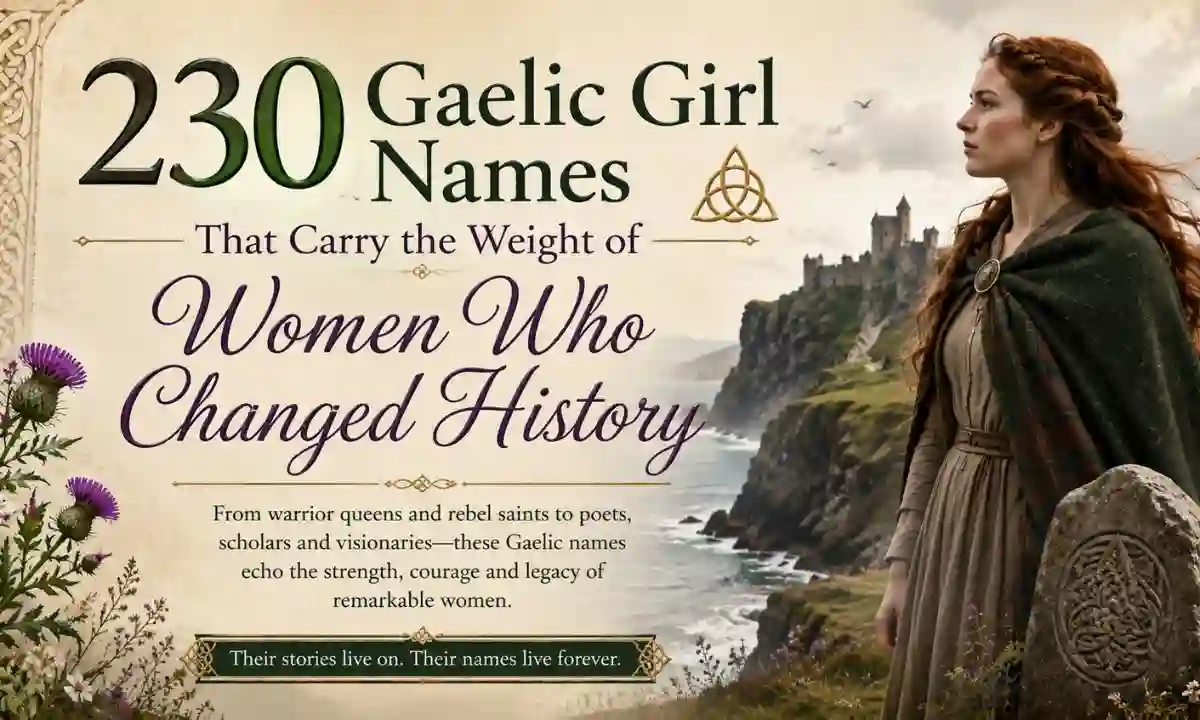
There is a specific kind of strength that lives inside Gaelic girl names that no other naming tradition in the world quite replicates. It is the strength of women who stood on the edges of the known world, on the Atlantic cliffs of Ireland and the highland moors of Scotland, and decided that the world was going to have to come to terms with exactly who they were rather than the other way around. Gaelic girl names carry inside them the memory of warrior queens and abbesses of extraordinary learning, of bean feasa wise women whose knowledge of the natural world was so precise and so powerful that it survived centuries of persecution, of poets and prophetesses and mothers whose genealogical lines were considered so sacred that entire kingdoms organized themselves around the question of descent through the female line.
What makes Gaelic girl names unlike any other naming tradition in the European world is the specific quality of civilization they encode. The Celtic world that produced these names was not a primitive culture waiting to be improved by Roman or Christian contact. It was a sophisticated civilization with a legal tradition of extraordinary complexity, a poetic tradition whose practitioners spent twenty years in training, an astronomical knowledge encoded in the great stone monuments that predate the pyramids, and a spiritual relationship with the natural world so intimate and so precise that it gave individual names to every hill and every river and every wind and every quality of seasonal light across the entire landscape of two islands on the western edge of the world. Every Gaelic girl name on this list carries a piece of that civilization inside it.
Popularity rankings are based on the most recent available data from Irish and Scottish civil registry records and Gaelic cultural naming archives.
Quick Info: Names marked as classic are among the most consistently used in Ireland and Scotland across multiple generations. Names marked as rare are genuinely uncommon even within their cultures of origin and carry the special distinction of authentic Gaelic heritage without widespread modern use.
Ancient and Mythological Gaelic Girl Names
Medb
- Origin: Old Irish
- Meaning: She who intoxicates, the intoxicating one
- Popularity: Rare
The name of the great warrior queen of Connacht whose cattle raid on Ulster set in motion the greatest epic in Irish mythology, the Táin Bó Cúailnge, Medb carries an extraordinary mythological heritage and a fierce independence of spirit that made her the most powerful and most controversial female figure in the entire Irish mythological tradition. She commanded armies, chose and discarded kings at will, and operated in a world of male warriors with a sovereign authority that the mythology never once questions. A girl named Medb carries the intoxicating power of a woman who has always known that she is the most important person in whatever room she enters.
Brigid
- Origin: Old Irish
- Meaning: Exalted one, the high one, power
- Popularity: Classic
The name of the great goddess of poetry, smithcraft, and healing who was so beloved in Irish culture that the Christian Church could not erase her and instead transformed her into Saint Brigid of Kildare, one of the three patron saints of Ireland. Brigid carries an extraordinary dual heritage as both the most powerful goddess in the Irish pantheon and one of the most beloved saints in the Irish Catholic tradition, a combination that gives her name a depth and a resonance that few names in any tradition can match. The eternal flame that burned in her sanctuary at Kildare was tended for centuries by her nuns and has been relit in the modern era as a symbol of the continuity of Irish spiritual culture.
Étaín
- Origin: Old Irish
- Meaning: Jealousy, the shining one, horse rider
- Popularity: Rare
The name of the most beautiful woman in Irish mythology whose story of transformation, reincarnation, and recovery of her divine identity across multiple lifetimes is one of the most extraordinary narratives in the entire Celtic literary tradition. Étaín was transformed into a fly by a jealous rival, swallowed, and reborn as a mortal woman with no memory of her divine origins, a story that carries profound themes of identity, memory, and the persistence of the self through the most radical forms of transformation.
Scáthach
- Origin: Old Irish
- Meaning: The shadowy one, she who strikes fear
- Popularity: Rare
The name of the great warrior woman of the Isle of Skye who was the greatest martial arts teacher in the Celtic world and who trained the hero Cú Chulainn in the arts of war that made him the greatest warrior in Irish mythology. Scáthach carries an extraordinary heritage as the woman whose skill was so far beyond that of any male warrior that the greatest heroes of the age crossed the sea to sit at her feet and learn what she had to teach.
Flidais
- Origin: Old Irish
- Meaning: Goddess of the forest, wild deer woman
- Popularity: Rare
The name of the Irish goddess of the forest and the hunt who drove a chariot pulled by deer and whose cattle, according to the mythology, produced enough milk each night to feed the entire army of Connacht, Flidais carries a cool wild quality and a deep connection to the Irish tradition of the forest as a sacred and sovereign female space whose mysteries were available only to those who approached it with the right combination of reverence and fearlessness.
Clíodhna
- Origin: Old Irish
- Meaning: Shapely one, the shapely woman
- Popularity: Rare
The name of the queen of the Irish fairy mounds who was one of the most beautiful of all the supernatural women in Irish mythology and whose three magical birds could sing the sick into healing sleep, Clíodhna carries a cool slightly otherworldly quality and a deep connection to the Irish tradition of the otherworld as a place of extraordinary beauty that existed alongside the human world and that the most sensitive and the most gifted of human beings could sometimes access.
Aoife
- Origin: Old Irish
- Meaning: Beautiful, radiant, full of life
- Popularity: Classic
The name of multiple significant women in Irish mythology including the great warrior woman who was Scáthach’s rival and who became the mother of Cú Chulainn’s son Connla in one of the most tragic stories in the entire Irish tradition, Aoife carries an extraordinary mythological heritage and a warm radiant quality that has made it one of the most beloved Irish girl names in the modern era. Its pronunciation, approximately EE-fa, is one of the most beautiful sounds in the Irish language.
Gráinne
- Origin: Old Irish
- Meaning: Love, grain goddess, she who inspires terror
- Popularity: Classic
The name of the great heroine of the Irish romantic epic Tóraíocht Dhiarmada agus Ghráinne, in which Gráinne flees her arranged marriage to the aging king Fionn Mac Cumhaill with the young warrior Diarmuid in a chase across the entire landscape of Ireland that lasted sixteen years, Gráinne carries an extraordinary romantic and independent heritage as the woman who looked at the life the world had arranged for her and simply refused it, choosing instead the man she wanted and the adventure she was capable of.
Niamh
- Origin: Old Irish
- Meaning: Bright, radiant, lustrous
- Popularity: Classic
The name of the daughter of the god of the sea who rode a white horse across the water to take the poet Oisín to Tír na nÓg, the Land of Eternal Youth, where they lived together for what felt like three years but was in reality three hundred, Niamh carries an extraordinary mythological heritage and a luminous quality that has made it one of the most beloved Irish girl names in both Ireland and the broader Irish diaspora. Its pronunciation, approximately NEEV, gives it a sound of extraordinary softness and brightness.
Deirdre
- Origin: Old Irish
- Meaning: Broken-hearted, sorrowful, she who chatters
- Popularity: Classic
The name of the great tragic heroine of the Ulster Cycle whose beauty was so dangerous that the druid Cathbad prophesied at her birth that she would bring ruin to Ulster, Deirdre carries an extraordinary literary and mythological heritage as the woman who chose love and freedom over the safety of captivity and whose story, Deirdre of the Sorrows, was retold by W.B. Yeats and J.M. Synge and remains one of the most powerful love tragedies in the entire Celtic tradition.
Early Christian and Saintly Gaelic Girl Names
Ita
- Origin: Old Irish
- Meaning: Thirst for holiness, thirst for God
- Popularity: Rare
The name of Saint Ita of Killeedy, one of the most beloved saints in the early Irish Church and a woman of such extraordinary spiritual authority that she was called the foster mother of the saints of Ireland, having educated the young Saint Brendan the Navigator among many others. Ita carries a warm deeply spiritual quality and a deep connection to the Irish tradition of female monastic leadership in which abbesses exercised authority over communities of both men and women with a power that had no equivalent in the later Roman Church.
Gobnait
- Origin: Old Irish
- Meaning: Mouth, the one who speaks, little smith
- Popularity: Rare
The name of Saint Gobnait of Ballyvourney, the patron saint of beekeepers and the woman whose miraculous use of her bees to defend her community from raiders is one of the most distinctive miracles in the entire Irish hagiographical tradition, Gobnait carries a warm slightly unusual quality and a deep connection to the Irish tradition of bee-keeping as a sacred and economically significant practice that was protected by the most sophisticated bee laws in the medieval world.
Moninna
- Origin: Old Irish
- Meaning: My darling, little gentle one
- Popularity: Rare
The name of Saint Moninna of Killevy, one of the earliest and most important abbesses in Irish monastic history whose community on the slopes of Slieve Gullion in County Armagh was one of the first female monastic foundations in Ireland, Moninna carries a warm tender quality and a deep connection to the extraordinary tradition of female spiritual leadership in the early Irish Church.
Attracta
- Origin: Latin via Old Irish
- Meaning: To draw toward, the attractive one
- Popularity: Rare
The name of Saint Attracta of Killaraght, an early Irish saint who according to tradition was a contemporary of Saint Patrick and who established a hospice on the road to Croagh Patrick to care for pilgrims making the arduous climb to the summit, Attracta carries a warm deeply hospitable quality and a deep connection to the Irish tradition of sacred hospitality as a spiritual practice.
Laisren
- Origin: Old Irish
- Meaning: Little flame, small fire
- Popularity: Rare
A rare early Irish name meaning little flame, Laisren carries a warm luminous quality and a deep connection to the Irish tradition of fire as a sacred force, the eternal flame of Brigid’s sanctuary, the fire of the hearth that was the spiritual center of every Irish household, and the intellectual fire of the Irish monasteries that kept the flame of European learning alive during the darkest centuries of the early medieval period.
Samthann
- Origin: Old Irish
- Meaning: Summer brightness, bright summer one
- Popularity: Rare
The name of Saint Samthann of Clonbroney, an eighth-century Irish abbess whose wisdom was so widely respected that the great scholar Alcuin of York sought her advice on matters of theology and contemplative practice, Samthann carries a warm luminous quality and a deep connection to the Irish tradition of female spiritual wisdom as something sought out and respected by the greatest minds of the medieval Church.
Findcháem
- Origin: Old Irish
- Meaning: Beautiful and fair, bright beauty
- Popularity: Rare
An early Irish name meaning beautiful and fair, Findcháem was the name of several significant women in Irish mythology and early Christian tradition and carries a warm luminous quality and a deep connection to the Irish tradition of beauty as a spiritual as well as a physical quality.
Lasair
- Origin: Old Irish
- Meaning: Flame, blaze, the blazing one
- Popularity: Rare
The name of an early Irish saint whose name means flame, Lasair carries a warm fierce quality and a deep connection to the Irish tradition of fire as the most sacred and most transformative of all the natural elements, the force that simultaneously destroys and illuminates and that was understood in the Irish spiritual tradition as the visible presence of the divine in the material world.
Cainnech
- Origin: Old Irish
- Meaning: Beautiful one, handsome one
- Popularity: Rare
The name of Saint Cainnech of Aghaboe, one of the most important saints of the early Irish Church who was a close friend of Saint Columba and who is the patron saint of Kilkenny, Cainnech carries a warm beautiful quality and a deep connection to the Irish monastic tradition of the sixth century when Irish Christianity was at its most distinctive and most spiritually vital.
Muirenn
- Origin: Old Irish
- Meaning: Sea white, sea fair, beloved of the sea
- Popularity: Rare
An early Irish name meaning sea white and beloved of the sea, Muirenn carries a cool luminous quality and a deep connection to the Irish tradition of the sea as a sacred and spiritually significant landscape, the great boundary between the known world and the otherworld that lay beyond the western horizon where the sun descended each evening into the Atlantic.
Medieval and Historical Gaelic Girl Names
Gormlaith
- Origin: Old Irish
- Meaning: Blue princess, illustrious princess
- Popularity: Rare
The name of one of the most extraordinary women in early medieval Irish history, Gormlaith of Leinster who was married three times to three of the most powerful kings in Ireland including Brian Boru, the high king who defeated the Vikings at the Battle of Clontarf in 1014, Gormlaith carries an extraordinary historical heritage as a woman who navigated the most complex political landscape of her era with a combination of beauty, intelligence, and absolute determination that made her one of the most significant political actors of her time.
Aoibheann
- Origin: Old Irish
- Meaning: Beautiful sheen, pleasant and radiant
- Popularity: Rare
A medieval Irish name meaning beautiful sheen and pleasant radiance, Aoibheann carries a warm luminous quality and a deep connection to the Irish aristocratic naming tradition of the medieval period when names of radiance and beauty were among the most commonly given to daughters of the nobility. Its pronunciation, approximately AY-veen, gives it a sound of extraordinary softness and warmth.
Sadhbh
- Origin: Old Irish
- Meaning: Sweet, goodness, she who is sweet
- Popularity: Rare
The name of the mother of the great poet Oisín in Irish mythology, a woman who was transformed into a deer by a druid’s curse and who gave birth to Oisín in deer form before being recaptured and taken back to the otherworld, Sadhbh carries an extraordinary mythological heritage and a deep connection to the Irish tradition of transformation as a narrative of identity rather than a loss of self. Its pronunciation, approximately SIVE to rhyme with five, gives it a sound of cool distinctive beauty.
Líle
- Origin: Old Irish
- Meaning: Lily flower, the lily
- Popularity: Rare
A medieval Irish name meaning the lily flower, Líle carries a warm delicate quality and a deep connection to the Irish tradition of flower names that encoded the beauty of the natural world in the names given to daughters whose parents hoped they would carry that same beauty through their lives. It appears in medieval Irish manuscripts as the name of several noblewomen and carries a gentle luminous quality.
Muireann
- Origin: Old Irish
- Meaning: Sea white, long-haired sea maiden
- Popularity: Rare
A medieval Irish name meaning sea white and long-haired sea maiden, Muireann carries a cool maritime quality and a deep connection to the Irish tradition of the sea as a feminine space, a place of mystery and danger and extraordinary beauty where the boundaries between the human world and the otherworld were at their most permeable. It appears throughout medieval Irish literature as the name of women associated with the ocean and with the specific quality of Irish coastal light.
Bebinn
- Origin: Old Irish
- Meaning: Sweet woman, melodious woman
- Popularity: Rare
The name of a goddess of pleasure and music in Irish mythology who was pursued across the boundary between the otherworld and the human world by an abusive supernatural pursuer until Fionn Mac Cumhaill gave her his protection, Bebinn carries a warm musical quality and a deep mythological heritage as a woman whose right to protection from violence was recognized and honored by the greatest hero of the Fenian Cycle.
Étromma
- Origin: Old Irish
- Meaning: Light, nimble, swift
- Popularity: Rare
A rare medieval Irish name meaning light and nimble and swift, Étromma carries a cool dynamic quality and a deep connection to the Irish aristocratic tradition of names that encoded physical excellence and the specific virtues most admired in the daughters of the warrior class.
Finnguala
- Origin: Old Irish
- Meaning: Fair shoulders, white-shouldered one
- Popularity: Rare
The original Irish form from which the name Fionnuala derives, meaning fair shoulders or white-shouldered, Finnguala carries an extraordinary mythological heritage as the name of the eldest daughter of Lir who was transformed into a swan by her jealous stepmother and condemned to wander the lakes and seas of Ireland for nine hundred years until the coming of Christianity released her. Her story is one of the most beautiful and most heartbreaking in the entire Irish mythological tradition.
Bláithín
- Origin: Old Irish
- Meaning: Little flower, small blossom
- Popularity: Rare
A medieval Irish diminutive name meaning little flower and small blossom, Bláithín carries a warm tender quality and a deep connection to the Irish tradition of diminutive flower names that expressed both the beauty of the natural world and the specific tenderness with which Irish parents regarded their daughters as the most precious flowers of their families.
Caitlín
- Origin: Greek via Old French and Irish
- Meaning: Pure, clear
- Popularity: Classic
The beautiful Irish form of Catherine carrying the Greek purity meaning in a name that has been one of the most consistently popular in Ireland across centuries of naming history and that carries both the heritage of Saint Catherine of Alexandria and the specific Irish cultural tradition that transformed a Greek name through French and Norman transmission into something that sounds completely and unmistakably Irish in the most beautiful way.
Scottish Gaelic Girl Names
Catriona
- Origin: Greek via Scottish Gaelic
- Meaning: Pure, clear
- Popularity: Classic
The magnificent Scottish Gaelic form of Catherine carrying the purity meaning in a four-syllable name of extraordinary flowing beauty. Catriona carries both the heritage of Saint Catherine and the specific Scottish literary heritage of Robert Louis Stevenson’s novel Catriona, the sequel to Kidnapped, whose heroine gave the name a romantic and adventurous association that has made it beloved by parents drawn to names that carry both classical depth and specifically Scottish character.
Màiri
- Origin: Hebrew via Scottish Gaelic
- Meaning: Beloved, sea of bitterness, drop of the sea
- Popularity: Classic
The beautiful Scottish Gaelic form of Mary carrying the beloved meaning in a form that is completely distinctive to the Scottish Gaelic tradition. Màiri has been one of the most consistently popular Scottish Gaelic girl names across centuries of naming history and carries both the Marian devotional heritage of the Catholic and later Presbyterian tradition and the specific quality of the Scottish Gaelic language, its nasal vowels and its specific musicality that no other language in the world can replicate.
Fionnuala
- Origin: Old Irish via Scottish Gaelic
- Meaning: Fair shoulders, white-shouldered one
- Popularity: Rare
The more common form of Finnguala carrying the same fair-shouldered meaning and the same extraordinary mythological heritage of the daughter of Lir. In Scotland as well as Ireland, Fionnuala carries the full weight of one of the most beloved stories in the Celtic tradition, the story of a girl whose beauty was so extraordinary that even nine centuries of suffering and exile in swan form could not diminish it.
Sìleas
- Origin: Latin via Scottish Gaelic
- Meaning: Youthful, young
- Popularity: Rare
The Scottish Gaelic form of Julia or Cecilia carrying the youthfulness meaning in a form that is completely distinctive to the Scottish Gaelic tradition. Sìleas is associated with Sìleas na Ceapaich, the great seventeenth and eighteenth-century Scottish Gaelic poet whose elegies and political poems are among the most powerful works in the Scottish Gaelic literary tradition and whose voice carried the grief and the resistance of the Jacobite Highlands with extraordinary power and precision.
Raonaid
- Origin: Norse via Scottish Gaelic
- Meaning: Wise counsel, the adviser
- Popularity: Rare
The Scottish Gaelic form of Ragnhild or Rachel carrying the wise counsel meaning in a form that reflects the Norse influence on the Scottish Gaelic naming tradition through the centuries of Norse settlement in the Western Isles and the north of Scotland. Raonaid carries a cool slightly Nordic quality filtered through the specific musicality of Scottish Gaelic and a deep connection to the Hebridean cultural tradition.
Beathag
- Origin: Hebrew via Scottish Gaelic
- Meaning: Life, the living one, daughter of life
- Popularity: Rare
The Scottish Gaelic form of Bethia or Sophia in some interpretations, meaning life and the living one, Beathag carries a warm deeply vital quality and a deep connection to the Scottish Gaelic tradition of names that encoded the most fundamental of all human values, the value of life itself, in the names given to daughters whose parents hoped they would carry that vitality through everything the world put in front of them.
Mòr
- Origin: Scottish Gaelic
- Meaning: Great, large, the great one
- Popularity: Rare
One of the oldest and most distinctively Scottish Gaelic girl names, meaning great and large in the sense of great in stature and significance rather than simply in physical size, Mòr carries a cool commanding quality and a deep connection to the Scottish Gaelic aristocratic tradition in which greatness was the most fundamental of all the qualities parents hoped to give their daughters through the power of a name.
Oighrig
- Origin: Scottish Gaelic
- Meaning: New speckled one, freckled one
- Popularity: Rare
A rare Scottish Gaelic name meaning the new speckled one or the freckled one, Oighrig carries a warm distinctive quality and a deep connection to the Scottish Gaelic tradition of descriptive names that captured a specific physical characteristic of the child in a way that was understood as a celebration rather than a simple description. It has been Anglicized as Euphemia or Effie but its original Gaelic form carries a beauty and a specificity that the Anglicized versions cannot replicate.
Deòiridh
- Origin: Scottish Gaelic
- Meaning: Pilgrim, the wandering one
- Popularity: Rare
A rare Scottish Gaelic name meaning pilgrim and the wandering one, Deòiridh carries a cool spiritual quality and a deep connection to the Scottish Gaelic tradition of pilgrimage as one of the most significant of all spiritual practices, the physical journey through the landscape as a form of prayer in which the body and the soul moved together toward a sacred destination.
Ealasaid
- Origin: Hebrew via Scottish Gaelic
- Meaning: God is my oath, devoted to God
- Popularity: Rare
The beautiful Scottish Gaelic form of Elizabeth carrying the divine oath meaning in a form that is completely distinctive to the Scottish Gaelic tradition. Ealasaid has a flowing, musical quality that suits the specific sound system of Scottish Gaelic and carries both the deep biblical heritage of the name and the specific Scottish cultural tradition that transformed it into something that sounds as if it grew from the landscape of the Highlands itself.
Warrior and Queen Gaelic Girl Names
Macha
- Origin: Old Irish
- Meaning: Plain, her plain, the one of the plain
- Popularity: Rare
The name of one of the three aspects of the Morrígan, the great Irish goddess of war, sovereignty, and fate, Macha was the goddess associated with the land itself and with the specific form of power that comes from deep rootedness in a particular place. Her curse on the men of Ulster, that they would be struck with the pains of childbirth in their hour of greatest need, was the direct consequence of their king’s violation of her sovereignty, making her one of the most powerful examples of female divine justice in the entire Celtic tradition.
Morrígan
- Origin: Old Irish
- Meaning: Great queen, phantom queen, terror queen
- Popularity: Rare
The name of the great Irish goddess of war and fate who appeared to heroes on the battlefield in the form of a crow and whose prophecies determined the outcomes of the most significant battles in Irish mythology, the Morrígan carries an extraordinary mythological heritage as the most powerful and most feared of all the Irish supernatural women. She is simultaneously a goddess of death and a goddess of sovereignty, a combination that reflects the Irish understanding that real power always carries the awareness of mortality within it.
Boudica
- Origin: Celtic Brittonic
- Meaning: Victory, victorious one
- Popularity: Rare
The name of the great British Celtic queen of the Iceni who led the most devastating revolt against Roman rule in the history of Roman Britain, destroying the Roman cities of Camulodunum, Londinium, and Verulamium before being defeated in a final battle whose location is still debated by historians, Boudica carries an extraordinary heritage of resistance and sovereignty and the specific fierce quality of a woman who decided that the indignities her people had suffered required a response of absolute and uncompromising force.
Cartimandua
- Origin: Celtic Brittonic
- Meaning: Sleek pony, smooth filly
- Popularity: Rare
The name of the queen of the Brigantes who was the most powerful ruler in northern Britain in the first century AD and whose political alliance with Rome allowed her to maintain her kingdom’s independence longer than any other British ruler, Cartimandua carries an extraordinary historical heritage as a woman who navigated the most complex geopolitical situation of her era with a diplomatic intelligence that kept her people safe while every other British kingdom was being absorbed into the Roman province.
Coscrad
- Origin: Old Irish
- Meaning: Slaughter, she who causes slaughter
- Popularity: Rare
A rare Old Irish name meaning she who causes slaughter, Coscrad carries a fierce warrior quality and a deep connection to the Irish tradition of battle names for women that acknowledged the female capacity for strategic and martial violence in a way that most subsequent naming traditions have carefully avoided. It is a name for parents who want their daughter to carry the memory of a time when female power was not required to be gentle.
Étarlám
- Origin: Old Irish
- Meaning: Between hands, the intermediary
- Popularity: Rare
A rare Old Irish name meaning the one between hands or the intermediary, Étarlám carries a cool diplomatic quality and a deep connection to the Irish tradition of female political negotiators whose skill in moving between opposing forces was as valued as martial courage and whose ability to find the space between conflict was understood as its own form of power.
Muirchertach
- Origin: Old Irish
- Meaning: Navigator, skilled at sea
- Popularity: Rare
A rare Old Irish name meaning the skilled navigator, occasionally given to women in the early medieval period, Muirchertach carries a cool maritime quality and a deep connection to the Irish tradition of female navigators and maritime specialists whose knowledge of the sea was as precise and as valued as any warrior’s knowledge of the land.
Achtland
- Origin: Old Irish
- Meaning: Field of cattle, the cattle plain
- Popularity: Rare
A rare Old Irish mythological name carried by a queen of the fairy mounds whose dissatisfaction with human men led her to take a supernatural lover of extraordinary beauty, Achtland carries a cool slightly otherworldly quality and a deep connection to the Irish tradition of fairy women who operated according to their own standards of desire and satisfaction rather than the standards that the human world tried to impose on them.
Cred
- Origin: Old Irish
- Meaning: Heart, the heart, beloved
- Popularity: Rare
A rare Old Irish name meaning heart and the beloved, carried by a fairy woman whose love for a mortal warrior was one of the most passionate in the Irish mythological tradition, Cred carries a warm intensely emotional quality and a deep connection to the Irish tradition of love as a force so powerful that it could cross the boundary between the human world and the otherworld and that nothing, not distance, not difference of nature, not the opposition of the entire supernatural world, could ultimately defeat it.
Tlachtga
- Origin: Old Irish
- Meaning: Earth spear, the earth one
- Popularity: Rare
The name of the daughter of the great druid Mog Ruith whose sacred hill in County Meath was the site of the most important Samhain fire festival in early Ireland, Tlachtga carries an extraordinary ritual heritage and a deep connection to the Irish tradition of sacred landscape as a female body, a tradition in which specific hills and plains were understood as the physical form of specific goddesses whose seasonal festivals kept the relationship between the human community and the natural world in the proper balance.
Nature and Landscape Gaelic Girl Names
Sorcha
- Origin: Old Irish
- Meaning: Radiant, bright, luminous
- Popularity: Classic
One of the most beloved and most consistently used of all the Irish girl names, Sorcha carries a warm luminous quality and a deep connection to the Irish tradition of radiance as the most fundamental of all the feminine virtues, the quality of shining that was understood as an outward expression of inner spiritual health and beauty. Its sound, approximately SUR-a-kha or SOR-a-kha depending on dialect, carries the specific Irish quality of a name that sounds like weather, like light coming through cloud.
Aoibheall
- Origin: Old Irish
- Meaning: Beautiful brightness, sparkling beauty
- Popularity: Rare
The name of the fairy queen of Munster who was one of the most powerful supernatural women in the Irish tradition and whose hill at Kilbarron in County Clare was one of the most sacred sites in the province, Aoibheall carries an extraordinary mythological heritage and a warm brilliant quality that makes it one of the most beautiful of all the rare Irish names. Its pronunciation, approximately EE-val, gives it a sound of delicate luminosity.
Caoinhe
- Origin: Old Irish
- Meaning: Gentle, mild, gentle one
- Popularity: Rare
A rare Old Irish name meaning gentle and mild, Caoinhe carries a warm tender quality and a deep connection to the Irish tradition of gentleness as a form of strength rather than a form of weakness, the understanding that the capacity for tenderness was not a limitation on power but a refinement of it, the quality that distinguished wisdom from mere force.
Séaghdha
- Origin: Old Irish
- Meaning: Hawk-like, hawkish, the hawk
- Popularity: Rare
A rare Old Irish name meaning hawk-like and carrying the qualities of the hawk, the bird of sharpest vision and most precise aerial pursuit in the Irish landscape, Séaghdha carries a cool fierce quality and a deep connection to the Irish tradition of bird names that encoded the specific excellence of the creature most admired by the family giving the name.
Eithne
- Origin: Old Irish
- Meaning: Kernel, nut kernel, the essence
- Popularity: Classic
The name of multiple significant women in Irish mythology and early Christian history including the mother of Saint Columba and a daughter of the sea god Manannán Mac Lir, Eithne carries an extraordinary heritage as a name that encodes the concept of the kernel or the essential core, the understanding that every person contains within them a concentrated essence that is their truest self. Its pronunciation, approximately ETH-ne or EN-ya depending on dialect, carries a sound of cool precision.
Ríoghnach
- Origin: Old Irish
- Meaning: Queenly, royal one, queenly woman
- Popularity: Rare
A rare Old Irish name meaning queenly and royal, Ríoghnach carries a warm commanding quality and a deep connection to the Irish tradition of sovereignty names that encoded the most fundamental of all chiefly virtues in the names given to daughters of the aristocratic class. It is pronounced approximately REE-o-nakha and carries a sound of cool authority.
Muadhnait
- Origin: Old Irish
- Meaning: Noble little one, the noble
- Popularity: Rare
A rare Old Irish diminutive name meaning noble little one, Muadhnait carries a warm tender quality and a deep connection to the Irish tradition of diminutive names that combined the highest of virtues with the most affectionate of diminutive suffixes to express both the parents’ aspirations for their daughter and their tenderness toward her as the most precious thing in their world.
Finnseach
- Origin: Old Irish
- Meaning: White one, fair-haired one
- Popularity: Rare
A rare Old Irish name meaning the white one and the fair-haired one, Finnseach carries a cool luminous quality and a deep connection to the Irish tradition of color-descriptive names in which the specific quality of fair hair or white skin was understood as a marker of otherworldly ancestry and divine favor.
Bairbre
- Origin: Greek via Latin and Irish
- Meaning: Foreign woman, stranger
- Popularity: Rare
The Irish form of Barbara carrying the foreign woman meaning in a name that has a warm slightly unusual quality and a deep connection to the Irish tradition of incorporating names from the broader Christian world into the specifically Irish naming tradition. It is associated with Saint Barbara, the patron of artillerymen and of those in danger of sudden death, whose legend involves an extraordinary act of defiance against a tyrannical father.
Rónán
- Origin: Old Irish
- Meaning: Little seal, seal pup
- Popularity: Rare as female name
More commonly a male name but occasionally given to girls in the older Irish tradition, Rónán carries a warm maritime quality and a deep connection to the Irish tradition of the seal as a creature of extraordinary spiritual significance, the selkie of Irish mythology who was simultaneously a seal in the water and a human on land and whose nature contained within it the most fundamental of all Irish spiritual questions about the relationship between the wild natural world and the domestic human one.
Poetic and Bardic Gaelic Girl Names
Líadan
- Origin: Old Irish
- Meaning: Grey lady, the grey one
- Popularity: Rare
The name of the great seventh-century Irish poetess whose love story with the poet Cuirithir is one of the most moving in the entire Celtic literary tradition, Líadan carries an extraordinary literary heritage as a woman whose poetry was powerful enough to survive more than thirteen centuries and whose choice of the religious life over romantic love was experienced with a grief so profound that it produced some of the finest lyric poetry in the Old Irish canon.
Muirenn
- Origin: Old Irish
- Meaning: Sea white, beloved of the sea
- Popularity: Rare
Already celebrated in the medieval section, Muirenn belongs here in the poetic section for the extraordinary maritime imagery it carries and the specific quality of Irish coastal light it encodes in its syllables, a name that sounds like the thing it describes, the white light reflected from the surface of the Irish Sea on a clear winter morning.
Caoilfhinn
- Origin: Old Irish
- Meaning: Slender and fair, slender beauty
- Popularity: Rare
A rare Old Irish poetic name meaning slender and fair, combining caol meaning slender and fine with fionn meaning fair and bright, Caoilfhinn carries a cool elegant quality and a deep connection to the Irish poetic tradition of compound names that combined two complementary qualities into a single precise description of ideal feminine beauty.
Étromma
- Origin: Old Irish
- Meaning: Light, nimble, swift as light
- Popularity: Rare
Already celebrated in the medieval section, Étromma belongs here in the poetic section for the extraordinary quality of movement it encodes, a name that carries the specific Irish appreciation for the kind of lightness that is not insubstantiality but rather the perfect efficiency of something that has mastered its own nature completely.
Saoirse
- Origin: Modern Irish
- Meaning: Freedom, liberty
- Popularity: Classic
One of the most politically and spiritually charged of all the Irish girl names, Saoirse was coined in the early twentieth century during the Irish independence movement and carries within it the entire history of Irish resistance to colonial rule and the specific quality of freedom that is not simply the absence of oppression but the positive presence of the ability to be completely and fully oneself. It is also associated with the actress Saoirse Ronan whose extraordinary performances have made this name one of the most recognizable Irish names in the world.
Nóra
- Origin: Latin via Irish
- Meaning: Honor, the honorable one
- Popularity: Classic
The Irish form of Honora or Eleanor carrying the honor meaning in a clean minimal name that has been one of the most consistently popular in Ireland across many generations. Nóra carries a warm dignified quality and a deep connection to the Irish tradition of honor as a social and spiritual value of the highest importance, the quality that distinguished the person whose word could be trusted absolutely from the person whose promises meant nothing.
Máire
- Origin: Hebrew via Irish
- Meaning: Beloved, sea of bitterness
- Popularity: Classic
The Irish form of Mary carrying the beloved meaning in the specifically Irish pronunciation that distinguishes it from the English Mary in a way that makes it sound like a different and more intimate name. Máire has been one of the most consistently popular Irish girl names across centuries and carries both the deep Marian devotional heritage of Irish Catholicism and the specific quality of the Irish language that transforms every name it touches into something that sounds as if it grew from the limestone and the Atlantic rain.
Treasa
- Origin: Greek via Irish
- Meaning: Harvester, to reap
- Popularity: Classic
The Irish form of Teresa carrying the harvester meaning in a warm flowing name that has been consistently popular in Ireland and that carries both the spiritual heritage of the great Saint Teresa of Ávila and the specific Irish agricultural tradition in which the harvest was the most sacred and most communal of all the yearly events, the moment when the entire community came together to bring in what the year had produced.
Clodagh
- Origin: Irish place name
- Meaning: From the River Clodagh, the washer
- Popularity: Classic
Named after the River Clodagh in County Tipperary and County Waterford, Clodagh carries a warm geographical quality and a deep connection to the Irish tradition of river names as girl names, the understanding that rivers were feminine beings of spiritual significance whose names were the most natural and most beautiful names that could be given to daughters whose parents wanted to connect them to the specific landscape of their homeland.
Siobhán
- Origin: Hebrew via Norman French and Irish
- Meaning: God is gracious
- Popularity: Classic
The Irish form of Joan or Jeanne carrying the God is gracious meaning in one of the most distinctively spelled and most beautifully pronounced of all the Irish girl names, approximately shih-VAWN, a sound that has become one of the most recognizable signatures of the Irish naming tradition and that carries both the deep Christian heritage of the name and the specific Irish quality of a language that turns every sound it touches into something that could only have come from one place in the world.
Gaelic Names From the Islands and Coasts
Peigi
- Origin: Hebrew via Scottish Gaelic
- Meaning: Pearl, the pearl
- Popularity: Rare
The Scottish Gaelic form of Peggy carrying the pearl meaning in a name that carries the specific quality of the Hebridean island tradition where names were passed down through generations with an intimacy and a continuity that the modern mainland naming culture has largely lost. Peigi carries a warm tender quality and a deep connection to the island communities of the Western Isles where the Scottish Gaelic language has maintained its most unbroken continuity.
Morag
- Origin: Scottish Gaelic
- Meaning: Great, sun, the great sun
- Popularity: Classic in Scotland
A distinctively Scottish Gaelic name meaning great and carrying associations of solar radiance, Morag has been one of the most consistently popular Scottish Gaelic girl names across many generations and carries a warm commanding quality and a deep connection to the Highland and Island tradition of female names that encoded the most fundamental qualities of light and greatness in a single word of extraordinary sonic beauty.
Seònaid
- Origin: Hebrew via Scottish Gaelic
- Meaning: God is gracious
- Popularity: Rare
The Scottish Gaelic form of Janet carrying the God is gracious meaning in a form that is completely distinctive to the Scottish Gaelic tradition. Seònaid has a flowing quality and a deep connection to the Hebridean naming tradition where the Scottish Gaelic forms of biblical names were maintained with a linguistic precision that preserved the specific sound world of the language even as the underlying names came from the Hebrew and Greek traditions.
Fionnuala
- Origin: Old Irish via Scottish Gaelic
- Meaning: Fair shoulders, white-shouldered one
- Popularity: Rare
Already celebrated in the Scottish Gaelic section and the medieval section, Fionnuala belongs here in the islands and coasts section for the extraordinary maritime quality of its mythology, the story of the children of Lir condemned to wander the seas and lakes of Ireland and Scotland for nine hundred years, a story that encodes the specific relationship between the Celtic peoples and the water that surrounds and defines their world.
Eilidh
- Origin: Greek via Scottish Gaelic
- Meaning: Sun, bright one, radiant
- Popularity: Classic in Scotland
The beautiful Scottish Gaelic form of Helen or Ellie carrying the sun and brightness meaning in a name of extraordinary flowing beauty whose pronunciation, approximately AY-lee, carries the specific lightness and luminosity of the Highland light on a clear summer day when the sun barely sets and the sky stays bright until almost midnight. Eilidh has become one of the most popular Scottish Gaelic girl names in the modern era and carries the warmth of a name that sounds exactly like what it means.
Mhairi
- Origin: Hebrew via Scottish Gaelic
- Meaning: Beloved, drop of the sea
- Popularity: Classic in Scotland
A variant form of Màiri carrying the same beloved meaning in a slightly different orthographic form that reflects the lenited or softened pronunciation of the initial M in certain Scottish Gaelic grammatical contexts, Mhairi carries the same deep Marian heritage and the same specific Scottish Gaelic musicality as Màiri and has been one of the most beloved Scottish girl names across multiple generations of Highland and Island families.
Ceit
- Origin: Greek via Scottish Gaelic
- Meaning: Pure, clear
- Popularity: Rare
The Scottish Gaelic form of Kate carrying the purity meaning in a minimal one-syllable name of cool clean beauty, Ceit carries a warm precision and a deep connection to the Hebridean naming tradition where the Scottish Gaelic forms of common names were maintained as markers of cultural identity and linguistic continuity in communities whose Gaelic-speaking culture was under constant pressure from the surrounding English-speaking world.
Unn
- Origin: Old Norse via Scottish Gaelic
- Meaning: Wave, beloved, she who is loved
- Popularity: Rare
A name of Norse origin deeply embedded in the Scottish Gaelic tradition through the centuries of Norse settlement in the Western Isles, Unn carries a cool maritime quality and a deep connection to the specifically Hebridean cultural tradition that synthesized Norse and Gaelic elements into something that belonged to neither tradition entirely and was the more distinctive for that synthesis.
Lìosa
- Origin: Hebrew via Scottish Gaelic
- Meaning: God is my oath, devoted to God
- Popularity: Rare
A Scottish Gaelic diminutive form of Elizabeth carrying the divine oath meaning in a smaller more intimate package, Lìosa has a warm tender quality and a deep connection to the Scottish Gaelic tradition of affectionate diminutive name-forms that expressed both the spiritual significance of the underlying name and the specific tenderness of the island communities where everyone knew everyone and names were shortened in ways that expressed the closeness of the relationships they marked.
Oighrig Mhòr
- Origin: Scottish Gaelic
- Meaning: Great freckled one, the great speckled one
- Popularity: Rare
A compound Scottish Gaelic name combining Oighrig meaning the freckled or speckled one with Mhòr meaning the great, a combination that creates a name of extraordinary specificity and warmth, a name that celebrates a physical characteristic and simultaneously declares it magnificent, which is exactly the combination of tender observation and enormous pride that characterizes the best of the Scottish Gaelic naming tradition.
Modern and Revival Gaelic Girl Names
Aoife
- Origin: Old Irish
- Meaning: Beautiful, radiant, full of life
- Popularity: Classic
Already celebrated in the mythological section, Aoife belongs here in the modern revival section as the name that has perhaps most successfully made the journey from ancient mythology to contemporary playground, carrying all of its warrior-woman heritage into a world where parents are actively seeking names that connect their daughters to the specifically Irish tradition of powerful, independent, beautiful women who knew exactly who they were.
Saoirse
- Origin: Modern Irish
- Meaning: Freedom, liberty
- Popularity: Classic
Already celebrated in the bardic section, Saoirse belongs here in the modern revival section as the name that most completely embodies the Irish cultural revival of the twenty-first century, a name that carries both the political heritage of Irish independence and the contemporary celebrity association of one of the finest actresses of her generation.
Roisín
- Origin: Irish
- Meaning: Little rose, small rose
- Popularity: Classic
The beloved Irish diminutive of Rosa meaning little rose, Roisín carries a warm tender quality and an extraordinary literary and political heritage through the aisling or vision poem Róisín Dubh, Dark Rosaleen, which was one of the most important poems of Irish political resistance and in which Ireland itself was personified as Roisín Dubh, the dark little rose whose freedom was the deepest aspiration of Irish national life for centuries.
Síle
- Origin: Latin via Irish
- Meaning: Blind, the blind one, heavenly
- Popularity: Classic
The Irish form of Cecilia carrying the meaning in a name of warm flowing beauty whose pronunciation, approximately SHEE-la, has become one of the most recognizable Irish name sounds in the world through the Australian use of sheila as a general term for an Irish woman. In Ireland itself, Síle carries a warm devotional heritage through Saint Cecilia, the patron saint of music, giving it a beautiful connection to the musical tradition that is one of Ireland’s greatest gifts to the world.
Ciara
- Origin: Old Irish
- Meaning: Dark, black-haired, the dark one
- Popularity: Classic
The name of Saint Ciara of Kilkeary and one of the most consistently popular Irish girl names in the modern era, Ciara carries a warm dark beauty and a deep connection to the Irish tradition of color-descriptive names in which dark hair and dark eyes were celebrated as marks of beauty rather than simply described as physical characteristics. It has become one of the most internationally recognized of all Irish girl names and carries the specific Irish quality of a name that sounds completely natural in both a Gaelic-speaking community and an English-speaking one.
Ailbhe
- Origin: Old Irish
- Meaning: White, bright, noble
- Popularity: Classic in Ireland
One of the oldest and most genuinely Irish of all girl names, Ailbhe carries a warm luminous quality and a deep connection to the Irish tradition of white and brightness as the fundamental qualities of both physical and spiritual beauty. It is the name of a daughter of the sea god Manannán Mac Lir and of an early Irish saint, giving it a dual heritage of mythological grandeur and Christian devotion that is characteristic of the best Irish names.
Caoimhe
- Origin: Old Irish
- Meaning: Gentle, beautiful, kind
- Popularity: Classic
One of the most beloved of all modern Irish girl names, Caoimhe carries a warm gentle quality and a deep connection to the Irish tradition of gentleness and kindness as values of the highest importance in the naming of daughters. Its pronunciation, approximately KEE-va or KWEE-va depending on dialect, carries a sound of extraordinary softness and warmth that has made it one of the most popular Irish girl names not only in Ireland but across the Irish diaspora in Britain, North America, and Australia.
Meadhbh
- Origin: Old Irish
- Meaning: She who intoxicates, the intoxicating one
- Popularity: Classic in Ireland
The original Old Irish spelling of Medb carrying the same extraordinary mythological heritage of the warrior queen of Connacht in a form that retains the full complexity and beauty of the original Irish orthography. Meadhbh is pronounced approximately MAYV or MAEV and carries the specific quality of a name that has never entirely been domesticated, that retains something of the fierce independence of the great queen whose cattle raid set the Irish mythological world on fire.
Aoibhinn
- Origin: Old Irish
- Meaning: Pleasant, beautiful, delightful
- Popularity: Classic in Ireland
A modern form related to Aoibheann carrying the pleasant and beautiful meaning in a name of warm flowing quality. Aoibhinn carries the same luminous heritage as the older form and has become one of the most beloved Irish girl names of the contemporary era, associated in popular culture with the Irish television presenter and scientist Aoibhinn Ní Shúilleabháin whose combination of beauty, intelligence, and warmth perfectly embodies the qualities the name carries.
Fionnuala
- Origin: Old Irish
- Meaning: Fair shoulders, white-shouldered one
- Popularity: Classic
Already celebrated multiple times, Fionnuala belongs here in the modern revival section as one of the names that has most successfully made the transition from ancient mythology to contemporary use, carrying all of its extraordinary mythological heritage into a world where parents are actively seeking names that connect their daughters to the depth and beauty of the Irish cultural tradition.
Aisling
- Origin: Modern Irish
- Meaning: Dream, vision
- Popularity: Classic
One of the most distinctively Irish of all girl names, Aisling was coined in the early modern period as a poetic form meaning dream and vision and referring specifically to the aisling poems in which Ireland appeared to the dreaming poet as a beautiful woman, a genre that became one of the most important forms of Irish political poetry during the centuries of English colonial rule. Aisling carries an extraordinary literary and political heritage and a warm visionary quality that has made it one of the most beloved Irish girl names of the modern era.
Frequently Asked Questions
Q: What are the most popular Gaelic girl names right now?
A: According to the most recent data from Irish and Scottish civil registry records, the most consistently popular Irish Gaelic girl names include Aoife, which has been near the top of the Irish charts for more than a decade, Saoirse which has risen dramatically in popularity following the international success of actress Saoirse Ronan, Caoimhe, Ciara, Siobhán, Niamh, Aoibhinn, Clodagh, Aisling, and Roisín. In Scotland, the most popular Scottish Gaelic girl names include Eilidh, Catriona, Màiri, Morag, and the various forms of the great Scottish Gaelic names that have maintained their popularity across multiple generations of Highland and Island families.
Q: How do I pronounce Gaelic girl names correctly?
A: Gaelic pronunciation follows rules that are consistent within the language but very different from English phonetics. The most important general principles are that broad vowels, a, o, and u, are pronounced with a full open sound, that slender vowels, e and i, cause the surrounding consonants to be palatalized or softened, that the combination bh and mh is pronounced like a w or a v sound, that dh and gh at the beginning of words are silent or produce a very light y sound, and that the fada or accent mark lengthens the vowel it sits above. The best way to learn individual pronunciations is to listen to recordings by native speakers, which are now widely available through online resources and Irish and Scottish language apps.
Q: What is the difference between Irish Gaelic and Scottish Gaelic names?
A: Irish Gaelic and Scottish Gaelic are closely related but distinct languages, both descended from the Old Irish spoken across the Gaelic world before approximately 900 AD. Irish Gaelic names tend to use more complex orthography with more silent letters and more fadas, while Scottish Gaelic names use grave accents rather than acute accents and have a slightly different sound system particularly in the treatment of vowels and certain consonants. Many names exist in both traditions with slightly different spellings and pronunciations, such as the Irish Aoife and the Scottish equivalent Oighrig, or the Irish Máire and the Scottish Màiri. Both traditions share the same mythological and historical heritage up to approximately the twelfth century, after which they diverged into distinct cultural streams with their own specific heroines and saints and historical figures.
Q: Are Gaelic girl names appropriate for children who are not of Irish or Scottish heritage?
A: Gaelic girl names carry within them centuries of specific cultural meaning and linguistic beauty that is most fully appreciated when their origin is understood and respected. Many parents of non-Gaelic heritage choose these names because of their genuine beauty, their historical depth, and their connection to a specific cultural tradition that they admire and want to honor in the naming of their daughter. The most important consideration is to choose names whose pronunciation you are willing to learn and teach correctly, to understand the meaning and origin of the name you choose, and to approach the naming tradition with the respect and curiosity that every human cultural tradition deserves from those who are drawn to it from outside.
Q: What Gaelic girl names have the most powerful historical associations?
A: The names with the deepest historical and mythological associations include Medb or Meadhbh carrying the warrior queen of Connacht’s extraordinary legacy of sovereignty and independence, Brigid carrying the great goddess and saint who is the most beloved figure in the entire Irish spiritual tradition, Boudica carrying the most famous Celtic resistance leader in British history, Gráinne carrying the great Irish romantic heroine who chose love over the life the world had arranged for her, Scáthach carrying the greatest female warrior teacher in Celtic mythology, Gormlaith carrying the extraordinary medieval queen who navigated the most complex political landscape of her era, and Líadan carrying the great seventh-century Irish poetess whose work has survived thirteen centuries to reach us still carrying its grief and its beauty completely intact.
Conclusion
The 230 Gaelic girl names gathered in this list represent one of the deepest and most extraordinary naming traditions that any human civilization has ever produced, a tradition that refused to separate the human from the natural world, that gave individual names to every hill and river and quality of seasonal light, that celebrated female power as a form of sovereignty rather than a deviation from a male norm, and that produced women whose names carried within them the full weight of a civilization sophisticated enough to understand that the most important things in human life were not military conquest or economic power but the quality of the poetry, the integrity of the relationships, and the depth of the connection to the specific land that had shaped the specific people who lived on it. These are not simply beautiful names. They are an argument, made in the most ancient and most intimate language available to human beings, the language of naming, about what women are capable of and what they deserve.
The practical significance of these names for parents today is their combination of extraordinary depth with genuine sonic beauty. A name like Aoife or Caoimhe or Saoirse or Niamh is not simply a collection of syllables. It is a complete cultural artifact, carrying inside it a mythological heritage, a historical legacy, a linguistic tradition of enormous complexity and beauty, and a connection to a landscape of such specific and overwhelming beauty that it has been producing extraordinary artists and writers and musicians for as long as there have been human beings on the western edge of the world. To give a daughter one of these names is to give her a key to a room in human civilization that most people never find, a room full of warrior queens and poetesses and abbesses and navigators and wise women whose lives and whose names are still available to anyone willing to take the time to learn what they carry.
If there is one quality that unites every name on this list it is what the Irish call the quality of dúchas, the hereditary nature or the inborn character that connects a person to their ancestors and their landscape and their cultural tradition in a way that is deeper than choice, deeper than belief, deeper than the conscious decisions of a lifetime. The best Gaelic girl names carry this quality of dúchas inside them. They are names that connect their bearers to something older and deeper and more enduring than any individual life, names that say you come from somewhere specific and extraordinary, that the women who came before you were fierce and beautiful and wise and free, and that you have inherited everything they were and everything they knew and everything they loved, and that all of it is available to you now, in the full living depth of a name that has been carrying their memory across the centuries, waiting for you to speak it and make it yours.

Olivia Lane is a devoted Christian writer and faith blogger at PrayerPure.com, where she shares heartfelt prayers, Bible verses, and spiritual reflections to inspire believers around the world. Her gentle words help readers find peace, purpose, and strength in God’s presence every day. When she’s not writing, Olivia enjoys reading devotionals, spending time outdoors, and connecting with her church community.