
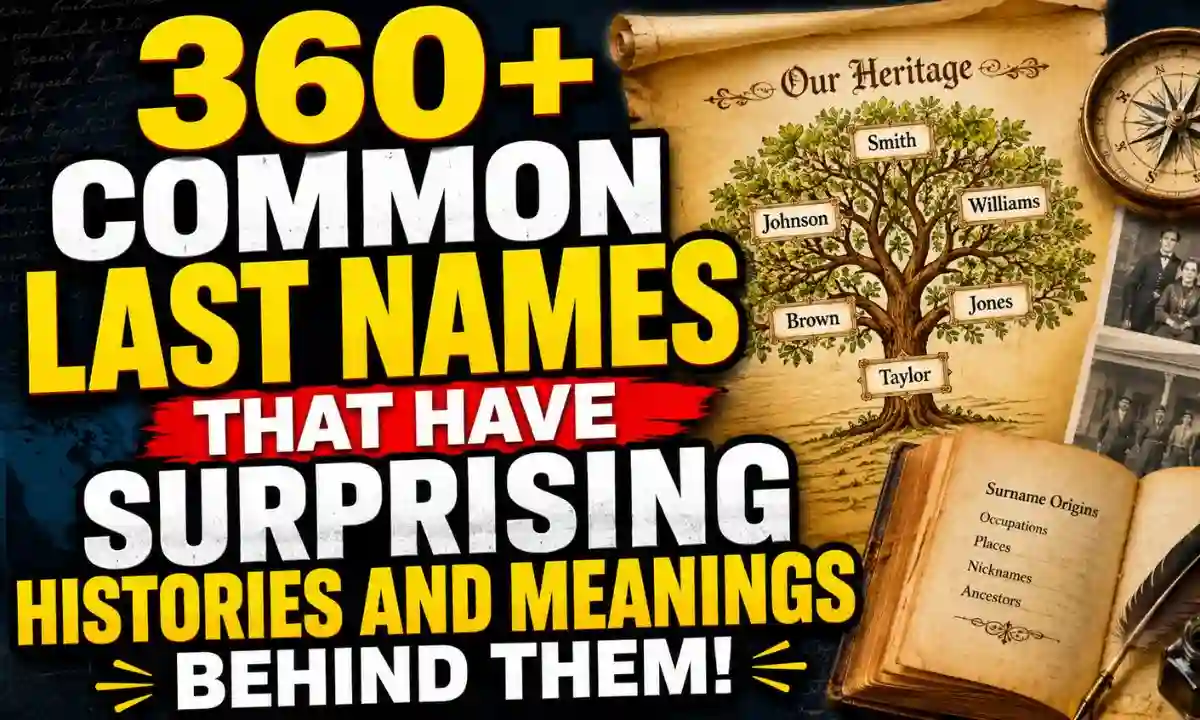
99+ Baby Names That Mean Gift From GodMost people walk through their entire lives carrying a last name they have never once stopped to examine. Smith. Johnson. Williams. Garcia. Patel. These names sit on driver’s licenses and tax returns and gravestones without ever being asked the most interesting question you can ask about any word: where did you come from, and what do you actually mean?
The answer, in almost every case, is genuinely surprising. The surname Smith does not just mean someone who worked with metal — it comes from an ancient Germanic root meaning to smite, to strike, and the smith was considered in pre-Christian Germanic culture to be a figure of magical power. Johnson literally means son of John, but John itself means God is gracious in Hebrew, which means every Johnson in the world is technically carrying the meaning son of God’s grace. Garcia, one of the most common surnames in the Spanish-speaking world, almost certainly comes from a Basque word meaning bear or young bear, connecting millions of Spanish-speaking people to the ancient bear worship traditions of pre-Roman Iberia.
This is what surnames do. They carry history that the people who bear them have entirely forgotten. They preserve linguistic records of occupations that no longer exist, geographical features that have been renamed or destroyed, physical characteristics of ancestors who died centuries ago, and patronymics connecting living people to forebears whose given names have been preserved only in the surnames of their descendants.
This list covers the most common last names across English, Spanish, French, German, Italian, Portuguese, Irish, Scottish, Welsh, Scandinavian, Slavic, Jewish, Arabic, South Asian, East Asian, and West African naming traditions, along with the genuine surprising histories and meanings that most people who carry these names have never been told.
English Occupational Surnames
Smith
Surprising history: Smith is the most common surname in the United States and the United Kingdom and its apparent simplicity hides extraordinary depth. The root is the Proto-Germanic word smitan meaning to strike or to smite — the same root that gives us the word smite in the Bible. In pre-Christian Germanic culture the smith was not merely a craftsman but a figure of semi-magical status who could transform raw ore into weapons and tools. Wayland the Smith in Norse mythology was a master craftsman of divine status. Every Smith alive today carries a name that once belonged to one of the most powerful and mysterious figures in their ancestors’ world.
Miller
Surprising history: The miller was one of the most significant and most distrusted figures in medieval English society. Mills were expensive and millers were the only people who could process grain into flour, giving them enormous economic power over their communities. Medieval literature from Chaucer to folk ballads is full of dishonest millers who skimmed more grain than their fee entitled them to. The surname Miller carries the memory of this complex social figure — essential, powerful, and perpetually suspected of cheating everyone who depended on them.
Cooper
Surprising history: The cooper made barrels and wooden containers and was absolutely essential to medieval and early modern commerce. Before cans, plastic, and refrigeration, barrels were the primary containers for everything from beer and wine to herring and gunpowder. The cooper’s craft required extraordinary skill — a poorly made barrel that leaked could destroy an entire ship’s cargo. Every Cooper alive today descends from an artisan whose craft kept the entire trade economy of the pre-industrial world functioning.
Taylor
Surprising history: The tailor name comes from the Old French tailleur meaning one who cuts. Before the industrial revolution, having clothes made was an expensive luxury and tailors were significant craftsmen rather than simple tradespeople. The word tailor is related to the word entail meaning to restrict inheritance, both coming from the French idea of cutting and shaping — the tailor cut cloth to shape and the law cut inheritance to a specific line of descent.
Turner
Surprising history: The turner was not someone who turned around but someone who worked a lathe — a person who shaped wood or metal by rotation. The root is the Latin tornare meaning to turn on a lathe. Medieval turners created everything from wooden bowls to metal components for weapons and machinery. The craft was considered highly skilled and turners occupied a respected position in the medieval guild system.
Walker
Surprising history: The Walker who gave this name to millions of people was not a pedestrian but a cloth worker who walked on wet wool to clean and thicken it — a process called fulling. Fullers or walkers would tread the cloth with their feet in large vats of water and urine for hours. The urine was critical to the process because the ammonia helped clean the wool fibers. Every Walker alive today potentially descends from someone who spent their working life treading cloth in vats of stale urine.
Fletcher
Surprising history: The fletcher made arrows and the name comes from the Old French fleche meaning arrow. Before gunpowder, the arrow was the most important long-range weapon in warfare and the fletcher was an essential military craftsman. The phrase fletch and flight — referring to the feathers that stabilized an arrow in flight — both derive from the same root. Every Fletcher descends from someone whose craft literally won medieval battles.
Thatcher
Surprising history: The thatcher made and maintained thatched roofs and the name comes from the Old English theccan meaning to cover or to thatch. Before clay tiles and slate became common roofing materials, thatch was the primary roofing material for most buildings in Britain. The thatcher’s craft was highly specialized and a well-thatched roof could last decades. The most famous Thatcher of recent history, Margaret Thatcher, was the daughter of a grocer named Roberts — she took her husband Denis Thatcher’s surname, whose family presumably had ancestors who thatched roofs.
Weaver
Surprising history: The weaver’s craft was so central to English medieval prosperity that the wool trade defined the entire medieval English economy. The Lord Chancellor in the House of Lords still sits on a woolsack as a reminder of the foundation of English wealth. The word web comes from the same root as weave, and both the spider’s web and the World Wide Web carry the memory of the weaver’s art in their names.
Mason
Surprising history: The mason worked with stone and the name comes from the Old French maçon. The Freemasons — the most famous secret society in Western history — took their name from the medieval stonemasons’ guilds whose rituals of initiation and their mathematical knowledge of geometry made them uniquely positioned to develop a philosophical fraternity. Every Mason alive today shares a surname with the founders of modern speculative Freemasonry.
Shepherd
Surprising history: The shepherd tended sheep and the name comes from the Old English sceaphierde. But the surprising history is the extraordinary religious and cultural significance of the shepherd. From the Twenty-Third Psalm to Jesus as the Good Shepherd, from Abel who was a shepherd to Moses who tended sheep in Midian before his calling, the shepherd is one of the most theologically significant occupational roles in Western civilization. Every Shepherd carries a name saturated in this religious heritage.
Barker
Surprising history: The barker was not someone who shouted outside a shop but a tanner who used bark to tan leather. The bark of oak trees contains tannin which is essential for curing animal hides into leather. The medieval leather industry was both economically essential and extraordinarily malodorous — tanneries were required by law in many medieval towns to be located downwind and downstream from habitation. Every Barker descends from someone whose craft produced a smell so powerful it required legal regulation.
Chandler
Surprising history: The chandler made and sold candles and the name comes from the Old French chandelier meaning candle maker. Before electric light, candles were the primary source of illumination and the chandler was an essential craftsman. The chandelier — the hanging candle holder — takes its name from the same root. Every Chandler carries the memory of a time when light itself was a luxury commodity.
Sawyer
Surprising history: The sawyer was a worker who sawed timber and the name comes from the Middle English sawyer. But the extraordinary history is that sawyers worked in pairs — one above and one below — in large pits called saw pits. The man below, working in a constant shower of sawdust, was called the bottom sawyer and the man above was the top sawyer. The phrase top sawyer meaning the most important or excellent person in any group comes directly from the saw pit, where the top position was considered the preferred one.
Ward
Surprising history: The ward was a guardian or watchman and the name comes from the Old English weard meaning guard. But the ward also gave its name to the hospital ward, the city ward, the prison ward, and the legal ward — all of these come from the same concept of a protected enclosure guarded by a responsible person. Every Ward carries a name that is embedded in the entire vocabulary of institutional care and custody.
Page
Surprising history: The page was a boy servant in a noble household who was training for knighthood, and the name comes from the Old French page. The page system was the first stage of the medieval education in arms — a boy would serve as a page before becoming a squire and eventually a knight. Every Page carries the memory of the medieval training system that produced the knightly class.
Hunt
Surprising history: The hunt was the person who managed a lord’s hunting activities and the name comes from the Old English huntian. But hunting in medieval England was far more than a sport — it was a highly regulated legal activity with an entire legal framework called Forest Law that imposed severe penalties including blinding and castration for killing the king’s deer. Every Hunt carries a name connected to one of the most legally consequential activities in medieval England.
Parker
Surprising history: The parker was the keeper of a medieval park or hunting ground and the name comes from the Old French parquier. The park in medieval England was not a public garden but a strictly private enclosed hunting ground reserved for the nobility. The parker was their employee and the parks they managed were protected by Forest Law. Every Parker carries the memory of an England divided between those who could hunt freely and those who could be mutilated for poaching.
Potter
Surprising history: The potter made ceramic vessels and the name comes from the Old English pottere. But the potter’s craft is one of the oldest human technologies — pottery predates agriculture in some traditions and the ability to make fired ceramic vessels fundamentally changed how humans stored food and water. The wheel itself is said to have been invented for pottery before it was applied to transportation. Every Potter carries the name of one of humanity’s most ancient and foundational craft traditions.
English Locational Surnames
Hill
Surprising history: Hill is among the most straightforward English surnames — a person who lived on or near a hill — but its simplicity hides genuine complexity. In medieval England, the specific characteristics of hills were linguistically distinguished in ways that no longer exist in standard English. A hlaw was a burial mound hill, a dun was a fortified hill, a tor was a rocky outcrop hill, and a down was a grassy hill. The people who simply lived on an unspecified hill got the surname Hill, but every other type of hill required a different word and potentially a different surname.
Brooks
Surprising history: Brooks is the plural of brook meaning a small stream and the name was given to families who lived near running water. But the surprise is etymological — the word brook comes from the Proto-Germanic word bruk meaning to use or to enjoy. The brook was named for its usefulness, and the connection between water and utility was so fundamental that the name for a useful thing and the name for a running stream became identical. Every Brooks carries a name that was once a word meaning useful.
Ford
Surprising history: Ford designated a family who lived near a river crossing point and comes from the Old English ford. Before bridges were common, fords were critically important geographical features that determined trade routes, military movements, and settlement patterns. Many of England’s most important towns grew at fords — Oxford was the ford of the oxen, Hereford was the army ford, and Bedford was Beda’s ford. Every Ford carries the memory of a pre-bridge landscape where the ability to cross a river shaped the entire course of civilization.
Wood
Surprising history: Wood designated a family who lived near or in a forest and comes from the Old English wudu. But in medieval England, wood was the most important material in everyday life — it was used for fuel, building, tools, vehicles, fences, and scores of other necessities. The management of woodland was a sophisticated science with an entire vocabulary — coppicing, pollarding, wood-pasture — that has almost entirely disappeared. Every Wood carries the memory of a material culture so dependent on trees that the word for the material and the word for its source were the same.
Moore
Surprising history: Moore designated a family who lived near a moor and comes from the Old English mor meaning uncultivated land. But the moor was not simply wasted land — it was common land where rural poor communities could graze animals, cut peat for fuel, and gather resources essential to survival. The enclosure of moorland in the seventeenth through nineteenth centuries was one of the most socially devastating events in British history, dispossessing rural communities of the common lands they had depended on for centuries. Every Moore carries the memory of a landscape that was once the last resort of the poor.
Burton
Surprising history: Burton designated a family from a settlement with a fortified place and comes from the Old English burh-tun meaning fortified enclosure settlement. The burh was the basic defensive unit of Anglo-Saxon England — a fortified place that could protect a community from Viking raids. King Alfred the Great’s system of burhs was the military and administrative network that allowed the English to resist and eventually reverse the Danish conquest. Every Burton carries the memory of the Anglo-Saxon military infrastructure.
Preston
Surprising history: Preston designated a family from a priest’s settlement and comes from the Old English preost-tun meaning priest’s farm. The priest’s farm was a significant medieval institution — the glebe land attached to a parish church that supported the local priest. In an era before cash stipends, the priest was supported by the income from this agricultural land. Every Preston carries the memory of the agricultural foundation of the medieval church.
Clayton
Surprising history: Clayton designated a family from a settlement on clay soil and comes from the Old English claeg-tun meaning clay settlement. Clay soil in medieval England was both a curse and a resource — it was difficult to drain and plow but it provided raw material for pottery, brick-making, and tile production. Settlements on clay were often centres of ceramic production. Every Clayton carries the memory of the geological foundations of medieval industry.
Clifton
Surprising history: Clifton designated a family from a cliff settlement and comes from the Old English clif-tun meaning cliff farm. In medieval England, cliff-edge settlements had strategic defensive value — a farm or village on a cliff was naturally protected on at least one side. Many Cliftons in England were originally defensive settlements chosen for their natural protective features. Every Clifton carries the memory of a landscape where geography was destiny.
Morton
Surprising history: Morton designated a family from a settlement on a moor and comes from the Old English mor-tun meaning moor farm. The farms on the edges of moorland were some of the most marginal agricultural land in medieval England — too exposed for most crops, too wet for most animals, but perfectly suited to sheep farming. Many of England’s great wool-producing areas were moor-edge settlements like Morton. Every Morton potentially carries the memory of the medieval wool economy.
Ashton
Surprising history: Ashton designated a family from a settlement by ash trees and comes from the Old English aesc-tun meaning ash tree farm. The ash tree was considered sacred in Norse mythology as Yggdrasil, the world tree, was an ash. In the areas of England with strong Norse settlement, ash tree place names carry a double heritage — both the practical value of the ash as a timber tree and the mythological significance of the cosmic ash that held the nine worlds together.
Bolton
Surprising history: Bolton designated a family from a building settlement and comes from the Old English bold-tun meaning building farm. The bold or dwelling was distinguished from other types of settlement by the presence of substantial permanent buildings, suggesting that Bolton families came from what were considered more developed or sophisticated settlements in the medieval landscape.
English Patronymic Surnames
Johnson
Surprising history: Johnson means son of John and John comes from the Hebrew Yohanan meaning God is gracious. This means that every Johnson in the world — and there are approximately two million in the United States alone — is technically carrying the meaning son of God’s grace. The name Yohanan was borne by several important figures in Hebrew scripture and was the name of John the Baptist and John the Apostle, which gave it extraordinary popularity in Christian Europe and explains why John became the most common masculine given name in English-speaking history.
Williams
Surprising history: Williams means son of William and William comes from the Germanic Willahelm meaning will helmet or helmet of resolution. The name was introduced to England by William the Conqueror in 1066 and became so popular in the aftermath of the Norman Conquest that it became the most common masculine name in medieval England. Every Williams carries the genetic and linguistic memory of the Norman Conquest’s cultural dominance.
Jones
Surprising history: Jones means son of John like Johnson but is specifically the Welsh patronymic form. Wales did not adopt fixed hereditary surnames until relatively late — many Welsh families only adopted surnames in the seventeenth and eighteenth centuries — and because patronymics like ap Ieuan meaning son of John were so common, a vast number of Welsh families simply standardized their most common patronymic into the surname Jones. The extraordinary prevalence of Jones in Wales is a direct record of the late adoption of fixed surnames in Welsh culture.
Davis
Surprising history: Davis means son of David and David comes from the Hebrew Dawid meaning beloved. King David was the most celebrated king in Hebrew scripture — the shepherd boy who killed Goliath, the musician who played for Saul, the man after God’s own heart despite his catastrophic moral failures. Every Davis carries the heritage of this complex beloved king whose psalms are still sung three thousand years after his death.
Wilson
Surprising history: Wilson means son of Will which is the short form of William. But the surprise is that Wilson became the second most common English surname in Scotland despite Scotland having a completely different native surname tradition. The prevalence of Wilson in Scotland reflects centuries of English cultural influence on Scottish naming practices and the extraordinary popularity of the name William across the entire medieval British Isles.
Thompson
Surprising history: Thompson means son of Thomas and Thomas comes from the Aramaic Toma meaning twin. The apostle Thomas was called the Twin — his identical twin has never been named in Christian tradition — and the uncertainty about who his twin was has fascinated theologians for two thousand years. Some early Christian traditions claimed his twin was Jesus himself. Every Thompson carries the memory of the unnamed twin of the doubting apostle.
Anderson
Surprising history: Anderson means son of Andrew and Andrew comes from the Greek Andreas meaning manly or strong. Saint Andrew is the patron saint of Scotland, Russia, Romania, Ukraine, and Greece — more national patron saints than any other apostle. The surprising history is that Andrew’s relics were brought to Scotland in the fourth or eighth century depending on which legend you follow, and the diagonal cross of his martyrdom became the Scottish flag, the most ancient national flag still in use.
Jackson
Surprising history: Jackson means son of Jack and Jack itself is a medieval English diminutive of John — so Jackson ultimately means son of son of God’s grace in an extended chain of derivation. But the name Jack has an interesting independent history — it was so common in medieval England as a generic term for any common man that it became a word meaning fellow or man in general, giving us jackass, flapjack, crackerjack, and dozens of other compound words where Jack simply means fellow or thing.
Harrison
Surprising history: Harrison means son of Harry and Harry is an English vernacular form of Henry from the Germanic Heimeric meaning home ruler. Two American presidents were named Harrison — William Henry Harrison who gave the longest inaugural address in American history and died after thirty-one days from pneumonia, and his grandson Benjamin Harrison. Every Harrison carries the hereditary memory of a home-ruling ancestor whose given name survived through generations of patronymic transformation.
Robinson
Surprising history: Robinson means son of Robin and Robin is a medieval English diminutive of Robert from the Germanic Hrodebert meaning bright fame. Robin Hood — whose surname was probably not Hood originally but was added later — was the most famous Robin in English culture and his story of noble outlawry carries the same English love of the underdog that gave the name its persistent popularity across medieval England.
Spanish and Portuguese Surnames
Garcia
Surprising history: Garcia is the most common surname in Spain and one of the most common in Latin America and its origin is genuinely debated among linguists. The most widely accepted theory traces it to the Basque word hartz meaning bear, possibly through the medieval Latin Garsea. This would make Garcia a bear name — connecting the tens of millions of Garcias worldwide to the ancient bear worship traditions of the pre-Roman indigenous peoples of the Pyrenean region. The bear was the most powerful animal in pre-agricultural European cultures and bear names were given to powerful or important individuals.
Lopez
Surprising history: Lopez means son of Lope and Lope comes from the Latin Lupus meaning wolf. So Lopez is essentially wolf descendant in Latin. Lupus was a common Roman given name because the wolf was the sacred animal of Mars the god of war and founding mother of Rome Romulus was suckled by a she-wolf. Every Lopez in the world carries a Latin wolf heritage that connects them to the founding mythology of the Roman Empire.
Martinez
Surprising history: Martinez means son of Martin and Martin comes from the Latin Martinus meaning of Mars or martial. Saint Martin of Tours who divided his cloak with a beggar in winter was one of the most beloved saints in medieval Europe and his feast day November 11th — now Remembrance Day — was one of the most important festivals of the medieval calendar. Every Martinez carries the heritage of this beloved saint of charity whose feast day was chosen three hundred years later to mark the end of the First World War.
Hernandez
Surprising history: Hernandez means son of Hernando or Fernando and Fernando comes from the Visigothic name Fridenand meaning brave journey or bold journey. The Visigoths were the Germanic people who ruled Spain after the fall of the Roman Empire and whose names and culture are preserved in Spanish surnames to a remarkable degree. Every Hernandez carries the memory of a Visigothic ancestor whose name meant brave journey — appropriate for the people who made the journey from the Germanic forests to the Iberian Peninsula.
Gonzalez
Surprising history: Gonzalez means son of Gonzalo and Gonzalo comes from the Visigothic name Gundisalvus meaning battle genius or warrior saved. The Visigothic elements gund meaning battle and salvo meaning saved combine to create a name of almost absurdist martial optimism — saved from battle or genius of battle depending on interpretation. Every Gonzalez carries this Visigothic warrior heritage from the Germanic migrations of the fifth century.
Rodriguez
Surprising history: Rodriguez means son of Rodrigo and Rodrigo comes from the Visigothic name Hrodric meaning famous ruler. The most famous Rodrigo in Spanish history is Rodrigo Diaz de Vivar known as El Cid — the military hero who fought for both Christian and Muslim rulers in medieval Spain and whose epic the Cantar de Mio Cid is the oldest major work of Spanish literature. Every Rodriguez carries a name connected to the first great work of Spanish literary culture.
Fernandez
Surprising history: Fernandez is the Portuguese and Spanish form of Hernandez and carries the same Visigothic bold journey meaning. What makes Fernandez particularly interesting is that it is one of the most common surnames in both Spain and Portugal — two countries with distinct languages and cultures — demonstrating how the Visigothic naming tradition crossed the linguistic divide that would eventually separate Castilian from Portuguese.
Santos
Surprising history: Santos means saints in Spanish and Portuguese and was typically given to children born on All Saints Day November 1st or to foundlings who had no known parents and were placed under the collective protection of all the saints. The name is particularly common in Brazil where it was also given to enslaved people who converted to Christianity — making Santos one of the surnames that carries the most complex and painful history of any common surname in the Americas.
Perez
Surprising history: Perez means son of Pedro and Pedro comes from the Latin Petrus which comes from the Greek Petros meaning rock. Jesus gave Simon the apostle the name Peter — Rock — in one of the most significant naming acts in the New Testament. Every Perez carries the heritage of this foundational Christian naming moment when Jesus renamed one of his closest followers with a geological metaphor that would become the name of the first bishop of Rome.
Alves
Surprising history: Alves is a Portuguese patronymic meaning son of Alvaro and Alvaro comes from the Visigothic name Alawari meaning all prudent or universal guard. Like many Spanish and Portuguese surnames, Alves preserves a Visigothic linguistic heritage that connects modern Portuguese speakers to the Germanic migrations of over fifteen hundred years ago.
Costa
Surprising history: Costa means coast or coastline in Portuguese and Spanish and was given to families who lived near the sea. But the extraordinary demographic history of the Costa surname is that it spread across the world during the Age of Exploration — Portuguese explorers carried their surnames to Brazil, Goa, Mozambique, Angola, Cape Verde, and dozens of other territories, making Costa one of the most geographically dispersed surnames on earth.
Silva
Surprising history: Silva means forest in Latin and was the name of the Roman goddess of the forest. The surname was given to families who lived near or in forests and it is the most common surname in Brazil, the most common in Portugal, and among the most common in Spain. The extraordinary prevalence of Silva in Brazil reflects both its Portuguese heritage and the forests that dominated the Brazilian landscape — making it perhaps the most ecologically appropriate common surname in any country.
French Surnames
Martin
Surprising history: Martin is the most common surname in France and it comes from the Latin Martinus meaning of Mars or martial. Saint Martin of Tours was one of the most beloved saints in all of France — over four thousand French churches are dedicated to him — and his name was given so frequently that it became the most common given name in medieval France, producing a correspondingly large number of Martin surnames. Every French Martin carries the heritage of a saint whose charity in sharing his cloak became one of the defining images of Christian Europe.
Bernard
Surprising history: Bernard comes from the Germanic Bernhard meaning brave bear or bear brave. The bear is the most powerful predatory animal in European forests and bear-strength names were given to powerful men across the Germanic and Celtic world. The most famous Bernard — Saint Bernard of Clairvaux who launched the Second Crusade with his preaching — made this a significant religious surname. The Saint Bernard dog breed was named after a different Bernard, the monk who built hospices on the Alpine passes.
Dubois
Surprising history: Dubois means of the woods in French and was given to families who lived near woodland. But the extraordinary history of this name is its transformation in American culture. Many enslaved people in French colonial territories were given or adopted French surnames, and Dubois became one of the most significant surnames in African American intellectual history through W.E.B. Du Bois whose scholarship and activism shaped the twentieth century. The woodland name of a French peasant family became the surname of one of America’s greatest intellectuals.
Lefevre
Surprising history: Lefevre means the blacksmith in French and comes from the Latin faber meaning craftsman. This is the French equivalent of Smith — the most common occupational surname translated into French. The extraordinary thing about Lefevre is that it preserves the Latin root rather than the Germanic root of the English Smith, making it a linguistic record of the Latin cultural influence on French that the Germanic influence on English did not produce.
Moreau
Surprising history: Moreau means dark-skinned or Moorish in French and was typically given to people with dark complexions or to people who had connections to North Africa or the Iberian Peninsula. The name preserves the medieval French understanding of the Mediterranean world — the Moors of North Africa and Spain were so culturally significant that their name became a descriptive surname for any dark-complexioned person.
Laurent
Surprising history: Laurent is the French form of Lawrence which comes from the Latin Laurentius meaning from Laurentum, the city of laurels. Saint Lawrence who was martyred by being roasted on a gridiron is said to have told his executioners to turn him over as he was done on that side — making him the patron saint of cooks and comedians and one of the most cheerfully macabre saints in the calendar. Every Laurent carries the heritage of this darkly humorous martyr.
Girard
Surprising history: Girard comes from the Germanic Gerard meaning spear brave and carries the same warrior heritage as Gerald and Gerard. The name was brought to France by the Franks — the Germanic people who gave France its name — and its persistence as a French surname records the Germanic linguistic layer that underlies modern French culture.
Dupont
Surprising history: Dupont means of the bridge in French and was given to families who lived near or at a bridge. Before the industrial revolution, bridges were expensive infrastructure requiring significant engineering skill and royal or noble patronage to build. A family who lived by a bridge lived at one of the most strategically important points in any medieval landscape — every river crossing was a potential bottleneck for trade, military movement, and taxation.
Blanc
Surprising history: Blanc means white in French and was typically given to people with very pale complexions or white hair. But the extraordinary history of the name is its connection to the medieval concept of fairness as beauty — in medieval European culture, pale skin was considered beautiful because it indicated that a person did not have to work outdoors. Every Blanc carries the memory of a medieval beauty standard that associated whiteness with privilege and indoor work.
Mercier
Surprising history: Mercier means merchant in French and comes from the Latin mercator. The merchant class in medieval France occupied an ambiguous social position — economically essential and often wealthy but socially below the nobility and clergy. The memory of this social ambiguity is preserved in the word mercenary — a soldier who fights for pay rather than principle — which comes from the same Latin root. Every Mercier carries the memory of the complex social position of medieval commerce.
German and Germanic Surnames
Mueller
Surprising history: Mueller or Müller is the German equivalent of the English Miller and is the most common surname in Germany. Like the English miller, the German müller was a figure of both economic power and social suspicion — the only person who could process grain into flour had enormous leverage over the communities they served. The German miller appears as a morally dubious figure in numerous folk tales and the Brothers Grimm story Rumpelstiltskin features a miller who claims his daughter can spin straw into gold.
Schmidt
Surprising history: Schmidt is the German equivalent of the English Smith and comes from the same Proto-Germanic root smitan meaning to strike. Like Smith, the German Schmidt preserves the memory of the quasi-magical status of the metalworker in Germanic culture. The smith-god figure appears across Germanic mythology — Wayland the Smith in Norse tradition, Goibniu the Smith in Irish mythology, and Hephaestus in Greek tradition — all preserving the ancient religious significance of metal-working.
Schneider
Surprising history: Schneider means tailor in German and comes from the German schneiden meaning to cut. Like the English Taylor from the French tailleur, Schneider preserves the same cutting meaning but through the entirely separate Germanic linguistic tradition. The convergence of English Taylor and German Schneider at the same meaning through different linguistic routes is a beautiful example of occupational surnames developing independently in parallel.
Fischer
Surprising history: Fischer means fisherman in German and comes from the Old High German fisc meaning fish. Fishing in medieval Germany was not simply a source of food but a complex regulated industry — fishing rights were among the most valuable economic assets in medieval Germany and the subject of constant legal disputes between monasteries, nobles, and towns. The Church’s requirement for fish consumption on Fridays and during Lent made the fishing industry economically central to the entire medieval economy.
Weber
Surprising history: Weber means weaver in German and comes from the Old High German weban meaning to weave. The weaving industry was the most important export industry in medieval Germany as it was across medieval Europe, and weavers were organised into powerful guilds. The word web itself comes from the same Germanic root, meaning that every use of the word web — including the World Wide Web — carries the memory of the medieval weaver’s art.
Wagner
Surprising history: Wagner means cart driver or wagon maker in German and comes from the Old High German wagan meaning wagon or cart. Before Richard Wagner’s operas gave the name a cultural association with operatic excess, Wagner was simply the person who drove or made the wagons that were the primary means of land transport in pre-industrial Germany. The wagon was as essential to medieval commerce as the truck is to modern commerce.
Bauer
Surprising history: Bauer means farmer or peasant in German and comes from the Old High German gibur meaning dweller. The Bauer was the backbone of the medieval German economy — the peasant farmer who worked the land. But the word bauer also meant neighbor in older German, reflecting the community-based nature of medieval farming where the bond between neighbors was both practical and legal. Every Bauer carries the memory of a farming and neighborly heritage.
Hoffman
Surprising history: Hoffman means courtyard man or estate manager in German and comes from Hof meaning courtyard or estate. The Hofmann was the manager of a noble estate — a position of considerable responsibility and relatively high social status for a commoner. Unlike the English steward which specifically referred to the household manager, the German Hofmann managed the entire agricultural enterprise of a noble estate.
Zimmermann
Surprising history: Zimmermann means carpenter in German and comes from Zimmer meaning room or chamber combined with Mann meaning man. The root of Zimmer is the Latin timber meaning wood — so the German carpenter was literally the wood man or the room builder, reflecting the carpenter’s essential role in constructing the rooms and buildings of medieval German life.
Richter
Surprising history: Richter means judge in German and comes from richten meaning to judge or to set right. The position of judge in medieval Germany was one of the most powerful in any community — not a lawyer or legal professional in the modern sense but rather the person who resolved disputes according to custom and local law. Every Richter carries the memory of an ancestor who held the power to right wrongs in their community.
Italian Surnames
Russo
Surprising history: Russo means red-haired or red in Italian and is one of the most common surnames in southern Italy and Sicily. The prevalence of red hair in Sicily is genuinely surprising given the island’s Mediterranean latitude and is attributed by historians to the Norman conquest of Sicily in the eleventh century — the Normans who invaded Sicily were descendants of the same Norse people who settled Normandy in France, and their red-haired genes left a genetic legacy in the Sicilian population that is preserved in thousands of Russo surnames.
Ferrari
Surprising history: Ferrari means blacksmith in Italian and comes from the Latin ferrarius meaning iron worker. It is the Italian equivalent of Smith and Schmidt. But Ferrari as a surname is known worldwide primarily through the luxury car manufacturer founded by Enzo Ferrari — a man whose surname meant blacksmith and whose company made some of the most sophisticated metal-working products in human history, creating an accidental perfect circle between the surname’s origin and its most famous bearer’s life work.
Esposito
Surprising history: Esposito means exposed one in Italian and was specifically the surname given to foundling children who were abandoned at the doors of churches or hospitals in Italy. The practice of exposing unwanted children was ancient in Mediterranean culture — the word exposed comes from the Latin exponere meaning to put outside — and the surname Esposito is a direct record of the historical reality of child abandonment in Italian history. Every Esposito potentially descends from a child who was left at a church door and whose identity was entirely unknown.
Romano
Surprising history: Romano means Roman in Italian and was given to families who came from Rome or who had some connection to Roman culture or the Roman Church. But the extraordinary history of this name is that it preserves the distinction between Roman and non-Roman that was fundamental to Italian identity for centuries after the fall of the Western Roman Empire. To be Romano was to be from the most prestigious city in the Western world.
Conti
Surprising history: Conti means counts in Italian and comes from the Latin comes meaning companion of the emperor. The comes was originally a member of the imperial court who accompanied the emperor, and over centuries the role evolved into a hereditary noble title. Every Conti potentially descends from a family that was at least connected to, if not actually members of, the medieval Italian nobility.
Ricci
Surprising history: Ricci means curly-haired in Italian and comes from the Italian riccio meaning curl or curly. Like Russo for red hair, Ricci is a physical characteristic surname that preserved a description of an ancestor’s most notable feature. The prevalence of Ricci suggests that curly hair was distinctive enough in parts of Italy to serve as a reliable identifier — most people in those communities presumably had straight hair.
Lombardi
Surprising history: Lombardi means people from Lombardy in Italian but Lombardy itself is named for the Lombards — a Germanic people who invaded northern Italy in 568 AD and whose name comes from their most distinctive feature, their long beards. The word Lombard meant long beard in the Germanic language. So every Lombardi carries a name that means descended from the long-bearded Germanic invaders of Italy.
Greco
Surprising history: Greco means Greek in Italian and was given to families with Greek heritage or to those who came from the Greek-influenced areas of southern Italy. But the surprise is the extent of Greek presence in southern Italy — the region of Magna Graecia was colonized by Greeks from about 800 BC and Greek culture remained dominant in southern Italy for centuries. Every Greco potentially carries the heritage of this ancient Greek colonial presence that predates the Roman Empire.
De Luca
Surprising history: De Luca means of Luke in Italian and is a patronymic meaning descended from someone named Luca. Luke comes from the Greek Loukas which probably comes from the Latin Lucius meaning light. Saint Luke was the patron saint of artists and physicians, making De Luca a surname with an artistic and medical heritage. The medical connection is particularly interesting since Luke was himself considered a physician in early Christian tradition.
Mancini
Surprising history: Mancini means left-handed people in Italian and comes from the Latin mancus meaning weak or defective, which is also the root of the English word maim. In medieval Italy, left-handedness was considered so unusual and potentially dangerous — left-handed people were suspected of witchcraft in some traditions — that it became a distinguishing characteristic worth recording in a surname. Every Mancini descends from a left-handed ancestor whose handedness was considered distinctive enough to become a family identifier.
Irish Surnames
Murphy
Surprising history: Murphy is the most common surname in Ireland and it comes from the Irish Gaelic Murchadh meaning sea warrior or sea battle. The name combines muir meaning sea with cadh meaning battle. In a country so defined by its relationship with the ocean that the Atlantic storms shaped both its history and its culture, having a name meaning sea warrior is entirely appropriate. Every Murphy carries the memory of Ireland’s ancient maritime warrior culture.
O’Brien
Surprising history: O’Brien means descendant of Brian and Brian comes from the Celtic bri meaning high or noble. Brian Boru — High King of Ireland who was killed at the Battle of Clontarf in 1014 while defeating the Vikings — is the most famous Brian in Irish history and gave his name to one of Ireland’s most distinguished noble lineages. Every O’Brien potentially descends from or carries the cultural heritage of the family of Ireland’s greatest medieval king.
Kelly
Surprising history: Kelly comes from the Irish Gaelic Ceallach meaning war or strife, or alternatively bright-headed. The name was among the most common in pre-Norman Ireland and Kelly was a given name before it became a hereditary surname. The extraordinary transformation of Kelly from a common Irish surname into a common Irish-American first name and then into a common American first name for both genders is one of the more interesting examples of a surname migrating back into the given name tradition.
Sullivan
Surprising history: Sullivan comes from the Irish Gaelic Suileabhan meaning dark-eyed or hawk-eyed. The name combines sul meaning eye with abhan meaning little black. The O’Sullivans were the most powerful Gaelic family in Munster before the Norman invasion and their name meaning dark-eyed carried the description of an ancestor’s distinctive physical feature across centuries of Irish history.
Walsh
Surprising history: Walsh means Welsh in Irish and was given to Irish families who had Welsh or British ancestry. The Welsh came to Ireland primarily as part of the Norman invasion of Ireland in the twelfth century — the first Anglo-Norman invaders of Ireland came largely from Wales and their Welsh designation stuck. Every Walsh in Ireland carries the linguistic memory of the twelfth century Norman invasion of Ireland through a Welsh connection.
Ryan
Surprising history: Ryan comes from the Irish Gaelic Riaghain which may mean little king or descendent of the king. It is a diminutive of the Irish word righ meaning king. The extraordinary popularity of Ryan as a first name in America — it was a top-ten name for boys for decades — represents one of the most successful migrations of an Irish surname into the American first-name mainstream, carrying the Irish kingly meaning into entirely new cultural territory.
O’Connor
Surprising history: O’Connor means descendant of Conor and Conor comes from the Irish Conchobar meaning lover of hounds or high desire. Conchobar mac Nessa was the legendary King of Ulster in the Irish mythological cycles — the king whose court included Cuchulainn and whose jealousy over Deirdre caused one of the greatest tragedies in Irish myth. Every O’Connor carries the heritage of this mythological king at the center of the Ulster Cycle.
Byrne
Surprising history: Byrne comes from the Irish Gaelic Bran meaning raven. The raven was sacred in Celtic mythology — Bran the Blessed in Welsh mythology and the raven symbolism throughout Celtic tradition gave this bird name an extraordinary mythological resonance. Every Byrne carries the heritage of this sacred Celtic bird whose name was given to kings and heroes across the Celtic world.
Doyle
Surprising history: Doyle comes from the Irish Gaelic Dubhghall meaning dark foreigner. The name was specifically given to Irish families with Viking ancestry — the dark foreigners were the Danish Vikings, distinguished from the fair foreigners who were the Norwegian Vikings. Every Doyle in Ireland carries the specific genetic and cultural memory of Danish Viking ancestors who settled in Ireland during the Viking Age.
O’Neill
Surprising history: O’Neill means descendant of Niall and Niall may come from the Celtic word for champion or cloud. The historical Niall of the Nine Hostages was a fifth century High King of Ireland whose descendants became so numerous and so powerful that the O’Neill family dominated Ulster politics for over a thousand years. Genetic studies have suggested that the historical Niall may have been one of the most genetically prolific men in Irish history, with potentially three million men worldwide carrying his Y chromosome.
Scottish Surnames
MacDonald
Surprising history: MacDonald means son of Donald and Donald comes from the Celtic Domhnall meaning world ruler. The MacDonalds — Lords of the Isles — were for centuries the most powerful family in the Scottish Highlands and Western Isles, ruling a virtually independent sea kingdom that stretched from Scotland to Ireland. The rivalry between the MacDonalds and the MacCampbells produced one of Scotland’s darkest events — the Massacre of Glencoe in 1692 when the Campbells murdered their MacDonald hosts in violation of sacred Highland hospitality.
MacGregor
Surprising history: MacGregor means son of Gregory and Gregory comes from the Greek Gregorios meaning watchful. The extraordinary history of the MacGregor clan is that their name was actually outlawed by the Scottish government in 1603 following a long period of feuding. For over a century, members of the clan were legally required to use other surnames and could be executed simply for identifying themselves as MacGregor. The outlaw clan was celebrated in Sir Walter Scott’s novel Rob Roy. Every MacGregor carries the memory of a name so dangerous it was once punishable by death.
Campbell
Surprising history: Campbell comes from the Gaelic cam beul meaning crooked mouth or wry mouth. The name was probably a physical description of an ancestor with a notable facial feature. But the notorious history of the Campbells in Scottish culture — their role in the Massacre of Glencoe and their general reputation as the clan most willing to support English authority against Highland independence — has made Campbell a complex surname in Scottish cultural memory.
Stewart
Surprising history: Stewart comes from the Old English stigweard meaning house guardian or steward. The High Steward of Scotland was one of the most important offices in the medieval Scottish kingdom. When Walter Steward married Marjorie Bruce daughter of Robert the Bruce, their son Robert became King Robert II and the first of the House of Stewart — later Stuart — who provided Scotland and then Britain with monarchs for over three hundred years. Every Stewart carries the heritage of an occupational surname that became a royal dynasty.
Thomson
Surprising history: Thomson is the Scottish form of Thompson meaning son of Thomas. But Scotland’s Thomson carries an interesting distinction from the English Thompson — the Scottish form typically lacks the p in the middle of the name. This is not a spelling variation but rather reflects a genuine difference in how the name was absorbed into Scottish Gaelic phonology versus English phonology, making Thomson and Thompson linguistic records of the different paths the apostle’s name took through the British Isles.
Fraser
Surprising history: Fraser is believed to come from the French fraise meaning strawberry or from a Norman place name. The Frasers came to Scotland with the Norman settlers in the twelfth century and became one of the most important Highland clans. The clan’s badge is a strawberry plant, preserving the botanical connection of the name. The Frasers were supporters of Robert the Bruce and their loyalty was rewarded with lands in Invernesshire that became the heartland of Fraser country.
Murray
Surprising history: Murray means from Moray in Scottish Gaelic — Moray being the northeastern region of Scotland. The name comes from the Brythonic Moreb which may mean sea settlement or low-lying coast. The Murrays became one of the most powerful noble families in Scotland and were central to the Wars of Scottish Independence. Sir Andrew Murray commanded the Scots alongside William Wallace at the Battle of Stirling Bridge in 1297 though he died shortly afterward from wounds received in the battle.
Duncan
Surprising history: Duncan comes from the Celtic Donnchadha meaning brown warrior or dark warrior. King Duncan of Scotland — the king murdered by Macbeth in Shakespeare’s play — made this name famous in English literature though Shakespeare’s portrayal bears little resemblance to the historical Duncan. The historical Duncan I was killed in battle by Macbeth in 1040 but the circumstances were rather different from Shakespeare’s dramatic version, which transformed a battle death into a murder in a castle.
Welsh Surnames
Evans
Surprising history: Evans is the Welsh patronymic form of John meaning son of Evan where Evan is the Welsh form of John. Like Jones, Evans became extremely common in Wales because the name Evan or Ieuan was so popular in medieval Wales that patronymics derived from it were given to enormous numbers of Welsh families when fixed hereditary surnames were adopted. Wales having two of the most common English surnames — Jones and Evans — both derived from Welsh forms of John is a remarkable testimony to the dominance of this single given name in medieval Welsh culture.
Owen
Surprising history: Owen as a surname comes from the Welsh given name Owain which may come from the Latin Eugenius meaning well-born. But the extraordinary history of the Owen surname in Wales is that it represents one of the ways Welsh families adopted surnames — not by adding a suffix like Mac or O but simply by fixing a given name as a hereditary surname. Every Welsh Owen carries a name that was once simply their ancestor’s given name.
Griffiths
Surprising history: Griffiths means son of Gruffudd and Gruffudd comes from the Welsh combining elements meaning strong lord or grip lord. The name was carried by two Welsh princes named Gruffudd ap Llewelyn who was the last king to rule all of Wales and by Gruffudd ap Llewelyn the father of Llewelyn the Great. Every Griffiths potentially carries the heritage of Welsh royal dynasties whose names meant strong lord.
Llewelyn
Surprising history: Llewelyn as a surname preserves the given name of the last native Prince of Wales. Llewelyn ap Gruffudd was killed in 1282 and his death ended Welsh independence, but his name lived on as a surname carried by families who bore the name in tribute to the prince. Every Llewelyn carries both the prince’s name and the memory of the end of Welsh independence.
Bevan
Surprising history: Bevan means son of Evan where the B represents the Welsh ap meaning son of. The Welsh patronymic system used ap or ab before vowels to indicate son of — ap Evan became Bevan, ap Rhys became Price, ap Richard became Prichard, and ap Hugh became Pugh. Bevan is therefore a frozen patronymic preserving both the patronymic system and the divine gracious meaning of the name John through its Welsh form Evan.
Price
Surprising history: Price means son of Rhys where the Pr comes from ap Rhys — son of Rhys — compressed over time into Price. Rhys was one of the most important Welsh given names — carried by Rhys ap Gruffudd lord of Deheubarth who was one of the most powerful Welsh rulers of the twelfth century. Every Price carries both the record of the Welsh patronymic system and the memory of these important Welsh rulers.
Morgan
Surprising history: Morgan comes from the Celtic elements mor meaning sea and cant meaning circle, brightness or completion, giving sea circle or sea chief as possible meanings. The name Morgan le Fay — the sorceress of Arthurian legend — made Morgan one of the most recognizable Welsh-Celtic names in Western culture. The extraordinary thing is that Morgan works as both a masculine and feminine name in Welsh tradition — the great Welsh name that refuses to be limited by gender.
Rees
Surprising history: Rees is an anglicization of the Welsh given name Rhys which means ardor, enthusiasm or warrior. Like many Welsh surnames, Rees represents a given name that was fixed as a hereditary surname. The name Rhys was so common in Welsh aristocratic circles that its various anglicizations — Rees, Reese, Rice, Price, Preece — collectively represent one of the most common Welsh surname groups.
Scandinavian Surnames
Anderson
Surprising history: While Anderson appears in the English patronymic section, it deserves separate attention in the Scandinavian context where it comes from Anders — the Scandinavian form of Andrew. In Scandinavia, patronymic surnames were used until the nineteenth century when fixed hereditary surnames were required by law. A man named Anders would have a son named Andersson — literally Anders’s son — but that son’s children might have a completely different surname derived from his name. The fixing of Scandinavian patronymics in the nineteenth century is why so many Scandinavian-Americans have surnames ending in -son.
Jensen
Surprising history: Jensen is the Danish and Norwegian form meaning son of Jens and Jens is the Scandinavian form of John. Because Jens was such a common name in Denmark and Norway, Jensen became the most common surname in Denmark. This represents the same phenomenon as Jones in Wales and Evans in England — the most common given name producing the most common surname through the patronymic system.
Eriksson
Surprising history: Eriksson means son of Erik and Erik comes from the Norse Eirikr meaning eternal ruler or always powerful. Leif Eriksson — the Norse explorer who reached North America approximately five hundred years before Columbus — bore this surname in the patronymic sense, meaning he was literally the son of Erik the Red who had settled Greenland. Every Eriksson carries the heritage of the Norse explorer culture that crossed the Atlantic a millennium ago.
Lindqvist
Surprising history: Lindqvist means linden tree branch in Swedish combining lind meaning linden tree with kvist meaning branch or twig. Swedish compound surnames were typically adopted in the late eighteenth and nineteenth centuries, particularly by families who needed to distinguish themselves from others with common patronymic names. The Swedish practice of adopting nature compound surnames — combining trees, flowers, and natural features with topographical elements — produced some of the most poetically beautiful surnames in any tradition.
Magnusson
Surprising history: Magnusson means son of Magnus and Magnus comes from the Latin magnus meaning great. The name was introduced to Scandinavia by Saint Olaf of Norway who named his son Magnus after Charlemagne. Every Magnusson carries a chain of heritage from the Latin word for greatness through a medieval Norwegian king to a family somewhere in Scandinavia.
Thorvaldsen
Surprising history: Thorvaldsen means son of Thorvald where Thorvald means Thor’s ruler. The Danish sculptor Bertel Thorvaldsen who created some of the most celebrated neoclassical sculptures of the nineteenth century bore this name, combining Norse thunder god heritage with artistic achievement. The prevalence of Thor compound names in Scandinavia reflects the extraordinary importance of the thunder god in Norse religious culture.
Karlsson
Surprising history: Karlsson means son of Karl and Karl comes from the Germanic Carl meaning free man or strong man. Karl was the name of Charlemagne — Carolus Magnus meaning Charles the Great — and his name became a common given name across the Germanic and Scandinavian world in tribute to the Frankish emperor who dominated European history in the ninth century. Every Karlsson carries the linguistic heritage of Charlemagne’s cultural dominance.
Bergstrom
Surprising history: Bergstrom means mountain stream in Swedish combining berg meaning mountain with strom meaning stream. This is one of the nature compound surnames adopted by Swedish families in the nineteenth century when patronymics were replaced by fixed hereditary names. The Swedish government’s encouragement of nature compound names produced a Swedish surname tradition of unusual natural beauty — families chose names that described their landscape.
Slavic and Eastern European Surnames
Nowak
Surprising history: Nowak is the most common surname in Poland and it means new one or newcomer in Polish. The surname was typically given to newcomers who arrived in a community — new settlers, new workers, or new converts. The extraordinary prevalence of Nowak in Poland suggests either that Poland had a particularly high rate of population movement in the period when surnames were being fixed, or that the name was used so broadly as a generic designation for any outsider that it became extraordinarily common.
Kowalski
Surprising history: Kowalski means blacksmith’s family in Polish — it is the adjectival form of kowal meaning blacksmith. Like Smith in English and Schmidt in German, the blacksmith surname is extraordinarily common in Polish culture. Every Kowalski carries the memory of the semi-magical smith tradition that is preserved across all of the Indo-European cultural traditions.
Horvat
Surprising history: Horvat means Croatian in South Slavic languages and is one of the most common surnames in Croatia, Slovenia, and Hungary. The name records the ethnic identity of Croat settlers in non-Croatian territories — families in Slovenia or Hungary who were identified as Croatian by their neighbors carried this surname. It is a beautiful example of how surnames record population movements across cultural boundaries.
Popescu
Surprising history: Popescu means son of the priest in Romanian and is the most common surname in Romania. Pop or Popa means priest in Romanian and the prevalence of Popescu suggests either that priests’ sons were numerous in Romanian history or that the name was applied more broadly to families with clerical connections or associations. Romania’s Orthodox Christian tradition gave priests an exceptionally important social role.
Ivanov
Surprising history: Ivanov means son of Ivan and Ivan is the Russian form of John meaning God is gracious. Ivanov is the most common surname in Russia — a country of over a hundred million people — making the concentration of son of God’s grace in a single country perhaps the highest density of this meaning in any national population in the world.
Petrovic
Surprising history: Petrovic means son of Petar and Petar is the South Slavic form of Peter meaning rock. The Petrovic dynasty ruled Montenegro for over two centuries — Prince-Bishops who combined religious and secular authority in one of the most unusual constitutional arrangements in European history. Every Petrovic carries both the rock meaning of the apostle’s name and the heritage of this unusual theocratic dynasty.
Kovalenko
Surprising history: Kovalenko is the Ukrainian diminutive form of koval meaning blacksmith and carries the same blacksmith heritage as Kowalski in Polish and Schmidt in German. The extraordinary thing about the distribution of blacksmith surnames across Slavic languages is that each language developed its own form independently — koval in Ukrainian, kowal in Polish, koval in Czech — demonstrating that the social significance of the smith was universal enough that each Slavic culture independently developed a hereditary surname from the occupation.
Szabo
Surprising history: Szabo means tailor in Hungarian and comes from the Hungarian szabni meaning to cut. Like the English Taylor and the German Schneider, the Hungarian Szabo carries the same cutting meaning for the same occupation across a completely unrelated linguistic tradition. The convergence of three linguistically unrelated languages — English, German, and Hungarian — all developing a tailor surname based on the concept of cutting is a beautiful illustration of how occupational necessity transcends linguistic barriers.
Jewish Surnames
Cohen
Surprising history: Cohen is the most common Jewish surname in the world and it comes from the Hebrew Kohen meaning priest. In ancient Israelite religion, the Kohanim were the descendants of Aaron the brother of Moses who served as priests in the Temple. When the Temple was destroyed, the Kohanim lost their ritual function but preserved their priestly identity through their surname. Every Cohen potentially carries an unbroken Y chromosome lineage from the ancient Israelite priestly class — genetic studies have found what is called the Cohen Modal Haplotype that appears with elevated frequency in Cohens worldwide.
Levi
Surprising history: Levi is the surname of the Levites — the tribe of Israel that assisted the priests in Temple service. The name comes from the Hebrew lawi meaning joined or attached. After the destruction of the Temple, the Levites also preserved their tribal identity through their surname. Every Levi potentially carries the genetic heritage of the ancient Levitical tribe, though the genetic evidence is less clear than for the Cohens.
Goldberg
Surprising history: Goldberg means gold mountain in German and was a place name surname adopted by Ashkenazi Jews in Central Europe. When European governments required Jews to take fixed hereditary surnames in the late eighteenth and early nineteenth centuries — often for the purpose of taxation and military conscription — Jewish families adopted names from their environment. The gold element in many Ashkenazi surnames — Goldstein, Goldman, Goldfarb — reflects both a place name tradition and the association of gold with wealth and prosperity.
Rosenberg
Surprising history: Rosenberg means rose mountain in German and was another place name surname adopted by Ashkenazi Jews. The rose in Jewish symbolism carries connections to the Song of Solomon where the Shulammite woman describes herself as the rose of Sharon. The prevalence of rose surnames among Ashkenazi Jews connects the botanical beauty of the name to the biblical poetic tradition.
Shapiro
Surprising history: Shapiro comes from the German place name Speyer — a city on the Rhine that was one of the great centers of medieval Jewish learning. The Speyer Jewish community was part of the ShUM communities — Speyer, Worms, and Mainz — which were the most important centers of medieval European Jewish scholarship. Every Shapiro carries the heritage of this great medieval German Jewish cultural tradition.
Katz
Surprising history: Katz is an acronym — it comes from the Hebrew Kohen Tzedek meaning righteous priest or priest of righteousness. This is an extraordinary example of how Jewish surnames can preserve acronymic forms that carry entire phrases of religious significance in two letters. Every Katz carries the priestly righteousness meaning compressed into the shortest possible form.
Schwartz
Surprising history: Schwartz means black in German and was a descriptive surname applied to people with dark hair or dark complexions. Like many Ashkenazi surnames, it was often applied by government officials who chose the descriptive surname rather than the family choosing it themselves. The imposition of surnames by external authority rather than organic development is a distinctive feature of Ashkenazi surname history that reflects the legal marginalization of Jewish communities in Europe.
Klein
Surprising history: Klein means small in German and was another descriptive surname applied to Jewish families. It was used both for genuinely small people and potentially as a diminutive to distinguish a younger branch of a family from an older one. The prevalence of Klein alongside Gross meaning large in Ashkenazi surnames suggests these were sometimes used as paired family distinctions within a community.
Arabic and Middle Eastern Surnames
Al-Rashid
Surprising history: Al-Rashid means the rightly guided or the one who follows the right path in Arabic and was one of the titles of Harun al-Rashid the Abbasid Caliph who is the caliph of the Thousand and One Nights. The name carries both a religious meaning of right guidance and a literary heritage through one of the most beloved collections of stories in world literature.
Hassan
Surprising history: Hassan means handsome or good in Arabic and is both one of the ninety-nine names of God in Islamic tradition and the name of the grandson of the Prophet Muhammad. As a surname, Hassan is found across the Arabic-speaking world, Iran, Turkey, and South Asia, carried by families who may trace lineage to the Prophet through Hassan ibn Ali, or who simply honored the name through its religious and aesthetic meaning.
Al-Farsi
Surprising history: Al-Farsi means the Persian one in Arabic — it is the Arabic adjective for someone from Persia or Iran. The most famous Al-Farsi was Salman al-Farsi, a companion of the Prophet Muhammad who was originally Persian and who is celebrated in Islamic tradition for suggesting the use of a trench in the Battle of the Trench. Every Al-Farsi carries the memory of this cross-cultural religious heritage.
Ibrahim
Surprising history: Ibrahim is the Arabic form of Abraham and carries the complete heritage of the Abrahamic founding narrative across all three of the Abrahamic faiths. Abraham means father of multitudes in Hebrew and his story is central to Judaism, Christianity, and Islam. Every Ibrahim carries the name of the founding patriarch of three of the world’s major religious traditions.
Khalil
Surprising history: Khalil means friend or intimate companion in Arabic and is one of the epithets of Abraham in Islamic tradition — Ibrahim Khalilullah means Abraham the intimate friend of God. The name carries a theological significance about the possibility of human-divine friendship that is central to Islamic understanding of the patriarchal relationship with God.
Mansour
Surprising history: Mansour means victorious or helped to victory in Arabic and comes from the root nasr meaning victory. Al-Mansur meaning the Victorious was the title of the second Abbasid Caliph who founded Baghdad in 762 AD — one of the greatest cities of the medieval world and the center of the Islamic Golden Age. Every Mansour carries the memory of the founding of the city that was once the intellectual capital of the world.
Qureshi
Surprising history: Qureshi means from the Quraysh tribe in Arabic — the Quraysh being the tribe of the Prophet Muhammad. Having the surname Qureshi indicates a claim to descent from the Quraysh tribe of Mecca, making it one of the most genealogically significant surnames in the Islamic world. The Quraysh were the custodians of the Kaaba in Mecca before Muhammad’s revelation and their tribal identity became one of the most prestigious lineages in Islamic history.
Al-Zahrani
Surprising history: Al-Zahrani is an Arabic tribal surname from the Zahran tribe of the Tihamah region of southwestern Saudi Arabia. Like many Arabic surnames, it preserves tribal identity rather than individual family lineage, connecting thousands of living people to an ancient tribal structure that predates Islam itself.
South Asian Surnames
Patel
Surprising history: Patel is the most common surname among Indian-Americans and comes from the Sanskrit pattakila meaning a village headman. The Patel community in Gujarat was the class of landholding village headmen who collected taxes for rulers and administered local governance. The extraordinary success of Patel families in business both in India and abroad has been attributed to the organizational and entrepreneurial skills developed over centuries of village administration. Every Patel carries the heritage of village leadership and administrative competence.
Singh
Surprising history: Singh means lion in Sanskrit and is the surname used by all Sikh men as part of their religious identity. The tenth Sikh Guru Gobind Singh established the Khalsa — the community of initiated Sikhs — in 1699 and gave all male initiates the surname Singh and all female initiates the surname Kaur meaning princess. This means that Singh is not primarily a hereditary surname but a religious identity marker shared by millions of Sikh men worldwide.
Sharma
Surprising history: Sharma means joy or shelter in Sanskrit and was traditionally associated with the Brahmin caste — the priestly and scholarly caste of the Hindu caste system. The name comes from the Sanskrit root shar meaning joy or comfort. As a Brahmin surname, Sharma preserves the ancient Sanskrit scholarly tradition and the social structure of classical Hindu society.
Kumar
Surprising history: Kumar means prince or son in Sanskrit and is a title that has become one of the most common given names and surnames in South Asia. The word is related to the Sanskrit kumara meaning boy or youth and is one of the names of Kartikeya the god of war. Every Kumar carries a name with both royal and divine warrior associations.
Gupta
Surprising history: Gupta means protected or hidden in Sanskrit and was the name of the Gupta Empire which ruled northern India from the fourth to the sixth century AD — the period often called the Golden Age of India. During the Gupta Empire, India produced extraordinary advances in mathematics, astronomy, literature, and art including the concept of zero and the decimal system that became the foundation of modern mathematics. Every Gupta carries the name of one of history’s most intellectually productive civilizations.
Joshi
Surprising history: Joshi comes from the Sanskrit Jyotishi meaning astrologer. The traditional Joshi family profession was astrology — the creation of horoscopes that guided important decisions including marriage, business, and travel. Every Joshi potentially carries the heritage of a family that served as the astrological advisors to their communities for generations.
Reddy
Surprising history: Reddy is one of the most common surnames in Andhra Pradesh and Telangana and comes from the Telugu word meaning headman or leader. Like Patel in Gujarat, the Reddy community were traditionally the dominant landowning and administrative class in their region. The prevalence of Reddy in the Telugu-speaking world reflects the same pattern of hereditary administrative surnames found in Patel communities.
Nair
Surprising history: Nair comes from the Sanskrit Nayaka meaning leader or chief and designates a prominent warrior caste from Kerala in southwestern India. The Nair community had an unusual matrilineal inheritance system — property and social identity passed through the mother rather than the father. Every Nair potentially carries the heritage of this matrilineal tradition that made their social organization quite different from most of the patrilineal castes.
East Asian Surnames
Wang
Surprising history: Wang is the most common surname in China — carried by approximately ninety-five million people — and it means king or monarch in Chinese. The extraordinary prevalence of the kingly surname in China reflects the fact that Wang was not reserved for actual royalty but was used broadly as a prestigious surname adopted by many families over centuries. China having the most people with a surname meaning king creates a remarkable demographic irony.
Li
Surprising history: Li is the second most common surname in China and has two possible origins — one from the Chinese character meaning plum or plum tree and one from the character meaning reason or logic. The Li family of the Tang Dynasty — one of China’s greatest imperial dynasties — made this surname particularly prestigious. The plum tree association connects Li to one of the most celebrated trees in East Asian art and poetry.
Zhang
Surprising history: Zhang is the third most common surname in China and comes from an ancient character depicting a bow and arrow with the arrow drawn. The original meaning was a bowman who has drawn his bow. Every Zhang carries the memory of an ancient archery heritage from the pre-historical period of Chinese civilization when archery was the defining martial skill of the warrior class.
Chen
Surprising history: Chen is the most common surname in southern China and Taiwan and comes from the name of the ancient Chen state — one of the Zhou Dynasty states that competed during the Spring and Autumn period from 770 to 476 BC. Like many Chinese surnames that come from ancient state names, Chen connects every bearer to the complex political history of pre-imperial China.
Kim
Surprising history: Kim is the most common surname in Korea — carried by approximately twenty percent of the Korean population — and it means gold in Korean. The Kim surname comes from the royal house of Silla one of the three kingdoms of ancient Korea. The Silla kingdom unified Korea in the seventh century and their Kim dynasty connected the surname to Korean national unity. Every Kim potentially carries the heritage of the royal house that unified Korea.
Park
Surprising history: Park is the second most common surname in Korea and comes from the ancient Korean family Bak whose name may derive from a gourd or from a word meaning bright. The Bak family were the royal house of Silla before the Kim family — making Park and Kim the two royal surnames of ancient Korean history. The majority of Koreans carry either of the two royal surnames of the unified Silla kingdom.
Yamamoto
Surprising history: Yamamoto means base of the mountain or foot of the mountain in Japanese — yama meaning mountain and moto meaning base or origin. Japanese compound surnames were typically created in the late nineteenth century when the Meiji government required all Japanese citizens to take fixed hereditary surnames. Many Japanese families chose geographic compound names describing features of the landscape around their home — making Japanese surnames collectively one of the most geographically detailed name systems in the world.
Tanaka
Surprising history: Tanaka means middle of the rice field in Japanese — ta meaning rice field and naka meaning middle. Like Yamamoto, Tanaka was adopted when Japanese commoners required surnames and reflects both the agricultural heritage of Japanese culture and the tendency to choose geographically descriptive names. Every Tanaka carries the memory of the rice-farming culture that shaped Japanese civilization.
Sato
Surprising history: Sato is the most common surname in Japan and comes from the Chinese characters sa meaning help or assistant and to meaning wisteria or capital. The wisteria element connects Sato to the powerful Fujiwara clan — Fuji also means wisteria — and to the imperial court culture where the Fujiwara dominated Japanese politics for centuries. Every Sato carries a surname that may originally have indicated service to or descent from one of Japan’s most powerful noble families.
Suzuki
Surprising history: Suzuki means bell tree or small bell tree in Japanese and refers to the pampas grass whose dried stalks were used to make bells. The name was common in central Japan and reflects the same geographic naming tradition as other common Japanese surnames. The prevalence of Suzuki in central Japan made the Suzuki Motor Corporation’s name one of the most globally recognized Japanese surnames.
West African Surnames
Okafor
Surprising history: Okafor is an Igbo surname from Nigeria meaning the Afor market day child — a child born on the Afor day of the four-day Igbo week. The Igbo naming tradition of naming children after the day they were born on creates surnames that are simultaneously personal identifiers and calendar records. Every Okafor carries the precise calendrical information about when an ancestor was born.
Mensah
Surprising history: Mensah is a Ghanaian surname from the Akan people and means third born child or third son. The Akan day-name system — giving children names based on their birth order and gender — created surnames that preserve the exact position of an ancestor in their family. Every Mensah carries the birth order record of their ancestor.
Diallo
Surprising history: Diallo is a Fula surname found across West Africa from Guinea to Cameroon and means bold or brave one in Fula. The Fula people are one of the largest ethnic groups in West Africa and their pastoral nomadic culture produced warriors and scholars celebrated across the Sahel. Every Diallo carries the heritage of the Fula warrior tradition.
Traore
Surprising history: Traore is a Mande surname found across Mali, Guinea, Burkina Faso, and Ivory Coast and carries the heritage of the Traore warrior clan who were defenders of the Malian empire. The Mali Empire at its height in the fourteenth century was one of the wealthiest states on earth — Mansa Musa’s pilgrimage to Mecca in 1324 carrying so much gold that he reportedly depressed the gold market in Egypt for years. Every Traore carries the memory of this extraordinary medieval African civilization.
Nkrumah
Surprising history: Nkrumah is a Ghanaian surname from the Akan Nzema people meaning ninth born child. The name was made famous globally by Kwame Nkrumah who led Ghana to independence in 1957 as the first sub-Saharan African colony to achieve independence from Britain. The surname that meant ninth born became the surname of African independence through its most celebrated bearer.
Dlamini
Surprising history: Dlamini is the most common surname in Swaziland now called Eswatini and is the surname of the Swati royal family. The extraordinary prevalence of Dlamini in Eswatini — approximately one third of the population bears this surname — reflects the polygamous tradition of the Swati kings whose many wives and hundreds of children spread the royal surname throughout the population over generations.
Osei
Surprising history: Osei is an Akan surname from Ghana meaning noble born or great one. The name was carried by Osei Tutu the founder of the Asante Empire in the late seventeenth century — one of the most powerful West African states that accumulated wealth through the gold and slave trades. Every Osei carries the heritage of the Asante Empire’s founding dynasty.
Banda
Surprising history: Banda is one of the most common surnames in Malawi and Zambia and comes from a Chewa word meaning family or clan. The name was made internationally known by Hastings Kamuzu Banda who led Malawi to independence and served as its president for three decades. The family or clan meaning of the surname reflects the community-centered values of Bantu-speaking cultures in Central Africa.
Descriptive and Nickname Surnames
White
Surprising history: White was given to people with very fair complexions or white hair and comes from the Old English hwit meaning white. But the medieval concept of whiteness was more complex than simple physical description — white was associated with purity, holiness, and wisdom in medieval European symbolism. A white-haired elder was respected for their age and wisdom. Every White carries a name that once carried these symbolic associations along with the physical description.
Black
Surprising history: Black was given to people with very dark complexions or black hair and comes from the Old English blaec meaning black or dark. The surprising history is that Black and Blake both come from the same Old English root — blaec meaning dark — but through different phonological developments. Blake might mean dark or shining depending on whether it comes from blaec meaning dark or blac meaning shining pale. Every Black and every Blake carries a name whose root word was pulled in two opposite directions.
Brown
Surprising history: Brown was given to people with brown complexions or brown hair and comes from the Old English brun meaning brown. The extraordinary thing about Brown as a surname is its extraordinary prevalence — it is the fourth most common surname in the United States — suggesting that a very large proportion of the English-speaking population had brown coloring that was distinctive enough to serve as an identifier. This tells us something about the range of physical variation in medieval England.
Young
Surprising history: Young was given to the younger of two people with the same name — typically a son named after his father — and comes from the Old English geong meaning young. The surname is essentially a frozen snapshot of a moment when two people in the same community had the same name and needed to be distinguished. Every Young potentially carries the memory of a specific ancestor whose relationship to an older name-bearer required this distinguishing epithet.
Long
Surprising history: Long was given to unusually tall people and comes from the Old English lang meaning tall or long. Height was sufficiently unusual in medieval England to serve as a distinctive personal characteristic — the average medieval English man was approximately 5 feet 7 inches, suggesting that a Long ancestor was probably over 6 feet tall. Every Long carries the genetic memory of an ancestor who was extraordinary in their physical height.
Short
Surprising history: Short was given to unusually short people and comes from the Old English scort meaning short. Like Long, Short preserves the memory of an ancestor whose physical stature was sufficiently unusual to serve as a community identifier. The fact that both Long and Short are common surnames tells us that the English-speaking world had a sufficiently normal height distribution that both extremes were notable enough to become names.
Sharp
Surprising history: Sharp was given to people considered mentally sharp or clever and comes from the Old English scearp meaning sharp. The metaphorical extension of physical sharpness to mental acuity is very old — we still describe intelligent people as sharp or sharp-witted. Every Sharp carries the memory of an ancestor who was considered particularly quick or clever in their community.
Wise
Surprising history: Wise was given to people considered wise or to village wise men who held informal advisory roles in their communities and comes from the Old English wis meaning wise. The village wise man or wise woman occupied an important social role in medieval communities — providing advice, mediating disputes, and serving as a repository of practical knowledge. Every Wise potentially carries the heritage of an ancestor who served this important community function.
Armstrong
Surprising history: Armstrong was given to men of exceptional physical strength — specifically strong arms — and comes from the Old English earm meaning arm combined with strong. The name was particularly common on the Scottish-English border where the Armstrong clan were one of the most feared raiding families. Neil Armstrong who was the first human to walk on the moon bore a surname meaning strong arms — a curious physical description for a man whose most famous act was performed in a space suit where no physical strength was required.
Longfellow
Surprising history: Longfellow means tall fellow or long fellow and combines the Old English lang meaning tall with fellow meaning companion or person. The poet Henry Wadsworth Longfellow who wrote Hiawatha and Paul Revere’s Ride bore a name that simply meant tall guy — one of the more prosaic origins for a literary surname.
Goodman
Surprising history: Goodman meant the head of a household in medieval English — the master of the house rather than a description of a morally good man. The goodman was the man responsible for managing a household and providing for his dependants. Every Goodman carries the memory of an ancestor who was recognized as the responsible head of their household.
Frequently Asked Questions
Q: Why do so many English surnames come from occupations? A: Occupational surnames developed in medieval England primarily between the twelfth and fifteenth centuries when the population grew large enough that single names became insufficient to identify individuals. The most practical way to distinguish two men both named John was by their occupation — John the Smith became John Smith. The occupations chosen as surnames tend to cluster around the most economically significant trades of medieval England, which is why Smith, Miller, Cooper, Taylor, and Walker appear so frequently. A man’s trade was both his most important social role and his most visible daily activity, making it the natural second identifier.
Q: Why are so many common surnames derived from John? A: John — from the Hebrew Yohanan meaning God is gracious — was by far the most common masculine given name in medieval Western Europe, adopted from the New Testament figures of John the Baptist and John the Apostle. When patronymic surnames were formed, the most common given name produced the most common surnames — Johnson, Jones, Evans, Jensen, Ivanov, Giovanni, and Jean all ultimately mean son of John or descended from John. The ubiquity of John across European naming traditions produced a corresponding ubiquity of John-derived surnames.
Q: What is the difference between patronymic and matronymic surnames? A: Patronymic surnames derive from the father’s given name — Johnson means son of John, MacDonald means son of Donald, O’Brien means descendant of Brian. Matronymic surnames — derived from a mother’s name — are far rarer in European traditions but exist. Some English surnames like Mallison meaning son of Mall or Molly and Marrisson meaning son of Mary are matronymic. Matronymic surnames are more common in cultures where children’s identity was traced through the mother — the Nair community of Kerala used a matrilineal system that produced some matronymic surnames.
Q: Why do so many surnames have the same meaning across different languages? A: The most common occupational surnames — blacksmith, miller, tailor, fisher — appear in almost every European language because these were the universally essential trades of pre-industrial society. The blacksmith was essential everywhere because metal tools and weapons were essential everywhere. The miller was essential everywhere because bread required flour and flour required grain processing. The same economic necessities produced the same naming patterns across unrelated linguistic traditions — English Smith, German Schmidt, French Lefevre, Italian Ferrari, and Polish Kowalski all carry the same memory of the same essential trade.
Q: Why do many immigrants change or simplify their surnames? A: Immigration produces surname modification through several mechanisms. Immigration officers at ports of entry who could not spell or pronounce foreign names sometimes recorded simplified versions — this is documented but often exaggerated in immigrant family lore. Immigrants themselves often chose to simplify or anglicize their names to ease integration — changing Kowalski to Cole, Schreiber to Scribe, or Mizrahi to Marsh. Some changes were also legally required or socially pressured. The result is that many American surnames carry the traces of deliberate or accidental modification at the moment of immigration.
Conclusion
Your surname is a time capsule. It carries information about ancestors who lived centuries ago — what they did for a living, where they lived, what they looked like, what tribe they belonged to, what language their neighbors spoke, and sometimes even what day of the week they were born. Most people walk through their entire lives without reading the message their name contains.
Smith carries the memory of a time when metal workers were considered magical. Garcia carries the memory of Pyrenean bear worship. Cohen carries genetic evidence of the ancient Israelite priesthood. Wang carries the irony of ninety-five million people with a surname meaning king. Murphy carries the memory of Ireland’s sea warrior culture. Patel carries the heritage of Gujarati village administration. Every name on this list — and every name not on it — is a compressed archive of human history waiting to be opened.

Olivia Lane is a devoted Christian writer and faith blogger at PrayerPure.com, where she shares heartfelt prayers, Bible verses, and spiritual reflections to inspire believers around the world. Her gentle words help readers find peace, purpose, and strength in God’s presence every day. When she’s not writing, Olivia enjoys reading devotionals, spending time outdoors, and connecting with her church community.