

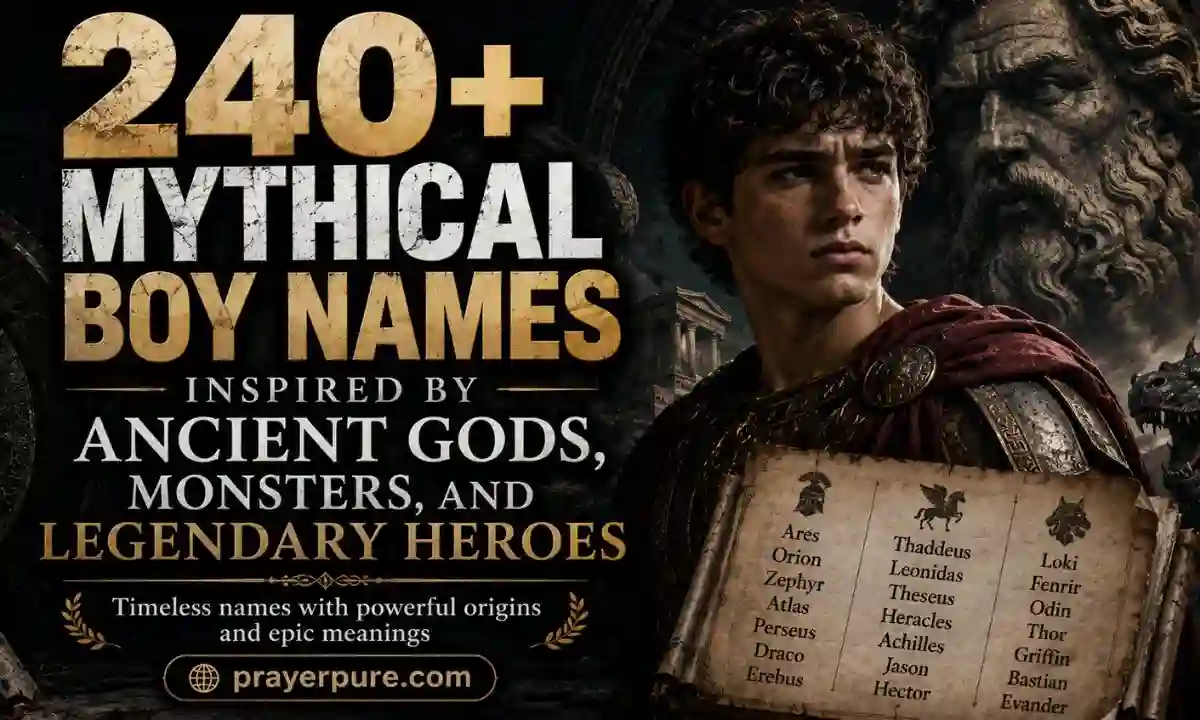
There is a particular kind of name that carries the weight of entire civilizations in it. Names that were spoken in temples before the foundations of modern cities were laid. Names that were carved into stone by people who believed that naming something correctly was one of the most powerful acts a human being could perform. Names that have survived the fall of every empire that first created them and arrived in the present day still carrying the full force of what they once meant. Mythical boy names have that quality at its most concentrated and most extraordinary.
What makes mythical boy names so richly varied is the remarkable breadth of traditions they draw from. The Greek tradition gives us the Olympian gods and the great heroes who challenged them, names of extraordinary dramatic power that have shaped Western literature for three thousand years. The Norse tradition gives us the warrior gods and the world-ending giants, names of fierce, elemental energy rooted in the cold clarity of Scandinavian mythology. The Hindu tradition gives us names of cosmic depth, the great gods and heroes of texts that are among the oldest continuous literary traditions in human history. The Mesopotamian, Egyptian, Celtic, Slavic, Japanese, and countless other traditions each contribute their own extraordinary names to a pool that is genuinely without equal in the entire world of naming.

Whether you are looking for something drawn from the great Greek pantheon or the fierce Norse world, the cosmic Hindu tradition or the wild Celtic myths, the ancient Mesopotamian civilizations or the warrior cultures of the Pacific, this list has 240+ mythical boy names inspired by ancient gods, monsters, and legendary heroes that carry the full weight of human storytelling at its most powerful. Popularity rankings are based on the most recent Social Security Administration (SSA) data.
Quick Info: Names ranked >1000 on the SSA database are considered truly rare and unique. Names closer to 1 are among the most popular in the US today.
Popular Mythical Boy Names
Orion
- Origin: Greek
- Meaning: Rising in the sky, son of fire
- Popularity: #306
The great hunter of Greek mythology whose constellation dominates the winter sky, Orion carries an extraordinary mythological legacy and a clean, modern sound that has made it one of the most beloved mythologically inspired boy names in the current national top 500.
Atlas
- Origin: Greek
- Meaning: To carry, enduring, the one who carries the world
- Popularity: #286
The great Titan condemned to carry the heavens on his shoulders for eternity, Atlas carries a profound mythological legacy of endurance and strength and has a clean, slightly architectural quality that has made it one of the rising mythological names.
Orion
- Origin: Greek
- Meaning: Rising in the sky, son of fire
- Popularity: #306
Already celebrated above, Orion belongs in this popular section as one of the most widely used mythological names in America today, beloved for its celestial quality and its extraordinary astronomical and mythological heritage.
Jasper
- Origin: Persian / Sanskrit
- Meaning: Treasurer, bringer of treasure
- Popularity: #181
One of the Three Wise Men whose Persian name connects to the ancient trading and gift-bearing tradition, Jasper carries a warm, slightly gemological quality and a genuine ancient heritage that suits a mythologically flavored name beautifully.
Caspian
- Origin: Persian / Latin
- Meaning: From the Caspian Sea
- Popularity: >1000
Made beloved by C.S. Lewis’s great Narnia chronicles, Caspian carries both an extraordinary literary legacy and a deep geographical beauty rooted in the ancient sea that Alexander the Great reached on his world-conquering journey.
Phoenix
- Origin: Greek
- Meaning: Dark red, mythical bird of fire and rebirth
- Popularity: #248
The great mythological bird that burns completely and rises from its own ashes, Phoenix carries a profound legacy of resilience and rebirth and has a bold, slightly dramatic quality that has made it one of the most powerfully mythological names in use today.
Dorian
- Origin: Greek
- Meaning: From Doris, gift
- Popularity: #384
Named after the ancient Greek Dorian people who created the Doric order of architecture, Dorian carries both a profound classical heritage and the extraordinary literary legacy of Oscar Wilde’s immortal protagonist.
Atticus
- Origin: Greek / Latin
- Meaning: From Attica, man of Athens
- Popularity: #370
Named after the great region of Attica where Athens stood at the center of the classical world, Atticus carries a profound classical heritage and both a literary and philosophical depth that makes it one of the most beloved mythologically flavored names.
Zephyr
- Origin: Greek
- Meaning: West wind, gentle breeze
- Popularity: >1000
Named after the god of the west wind in Greek mythology, the gentle breath of spring that Botticelli painted in the Primavera, Zephyr carries a luminous, slightly poetic quality and a deep classical heritage.
Cassian
- Origin: Latin
- Meaning: Of the Cassii family, hollow
- Popularity: >1000
Warm and slightly unusual with a genuine classical Roman quality, Cassian carries a deep Latin heritage and has appeared in several beloved fantasy and science fiction works as the name of morally complex heroes with genuine mythological resonance.
Evander
- Origin: Greek
- Meaning: Good man, bow warrior
- Popularity: >1000
The great Arcadian hero who founded a settlement on the Palatine Hill before Rome itself existed, Evander carries an extraordinary mythological depth and a warm, slightly unusual beauty that sounds completely natural as a mythological name.
Leander
- Origin: Greek
- Meaning: Lion man, brave as a lion
- Popularity: >1000
The great mythological hero who swam the Hellespont each night to reach his beloved Hero, guided only by the flame she held at her window, Leander carries an extraordinary romantic and heroic legacy.
Greek God and Hero Boy Names
Zeus
- Origin: Greek
- Meaning: Sky, shine, the sky god
- Popularity: >1000
The king of the Olympian gods, hurler of thunderbolts and ruler of the sky, whose authority over both gods and mortals defines the entire structure of Greek mythology, Zeus carries an extraordinary divine legacy and a minimal, bold quality.
Apollo
- Origin: Greek
- Meaning: Destroyer, the god of light and music
- Popularity: #360
The great god of light, music, poetry, prophecy, and the sun, whose oracles shaped the decisions of kings and generals across the ancient Greek world, Apollo carries an extraordinary divine legacy and a warm, flowing quality.
Hermes
- Origin: Greek
- Meaning: Cairn of stones, messenger, boundary marker
- Popularity: >1000
The winged messenger of the gods, patron of travelers and thieves, guide of souls to the underworld, whose caduceus became the symbol of medicine, Hermes carries an extraordinary divine legacy and a warm, slightly playful quality.
Ares
- Origin: Greek
- Meaning: Ruin, bane, the god of war
- Popularity: >1000
The fierce, bloodthirsty god of war whose battle frenzy drove armies to slaughter, Ares carries an extraordinary divine legacy and a bold, slightly dangerous quality that makes it one of the most naturally powerful Greek mythological names.
Hephaestus
- Origin: Greek
- Meaning: God of fire and the forge
- Popularity: >1000
The divine blacksmith who forged the weapons of the gods, built the palaces of Olympus, and created the first woman Pandora, Hephaestus carries an extraordinary creative and divine legacy and a bold, slightly unusual beauty.
Poseidon
- Origin: Greek
- Meaning: Lord of the earth, husband of the earth
- Popularity: >1000
The great god of the sea, earthquakes, and horses whose trident shakes the foundations of the world, Poseidon carries an extraordinary elemental divine legacy and a bold, flowing quality that makes it one of the most powerful Greek god names.
Dionysus
- Origin: Greek
- Meaning: God of Zeus, divine one
- Popularity: >1000
The great god of wine, theater, madness, and religious ecstasy whose worship transformed Greek culture, Dionysus carries an extraordinary divine legacy and a warm, slightly dramatic quality and has a flowing sound that suits a mythological name beautifully.
Achilles
- Origin: Greek
- Meaning: Pain, the hero of the Trojan War
- Popularity: >1000
The greatest warrior of the Trojan War whose rage opens Homer’s Iliad and whose heel gave the English language one of its most enduring phrases, Achilles carries an extraordinary heroic legacy and a bold, dramatic beauty.
Perseus
- Origin: Greek
- Meaning: Destroyer, avenger
- Popularity: >1000
The great hero who slew the Medusa with a mirrored shield, rescued Andromeda from the sea monster, and founded the city of Mycenae, Perseus carries an extraordinary mythological legacy and a bold, slightly dramatic quality.
Theseus
- Origin: Greek
- Meaning: To set, to establish, the one who establishes
- Popularity: >1000
The great Athenian hero who slew the Minotaur in the Labyrinth, united the city-states of Attica, and sailed with the Argonauts, Theseus carries an extraordinary mythological legacy and a bold, slightly formal quality.
Odysseus
- Origin: Greek
- Meaning: Angry one, one who causes pain
- Popularity: >1000
The great wandering hero of Homer’s Odyssey whose intelligence and resourcefulness carry him through twenty years of war and travel, Odysseus carries an extraordinary literary and mythological legacy and a bold, flowing sound.
Heracles
- Origin: Greek
- Meaning: Glory of Hera, glorious through Hera
- Popularity: >1000
The greatest of all Greek heroes whose twelve labors against impossible monsters defined the heroic ideal for the entire ancient world, Heracles carries an extraordinary mythological legacy and a bold, flowing quality.
Leonidas
- Origin: Greek
- Meaning: Son of the lion, lion-like
- Popularity: >1000
The great Spartan king who held the pass at Thermopylae with three hundred warriors against the entire Persian army, Leonidas carries one of the most extraordinary warrior legacies in all of human history.
Lysander
- Origin: Greek
- Meaning: Liberator of man, one who frees
- Popularity: >1000
The great Spartan admiral who defeated the Athenian fleet and appears in Shakespeare’s A Midsummer Night’s Dream, Lysander carries an extraordinary historical and literary legacy and a warm, flowing Greek beauty.
Ptolemy
- Origin: Greek
- Meaning: Warlike, aggressive
- Popularity: >1000
The name of the great Egyptian dynasty and the ancient astronomer whose model of the universe shaped human understanding for fourteen centuries, Ptolemy carries an extraordinary historical depth and a bold, slightly dramatic quality.
Pyrrhus
- Origin: Greek
- Meaning: Flame-colored, red, fire
- Popularity: >1000
The great Greek king of Epirus whose brilliant but costly military victories gave the English language the phrase pyrrhic victory, Pyrrhus carries an extraordinary historical legacy and a bold, flame-colored quality.
Castor
- Origin: Greek
- Meaning: Beaver, pious one, the mortal twin
- Popularity: >1000
The mortal twin of Pollux whose immortality was shared across both brothers so that they alternated between life and death, Castor carries a profound mythological legacy of brotherhood and sacrifice.
Hylas
- Origin: Greek
- Meaning: Of the forest, woodland
- Popularity: >1000
The beautiful companion of Heracles who was pulled into a spring by water nymphs enchanted by his beauty, Hylas carries a warm, slightly tragic quality and a genuine Greek heritage and has a clean, flowing sound.
Alcides
- Origin: Greek
- Meaning: Strength, might, the mighty one
- Popularity: >1000
The birth name of Heracles before he was renamed, meaning the mighty one and carrying the full force of the greatest Greek hero before his labors had even begun, Alcides has a bold, slightly unusual quality.
Patroclus
- Origin: Greek
- Meaning: Glory of the father, father’s glory
- Popularity: >1000
The beloved companion of Achilles whose death in battle drives the great hero back into the fighting at Troy and leads directly to the killing of Hector, Patroclus carries an extraordinary legacy of devotion and sacrifice.
Norse God and Warrior Boy Names
Odin
- Origin: Norse
- Meaning: Fury, inspiration, the Allfather
- Popularity: #468
The great Allfather of Norse mythology, master of wisdom, war, and magic who sacrificed his eye for knowledge and hung on the World Tree to learn the runes, Odin carries a profound mythological legacy.
Thor
- Origin: Norse
- Meaning: Thunder, the thunder god
- Popularity: >1000
The great Norse god of thunder who defends humanity with his hammer Mjolnir and whose strength is the last defense against the giants at the end of the world, Thor carries an extraordinary mythological legacy.
Loki
- Origin: Norse
- Meaning: Trickster, knot, the shape-shifter
- Popularity: #666
The great Norse trickster who shifts between genders and species, causes both the greatest problems and the greatest solutions in Norse mythology, Loki carries a cool, slightly dangerous quality and a profound mythological legacy.
Tyr
- Origin: Norse
- Meaning: God of war, the just god
- Popularity: >1000
The one-handed god of war and justice who sacrificed his hand to bind the great wolf Fenrir, Tyr carries a profound mythological legacy of sacrifice for the greater good and a clean, minimal quality that makes it completely distinctive.
Baldur
- Origin: Norse
- Meaning: Prince, bold, brave
- Popularity: >1000
The most beloved of all the Norse gods, son of Odin, whose death at the hands of his brother Hodr marks the beginning of Ragnarok, Baldur carries a profound mythological legacy of beauty, love, and tragic loss.
Freyr
- Origin: Norse
- Meaning: Lord, the lord
- Popularity: >1000
The great Norse god of fertility, sunlight, and rain who sacrificed his magical sword for love and stands unarmed at Ragnarok, Freyr carries a profound mythological legacy and a warm, clean quality.
Bragi
- Origin: Norse
- Meaning: Poet, the foremost, the best
- Popularity: >1000
The great Norse god of poetry and eloquence whose honey-sweet verse greets heroes arriving at Valhalla, Bragi carries a warm, slightly artistic quality and a genuine Norse heritage that suits a mythological name with creative power.
Vidar
- Origin: Norse
- Meaning: Wide warrior, forest warrior
- Popularity: >1000
The silent Norse god who will avenge his father Odin at Ragnarok by tearing apart the great wolf Fenrir with his bare hands, Vidar carries a profound mythological legacy and a clean, slightly silent quality.
Hoenir
- Origin: Norse
- Meaning: Unknown, the silent god
- Popularity: >1000
The mysterious, silent Norse god who accompanied Odin and Mimir in their wanderings and who will survive Ragnarok to give the power of prophecy to the world that emerges from the ruin, Hoenir carries a profound mysterious quality.
Magni
- Origin: Norse
- Meaning: Mighty, the strong one
- Popularity: >1000
The son of Thor whose strength exceeds even his father’s, who will survive Ragnarok and inherit his father’s hammer, Magni carries a profound mythological legacy and a clean, bold quality that makes it one of the most naturally powerful Norse names.
Ragnar
- Origin: Norse
- Meaning: Warrior judgment, deciding warrior
- Popularity: >1000
The legendary Norse king and Viking hero whose exploits have been told and retold across a thousand years of Scandinavian legend, Ragnar carries a fierce, bold quality and a profound Viking age heritage.
Sigurd
- Origin: Norse
- Meaning: Victory guardian, victorious protector
- Popularity: >1000
The great Norse hero who slew the dragon Fafnir, bathed in its blood to become invulnerable, and learned the language of birds, Sigurd carries one of the most extraordinary dragon-slayer legacies in all of mythology.
Gunnar
- Origin: Norse
- Meaning: Bold warrior, brave in battle
- Popularity: >1000
One of the great Norse warrior names whose bold, decisive quality has made it beloved across Scandinavian tradition, Gunnar carries a fierce, clean sound and a genuine Viking age heritage.
Ivar
- Origin: Norse
- Meaning: Bow warrior, yew warrior
- Popularity: >1000
The name of the great Viking leader Ivar the Boneless, one of the most feared commanders of the Great Heathen Army that invaded England, Ivar carries an extraordinary Viking historical legacy.
Fenrir
- Origin: Norse
- Meaning: Fen dweller, the great wolf
- Popularity: >1000
The great wolf of Norse mythology destined to swallow Odin at the end of the world, Fenrir carries an extraordinary mythological weight and a fierce, slightly dangerous quality that suits a name of genuine dark power.
Skadi
- Origin: Norse
- Meaning: Shadow, harm, the ski goddess
- Popularity: >1000
The great Norse goddess of skiing, winter, and hunting who married the sea god Njord after demanding blood justice for her father’s death, Skadi carries an extraordinary mythological legacy of fierce independence.
Heimdall
- Origin: Norse
- Meaning: World brightener, the one who illuminates the world
- Popularity: >1000
The great watchman of the gods who stands at the Rainbow Bridge and whose hearing is so acute he can hear grass growing, Heimdall carries a profound mythological legacy and a clean, slightly luminous quality.
Mimir
- Origin: Norse
- Meaning: The rememberer, the one who thinks
- Popularity: >1000
The great Norse keeper of the well of wisdom whose severed head was preserved by Odin and consulted for its extraordinary knowledge, Mimir carries a profound mythological legacy of wisdom and a slightly unusual quality.
Hindu and Vedic Boy Names
Indra
- Origin: Sanskrit
- Meaning: Possessing drops of rain, the king of gods
- Popularity: >1000
The great king of the gods in the Hindu tradition, the wielder of the thunderbolt and the lord of heaven, whose battles against the demon Vritra define the cosmic struggle between order and chaos, Indra carries a profound divine legacy.
Varuna
- Origin: Sanskrit
- Meaning: All-enveloping, the celestial ocean
- Popularity: >1000
The great Vedic god of the cosmic waters, oaths, and moral law whose all-seeing eye observes every action of every being, Varuna carries an extraordinary ancient heritage and a warm, flowing quality that suits a mythological name beautifully.
Agni
- Origin: Sanskrit
- Meaning: Fire, the divine fire god
- Popularity: >1000
The great Vedic god of fire who carries sacrifices from the human world to the divine and whose presence at every sacred ceremony makes him the most invoked deity in the Rig Veda, Agni carries a profound ancient heritage.
Yama
- Origin: Sanskrit
- Meaning: The twin, the restrainer, the god of death
- Popularity: >1000
The first mortal to die and the lord of the dead in the Hindu tradition, whose dharmic judgment determines the fate of every soul that comes before him, Yama carries a profound mythological legacy and a clean, minimal quality.
Surya
- Origin: Sanskrit
- Meaning: Sun, the solar deity
- Popularity: >1000
The great solar deity who drives his chariot across the sky each day, father of great heroes including Karna and Yama, Surya carries a profound Hindu heritage and a warm, luminous quality.
Vishnu
- Origin: Sanskrit
- Meaning: All-pervading, the pervader
- Popularity: >1000
The great preserver of the Hindu trinity whose ten avatars descend to earth whenever dharma is threatened, Vishnu carries an extraordinary divine legacy and a clean, slightly formal quality that makes it one of the most profound Hindu mythological names.
Shiva
- Origin: Sanskrit
- Meaning: Auspicious, the great god
- Popularity: >1000
The great destroyer and recreator of the Hindu trinity whose cosmic dance maintains the rhythm of the universe, Shiva carries an extraordinary divine legacy and a clean, minimal quality that makes it one of the most profound Hindu names.
Brahma
- Origin: Sanskrit
- Meaning: Growth, creator, expansion
- Popularity: >1000
The great creator of the Hindu trinity who emerged from the cosmic egg and spoke the universe into existence, Brahma carries an extraordinary divine legacy and a bold, slightly grand quality that makes it one of the most profound Hindu names.
Arjuna
- Origin: Sanskrit
- Meaning: Bright, shining, silver
- Popularity: >1000
The great hero of the Mahabharata and recipient of the Bhagavad Gita, the greatest archer of his age whose moment of doubt before battle leads to one of the most profound philosophical conversations in world literature.
Karna
- Origin: Sanskrit
- Meaning: Ear, radiant armor
- Popularity: >1000
The great tragic hero of the Mahabharata whose loyalty, generosity, and martial greatness are undermined by accidents of birth and fate, making him one of the most compelling tragic heroes in all of world literature.
Rama
- Origin: Sanskrit
- Meaning: Pleasing, charming, the seventh avatar of Vishnu
- Popularity: >1000
The great avatar of Vishnu whose rescue of his wife Sita from the demon king Ravana forms the narrative of the Ramayana, one of the foundational texts of Hindu civilization, Rama carries a profound divine heroic legacy.
Krishna
- Origin: Sanskrit
- Meaning: Dark, black, all-attractive
- Popularity: >1000
The eighth avatar of Vishnu whose teachings in the Bhagavad Gita and whose extraordinary life as a divine hero, lover, and king make him one of the most beloved figures in all of Hindu mythology.
Hanuman
- Origin: Sanskrit
- Meaning: Jaw, the one with the jaw, the devoted
- Popularity: >1000
The great monkey god whose devotion to Rama is absolute and whose strength, wisdom, and faithfulness make him one of the most beloved figures in the Hindu tradition and one of the most extraordinary mythological heroes.
Parashurama
- Origin: Sanskrit
- Meaning: Rama with the axe
- Popularity: >1000
The sixth avatar of Vishnu who destroyed the warrior caste twenty-one times for their arrogance and carries the sacred axe as his divine weapon, Parashurama carries a profound mythological legacy of fierce, righteous destruction.
Ashwatthama
- Origin: Sanskrit
- Meaning: Horse’s voice, the one who cries like a horse
- Popularity: >1000
The immortal warrior of the Mahabharata whose curse of immortality condemns him to wander the earth forever with an unhealing wound, Ashwatthama carries one of the most extraordinary tragic mythological legacies in Hindu tradition.
Kartikeya
- Origin: Sanskrit
- Meaning: Son of the Pleiades, the war god
- Popularity: >1000
The great god of war in the Hindu tradition, son of Shiva and commander of the divine army, whose peacock vehicle and spear Vel make him one of the most visually striking of all Hindu deities.
Celtic and Arthurian Boy Names
Lugh
- Origin: Irish / Celtic
- Meaning: Light, bright, the shining one
- Popularity: >1000
The great Irish sun god and master of all arts whose spear was one of the four treasures of the Tuatha De Danann and whose victory over the Fomorians established the order of the Irish mythological world.
Dagda
- Origin: Irish / Celtic
- Meaning: The good god, the great father
- Popularity: >1000
The great father god of Irish mythology whose magic cauldron never empties and whose club can kill with one end and restore life with the other, the Dagda carries a profound Irish mythological legacy.
Cernunnos
- Origin: Celtic
- Meaning: The horned one
- Popularity: >1000
The mysterious horned god of the Celtic tradition whose antlers connect him to the wild world and whose presence in pre-Roman Celtic art makes him one of the most ancient and enigmatic of all Celtic deities.
Manannán
- Origin: Irish
- Meaning: From Mona, the isle
- Popularity: >1000
The great Irish sea god whose cloak of invisibility, magical horse, and kingdom beneath the waves define the Irish otherworld tradition, Manannán carries an extraordinary mythological legacy and a warm, flowing quality.
Cúchulainn
- Origin: Irish
- Meaning: Hound of Culann
- Popularity: >1000
The great Ulster hero whose battle fury, warrior training on the Isle of Skye, and tragic death make him the greatest hero of the Ulster Cycle, Cúchulainn carries an extraordinary Irish mythological legacy.
Fionn
- Origin: Irish
- Meaning: Fair, white, bright
- Popularity: >1000
The great Irish hero Fionn mac Cumhaill who led the warrior band the Fianna and whose childhood encounter with the salmon of knowledge gave him all wisdom, Fionn carries a profound Irish mythological legacy.
Diarmuid
- Origin: Irish
- Meaning: Free from envy, without jealousy
- Popularity: >1000
The great Irish hero whose love spot made every woman who saw him fall in love with him and whose tragic elopement with Grainne is one of the most beautiful love stories in Celtic mythology.
Gawain
- Origin: Welsh / Arthurian
- Meaning: White hawk, May hawk
- Popularity: >1000
The great knight of the Round Table who accepts the Green Knight’s challenge alone to protect his king, Gawain carries an extraordinary chivalric legacy and a warm, slightly hawklike quality.
Percival
- Origin: Welsh / French / Arthurian
- Meaning: Pierce the valley, pierce through
- Popularity: >1000
The pure fool knight who eventually achieves the Holy Grail after years of learning what questions to ask, Percival carries a profound spiritual and chivalric legacy and a warm, slightly unusual quality.
Galahad
- Origin: Welsh / Arthurian
- Meaning: Pure, the pure knight
- Popularity: >1000
The pure knight who alone achieves the Holy Grail in the Arthurian tradition, Galahad carries the most spiritually elevated legacy of all the Round Table knights and a bold, slightly formal quality.
Emrys
- Origin: Welsh
- Meaning: Immortal, divine
- Popularity: >1000
The great Welsh name of Merlin in the Arthurian tradition, Emrys carries both an extraordinary mythological legacy and a warm, slightly unusual beauty and sounds like the name of someone who carries power they do not entirely understand.
Cormac
- Origin: Irish
- Meaning: Charioteer, son of the raven
- Popularity: >1000
The great Irish high king Cormac mac Airt whose reign was a golden age of wisdom and justice, Cormac carries a genuine ancient Celtic quality and a bold, clean sound that suits a mythological name of royal heritage.
Lorcan
- Origin: Irish
- Meaning: Little fierce one, silent
- Popularity: >1000
The name of several ancient Irish kings and saints whose fierce quality is balanced by the silence of deep thought, Lorcan carries a bold, slightly unusual sound and a genuine Gaelic heritage.
Niall
- Origin: Irish
- Meaning: Champion, cloud, passionate
- Popularity: >1000
The great Irish high king Niall of the Nine Hostages whose descendants founded the royal dynasties of Ireland, Niall carries an extraordinary historical legacy and a clean, minimal Celtic beauty.
Caradoc
- Origin: Welsh
- Meaning: Beloved, amiable, loved
- Popularity: >1000
The legendary British king who resisted the Roman invasion, Caradoc carries an extraordinary historical and legendary legacy and a bold, slightly unusual quality that makes it completely distinctive as a Celtic mythological name.
Roman God Boy Names
Jupiter
- Origin: Latin
- Meaning: Sky father, the father of the sky
- Popularity: >1000
The king of the Roman gods, hurler of thunderbolts, and ruler of the sky, whose authority shaped Roman religion for a thousand years, Jupiter carries an extraordinary divine legacy and a bold, slightly grand quality.
Mars
- Origin: Latin
- Meaning: God of war, the martial one
- Popularity: >1000
The great Roman god of war who was the father of Romulus and Remus and the divine patron of the Roman legions, Mars carries an extraordinary martial legacy and a minimal, bold quality that makes it one of the most powerful Roman god names.
Mercury
- Origin: Latin
- Meaning: Trade, the messenger god
- Popularity: >1000
The winged messenger of the Roman gods, patron of travelers, merchants, and thieves, whose caduceus became the symbol of medicine, Mercury carries an extraordinary divine legacy and a warm, flowing quality.
Neptune
- Origin: Latin
- Meaning: God of the sea, moist
- Popularity: >1000
The great Roman god of the sea whose trident rules the waters of the world, Neptune carries an extraordinary divine legacy and a bold, flowing quality that makes it one of the most naturally powerful Roman god names.
Vulcan
- Origin: Latin
- Meaning: Flash, the god of fire and the forge
- Popularity: >1000
The great Roman god of fire and the forge whose volcanic mountains bear his name, Vulcan carries an extraordinary mythological legacy and a bold, slightly elemental quality.
Saturn
- Origin: Latin
- Meaning: God of agriculture, sower
- Popularity: >1000
The great Roman god of agriculture and time who ruled over the golden age of humanity, Saturn carries an extraordinary mythological legacy and a clean, slightly formal quality that makes it one of the most distinctive Roman god names.
Janus
- Origin: Latin
- Meaning: Archway, the two-faced god
- Popularity: >1000
The great Roman god of beginnings, endings, and passages whose two faces look simultaneously into the past and the future and who gave January its name, Janus carries an extraordinary divine legacy.
Pluto
- Origin: Latin / Greek
- Meaning: Wealth, the rich one
- Popularity: >1000
The Roman god of the underworld whose realm beneath the earth contains all the mineral wealth of the world, Pluto carries an extraordinary mythological legacy and a clean, minimal quality.
Bacchus
- Origin: Latin / Greek
- Meaning: Noisy, riotous, the god of wine
- Popularity: >1000
The great Roman god of wine, theater, and religious ecstasy whose festivals transformed Roman culture, Bacchus carries an extraordinary divine legacy and a warm, slightly dramatic quality.
Quirinus
- Origin: Latin
- Meaning: Of the spear, the spear god
- Popularity: >1000
The great Roman god who was the deified Romulus, the founder of Rome himself, Quirinus carries an extraordinary founding legacy and a bold, slightly formal quality that suits a mythological name of genuine Roman depth.
Silvanus
- Origin: Latin
- Meaning: Of the forest, forest god
- Popularity: >1000
The great Roman god of forests, fields, and uncultivated land whose presence marks the boundary between civilization and the wild world, Silvanus carries an extraordinary natural legacy and a warm, flowing quality.
Consus
- Origin: Latin
- Meaning: Counselor, the god of stored grain
- Popularity: >1000
The ancient Roman god of the granary and good counsel whose festivals included the great Consualia chariot races, Consus carries a genuine ancient Roman heritage and a clean, slightly unusual quality.
Egyptian Mythology Boy Names
Osiris
- Origin: Egyptian
- Meaning: Powerful, mighty, the throne
- Popularity: >1000
The great Egyptian god of the dead and resurrection who was murdered by his brother Set and resurrected by his wife Isis, Osiris carries an extraordinary mythological legacy of death, resurrection, and divine judgment.
Horus
- Origin: Egyptian
- Meaning: Falcon, the distant one, height
- Popularity: >1000
The great falcon-headed god who avenged his father Osiris and whose eye became the most powerful protective symbol in Egyptian history, Horus carries an extraordinary divine legacy and a clean, bold quality.
Ra
- Origin: Egyptian
- Meaning: Sun, the sun god
- Popularity: >1000
The great solar deity who sailed across the sky each day in his bark of millions of years and through the underworld each night, Ra carries an extraordinary divine legacy and the most minimal, bold sound in all Egyptian mythology.
Thoth
- Origin: Egyptian
- Meaning: Ibis, the measurer
- Popularity: >1000
The great Egyptian god of wisdom, writing, and the moon who recorded the judgment of souls in the Hall of Two Truths, Thoth carries an extraordinary divine legacy of knowledge and a clean, slightly unusual quality.
Anubis
- Origin: Egyptian / Greek
- Meaning: Royal child, the jackal god
- Popularity: >1000
The great jackal-headed god who guided souls through the underworld and weighed hearts against the feather of truth, Anubis carries an extraordinary divine legacy and a bold, slightly dark quality.
Set
- Origin: Egyptian
- Meaning: One who dazzles, the desert god
- Popularity: >1000
The great god of chaos, desert storms, and foreign lands who murdered his brother Osiris and battled Horus for the throne of Egypt, Set carries an extraordinary mythological legacy and a minimal, stark quality.
Ptah
- Origin: Egyptian
- Meaning: Creator, the one who opens
- Popularity: >1000
The great creator god of Memphis who spoke the world into existence through his heart and tongue, Ptah carries an extraordinary creative divine legacy and a clean, minimal quality that makes it one of the most distinctive Egyptian names.
Sobek
- Origin: Egyptian
- Meaning: Crocodile god, the fierce one
- Popularity: >1000
The great crocodile-headed god of the Nile whose fearsome power protected Egypt and whose waters brought life, Sobek carries an extraordinary divine legacy and a bold, slightly fierce quality.
Khepri
- Origin: Egyptian
- Meaning: He who has come into being, the scarab
- Popularity: >1000
The great scarab-headed aspect of the sun god who rolled the solar disk across the sky like a dung beetle rolls its ball, Khepri carries an extraordinary mythological legacy and a warm, slightly unusual quality.
Atum
- Origin: Egyptian
- Meaning: The complete one, he who brings completion
- Popularity: >1000
The great self-created god who emerged from the primordial waters of Nun and whose sunset aspect marks the dying of each day, Atum carries an extraordinary divine legacy and a clean, minimal quality.
Montu
- Origin: Egyptian
- Meaning: Nomad, the wandering god
- Popularity: >1000
The great Egyptian god of war whose fierce, falcon-headed aspect represented the heat of the sun at its most scorching and whose worship was central to the warrior pharaohs of the Middle Kingdom.
Khonsu
- Origin: Egyptian
- Meaning: Traveler, the moon god
- Popularity: >1000
The great Egyptian moon god whose travels across the night sky brought healing and protection, Khonsu carries an extraordinary divine legacy and a warm, slightly nomadic quality that suits a mythological name of lunar beauty.
Mesopotamian and Ancient Boy Names
Gilgamesh
- Origin: Sumerian
- Meaning: The old man is a young man, the hero who saw the deep
- Popularity: >1000
The great king of Uruk whose epic poem is the oldest written story in human history, Gilgamesh carries an extraordinary literary and mythological legacy of friendship, grief, and the search for immortality.
Enkidu
- Origin: Sumerian
- Meaning: Lord of the earth, created by earth
- Popularity: >1000
The wild man created by the gods as a companion for Gilgamesh, whose friendship with the king is one of the most moving relationships in all of ancient literature, Enkidu carries an extraordinary mythological legacy.
Marduk
- Origin: Babylonian
- Meaning: Solar calf, bull calf of the sun
- Popularity: >1000
The great patron deity of Babylon who slew the chaos dragon Tiamat and created the world from its body, Marduk carries an extraordinary mythological legacy of cosmic creation and divine kingship.
Nergal
- Origin: Sumerian / Babylonian
- Meaning: Lord of the great city, great watcher
- Popularity: >1000
The great Mesopotamian god of the underworld and plague whose descent to the realm of the dead and marriage to its queen Ereshkigal is one of the most dramatic mythological narratives of the ancient Near East.
Enlil
- Origin: Sumerian
- Meaning: Lord wind, lord of the air
- Popularity: >1000
The great Sumerian god of wind, air, and storms who created the flood to destroy humanity, Enlil carries an extraordinary ancient mythological legacy and a clean, minimal quality that makes it one of the most distinctive Sumerian names.
Enki
- Origin: Sumerian
- Meaning: Lord of the earth, lord of wisdom
- Popularity: >1000
The great Sumerian god of wisdom, fresh water, and craftsmanship who warned Ziusudra about the flood and whose deep wisdom shaped the civilization of Mesopotamia, Enki carries an extraordinary ancient legacy.
Nanna
- Origin: Sumerian
- Meaning: The illuminator, the moon god
- Popularity: >1000
The great Sumerian moon god whose light guided travelers and shepherds through the darkness, Nanna carries an extraordinary ancient legacy and a warm, slightly luminous quality that connects it to the celestial fire tradition.
Shamash
- Origin: Akkadian / Babylonian
- Meaning: Sun, the sun god
- Popularity: >1000
The great Mesopotamian sun god who revealed himself to Gilgamesh on his journey and whose rays of justice illuminate every corner of the earth, Shamash carries an extraordinary ancient legacy and a bold, warm quality.
Adad
- Origin: Akkadian / Babylonian
- Meaning: Father, the storm god
- Popularity: >1000
The great Mesopotamian god of storms, rain, and thunder whose voice was the thunder itself and whose power over the weather determined the fate of harvests, Adad carries an extraordinary ancient legacy.
Ninurta
- Origin: Sumerian
- Meaning: Lord of the earth, lord of grain
- Popularity: >1000
The great Sumerian warrior god who defeated the stone demon Asag and whose exploits define the Mesopotamian heroic tradition, Ninurta carries an extraordinary ancient legacy and a bold, slightly unusual quality.
Tammuz
- Origin: Sumerian / Akkadian
- Meaning: Faithful son, the dying and rising god
- Popularity: >1000
The great Mesopotamian god of vegetation and fertility who died each year with the harvest and rose again with the spring, Tammuz carries an extraordinary ancient legacy of death and rebirth.
Baal
- Origin: Canaanite / Semitic
- Meaning: Lord, master, owner
- Popularity: >1000
The great Canaanite storm god whose battles against the sea dragon Yam and the death god Mot define the mythology of the ancient Levant, Baal carries an extraordinary ancient Near Eastern legacy.
Slavic and Eastern European Boy Names
Perun
- Origin: Slavic
- Meaning: Thunder, the thunder god
- Popularity: >1000
The great Slavic god of thunder and lightning who battled the serpent Veles across the cosmic tree, Perun carries an extraordinary ancient Slavic legacy and a bold, clean quality that makes it one of the most naturally powerful Slavic mythological names.
Veles
- Origin: Slavic
- Meaning: Cattle, the underworld god
- Popularity: >1000
The great Slavic god of the underworld, cattle, magic, and wealth who stands in eternal opposition to the thunder god Perun, Veles carries an extraordinary mythological legacy and a clean, slightly dark quality.
Svarog
- Origin: Slavic
- Meaning: Heavenly fire, the forge god
- Popularity: >1000
The great Slavic god of fire and the forge, father of the sun, whose divine fire gave humanity the gift of metalworking and the warmth of the hearth, Svarog carries an extraordinary ancient heritage.
Dazbog
- Origin: Slavic
- Meaning: Give god, the giving god
- Popularity: >1000
The great Slavic solar deity and god of fortune whose generous giving of sunlight and warmth sustained the Slavic world, Dazbog carries an extraordinary ancient legacy and a warm, slightly unusual quality.
Jarilo
- Origin: Slavic
- Meaning: Fierce, fervent, spring sun
- Popularity: >1000
The great Slavic god of spring vegetation and the returning sun, whose death and resurrection each year mirrors the cycle of the seasons, Jarilo carries an extraordinary mythological legacy of renewal and fierce energy.
Stribog
- Origin: Slavic
- Meaning: Wind god, the spreading god
- Popularity: >1000
The great Slavic god of winds who scattered the seeds and carried the voices of the gods across the world, Stribog carries an extraordinary ancient legacy and a clean, slightly unusual quality.
Mokosh
- Origin: Slavic
- Meaning: Moist, the great mother
- Popularity: >1000
The great Slavic earth goddess whose moist earth brought forth all life, Mokosh carries an extraordinary ancient legacy and appears here as a name that has crossed gender boundaries in certain Slavic traditions.
Volos
- Origin: Slavic
- Meaning: Hair, cattle, the great ox
- Popularity: >1000
The great Slavic god of cattle and wealth whose association with the underworld and magic makes him one of the most complex figures in Slavic mythology, Volos carries an extraordinary ancient legacy.
Triglav
- Origin: Slavic
- Meaning: Three-headed, the three-headed god
- Popularity: >1000
The great three-headed deity of the Baltic Slavs whose three heads represented the sky, the earth, and the underworld, Triglav carries an extraordinary ancient legacy and a bold, slightly dramatic quality.
Chernobog
- Origin: Slavic
- Meaning: Black god, the dark god
- Popularity: >1000
The great black god of the Slavic tradition who represented misfortune, chaos, and the dark half of the cosmic balance, Chernobog carries an extraordinary ancient legacy and a stark, slightly ominous quality.
Japanese and East Asian Boy Names
Susanoo
- Origin: Japanese
- Meaning: Swift impetuous male, the storm god
- Popularity: >1000
The great Japanese god of storms and the sea who killed the eight-headed serpent Yamata no Orochi and discovered the divine sword Kusanagi, Susanoo carries an extraordinary mythological legacy and a bold, flowing quality.
Izanagi
- Origin: Japanese
- Meaning: Male who invites, the creator father
- Popularity: >1000
The great creator father of Japanese mythology who dipped his jeweled spear into the ocean and created the islands of Japan, Izanagi carries an extraordinary cosmogonic legacy and a warm, flowing quality.
Tsukuyomi
- Origin: Japanese
- Meaning: Moon reader, moon counter
- Popularity: >1000
The great Japanese moon god whose killing of the food goddess Uke Mochi separated him from his sister the sun goddess Amaterasu and created the alternation of day and night, Tsukuyomi carries a profound mythological legacy.
Fujin
- Origin: Japanese
- Meaning: Wind god, divine wind
- Popularity: >1000
The great Japanese god of wind who carries the winds of the world in a great sack over his shoulder, Fujin carries an extraordinary mythological legacy and a clean, bold quality that makes it one of the most naturally distinctive Japanese god names.
Raijin
- Origin: Japanese
- Meaning: Thunder god, the divine thunder
- Popularity: >1000
The great Japanese god of thunder whose drums of lightning roll across the sky, Raijin carries an extraordinary mythological legacy and a bold, slightly dramatic quality that makes it one of the most powerful Japanese mythological names.
Ryujin
- Origin: Japanese
- Meaning: Dragon god, the divine dragon
- Popularity: >1000
The great Japanese dragon king of the sea whose palace beneath the waves contains the jewels that control the tides, Ryujin carries an extraordinary mythological legacy and a bold, flowing quality.
Raiden
- Origin: Japanese
- Meaning: Thunder and lightning, god of thunder
- Popularity: >1000
Named after the thunder and lightning of the Japanese tradition, Raiden carries an extraordinary mythological legacy and a bold, slightly dramatic quality and has become beloved in Western popular culture through gaming.
Benzaiten
- Origin: Japanese / Sanskrit
- Meaning: Saraswati, goddess of flowing things
- Popularity: >1000
The great Japanese goddess of music, knowledge, and flowing things whose Sanskrit origins connect Japanese and Hindu mythology, Benzaiten carries an extraordinary cross-cultural legacy and a warm, flowing quality.
Takemikazuchi
- Origin: Japanese
- Meaning: Brave thunder, the thunder god
- Popularity: >1000
The great Japanese god of thunder and swords who descended from heaven to pacify the land of Japan before the imperial dynasty arrived, Takemikazuchi carries an extraordinary mythological legacy and a bold, flowing quality.
Okuninushi
- Origin: Japanese
- Meaning: Master of the great land, lord of the earth
- Popularity: >1000
The great Japanese god of nation-building, medicine, and sorcery who built the land of Japan before surrendering it to the heavenly gods, Okuninushi carries an extraordinary mythological legacy.
Monster and Creature Boy Names
Typhon
- Origin: Greek
- Meaning: Monster, whirlwind, the father of monsters
- Popularity: >1000
The great monster of Greek mythology, father of Cerberus and the Hydra and the Chimera, whose battle with Zeus shook the foundations of the world, Typhon carries an extraordinary mythological weight.
Cerberus
- Origin: Greek
- Meaning: Spotted, demon of the pit
- Popularity: >1000
The great three-headed dog who guards the entrance to the Greek underworld, Cerberus carries an extraordinary mythological legacy and a bold, slightly dark quality that makes it one of the most immediately distinctive monster names.
Ladon
- Origin: Greek
- Meaning: The one of Ladon, the river dragon
- Popularity: >1000
The great dragon who guarded the golden apples of the Hesperides and was slain by Heracles on his eleventh labor, Ladon carries an extraordinary mythological legacy and a warm, flowing quality.
Grendel
- Origin: Old English / Norse
- Meaning: Grinder, destroyer
- Popularity: >1000
The great monster of the Beowulf epic whose nocturnal attacks on Heorot define one of the oldest dark fantasy narratives in English literature, Grendel carries an extraordinary literary and mythological legacy.
Balor
- Origin: Irish
- Meaning: The deadly one, the fatal eye
- Popularity: >1000
The great Fomorian king of Irish mythology whose deadly eye could kill anyone it rested upon and who was slain by his own grandson Lugh, Balor carries an extraordinary mythological legacy.
Jormungandr
- Origin: Norse
- Meaning: The great serpent, world serpent
- Popularity: >1000
The great world serpent of Norse mythology who encircles all of Midgard with his body and whose release of his tail will signal the beginning of Ragnarok, Jormungandr carries an extraordinary cosmological legacy.
Nidhogg
- Origin: Norse
- Meaning: Malice striker, the gnawing dragon
- Popularity: >1000
The great dragon who gnaws eternally at the roots of Yggdrasil the World Tree, slowly weakening the foundation of the cosmos, Nidhogg carries an extraordinary mythological weight and a fierce, slightly menacing quality.
Cetus
- Origin: Greek
- Meaning: Sea monster, whale
- Popularity: >1000
The great sea monster sent by Poseidon to devour Andromeda and slain by Perseus, Cetus carries an extraordinary mythological legacy and a clean, minimal quality that gives it a distinctive presence as a mythological name.
Scylla
- Origin: Greek
- Meaning: She who tears, the ripping one
- Popularity: >1000
The great six-headed sea monster who devoured sailors from her rock in the straits that Odysseus navigated between her and the whirlpool Charybdis, Scylla carries an extraordinary mythological legacy.
Echidna
- Origin: Greek
- Meaning: She-viper, the mother of monsters
- Popularity: >1000
The great mother of monsters in Greek mythology, half woman and half serpent, who with Typhon produced most of the great monsters of the Greek world, Echidna carries an extraordinary mythological legacy.
Charybdis
- Origin: Greek
- Meaning: The one who sucks down
- Popularity: >1000
The great whirlpool monster who three times a day swallowed the sea and three times spat it back, navigated famously by Odysseus, Charybdis carries an extraordinary mythological legacy and a bold, flowing quality.
Orthrus
- Origin: Greek
- Meaning: The twilight, morning twilight
- Popularity: >1000
The two-headed dog who guarded the cattle of the monster Geryon and was slain by Heracles on his tenth labor, Orthrus carries a warm, slightly unusual quality and a genuine Greek mythological heritage.
Rare and Forgotten Boy Names
Aeronwy
- Origin: Welsh
- Meaning: Berry stream, war goddess
- Popularity: >1000
A rare and beautiful Welsh name connected to the ancient war goddess tradition, Aeronwy carries a genuine Celtic heritage and a clean, flowing quality and has a slightly unusual character that makes it feel genuinely distinctive today.
Cailte
- Origin: Irish
- Meaning: Hardness, the slender one
- Popularity: >1000
The great Irish hero Cailte mac Ronáin who survived long enough to tell the stories of the Fianna to Saint Patrick, carrying the memory of the heroic age into the Christian world, Cailte has a deep Irish mythological heritage.
Dumuzid
- Origin: Sumerian
- Meaning: Good son, the faithful son
- Popularity: >1000
The great Sumerian shepherd god whose descent to the underworld in place of his wife Inanna defines one of the oldest death and resurrection myths in human history, Dumuzid carries an extraordinary ancient legacy.
Erlik
- Origin: Turkic / Mongolian
- Meaning: The great god of the underworld
- Popularity: >1000
The great underworld deity of Turkic and Mongolian shamanic tradition, Erlik carries an extraordinary Central Asian mythological legacy and a clean, slightly unusual quality that makes it one of the most distinctive names from the Eurasian steppe tradition.
Koschei
- Origin: Slavic
- Meaning: Bone, the immortal one
- Popularity: >1000
The great immortal villain of Slavic folklore whose death is hidden inside a needle inside an egg inside a duck inside a chest, Koschei carries an extraordinary folkloric legacy and a cool, slightly dark quality.
Anansi
- Origin: Akan / West African
- Meaning: Spider, the spider god
- Popularity: >1000
The great spider god of the Akan tradition whose stories contain all the stories in the world and who outwitted the sky god to bring knowledge to humanity, Anansi carries an extraordinary West African mythological legacy.
Eshu
- Origin: Yoruba / West African
- Meaning: The divine trickster
- Popularity: >1000
The great Yoruba god of crossroads, beginnings, and communication who must be honored before any other deity, Eshu carries an extraordinary West African mythological legacy and a clean, minimal quality.
Ogun
- Origin: Yoruba / West African
- Meaning: Iron, the god of iron
- Popularity: >1000
The great Yoruba god of iron, war, and labor who opened the road between the divine world and the human world, Ogun carries an extraordinary West African mythological legacy and a bold, clean quality.
Shango
- Origin: Yoruba / West African
- Meaning: Thunder, the thunder king
- Popularity: >1000
The great Yoruba god of thunder and lightning who was once a mortal king before his apotheosis into divinity, Shango carries an extraordinary mythological legacy of power, passion, and the transformation of mortal into divine.
Tezcatlipoca
- Origin: Nahuatl / Aztec
- Meaning: Smoking mirror, the dark lord
- Popularity: >1000
The great Aztec god of the night sky, sorcery, and conflict whose smoking obsidian mirror reflected the sins of all who looked into it, Tezcatlipoca carries an extraordinary mythological legacy and a bold, flowing quality.
Quetzalcoatl
- Origin: Nahuatl / Aztec
- Meaning: Feathered serpent, plumed serpent
- Popularity: >1000
The great feathered serpent deity of Mesoamerican mythology who created humanity and gave it the gifts of maize and civilization, Quetzalcoatl carries one of the most extraordinary mythological legacies in the Americas.
Chaac
- Origin: Mayan
- Meaning: The rain deity, the lightning axe
- Popularity: >1000
The great Mayan rain god whose lightning axes struck the clouds to release the rain that sustained Mayan civilization, Chaac carries an extraordinary ancient Mesoamerican legacy and a bold, minimal quality.
Kukulkan
- Origin: Mayan
- Meaning: Feathered serpent, plumed snake
- Popularity: >1000
The great Mayan feathered serpent deity whose pyramid at Chichen Itza creates the shadow of a descending serpent at the equinoxes, Kukulkan carries an extraordinary ancient Mesoamerican legacy.
Inti
- Origin: Quechua / Incan
- Meaning: Sun, the sun god
- Popularity: >1000
The great Incan sun god whose children founded the Incan dynasty and whose temple at Cusco was the most sacred place in the Andean world, Inti carries an extraordinary South American mythological legacy.
Viracocha
- Origin: Quechua / Incan
- Meaning: Sea foam, creator god
- Popularity: >1000
The great Incan creator deity who emerged from Lake Titicaca, created humanity from clay and breath, and disappeared across the sea promising to return, Viracocha carries an extraordinary Andean mythological legacy.
Frequently Asked Questions
Q: What are the most popular mythological boy names right now? A: According to the most recent SSA data, the most widely used mythologically inspired boy names today include Apollo at #360, Atlas at #286, Orion at #306, Phoenix at #248, Dorian at #384, Atticus at #370, Loki at #666, and Odin at #468. These names carry genuine mythological depth while remaining familiar enough to rank in the national top 700, demonstrating that mythological names can be both deeply meaningful and widely beloved.
Q: What are the rarest mythological boy names on this list? A: The rarest and most distinctive choices include Tezcatlipoca, Quetzalcoatl, Gilgamesh, Enkidu, Jormungandr, Kagutsuchi, Xiuhtecuhtli, Takemikazuchi, Kukulkan, and Ashwatthama, all of which rank well above 1000 in SSA data. These names carry extraordinary mythological depth from Aztec, Sumerian, Norse, Japanese, and Hindu traditions while being virtually unknown on modern birth certificates.
Q: Are mythological names appropriate for everyday use? A: Most mythological names work beautifully in everyday contexts. Names like Apollo, Atlas, Orion, Finn, Rowan, Luca, and Jasper are mythologically inspired while being completely natural in modern settings. For more elaborate mythological names like Gilgamesh or Quetzalcoatl, parents might consider whether the name works in the specific cultural and social contexts where their child will grow up, or use such names as middle names paired with more familiar first names.
Q: What middle names pair well with mythological first names? A: Shorter, classic middle names tend to pair beautifully with the bold, sweeping energy of mythological first names. Consider pairing Achilles with James or Cole, Orion with Reed or Blake, or Perseus with John or Mark. For shorter mythological names like Zeus or Mars or Tyr, a slightly longer middle name like Alexander, Sebastian, or Nathaniel creates a beautiful rhythm and balance between the two names.
Q: Which mythological tradition has the most usable names for modern boys? A: The Greek and Norse traditions tend to produce the most immediately usable mythological names for modern boys because their sounds are familiar to English-speaking ears and their meanings are widely known. Names like Apollo, Orion, Leander, Lysander, Thor, Loki, Odin, Ragnar, and Sigurd all carry extraordinary mythological depth while being pronounceable and memorable in everyday English-speaking contexts. Celtic names like Finn, Cormac, Lorcan, and Niall also work beautifully as modern names with genuine ancient depth.
Conclusion
Mythical boy names carry a divine power, an ancient depth, and a genuinely extraordinary range of cultural heritage that makes them some of the most rewarding names to explore for any parent who wants something truly distinctive and full of legendary character for their son. Whether you choose a popular favorite like Orion or Atlas, a Greek heroic name like Achilles or Perseus, a Norse warrior name like Odin or Sigurd, a Hindu cosmic name like Arjuna or Indra, a Celtic legendary name like Fionn or Cormac, a Roman divine name like Apollo or Mars, an Egyptian sacred name like Horus or Osiris, an ancient Mesopotamian name like Gilgamesh or Marduk, a Slavic mythological name like Perun or Veles, a Japanese divine name like Susanoo or Raijin, a monster name like Typhon or Ladon, or a rare forgotten name like Anansi or Quetzalcoatl, you are giving your son a name that carries the weight of the most extraordinary stories ever told and the power of the human imagination at its most magnificent. Take your time with this list, let the names settle, and trust that the right mythological name will find you.

Olivia Lane is a devoted Christian writer and faith blogger at PrayerPure.com, where she shares heartfelt prayers, Bible verses, and spiritual reflections to inspire believers around the world. Her gentle words help readers find peace, purpose, and strength in God’s presence every day. When she’s not writing, Olivia enjoys reading devotionals, spending time outdoors, and connecting with her church community.